







• SHQIPËRI
  • KOSOVË
  • MAQEDONIA E VERIUT
  • MALI I ZI
  • Revista në PDF
4 June, 2026
  • Home
  • OP/ED

    The Blueprint of a Diplomatic Debacle: Analyzing Germany’s Historic UNSC Loss

    Cyber Attribution, Corruption, and the False-Flag Question in Albania’s 2022 Alleged Iranian Cyberattack

    Between Russia, Iran and Europe: Azerbaijan as a balancing power in the South Caucasus

    The Zero-Tariff Gate: Sovereignty as a Service in the Sino-African Corridor

    Albania vs. the Sea/ Marginal Notes on A. Leka’s Novel The Hidden Side of the Albanian Socialist Garden

    May 9 and the long shadow of a Letter: Is Europe still Schuman’s Project?

    The Arbnesh of Zadar: A living memory of Albanian identity on the Adriatic coast

    Science Diplomacy and Academic Freedom: A strategic nexus for contemporary diplomacy

    Serbia and Kosovo between new regional alliances and old geopolitical patterns

  • Interview

    Exclusive Interview with Oleksandr Tyshchenko: A 40-Year Legacy of Chernobyl, Nuclear Risks, and Global Responsibility

    INTERVIEW: ZLATKO KRAMARIĆ – THOUGHTS ON THE OLD CONTINENT

    EXCLUSIVE / Ukrainian Ambassador to Albania, Volodymyr Shkurov: “Ukraine wants peace, but not at the expense of its freedom and independence”

    EXCLUSIVE| Ambassador Tayyar Kagan Atay: Türkiye and Albania, a Strategic Partnership Rooted in Shared Heritage and a Common Vision for the Future

    “Diplomacy, Not War”: Palestinian Ambassador to Albania Calls for Justice, Peace, and Global Action for Gaza

    Exclusive: “Even After Tito – Tito”/ Ambassador Zlatko Kramarić on Authoritarian Legacies and Democracy’s Future in the Balkans

    The Conclusion of the Diplomatic Mission / Ambassador Dancho Markovski: Strengthening Albania-North Macedonia Relations for a Shared European Future

    A Century of Diplomatic Relations Between Albania and Russia: Exclusive Interview with the Russian Ambassador to Albania, H.E. Alexey Zaytsev

    Exclusive/ The chairman of the Freedom Party, Ilir Meta: “The will of the citizens will triumph in Albania, as it did in North Macedonia”

  • Realpolitik

    IBAR? ”Sufficiently! Much ado about nothing! Shart contrasts in Beijing! Where is the exit?!

    Neither peace nor war! Peace with bombs?! IBAR in autumn?! Not another Hormuz in Taivan! 

    IBAR – a springing board or an obstacle? Can we catch the EU Negotiation train 2027? When the dress makes the news!  EU electoral April  ends in a draw 1:1!  

    The European Parliament building in Strasbourg, France with flags waving calmly celebrating peace of the Europe. July 12, 2020.

    EU 2027 or 2037! Even half membership failed! No exit strategy!     

    What next?

    “With diplomatic velvet“! Major question marks! In Washington yes, but  in the White House NO! A strange dinner in Brussels!

    From a great ‘apple of disaccord’ to a  point of  cooperation! A bad start! The strange absence in Davos!

    5 lessons from the American 3 January! Don’t count the chicken before they are hatched! Will NATO freeze in Greenland? Wrong diplomatic messages!

    German Chancellor Friedrich Merz, European Commission President Ursula von der Leyen, Ukraine's President Volodymyr Zelenskiy, U.S. Special Envoy Steve Witkoff and Jared Kushner, son-in-law of U.S. President Donald Trump line up for a family photo opportunity at the Chancellery in Berlin, Germany, December 15, 2025.    REUTERS/Lisi Niesner/Pool

    A Strategy that could change the world! Europe in Berlin! Why an historic compromise? Only charm diplomacy in Athens!

  • Current Events

    Serbia – China 2026: Technological partnership, geopolitical positioning and a new phase of the Chinese presence in the Western Balkans

    The Digital Protectorate: How the EU AI Act Codified Silicon Valley’s Monopoly

    The 28th MFC Annual Conference in Durrës / Sulaj: Microfinance remains a key instrument for financial inclusion

    Serbia at the Crossroads of EU Integration and Geopolitical Balancing: IFIMES Analysis

    Tirana – €20 Million EU–Banking Agreement Boosts Albanian SMEs

    The Myth of Independence: How Chinese Efficiency is Rewriting the Constitution of Modern Geopolitics!

    Europe Yesterday and Today: Why 9 May Still Matters

    “EU4Municipalities II” Project, a Strategic Investment for Strengthening Municipalities and Accelerating Albania’s Path towards the EU

    Eight Years in the Service of Identity: The Journey of the Montenegrin Community in Albania

  • Top News

    No End in Sight: Trump, Netanyahu and the Expanding Middle East War

    Tirana – €20 Million EU–Banking Agreement Boosts Albanian SMEs

    “EU4Municipalities II” Project, a Strategic Investment for Strengthening Municipalities and Accelerating Albania’s Path towards the EU

    Albania, Italy deepen defence ties with naval shipbuilding deal

    U.S. Embassy: Iran-Linked Groups May Target Americans and Iranian Opposition in Albania

    The Council of Albanian Ambassadors disappointed with the voting of the draft law on the foreign service in the parliamentary committees.

    Prime Minister Edi Rama Addresses Israel’s Knesset in Historic Special Session

    Kazakhstan’s Strategic Reform Agenda: Stability, Modern Governance, and Responsible Diplomacy

    Trump Invites Rama to Peace Board, Prime Minister: Proud of Albania

  • YOUR VOICE
  • Shqip
No Result
View All Result
Argumentum
  • Home
  • OP/ED

    The Blueprint of a Diplomatic Debacle: Analyzing Germany’s Historic UNSC Loss

    Cyber Attribution, Corruption, and the False-Flag Question in Albania’s 2022 Alleged Iranian Cyberattack

    Between Russia, Iran and Europe: Azerbaijan as a balancing power in the South Caucasus

    The Zero-Tariff Gate: Sovereignty as a Service in the Sino-African Corridor

    Albania vs. the Sea/ Marginal Notes on A. Leka’s Novel The Hidden Side of the Albanian Socialist Garden

    May 9 and the long shadow of a Letter: Is Europe still Schuman’s Project?

    The Arbnesh of Zadar: A living memory of Albanian identity on the Adriatic coast

    Science Diplomacy and Academic Freedom: A strategic nexus for contemporary diplomacy

    Serbia and Kosovo between new regional alliances and old geopolitical patterns

  • Interview

    Exclusive Interview with Oleksandr Tyshchenko: A 40-Year Legacy of Chernobyl, Nuclear Risks, and Global Responsibility

    INTERVIEW: ZLATKO KRAMARIĆ – THOUGHTS ON THE OLD CONTINENT

    EXCLUSIVE / Ukrainian Ambassador to Albania, Volodymyr Shkurov: “Ukraine wants peace, but not at the expense of its freedom and independence”

    EXCLUSIVE| Ambassador Tayyar Kagan Atay: Türkiye and Albania, a Strategic Partnership Rooted in Shared Heritage and a Common Vision for the Future

    “Diplomacy, Not War”: Palestinian Ambassador to Albania Calls for Justice, Peace, and Global Action for Gaza

    Exclusive: “Even After Tito – Tito”/ Ambassador Zlatko Kramarić on Authoritarian Legacies and Democracy’s Future in the Balkans

    The Conclusion of the Diplomatic Mission / Ambassador Dancho Markovski: Strengthening Albania-North Macedonia Relations for a Shared European Future

    A Century of Diplomatic Relations Between Albania and Russia: Exclusive Interview with the Russian Ambassador to Albania, H.E. Alexey Zaytsev

    Exclusive/ The chairman of the Freedom Party, Ilir Meta: “The will of the citizens will triumph in Albania, as it did in North Macedonia”

  • Realpolitik

    IBAR? ”Sufficiently! Much ado about nothing! Shart contrasts in Beijing! Where is the exit?!

    Neither peace nor war! Peace with bombs?! IBAR in autumn?! Not another Hormuz in Taivan! 

    IBAR – a springing board or an obstacle? Can we catch the EU Negotiation train 2027? When the dress makes the news!  EU electoral April  ends in a draw 1:1!  

    The European Parliament building in Strasbourg, France with flags waving calmly celebrating peace of the Europe. July 12, 2020.

    EU 2027 or 2037! Even half membership failed! No exit strategy!     

    What next?

    “With diplomatic velvet“! Major question marks! In Washington yes, but  in the White House NO! A strange dinner in Brussels!

    From a great ‘apple of disaccord’ to a  point of  cooperation! A bad start! The strange absence in Davos!

    5 lessons from the American 3 January! Don’t count the chicken before they are hatched! Will NATO freeze in Greenland? Wrong diplomatic messages!

    German Chancellor Friedrich Merz, European Commission President Ursula von der Leyen, Ukraine's President Volodymyr Zelenskiy, U.S. Special Envoy Steve Witkoff and Jared Kushner, son-in-law of U.S. President Donald Trump line up for a family photo opportunity at the Chancellery in Berlin, Germany, December 15, 2025.    REUTERS/Lisi Niesner/Pool

    A Strategy that could change the world! Europe in Berlin! Why an historic compromise? Only charm diplomacy in Athens!

  • Current Events

    Serbia – China 2026: Technological partnership, geopolitical positioning and a new phase of the Chinese presence in the Western Balkans

    The Digital Protectorate: How the EU AI Act Codified Silicon Valley’s Monopoly

    The 28th MFC Annual Conference in Durrës / Sulaj: Microfinance remains a key instrument for financial inclusion

    Serbia at the Crossroads of EU Integration and Geopolitical Balancing: IFIMES Analysis

    Tirana – €20 Million EU–Banking Agreement Boosts Albanian SMEs

    The Myth of Independence: How Chinese Efficiency is Rewriting the Constitution of Modern Geopolitics!

    Europe Yesterday and Today: Why 9 May Still Matters

    “EU4Municipalities II” Project, a Strategic Investment for Strengthening Municipalities and Accelerating Albania’s Path towards the EU

    Eight Years in the Service of Identity: The Journey of the Montenegrin Community in Albania

  • Top News

    No End in Sight: Trump, Netanyahu and the Expanding Middle East War

    Tirana – €20 Million EU–Banking Agreement Boosts Albanian SMEs

    “EU4Municipalities II” Project, a Strategic Investment for Strengthening Municipalities and Accelerating Albania’s Path towards the EU

    Albania, Italy deepen defence ties with naval shipbuilding deal

    U.S. Embassy: Iran-Linked Groups May Target Americans and Iranian Opposition in Albania

    The Council of Albanian Ambassadors disappointed with the voting of the draft law on the foreign service in the parliamentary committees.

    Prime Minister Edi Rama Addresses Israel’s Knesset in Historic Special Session

    Kazakhstan’s Strategic Reform Agenda: Stability, Modern Governance, and Responsible Diplomacy

    Trump Invites Rama to Peace Board, Prime Minister: Proud of Albania

  • YOUR VOICE
  • Shqip
No Result
View All Result
Argumentum
No Result
View All Result
Home ENGLISH

Polish Armed Forces Day Marked in Tirana /“Poland and Albania Will Make Military Ties Stronger”

30 August, 2019
in ENGLISH, English Top News
A A
Share on FacebookShare on Twitter

As the father of the Polish rebirth in 1918 and the commander in chief of the Warsaw Battle of 1920 Marshall Pitsudski stated: “A nation that does not respect its past does not deserve the respect of the present and has no right to the future”

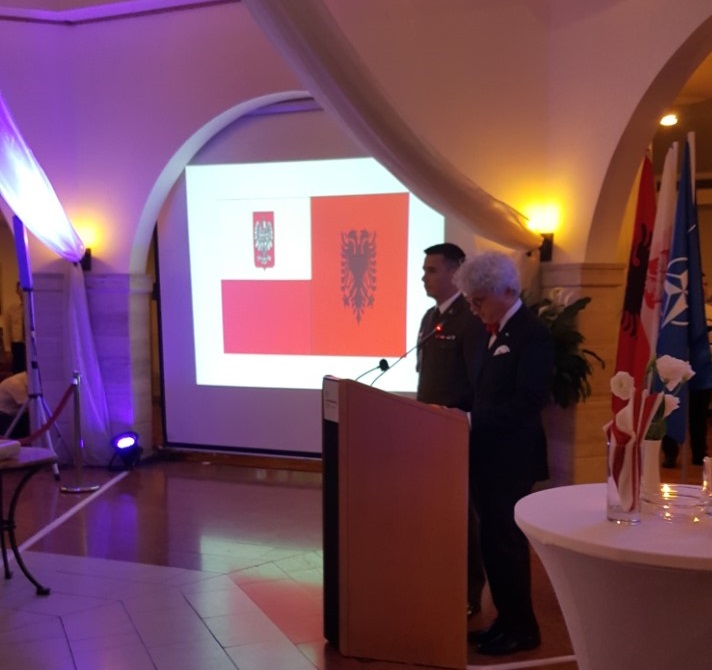
TIRANA – “Today in Albania we are celebrating Polish Armed Forces Day which was established as a commemoration of the 1920 victory over Soviet Russia at the Battle of Warsaw also known as the “Miracle of the Vistula” during the Polish – Soviet War,” it was said in a speech delivered jointly by the Ambassador of the Republic of Poland, Karol Bachura and the Defence, Military, Naval and Air Attaché, Lt Col Tomasz Koperwas in a reception on the occasion of the Armed Forces Day of the Republic of Poland.

“Nowadays Polish Armed Forces are a strong and reliable member of NATO. Ongoing modernization process, participation in peace and stabilization missions in different parts of the world including the Middle East, shows our nation’s willingness to build a strong army which will be able to face current challenges,” it was said in the speech which dwelt at length on the historical background of the establishment of the Polish Armed Forces Day celebrated by the Polish people.

“We profoundly trust that during the upcoming years Poland and Albania will be able to discover new platforms of cooperation as well as make our military ties stronger and stronger,” it was pointed out in the speech which follows:

Today in Albania we are celebrating Polish Armed Forces Day which was established as a commemoration of the 1920 victory over Soviet Russia at the Battle of Warsaw also known as the “Miracle of the Vistula” during the Polish – Soviet War.

Armed Forces Day is held in conjunction with the Day of the Assumption of the Virgin Mary, itself a separate religious and public holiday. Originally celebrated since 1923 the holiday was banned by communist authorities after WWII, only to be revived again in 1992. This year we also celebrate this holiday after the revival  in October last year of the Polish Military Attache Office in Tirana.

Image

The “Miracle of the Vistula” is a given name to the battle of Warsaw during which the Polish Army, under the command of Marshal Jozef Pitsudski successfully pushed back the Red Army offensive outside of the Polish capital in mid-August 1920. The defeat of the Russian army ensured the capital’s protection and the survival of the young Second Polish Republic which regained independence in November 1918 after 123 years of nonexistence on the maps of Europe. At first this holiday was called “Soldiers Day” and in the words of the Polish minister of defense from 1923 to mark “on the anniversary of the memorable defeat of the Bolshevik onslaught on Warsaw, we honor the memory of those killed in battles for Polish independence throughout the ages”.

After the WWII, the communist government found it impossible to celebrate the original date of 15 August and its coinciding historical significance, owing to its glorification of the Red Army’s defeat. The date’s religious accent was also uncomfortable. Following the return of democracy in the wake of the events of 1989, and parliamentary semi-free elections of 4 June which gave communist opposition ”Solidarity” movement a landslide win in both chambers of the parliament, thus triggering the fall of the communist system in the states of Central and Eastern Europe and in 1991 in the Soviet Union itself, the Polish parliament approved on 30 July 1992 the restoration of Armed Forces Day to the original 15 August date.

As the day coincides with the religious Day of the Assumption of Virgin Mary, church masses across the country reflect on the memory of Poland’s military dead.Nevertheless the roots go back to the Polish-Soviet War of 1920 and the Battle of Warsaw.

The Battle of Warsaw was a decisive Polish victory in 1920 during the 1919-1920 Polish–Soviet War. Poland, on the verge of total loss, pushed back the Red Army in what Vladimir Lenin, the Bolshevik leader, called “an enormous defeat” for his forces.

The battle of Warsaw was fought from August 12–25, 1920, its outcome secured the Polish state’s Eastern frontiers until 1939.

High ranking British diplomat Edgar Vincent regarded this event as one of the most important battles in the history of mankind, since the victory over the Soviets stopped the spread of communism to Europe – at least for a couple of decades.

In the aftermath of World War I, Poland fought to preserve its newly regained independence, lost in the 1795 partitions. At the same time in 1919, the Bolsheviks had gained the upper hand in the Russian Civil War, having dealt crippling blows to the Russian White Movement. Lenin viewed Poland as a bridge to bring communism to Central and Western Europe, and the Polish–Soviet War seemed the perfect way to test the Red Army’s strength. The Bolshevik’s speeches asserted that the revolution was to be carried to Western Europe on the bayonets of Russian soldats and that the shortest route to Berlin and Paris lay through Warsaw. Moscow assumed that the fall of the Polish capital city not only would undermine the morale of the Poles, but spark an international series of communist uprisings and clear the way for the Red Army to join the German Revolution.

Bolshevik propaganda before the Battle of Warsaw had described the fall of Poland’s capital as imminent, and its anticipated defeat was to be a signal for the start of large-scale communist revolutions in Poland, Germany, and other European countries, economically devastated by the WWI. As the then Soviet commander, Tukhachevsky spoke to his army in July 1920: “Through the corpse of Poland leads the way to the global fire. On our bayonets we will bring peace and happiness to the working masses. Let us march to the West!” Due to the Polish victory, however, the Soviet plans had to be canceled.The Soviet defeat was a major setback for Lenin who aimed for the revolution to have a global reach.

Since we are celebrating the Polish Army Day on the eve of the 80th anniversary of the outbreak of the WWII and the German Nazi– Soviet Russia invasion on my country, as well as the 75th  anniversary of the Warsaw Uprising – the biggest arms resistance against occupation in war thorn Europe, let me bring to your attention the modest picture exhibition devoted to these events and at the same time allow me to use this opportunity to already invite you tonight to a more extensive exposition on the subject that will be held in close cooperation with the National Museum of Tirana on the 17th of September.

It is also my privilege to inform you of a – fresh off the press, Albanian language historical publication that will be available as of September in the local bookstores, entitled “Poland – victim of WW II”, written by an Albanian professor S.V. Mehilli,  which among other topics contains more thorough information on the Ribbentrop-Molotov pact of 23 August 1939 and its secret annex of partition of the Polish territory between the two signatory states; the attack on Poland from the West by Nazi Germany on the 1st of September and from the East the aggression of the Soviet Army on the 17th of September; the Katyn massacre in which over 20 thousand Polish officers and POW were slaughtered by the Soviet Secret Police, as well as the fate of the Warsaw Uprising in which my city was devastated and turned to shambles in over 85% leaving about 200 thousand dead in a sea of ruins. But Warsaw, a city that saw war managed to survive its own death and become a modern, vibrant European capital of a NATO ally country.

Nowadays Polish Armed Forces are a strong and reliable member of NATO. Ongoing modernization process, participation in peace and stabilization missions in different parts of the world including the Middle East, shows our nation’s willingness to build a strong army which will be able to face current challenges.

For the last decades we’ve observed rapid increase of military cooperation among NATO members. Such an achievement was possible due to many reasons. However some of the important factors are mutual trust and understanding of the threats which we face every day from the national security point of view. We as soldiers are sharing mutual values regarding the role of the army and the necessity to serve our nations.

We profoundly trust that during the upcoming years Poland and Albania will be able to discover new platforms of cooperation as well as make our military ties stronger and stronger.

And finally, as the father of the Polish rebirth in 1918 and the commander in chief of the Warsaw Battle of 1920 Marshall Pitsudski stated: “A nation that does not respect its past does not deserve the respect of the present and has no right to the future” – after respecting the past, looking at the present let us now turn to the future and enjoy the evening.

© Argumentum. 
Related Posts

ENGLISH

The Blueprint of a Diplomatic Debacle: Analyzing Germany’s Historic UNSC Loss

4 June, 2026
Current Events

Serbia – China 2026: Technological partnership, geopolitical positioning and a new phase of the Chinese presence in the Western Balkans

1 June, 2026
ENGLISH

IBAR? ”Sufficiently! Much ado about nothing! Shart contrasts in Beijing! Where is the exit?!

1 June, 2026

Follow US

Subscribe

Receive Argumentum Magazine by Email

Last Posts

The Blueprint of a Diplomatic Debacle: Analyzing Germany’s Historic UNSC Loss

4 June, 2026

Serbia – China 2026: Technological partnership, geopolitical positioning and a new phase of the Chinese presence in the Western Balkans

1 June, 2026

IBAR? ”Sufficiently! Much ado about nothing! Shart contrasts in Beijing! Where is the exit?!

1 June, 2026

How Alkida Lushaj is redefining democratic inclusion globally

31 May, 2026

Cyber Attribution, Corruption, and the False-Flag Question in Albania’s 2022 Alleged Iranian Cyberattack

30 May, 2026
Argumentum

“Argumentum”, një proces intelektual …

Contact Us

[email protected]
[email protected]
[email protected]

Follow Us

Media Partner

Register

Receive Argumentum Magazine by Email
  • Home
  • Privacy Policy
  • About Us
  • Contact

© 2022 Argumentum. All Rights Reserved. | NUIS: L91415033Q

Welcome Back!

Login to your account below

Forgotten Password? Sign Up

Create New Account!

Fill the forms bellow to register

*By registering into our website, you agree to the Terms & Conditions and Privacy Policy.
All fields are required. Log In

Retrieve your password

Please enter your username or email address to reset your password.

Log In

Add New Playlist

No Result
View All Result
  • Home
  • OP/ED
  • Interview
  • Realpolitik
  • Current Events
  • Top News
  • YOUR VOICE
  • Shqip

© 2022 Argumentum. All Rights Reserved. | NUIS: L91415033Q

This website uses cookies. By continuing to use this website you are giving consent to cookies being used. Visit our Privacy and Cookie Policy.