









• SHQIPËRI
  • KOSOVË
  • MAQEDONIA E VERIUT
  • MALI I ZI
  • Revista në PDF
18 October, 2026
 
  • Home
  • OP/ED

    THE GREEN BERETS LAND IN TIRANA

    Some Myths Simply Refuse to Die

    UN Monologue: Why Kosovo Cannot Respond to Serbia’s Accusations

    The War That Was Waged Before the War

    The Structural Impasse: Can Merz Offer a Leadership Anchor to Europe?

    Will Europe Finally Ditch the Poisonous Myth of Perpetual Peace?

    Resolution 522 – When the U.S. Congress Honored Skanderbeg

    The Reconfiguration of Maritime Governance: Structural Hegemonic Decline and the Arctic Pivot

    Between Political Calculation and Retreat: Croatian Communists at the End of an Era

  • Interview

    Exclusive Interview with Oleksandr Tyshchenko: A 40-Year Legacy of Chernobyl, Nuclear Risks, and Global Responsibility

    INTERVIEW: ZLATKO KRAMARIĆ – THOUGHTS ON THE OLD CONTINENT

    EXCLUSIVE / Ukrainian Ambassador to Albania, Volodymyr Shkurov: “Ukraine wants peace, but not at the expense of its freedom and independence”

    EXCLUSIVE| Ambassador Tayyar Kagan Atay: Türkiye and Albania, a Strategic Partnership Rooted in Shared Heritage and a Common Vision for the Future

    “Diplomacy, Not War”: Palestinian Ambassador to Albania Calls for Justice, Peace, and Global Action for Gaza

    Exclusive: “Even After Tito – Tito”/ Ambassador Zlatko Kramarić on Authoritarian Legacies and Democracy’s Future in the Balkans

    The Conclusion of the Diplomatic Mission / Ambassador Dancho Markovski: Strengthening Albania-North Macedonia Relations for a Shared European Future

    A Century of Diplomatic Relations Between Albania and Russia: Exclusive Interview with the Russian Ambassador to Albania, H.E. Alexey Zaytsev

    Exclusive/ The chairman of the Freedom Party, Ilir Meta: “The will of the citizens will triumph in Albania, as it did in North Macedonia”

  • Realpolitik

    Long live the UN! A prewarned decision! A  G – 2? Putin in Miami!

    Montenegrin diplomatic blunder! Small Cyprus without great hopes! 4 blocks of Enlargement challenges! Political earthquake in Germany!

    Belgrade, Zelensky and the Consulates! The European Pact takes water! Drone in Leipzig and hybrid war! Why a  ceasefire is needed in September

    The Summit of Unity! Think of peace and prepare for war! It’s only the start to the end! Just a pause between two wars!

    Peace with war diplomacy! The protest,  image and tourism! Why this silence from the EU Commission and Council? A deal or a pause?

    Just kind words  in Tivat! Where is the peace!? A deal yes, peace No!What is happening with USA and  EU?  5 elections but no solution!

    IBAR? ”Sufficiently! Much ado about nothing! Shart contrasts in Beijing! Where is the exit?!

    Neither peace nor war! Peace with bombs?! IBAR in autumn?! Not another Hormuz in Taivan! 

    IBAR – a springing board or an obstacle? Can we catch the EU Negotiation train 2027? When the dress makes the news!  EU electoral April  ends in a draw 1:1!  

  • Current Events

    Albania Police Chief Alleges Protest Violence Orchestrated by Organisers at Home and Abroad

    Albanian PM Rama Rules Out Resignation Amid Escalating Protests

    EU Gives Green Light to the Provisional Closure of Albania’s Chapter 20 Negotiations

    Balkan Business Forum in Tirana: Albania and Türkiye Seek to Expand Investment and Regional Economic Cooperation

    Albania’s Parliament Approves Territorial Reform, Reducing Municipalities from 61 to 46

    Von der Leyen in Skopje: North Macedonia Belongs in Europe, Mickoski Seeks Fair EU Accession Process

    Von der Leyen in Pristina: “The Hague Verdict Must Be Respected, Nothing Can Rewrite Kosovo’s History”

    Albania’s Top Diplomat Ferit Hoxha at Berlin Process: “EU Enlargement Is a Strategic Investment in Europe’s Security”

    Von der Leyen in Tirana: EU Support, Reform Push and Protests

  • Top News

    Albania Student Protests Spread to Multiple Cities as Clashes Escalate

    NATO to Hold Annual Nuclear Deterrence Exercise Steadfast Noon in Italy

    Albania’s Parliament Approves Territorial Reform, Reducing Municipalities from 61 to 46

    US Secretary of State Marco Rubio speaks at the Pnyx hill, where ancient Athenians held democratic assemblies, with the ancient Parthenon temple atop the Acropolis in the background, in Athens, Greece October 7, 2026.   Mark Schiefelbein/Pool via REUTERS

    Rubio in Athens: When History Becomes Political Doctrine

    Albanian PM Rama to U.S. Democrats: “Don’t Come to Albania to Take Revenge on Trump”

    Albania’s Top Diplomat Ferit Hoxha at Berlin Process: “EU Enlargement Is a Strategic Investment in Europe’s Security”

    From Pre-Trial Measures to the Presumption of Innocence: What Changes in Albania’s Criminal Procedure Code

    Eric Wendt in Tirana: A New U.S. Mandate at a Turning Point for Albania and the Balkans

    Albanian PM Edi Rama at UN: “The greatest danger of AI is that it perfectly obeys the wrong people”

  • YOUR VOICE
  • ARGUMENTUM MAGAZINE
  • Shqip
No Result
View All Result
Argumentum
  • Home
  • OP/ED

    THE GREEN BERETS LAND IN TIRANA

    Some Myths Simply Refuse to Die

    UN Monologue: Why Kosovo Cannot Respond to Serbia’s Accusations

    The War That Was Waged Before the War

    The Structural Impasse: Can Merz Offer a Leadership Anchor to Europe?

    Will Europe Finally Ditch the Poisonous Myth of Perpetual Peace?

    Resolution 522 – When the U.S. Congress Honored Skanderbeg

    The Reconfiguration of Maritime Governance: Structural Hegemonic Decline and the Arctic Pivot

    Between Political Calculation and Retreat: Croatian Communists at the End of an Era

  • Interview

    Exclusive Interview with Oleksandr Tyshchenko: A 40-Year Legacy of Chernobyl, Nuclear Risks, and Global Responsibility

    INTERVIEW: ZLATKO KRAMARIĆ – THOUGHTS ON THE OLD CONTINENT

    EXCLUSIVE / Ukrainian Ambassador to Albania, Volodymyr Shkurov: “Ukraine wants peace, but not at the expense of its freedom and independence”

    EXCLUSIVE| Ambassador Tayyar Kagan Atay: Türkiye and Albania, a Strategic Partnership Rooted in Shared Heritage and a Common Vision for the Future

    “Diplomacy, Not War”: Palestinian Ambassador to Albania Calls for Justice, Peace, and Global Action for Gaza

    Exclusive: “Even After Tito – Tito”/ Ambassador Zlatko Kramarić on Authoritarian Legacies and Democracy’s Future in the Balkans

    The Conclusion of the Diplomatic Mission / Ambassador Dancho Markovski: Strengthening Albania-North Macedonia Relations for a Shared European Future

    A Century of Diplomatic Relations Between Albania and Russia: Exclusive Interview with the Russian Ambassador to Albania, H.E. Alexey Zaytsev

    Exclusive/ The chairman of the Freedom Party, Ilir Meta: “The will of the citizens will triumph in Albania, as it did in North Macedonia”

  • Realpolitik

    Long live the UN! A prewarned decision! A  G – 2? Putin in Miami!

    Montenegrin diplomatic blunder! Small Cyprus without great hopes! 4 blocks of Enlargement challenges! Political earthquake in Germany!

    Belgrade, Zelensky and the Consulates! The European Pact takes water! Drone in Leipzig and hybrid war! Why a  ceasefire is needed in September

    The Summit of Unity! Think of peace and prepare for war! It’s only the start to the end! Just a pause between two wars!

    Peace with war diplomacy! The protest,  image and tourism! Why this silence from the EU Commission and Council? A deal or a pause?

    Just kind words  in Tivat! Where is the peace!? A deal yes, peace No!What is happening with USA and  EU?  5 elections but no solution!

    IBAR? ”Sufficiently! Much ado about nothing! Shart contrasts in Beijing! Where is the exit?!

    Neither peace nor war! Peace with bombs?! IBAR in autumn?! Not another Hormuz in Taivan! 

    IBAR – a springing board or an obstacle? Can we catch the EU Negotiation train 2027? When the dress makes the news!  EU electoral April  ends in a draw 1:1!  

  • Current Events

    Albania Police Chief Alleges Protest Violence Orchestrated by Organisers at Home and Abroad

    Albanian PM Rama Rules Out Resignation Amid Escalating Protests

    EU Gives Green Light to the Provisional Closure of Albania’s Chapter 20 Negotiations

    Balkan Business Forum in Tirana: Albania and Türkiye Seek to Expand Investment and Regional Economic Cooperation

    Albania’s Parliament Approves Territorial Reform, Reducing Municipalities from 61 to 46

    Von der Leyen in Skopje: North Macedonia Belongs in Europe, Mickoski Seeks Fair EU Accession Process

    Von der Leyen in Pristina: “The Hague Verdict Must Be Respected, Nothing Can Rewrite Kosovo’s History”

    Albania’s Top Diplomat Ferit Hoxha at Berlin Process: “EU Enlargement Is a Strategic Investment in Europe’s Security”

    Von der Leyen in Tirana: EU Support, Reform Push and Protests

  • Top News

    Albania Student Protests Spread to Multiple Cities as Clashes Escalate

    NATO to Hold Annual Nuclear Deterrence Exercise Steadfast Noon in Italy

    Albania’s Parliament Approves Territorial Reform, Reducing Municipalities from 61 to 46

    US Secretary of State Marco Rubio speaks at the Pnyx hill, where ancient Athenians held democratic assemblies, with the ancient Parthenon temple atop the Acropolis in the background, in Athens, Greece October 7, 2026.   Mark Schiefelbein/Pool via REUTERS

    Rubio in Athens: When History Becomes Political Doctrine

    Albanian PM Rama to U.S. Democrats: “Don’t Come to Albania to Take Revenge on Trump”

    Albania’s Top Diplomat Ferit Hoxha at Berlin Process: “EU Enlargement Is a Strategic Investment in Europe’s Security”

    From Pre-Trial Measures to the Presumption of Innocence: What Changes in Albania’s Criminal Procedure Code

    Eric Wendt in Tirana: A New U.S. Mandate at a Turning Point for Albania and the Balkans

    Albanian PM Edi Rama at UN: “The greatest danger of AI is that it perfectly obeys the wrong people”

  • YOUR VOICE
  • ARGUMENTUM MAGAZINE
  • Shqip
No Result
View All Result
Argumentum
No Result
View All Result
Home ENGLISH

Are Germany and the EU prepared for a new influx of refugees?

5 March, 2020
in ENGLISH, Interview
A A
Share on FacebookShare on Twitter

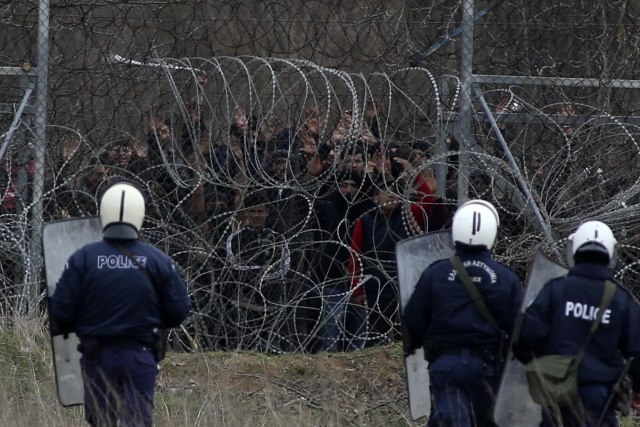
Thousands are stranded on the Greek-Turkish border. Some have drawn parallels to the 2015 crisis but both Berlin and Brussels reject the comparison. DW breaks down what’s changed since then, and where problems remain.

Thousands of migrants and refugees have gathered at the Turkish-Greek border, desperate to make it into the European Union. Turkey’s President Recep Tayyip Erdogan has called on Europe to share the migrant “burden.” Some now are drawing parallels to the 2015 migrant influx, saying the past few weeks have felt like deja vu — but whether the EU is any better prepared than it was five years ago remains to be seen.

What happened in 2015?

At the height of the refugee crisis in 2015 and 2016, Germany took in around 1 million asylum-seekers — many fleeing conflicts in countries like Syria, Iraq and Afghanistan and who were looking for safety in Europe.

German Chancellor Angela Merkel sought to rally the country with the phrase: “We can do this” (“Wir schaffen das”).  Thousands of volunteers nationwide stepped up to support the new arrivals — but the rallying cry rang hollow to border authorities and local officials who were swamped and felt unsupported.

“The problem in 2015 was that the countries in southern Europe simply waved through unregistered refugees and sent them in the direction of northern Europe,” Heiko Teggatz, the head of the federal police union, told DW. “That shouldn’t have happened.”

The authorities who registered the new arrivals and took on their cases lacked not only personnel, but key equipment. As recently as 2017, nearly 40% of the immigration offices in Germany lacked technical equipment used for identification — with many names incorrectly spelled in the system and fingerprints attributed to the wrong person.

Much of the work fell to Germany’s nearly 11,000 municipalities, who were responsible for housing as well as integrating the new arrivals. Due to a lack of space, many asylum-seekers were placed in makeshift centers built from shipping containers, or housed in gymnasiums.

“From the perspective of the municipalities, a situation like the one in 2015 should not be repeated,” Alexander Handschuh, the spokesperson for the German Association of Towns and Municipalities, said. “That would lead to an overload.”

What’s changed in Germany since then?

Although many stepped up to help during the crisis in 2015, the arrival of refugees and the bureaucratic chaos that ensued also fed into the rise of right-wing populism in Germany. In 2017, the far-right Alternative for Germany (AfD) garnered enough support to enter the German parliament for the first time after campaigning on an anti-immigration platform.

Five years later, Merkel stands by her decision and says it was necessary to avert a humanitarian crisis, but she also says that “mistakes” were made in the way it way handled.

New systems and personnel have helped Germany’s towns and municipalities become better prepared to handle new arrivals — up to a certain point. Cross-border cooperation within the EU has also improved, including the creation of a central data bank which stores the fingerprints of asylum-seekers.

The German government has also since pushed for increased security at the country’s borders, with around 3,000 to 5,000 officers. Teggatz told DW that the police powers have also been expanded so that officers are also now allowed to use pepper spray and water cannons to deter “unauthorized border crossings.”

Where does the EU stand?

Politically, things have taken a turn to the right. Efforts to come up with an EU-wide asylum policy have failed, with countries including Hungary and Poland rejecting efforts to distribute migrants equally among member states. “Hot spotarrival points in Greece and Italy remain under pressure, with authorities there arguing that they’ve been left alone by Brussels.

An EU project following the developments over the past few years came to the conclusion that in response to the situation in 2015, governments enacted “very restrictive measures” to discourage migrants and refugees.

“Nothing has really changed for the better since 2015,” Professor Sabine Hess, one of the project leaders and a cultural anthropologist at the University of Göttingen, told DW.

Hess noted that politicians have only been able to come up with ideas on bolstering the borders “instead of thinking about the global problems that cause people to flee.”

What is the EU-Turkey refugee accord and is it still active?

In a bid to prevent another wave of migration into Europe, the EU and Turkey signed a deal in 2016 to regulate the flow of migrants. Under the agreement, Turkey agreed to prevent human traffickers from sending refugees to the EU and to take back Syrian refugees who arrived in Greece.

In exchange, Brussels agreed that for every Syrian refugee sent back to Turkey, another would be resettled in the bloc. The EU also agreed to provide Ankara with financial assistance and speed up EU accession talks, as well as loosening visa requirements and extending the customs union.

Under the deal, migrant arrivals in the EU dropped off significantly compared to the situation in 2015 and in 2016.

Since then, the EU has either already paid or has budgeted around €6 billion ($6.7 billion) in financial aid and projects for the around 3.6 million Syrian refugees who are being hosted by Turkey. Ankara has regularly complained that the EU has not held up its part of the bargain, and that payments have been slow. Due to concerns about rule of law in Turkey, the EU has also not yet followed through on membership talks or loosening visa requirements.

When Erdogan announced his country’s borders with the EU were open over the weekend, many viewed the move as a signal that the deal was off.

However, both Germany and the EU said this week that they continue to operate under the assumption that the deal with Turkey is still being implemented — although they’ve strongly criticized the move.

Both France and Austria have slammed Turkey for “blackmailing” the EU, while Merkel said it was “completely unacceptable” that Turkey is using refugees as political pawns.

What role is Frontex playing?

Since the mass arrival of asylum-seekers in 2015, the European Border and Coast Guard Agency — or Frontex — has played an increasingly important role in the EU’s refugee policies.

“After the crisis of 2015, a pool of officers for rapid intervention was created, and that’s the pool we’re drawing on right now to deploy in Greece — both at the sea border and at the land border,” Frontex spokesperson Ewa Moncure told DW.

This week, Greece requested additional support from Frontex, which helps member states patrol the external borders of the European Schengen Area.

The German government said this week that it will send 20 additional officers to support Greek authorities at the border as well as an amphibious helicopter. There are currently 60 German federal police officers taking part in Frontex operations in Greece.

Frontex is also building up its own standing corps after a new regulation went into effect in 2019, with the agency getting a massive budget boost amounting to €1.6 billion ($1.7 billion) in the coming year.

“We are still using the old mechanism that is used for the rapid deployment — but in the future that will be more flexible,” Moncure said./dw
Related Posts

ENGLISH

For those who offer or put themselves forward for dialogue and mediation

16 October, 2026
Current Events

Albania Police Chief Alleges Protest Violence Orchestrated by Organisers at Home and Abroad

15 October, 2026
ENGLISH

Albania Student Protests Spread to Multiple Cities as Clashes Escalate

15 October, 2026

Follow US

Subscribe

Receive Argumentum Magazine by Email

Last Posts

For those who offer or put themselves forward for dialogue and mediation

16 October, 2026

Albania Police Chief Alleges Protest Violence Orchestrated by Organisers at Home and Abroad

15 October, 2026

Albania Student Protests Spread to Multiple Cities as Clashes Escalate

15 October, 2026

Albanian PM Rama Rules Out Resignation Amid Escalating Protests

15 October, 2026

DEMOCRACY BEYOND THE VOTE: POLITICAL MEMORY AS A PUBLIC RESPONSIBILITY

15 October, 2026
Argumentum

“Argumentum”, një proces intelektual …

Contact Us

[email protected]
[email protected]
[email protected]

Follow Us

Media Partner

Register

Receive Argumentum Magazine by Email
  • Home
  • Privacy Policy
  • About Us
  • Contact

© 2022 Argumentum. All Rights Reserved. | NUIS: L91415033Q

Welcome Back!

Login to your account below

Forgotten Password?

Retrieve your password

Please enter your username or email address to reset your password.

Log In

Add New Playlist

No Result
View All Result
  • Home
  • OP/ED
  • Interview
  • Realpolitik
  • Current Events
  • Top News
  • YOUR VOICE
  • ARGUMENTUM MAGAZINE
  • Shqip

© 2022 Argumentum. All Rights Reserved. | NUIS: L91415033Q

This website uses cookies. By continuing to use this website you are giving consent to cookies being used. Visit our Privacy and Cookie Policy.