





















General (Rtd) Corneliu Pivariu,
“The Middle East is a region where the past has never passed, where history weighs on the present more heavily than anywhere else.”
— Bernard Lewis (British historian specialized in the Middle East)
Introduction
Against this loaded historical backdrop, Prime Minister Benjamin Netanyahu’s statement that Israel must become a “super Sparta” takes on a special significance. It is not merely a rhetorical formula, but a strategy through which Israel reaffirms its intention to consolidate itself as a first-rank military power in a region marked by chronic rivalries, identity conflicts, and global geopolitical competitions.
Self-definition as a “super Sparta” reflects both the perception of a constant threat to the security of the Jewish state and the desire to project strength and deterrence. At the same time, this concept has multiple effects: it mobilizes Israeli society, fuels Palestinian anxieties, provokes contradictory reactions in the Arab world, and draws the attention of great powers interested either in the stability or in the instability of the Middle East.
Understanding the contemporary Middle East requires the recognition of two strategic constants: the permanent support of the United States for Israel[3], and the inability of Arab states[4] to build a united stance around the Palestinian issue. The first constant ensured Israel’s survival and rise; the second facilitated its consolidation. Together, they explain the resilience and permanence of the conflict in the region.
Israel’s Position
In light of the two constants—the American support and the division of the Arab world—Israel has built its own strategy of survival and regional assertion. Prime Minister Benjamin Netanyahu’s statement that the Jewish state must become a “super Sparta” is not just a rhetorical formula, but the expression of a security philosophy deeply rooted in the country’s geopolitical reality[5].
- Military Consolidation. Israel has consistently maintained a high level of defense spending (over 4.5% of GDP), which places it among the top states in the world in relative terms. The Israel Defense Forces (IDF) are conceived as a versatile force, capable of conducting rapid ground operations, dominating regional airspace, and neutralizing maritime threats. Moreover, the development of cyber and informational capabilities is considered essential for maintaining a strategic edge.
- Technological Supremacy. A defining element of the “super Sparta” vision is innovation. Israel invests massively in military research, pioneering fields such as:
- missile defense (Iron Dome, David’s Sling, Arrow),
- drones and autonomous systemsartificial intelligence applied to intelligence and combat operations.
This technological advance allows Israel to compensate for its numerical disadvantage compared to Arab states and to convey the message to its adversaries that qualitative superiority prevails over sheer numbers.
3. Social Mobilization and the Culture of Security. Mandatory military service and the reservist network anchor the army within the very structure of society. The IDF is not only a military instrument, but also a factor of national cohesion, a place where political, economic, and cultural leaders are shaped. The “super Sparta” discourse reinforces this culture, presenting security not as a task of the government alone, but as a collective responsibility of the entire nation.
4. External Projection. On the diplomatic level, self-definition as a “super Sparta” serves both to deter adversaries and to attract the respect of strategic partners. Israel seeks to be perceived not merely as an isolated regional democracy, but as an impregnable fortress, able to face any challenge on its own and to be a reliable ally for the great powers.
Thus, Israel’s position can be summarized as a combination between the existential need for security and the ambition to project power in a hostile environment, where diplomacy is often secondary to military strength.
The Palestinian Position
If for Israel the concept of a “super Sparta” represents a strategy of survival and power projection, for the Palestinians it confirms the exact opposite: the intention of the Jewish state to perpetuate military domination and to exclude any real political solution.
- The Palestinian Authority (PA). The leadership in Ramallah interprets Netanyahu’s discourse as clear proof of the refusal of dialogue and the abandonment of the two-state solution perspective. From the PA’s standpoint, the emphasis on militarization and on strengthening Israel’s defensive identity amounts to an attempt to transform the occupation status quo into a permanent reality. Thus, “super Sparta” is not perceived as a defensive concept, but as an expression of hegemony.
- Hamas and Islamic Jihad. For radical Palestinian movements, Israeli rhetoric validates the choice of armed struggle. If Israel defines itself as a fortress, the only way to counter it is through asymmetric warfare: rocket attacks, urban guerrilla operations, and the use of tunnel networks. In their logic, “super Sparta” justifies resistance even more, even at the cost of escalating violence and civilian suffering.
The Situation in Gaza
The Gaza Strip has become the epicenter of the Palestinian tragedy and the strongest image of the disproportion between Israel’s military power and the fragility of the Palestinian population. Successive Israeli military campaigns have caused massive destruction of civilian infrastructure, and the death toll exceeds 70,000[6], the majority being civilians. Extensive bombardments, the lack of access to drinking water, electricity, and medical services have turned Gaza into a devastated territory.
Beyond the military dimension, more and more voices argue that Israel’s real objective is the displacement of the entire Palestinian population from Gaza to Egypt or other areas, which would mean a radical demographic change, unprecedented in the recent history of the region. This perception is based not only on the analysis of factual consequences, but also on official Israeli documents and statements suggesting that the evacuation of the population would be seen as the “final solution” for Israel’s security[7].
For Palestinians, “super Sparta” is no longer just a metaphor of a military fortress, but the synonym of a project of systematic elimination through death, exile, or marginalization. Gaza thus becomes not only a battlefield, but also the laboratory of a policy aimed at irreversibly altering the demographic reality of the conflict.
3. Public Opinion among Palestinians. At the societal level, Palestinians experience this rhetoric as a condemnation to perpetual confrontation. In the absence of a credible political horizon, the population feels frustration and despair, which fuel extremism and diminish the chances of a negotiated resolution. For many, “super Sparta” means that Israel will concede nothing, and peace becomes an illusion.
4. Political Consequences. The Israeli discourse contributes to the isolation of the moderate Palestinian camp and strengthens the radical factions. At the same time, it provides an additional argument to states and organizations that contest Israel’s legitimacy on the international stage. From this perspective, “super Sparta” risks becoming a self-fulfilling prophecy: the more Israel defines itself as a fortress, the fewer alternatives Palestinians see outside confrontation.
The Reaction of Middle Eastern States
Israel’s declaration regarding its transformation into a “super Sparta” generated diverse and sometimes contradictory reactions in the Arab and Muslim world. These reflect not only attitudes toward Israel but also the region’s internal rivalries.
- Iran. Tehran immediately used the “super Sparta” rhetoric to justify its policy of total support for Hamas, Islamic Jihad, and Hezbollah. In official Iranian discourse, Israel is presented as an aggressive entity with expansionist ambitions, and “super Sparta” is merely confirmation that the only possible response is armed resistance and escalation of the confrontation.
- Turkey. Ankara openly condemned the Israeli statements, accusing Netanyahu of destabilizing the region and perpetuating the conflict. Yet economic relations and occasional intelligence cooperation remain active, revealing the ambivalence of Turkey’s strategy: firm public opposition, but pragmatism behind the scenes.
- Saudi Arabia and the Gulf States[8]. Rivalry with Iran drives the United Arab Emirates and Bahrain to cooperate discreetly with Israel in sensitive areas such as missile defense and security technology. However, these states cannot publicly endorse the “super Sparta” rhetoric, which would be perceived by Arab public opinion as capitulation to Israeli hegemony. For Saudi Arabia, “super Sparta” is more a matter of political balancing: while rivalry with Iran pushes Riyadh toward pragmatic rapprochement with Israel, domestic pressure and its status as guardian of Islam prevent it from openly approving Israel’s excessive militarization. As a result, Saudi Arabia oscillates between discreet cooperation and pro-Palestinian rhetoric, without ever embracing the concept itself.
- Egypt and Jordan. Both states have peace treaties with Israel and maintain good security cooperation. Their reactions to the “super Sparta” rhetoric have been moderate, with formal diplomatic criticism but no concrete actions. For Cairo, the priority remains stability on the Gaza border, while for Amman it is the internal balance between its majority Palestinian population and its strategic relationship with the West.
- Syria. Damascus continues to consider Israel an illegal occupier of the Golan Heights, annexed in 1967 and recognized by the United States in 2019. In Syrian rhetoric, “super Sparta” confirms Israel’s expansionist and aggressive character. Nevertheless, against the backdrop of international isolation and the need for reconstruction after the civil war, the Assad regime has engaged in discreet contacts mediated by Russia and, at times, by the United Arab Emirates, exploring the possibility of limited arrangements with Israel (especially regarding border security and prisoner exchanges). So far, these overtures have produced no concrete results, but their mere existence shows that Syria, weakened and dependent on Moscow and Tehran, keeps open the option of pragmatic negotiation.
- The Wider Arab World. In the Maghreb and in states such as Iraq or Yemen, Israeli discourse is used propagandistically to denounce the West and its alliance with the U.S. However, the lack of real capacity for action means that these reactions remain symbolic.
- Qatar and the Arab World’s Reaction. The Israeli attack on Doha sent a shockwave through the region, given Qatar’s status as a wealthy, influential state and host of major U.S. military bases. Normally, such an action should have generated a firm and united Arab reaction. In reality, the responses were weak and fragmented: strong verbal condemnations from Qatar and a few close allies, but no concrete retaliatory measures or collective Arab mobilization.
This lack of unity, manifested even in the face of an attack on a sovereign Gulf state, highlights the second constant of the Middle East: the inability of Arab states to coalesce into a common strategy. For Israel, this confirms that it can continue unilateral actions without the risk of a concerted regional response.
Partial Conclusion. The reactions in the Middle East confirm the region’s second constant: the inability of Arab and Muslim states to formulate a unified stance. While some see “super Sparta” as an existential threat, others perceive it as a strategic ally against Iran. This divergence is, in fact, one of the essential.
The Influence of the Great Powers
Israel’s position as a “super Sparta” cannot be understood apart from its relationship with the global great powers, each of which has distinct interests in the region.
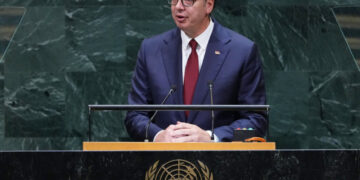
- The United States. Washington remains the fundamental guarantor of Israel’s security. Military, financial, and diplomatic support is constant, regardless of the administration in power. Netanyahu’s declaration about “super Sparta” was not criticized by the U.S., being interpreted instead as a reaffirmation of Israel’s role as a regional bastion of American interests.The most recent speech of President Donald Trump at the UN (September 2025) consolidated this line by explicitly rejecting the recognition of the Palestinian state. Trump stated that such recognition would amount to “a reward for Hamas” and would undermine Israel’s security. This position confirms not only unconditional support for Israel, but also opposition to the two-state solution in the form advocated by the UN and by most member states.
- Russia. Moscow plays an ambivalent role. On the one hand, it supports anti-hegemonic discourse against the U.S. and Israel, criticizing excessive militarization and unilateral interventions that destabilize the region. On the other hand, its strategic position in Syria and its closeness to Iran oblige it to maintain a pragmatic balance with Israel—including tactical coordination to avoid aerial collisions. Russia views the “super Sparta” concept as a consolidation of the U.S.’s regional role and, implicitly, as a limitation on its own ambitions in the Middle East.
- China. Beijing avoids directly criticizing Israel, but uses regional tensions to present itself as a mediator and indispensable economic actor. Recent Chinese statements emphasize the need to protect the Palestinian civilian population and to resume negotiations. In parallel, China is expanding its economic influence in Arab states (energy, infrastructure, technology) and cultivating the image of an alternative to American and Israeli hegemony. For Beijing, “super Sparta” is a useful symptom: it confirms the perception of a tense region where China can play the role of “rational balancer.”
- The European Union. The EU is among the most vocal critics of Israeli policies, constantly warning that excessive militarization and political deadlock undermine the two-state solution. However, its practical influence remains limited: the lack of a unified foreign policy and economic dependencies restrict its ability to act. A new element is the growing number of Western states that have recognized Palestine as a state. In September 2025, the United Kingdom, Australia, Canada, France[9], and Portugal joined this wave of recognition, raising the total to 158 UN member states (about 82% of the total). This trend increases Israel’s diplomatic isolation on the Palestinian issue and affects the U.S.’s position in blocking global consensus.
Partial Conclusion. The great powers relate differently to Israel: for the U.S., it is a top-tier strategic ally; for Russia, an inconvenient rival but one that must be managed; for China, an opportunity for diplomatic affirmation; and for the EU, more of a political and humanitarian issue than a strategic one. This asymmetry of positions explains why Israel can afford to embrace the “super Sparta” discourse without risking major sanctions, even as recognition of Palestine grows increasingly widespread internationally.
Conclusions
Defining Israel as a “super Sparta” synthesizes the reality of a society and a state built on the idea of total security—permanently threatened, but also permanently armed. The concept has strong symbolic value: it evokes a besieged citadel, but also a power that assumes dominance through military and technological superiority.
In the short term, this strategy serves Israel by:
- strengthening internal cohesion,
- deterring direct adversaries,
- attracting the respect and support of the great Western powers, especially the U.S.
In the long term, however, the risks are evident:
- Diplomatic Isolation – while Israel defines itself as a fortress, more than 158 UN states now officially recognize Palestine. This gap between internal perception and international reality creates a breach increasingly difficult to manage.
- Palestinian Radicalization – the absence of any political horizon fuels despair and strengthens radical groups, turning the conflict into an intergenerational one. Gaza is already the most tragic example of this process.
- Fragmentation of the Middle East – the inability of Arab states to react in unison, illustrated even by the weak response to the attack on Qatar, gives Israel freedom of action but also perpetuates a climate of chronic instability.
- Global Competition – while the U.S. supports Israel unreservedly, Russia, China, and the EU seek to consolidate their own role in the region, turning the Middle East into an arena of emerging multipolarity.
Another element often overlooked, yet essential to understanding Israel’s resilience, is international financial support. Major Western financial centers—traditionally associated with networks such as the Rockefeller group—have over decades contributed to Israel’s integration into the global financial order. This support has manifested not only through investments and technological partnerships, but also through influence on American and European political decisions. In essence, Israel benefits from a double shield: the strategic guarantee of the U.S. and anchoring in major international financial flows. This combination provides it with considerable room for maneuver and the ability to pursue its plans even in the face of increasingly broad diplomatic opposition. Yet the emergence of a multipolar system and the rise of new centers of global finance (China, the Gulf States, BRICS) could, in the long term, limit the absolute nature of this support.
In essence, “super Sparta” is a concept that reflects Israel’s power to survive and dominate in the short term, but also the risk that this strategy will become a long-term trap. A military fortress may be formidable, but if it remains isolated and surrounded by hostility, it becomes vulnerable to diplomatic pressures, international contestation, and endless conflicts.
The contemporary Middle East thus finds itself in a paradox: Israel strengthens its security through total militarization, but each step in this direction seems to push further away the prospect of lasting peace.