







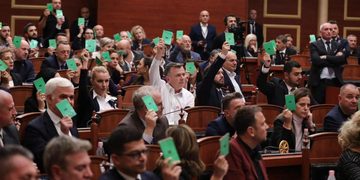


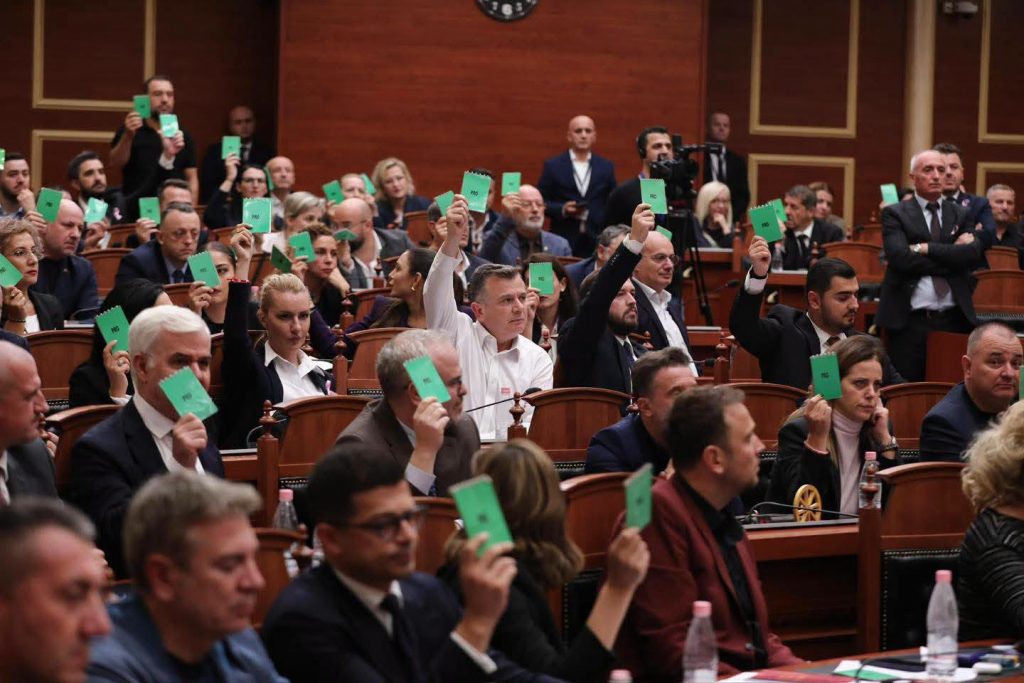
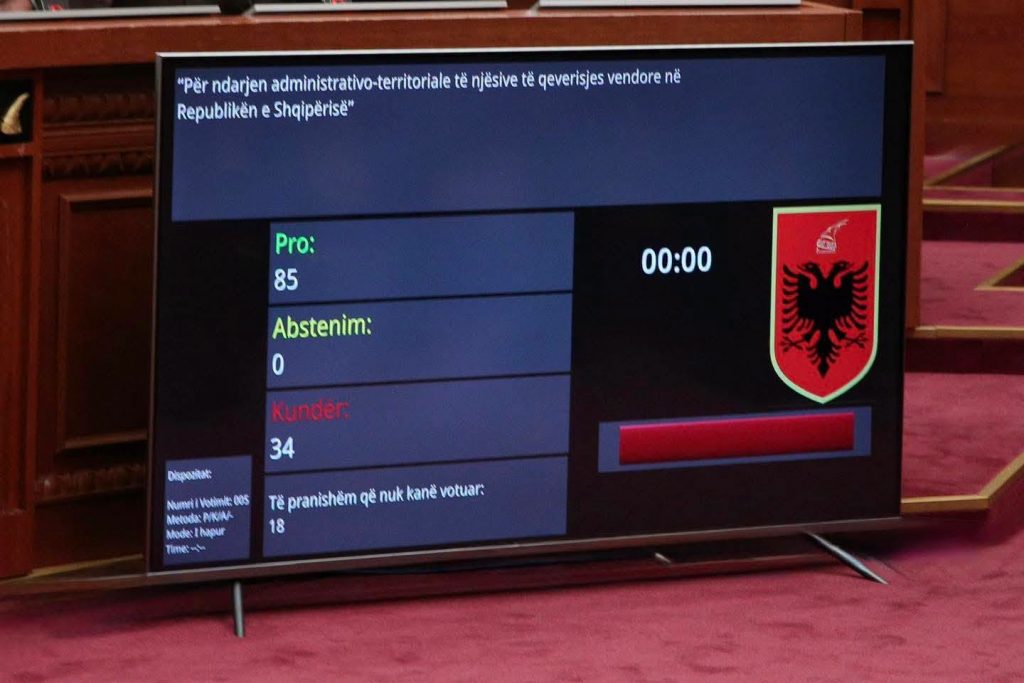
Albania’s Parliament approved the bill on the territorial-administrative division of local government units in the Republic of Albania in the early hours of the morning, following a marathon parliamentary session. The new territorial map was approved with 85 votes in favour, reducing the number of municipalities from 61 to 46, while the country’s 12 existing counties will remain unchanged.
The bill received 84 votes in favour, 34 against and no abstentions during the vote in principle.
Before the vote, Democratic Party MP Tritan Shehu, backed by seven MPs, requested a roll-call vote, arguing that the procedure would ensure greater transparency. The proposal was put to a vote by the Speaker of Parliament but was rejected, with 84 votes against and 32 in favour.
The session then proceeded to the vote on the bill amid protests by Democratic Party MPs. Opposition lawmakers gathered in front of the parliamentary rostrum and used vuvuzelas to express their opposition to the reform. They also threw hard objects towards the Speaker of Parliament.
Under the new territorial map, 15 municipalities are set to lose their separate status and be incorporated into larger local government units, with the stated aim of improving territorial administration, financial management and the delivery of public services.
A total of 33 municipalities will remain unchanged, while 28 others will be affected by the territorial reorganisation.
The municipalities set to lose their independent status are Fushë-Arrëz, Klos, Rrogozhinë, Dimal, Poliçan, Patos, Divjakë, Selenicë, Maliq, Këlcyrë, Memaliaj, Libohovë, Cërrik, Belsh and Përrenjas.
Under the proposed changes, Fushë-Arrëz will be incorporated into Pukë, Klos into Mat, and Rrogozhinë into Kavajë. In Berat County, the municipalities of Dimal and Poliçan will merge with Berat.
Changes are also planned in Elbasan County, where Cërrik and Belsh will be incorporated into Elbasan Municipality, while Përrenjas will merge with Librazhd. In Fier County, Patos will become part of Fier Municipality, while Divjakë will be incorporated into Lushnjë.
Under the new structure, Albania will be organised into 46 municipalities, 71 constituent towns and 387 administrative units. Each municipality will continue to have one mayor, one municipal council, a single administration and a unified budget, while constituent towns will play a role in administrative coordination and service organisation.
The reform also aims to strengthen the financial autonomy of local government, increase administrative capacity and adapt the territorial structure to demographic changes and the requirements of European integration.
The vote followed a lengthy parliamentary session marked by disagreements between the ruling majority and the opposition over the new territorial map. Protests against the proposed reorganisation also took place outside the Parliament building.
© 2026 Argumentum