














ARGUMENTUM ANALYSIS
What happens when a statesman does not invoke history simply to remember the past, but to explain how the future should be built?
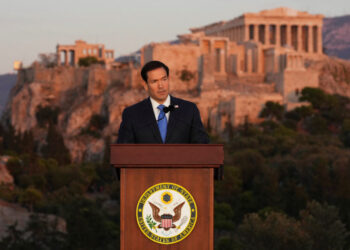
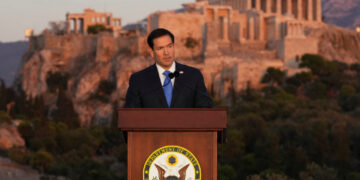
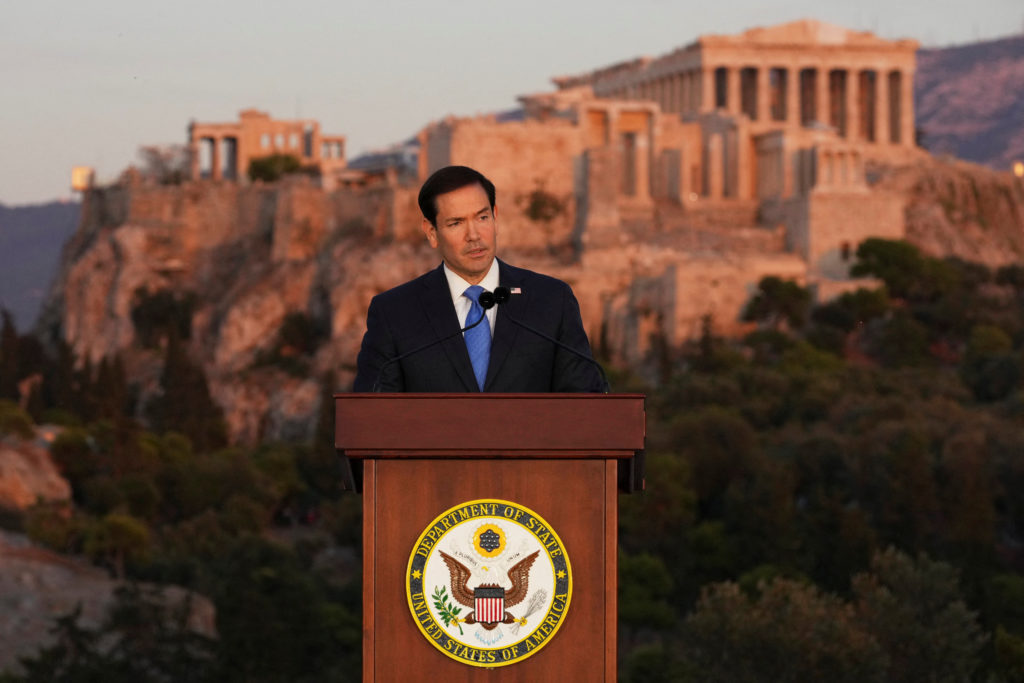
In Athens, at the Pnyx, Marco Rubio did not simply deliver a speech about Greece, democracy, or the classical inheritance of the West. He used ancient Greece as the point of departure for a much broader argument about the nature of Western civilization, about the character that, in his reading, made that civilization capable of creating, exploring, competing and defending what it had built, and about the reasons why political, industrial, military and technological power must once again occupy a central place in American and European strategic thinking.
This is what makes the speech interesting beyond the symbolism of the setting in which it was delivered. Rubio does not treat history as a collection of glorious episodes to be remembered with reverence, but as a source of arguments through which the present can be interpreted. The Acropolis, the Pnyx, Pericles, Socrates, Sparta, Alexander, Rome, Christianity, Europe and, eventually, America do not appear as isolated points in a chronology. They are presented as elements of a continuous story through which Rubio seeks to explain what the West is and what he believes it requires in the decades ahead.
The speech can therefore be read as an attempt to connect the history of civilization with the politics of power.
From the Acropolis to Character
Rubio begins with a historical moment that initially appears distant from contemporary politics. Athens was destroyed by the Persians in 480 BC, yet the Athenians returned and rebuilt the city, eventually raising the Parthenon and creating what would become one of the most powerful symbols of Western civilization.
The importance of this episode in Rubio’s speech, however, lies in more than the fact that Athens was rebuilt. What he seeks to draw from it is a particular attitude toward history and crisis: a civilization may be devastated, but it is not necessarily compelled to accept devastation as its permanent condition.
This is where the most important movement in the speech begins. Rubio acknowledges Greece’s contribution to democracy, philosophy, citizenship, law and political thought, and even to much of the vocabulary through which the West continues to describe political life. Yet he places particular emphasis on something he calls “character.”
The Greek inheritance, in other words, is presented not only as an inheritance of institutions, but as an inheritance of character.
In Rubio’s interpretation, the Greeks were fiercely individualistic, ambitious, curious, competitive and willing to take risks in pursuit of knowledge and achievement. They did not regard the unknown as a final boundary, but as something that could be studied, measured and understood. At this point, Rubio moves from political history toward a broader proposition about human beings and civilization.
The West, in this narrative, did not rise simply because it developed effective institutions. It also developed a culture in which progress itself was understood to be possible.
And it is precisely at this point that the speech begins to move away from history and toward contemporary politics.
Thumos as the Link Between Civilization and Power
The concept that gives this argument its particular character is thumos, which Rubio describes through ideas of passion, strength, courage, pride and the desire to achieve something greater.
In the speech, thumos does not remain a philosophical concept associated with ancient Greece. It becomes a way of describing the energy that, in Rubio’s interpretation, lies behind great civilizations.
This is one of the central connections in the entire speech because it allows Rubio to link something apparently belonging to the history of philosophy with something that belongs directly to the politics of the modern state.
A society that no longer wants to take risks, compete, build, explore and seek something beyond the security of the present, according to this logic, gradually loses part of its capacity to create the power necessary to protect itself.
This is why Rubio’s criticism of a culture organized around absolute safety, the elimination of failure, comfort and what he describes as “building downwards” is not merely a moral criticism of contemporary society. It also carries a strategic argument: a civilization that continually avoids risk may eventually lose some of the capacity required to confront risk when it becomes unavoidable.
This is what makes thumos so important to the structure of the speech. It becomes the bridge between individual character and collective power.
From the Weakening of the West to the Return of Power
After establishing this historical and philosophical argument, Rubio turns toward the present, and it becomes clear that the history of Greece was not the ultimate subject of the speech but the means through which he reaches a contemporary political conclusion.
He argues that the West has lost some of its confidence in itself, become uncertain about its own history, moved away from the idea of national power, weakened parts of its industrial and military capacity, and transferred significant elements of production, energy, strategic capability and decision-making elsewhere.
Rubio does not present this simply as an economic problem. Within the logic of the speech, economic and technological dependence can become strategic dependence, while strategic dependence ultimately constrains political sovereignty.
This is where one of the central ideas of the speech becomes visible: power is no longer simply a question of military strength. Power also means the capacity to produce, to develop technology, to secure energy, to control critical supply chains, to manufacture semiconductors, to access essential minerals, to build advanced defense systems and to maintain an advantage in emerging fields such as artificial intelligence, drones, space and military technology.
At this point, the speech becomes much more concrete than its opening might suggest.
The Parthenon is no longer simply a monument.
It becomes the first point in a historical argument that ultimately reaches factories, laboratories, armed forces, energy systems, technological competition and space exploration.
America and the Return of Power Politics
This is also why Rubio’s speech can be read as an attempt to give a broader historical foundation to the Trump administration’s approach to national power.
Rubio speaks of the unapologetic pursuit of national power, critical supply chains, reindustrialization, defense and technological superiority, but he does not present these merely as economic or military policies. He places them within a larger civilizational interpretation.
Within this narrative, the United States is not simply changing its economic or security policy. It is attempting to restore a political vocabulary in which the nation-state, productive capacity, military strength and sovereignty once again constitute fundamental elements of political life.
This also clarifies the way Rubio discusses international institutions.
He does not argue for a world without alliances or institutions. On the contrary, he regards them as necessary, but assigns them a particular function: institutions and alliances should help sovereign states protect their interests rather than replace sovereignty itself.
That distinction is important because it shows that Rubio’s argument is not isolationist in any simple sense. It is closer to a conception of international order in which cooperation remains necessary but is built upon the interests, capabilities and sovereignty of states.
Europe and the Idea of an Alliance of Capable States
The same framework helps explain the section of the speech devoted to Europe.
Rubio does not portray Europe simply as a partner that must be protected by the United States. He calls on Europe to increase defense spending, strengthen its industrial base, expand production and develop greater strategic capacity.
The Europe that emerges from the speech is therefore a Europe that should become more capable of defending itself and contributing to the defense of the wider Western order.
In this sense, the transatlantic relationship is not presented as a relationship in which one side provides security while the other consumes it. It is presented as a relationship that should rest upon real capabilities on both sides.
This is why Greece occupies such a significant place in Rubio’s argument. He presents it as an example of an ally capable of connecting defense, energy, migration and strategic interests within a broader national policy.
Even his reference to the Arctic and the new agreement involving the United States, Denmark and Greenland fits within this logic. Alliances, in this conception, matter not simply because of historical friendship but because they create concrete strategic capacity.
Power and Diplomacy
Another important element of the speech is the way Rubio treats the relationship between diplomacy and force.
Rather than presenting them as alternatives, he places them in a relationship of dependence.
Diplomacy requires credibility, and credibility, in his argument, depends in part upon a willingness to use force when diplomacy fails.
This is a familiar proposition in realist thinking about international relations, but Rubio once again connects it to ancient history, arguing that the Greeks understood national interest, prudence, diplomacy and the necessity of force when circumstances demanded it.
The historical reference therefore serves a contemporary purpose. It supports the proposition that without credible capacity to defend its interests, diplomacy itself can lose part of its effectiveness.
The broader implication is that peace is not treated as the opposite of power. Rather, power becomes one of the conditions through which peace and diplomacy can remain credible.
A History of the West, but Also a Selective History
It is precisely here that the speech requires a more careful reading.
The history Rubio constructs is coherent, but it is also selective. The Greece that appears in his narrative is primarily the Greece of philosophy, citizenship, inquiry, heroism and competition, the Greece that can serve as the starting point of a long Western story.
Yet Greek history was also a history of war, exclusion, political inequality and societies in which citizenship was far from universal.
The same applies to the movement from Greece to Christian Europe, from Europe to the scientific revolution and from Europe to America. The historical relationships involved are considerably more complex than the linear continuity suggested by the speech.
This does not make Rubio’s argument historically meaningless. It clarifies its nature.
He is not attempting to write a comprehensive history of the West.
He is constructing a history that can perform a political function.
This is where the title “When History Becomes Political Doctrine” acquires its full meaning. History in Rubio’s speech is not simply memory. It becomes a way of defining which values should be defended, what kind of state should be built and what kind of relationship should exist between America and Europe.
Heroism as a Political Idea
This also explains the unusual importance Rubio gives to heroic figures and acts of sacrifice.
Socrates, the 300 Spartans, Achilles, Christian martyrs, Thomas More, the defenders of the Alamo and the founders of the United States are placed within a common line of argument.
Rubio seeks to show that civilizations do not survive through institutions alone. They also depend upon people who are willing to sacrifice for something they regard as larger than themselves.
Here again, he draws a distinction between Western heroism and what he describes as a cult of death associated with radical Iranian rulers. For Rubio, Western heroism is not a desire for death but a willingness to accept risk and sacrifice in defense of life, freedom and political community.
That distinction serves a broader argument: the strength of a society is measured not only by the resources it possesses, but also by what it considers worth defending.
From Greece to the Moon
In the final part of the speech, Rubio completes the historical arc that began at the Pnyx.
Greece, Rome, Christianity, Europe, modern science, geographical exploration and the United States are connected in a long narrative that culminates in Apollo 11 and the arrival of human beings on the Moon.
This is perhaps the most symbolic moment in the speech.
The Moon is not presented simply as an American technological achievement. It is presented as the product of a much longer tradition of human inquiry, from the Greek desire to understand the cosmos to modern science and American technological achievement.
In this way, Rubio returns to the idea with which the speech began: that apparent limits do not necessarily have to be accepted as permanent boundaries.
But by this point the idea has acquired a distinctly political meaning.
A civilization that believes the future can be built will invest, produce, explore and take risks. A civilization that believes the future can only be managed will tend to concentrate on preserving what already exists.
What Is Rubio Really Trying to Say?
Ultimately, the speech is less a speech about Greece than an attempt to define a particular conception of the West.
The West, in Rubio’s formulation, is defined not only by democracy and free markets, but by a broader combination of history, character, sovereignty, power, competition, cultural confidence and the willingness to defend what it considers valuable.
In that sense, Rubio is attempting to connect two questions that are often treated separately.
The first is cultural: What is the West, and what history binds it together?
The second is strategic: How can the West remain capable of defending its interests in a world in which states continue to compete over territory, technology, resources, markets, energy and influence?
For Rubio, these questions cannot ultimately be separated.
A society that loses confidence in its history and character may gradually lose the willingness to invest in the power necessary to defend itself; while a state that possesses considerable material power but no longer knows what it wishes to defend may find it increasingly difficult to give that power a coherent political purpose.
This may be the deepest idea contained in Rubio’s speech at the Pnyx.
He is not simply arguing that America should become stronger or that Europe should spend more on defense.
He is attempting to reconstruct the connection between identity, character and power.
That is why Greece is indispensable to his argument.
If the West is a historical story, then remembering where that story began becomes a way of asking where it should go next.
The Pnyx, in this reading, is not merely the place from which Rubio speaks about ancient democracy.
It is the place from which he asks whether the West still believes that it has a future worth building and, more importantly, whether it still possesses the character, confidence and power required to build it.
_______________
© 2026 Argumentum