












By Zlatko Kramarić*
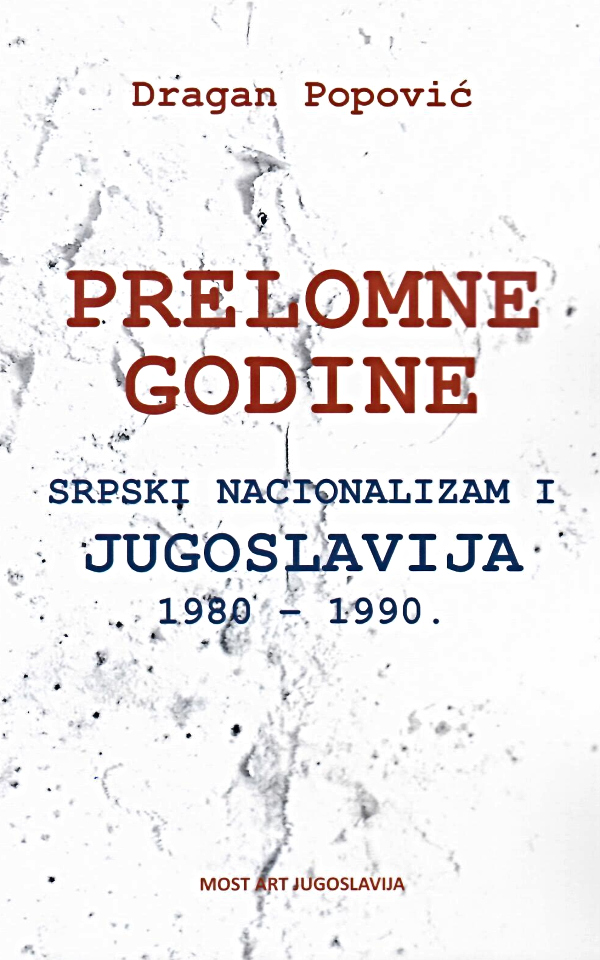
In his book The War of Memory in Serbia 1980–1990, XX vek, Belgrade, 2024, Dragan Popović attempts to explain how the memory of the (recent) past can become a deadly political weapon. For when we speak about the culture of memory, we actually refer much less to the past and far more to the present that interprets that past and, just to be safe, rearranges it somewhat, suppressing some things while transforming others into myths, which are then ultimately used for certain political projects. In short, these are by no means benign projects!
D. Popović’s book is one of those books that should be read precisely because it does not explain the breakup of Yugoslavia exclusively through the prism of political developments, constitutional crises, insoluble economic problems², or the unrealistic ambitions of individual political elites. In this book, the author takes a step back and asks how it was possible for a society, even before the outbreak of armed conflict, to first begin remembering differently.
In this sense, the title of the book is very precise. The war was not fought only over territory, constitutions, institutions and political power. It was also fought over what a society would remember and what it would, in turn, forget or suppress; who would be the victim and who the culprit; who would be the hero and who the traitor; where one’s national space begins and where it ends and, finally, what kind of past that future state would have.
Popović does not view the period from 1980 to 1990 as some kind of introduction to the war that was yet to come, but as a period in which the intellectual, political and cultural preconditions for what would happen during the 1990s were gradually being created. The book’s basic thesis is that the transformation of the dominant culture of memory was one of the important preconditions for the political transformation of Serbia and Yugoslavia. A new, radical nationalist interpretation of the past gradually entered the public sphere, pushed aside previous interpretative patterns and created a new view of almost all the important events and individuals of the shared Yugoslav history.
From Memory to a Political Programme
A particular value of Popović’s approach lies in the fact that he does not start from the assumption that collective memory exists as some innocent, natural and self-evident fact. Memory is consciously and deliberately produced.³ It is institutionalized, transmitted through the education system,⁴ literature, strictly controlled state media, public ceremonies, monuments,⁵ political speeches, historiographical texts, monographs on important historical events and their actors (once again, the memory of “forgotten heroes”, dukes, warriors, etc. is revived), and popular culture, rock music…
In other words, society does not simply remember what happened; rather, it produces a desirable version of what happened in the recent or distant past.
And precisely here, it seems, lies one of the key messages of Popović’s book: a change in the culture of memory preceded a change in political reality.
After Tito’s death, a gradual process began in which the existing Yugoslav interpretative framework was increasingly perceived as something that should not be preserved, but rather as something that needed to be radically dismantled. And it was precisely those who, until recently, had been conscious “guardians of memory” who would carry out this dismantling! Instead of the idea of a shared revolutionary experience and victory over fascism, Serbian historical traumas, real or constructed injustices, the question of (republican) borders, the position of Serbs outside Serbia, the question of Kosovo, the Second World War, the Chetnik movement, Serbia’s asymmetrical relationship with the other republics and, above all, interpretations of the Yugoslav communist period increasingly came to the fore.
And in order for such activities to produce visible effects, it was not enough to create a new interpretation of the past; it was also necessary to construct a new collective subject that would believe in that past uncritically. And that was not difficult at all!
This is where nationalism ceases to be merely a political ideology. It would manifest itself most clearly through the practice of so-called “tavern hermeneutics”; one only needs to imagine a typical “Balkan tavern”, where the loudest drunks have the final say. But in this case, those “drunks” were Serbian academics, writers, artists, journalists and publicists…, to whom, after a few rounds of drinks, all of Serbian history suddenly became much clearer.
Suddenly, the past begins to be read in such a way that almost every event confirms the same predetermined story: Serbs are victims, while others (Croats, Slovenes, Albanians, world powers, the Vatican, the Comintern…) are their merciless oppressors; Yugoslavia is the space of their historical loss (everything they gained in the war they lost in peace); and the existing AVNOJ republican borders represent an injustice that must, in one way or another, be corrected. And, as we know, when it came to correcting this historical injustice, S. Milošević, in his speech of 28 June 1989, marking the 600th anniversary of the Battle of Kosovo, did not rule out even armed conflict.⁶
***
D. Popović is exceptionally open in identifying the institutions, intellectual patterns and social mechanisms that participated in the transformation of the culture of memory into a politics of memory. And this transformation did not involve only communist politicians. It would be far too simple to place all responsibility for the nationalist transformation of Serbia on Slobodan Milošević. He merely made use of the material that others (academics, historians, writers, publicists…) had prepared for him.
In order to realize his political projections, this politician needed a consistent intellectual infrastructure, historiographical authorities, media intermediaries (Politika, Večernje novosti, Duga, NIN…), cultural institutions, public intellectuals and a new interpretative matrix that would give his political projections (“all Serbs in one state”…) the appearance of historical credibility and seriousness.
D. Popović shows that nationalist discourse became dominant not only because it was imposed by those in power, but also because various segments of the social and intellectual elites gradually accepted, elaborated and normalized it. In other words, it is not enough to ask what Milošević did. We must also ask what Serbian society, including its intellectual elites, was prepared to accept before Milošević could even implement that policy. We are aware that this kind of question is by no means comfortable.
The author’s position is not an easy one. In the book’s preface, he explains its genesis in very personal terms, and particularly moving is the story of his grandfather, a man who sincerely despised the Chetniks and nationalism, loved Yugoslavia and was a convinced communist, but who would remain a voter for Slobodan Milošević until the end of his life and, without asking unnecessary questions, accept all the key myths of the new Greater Serbian nationalist narrative. The author asks how it is possible that a man who had one moral system throughout his life could suddenly accept a political narrative that was in obvious conflict with his own life experience? How is it possible that a man who hated the Chetniks could accept the rehabilitation of Chetnik ideology? How is it possible that someone who achieved his social and personal emancipation precisely in socialist Yugoslavia could accept the narrative according to which that same Yugoslavia was exclusively a historical misfortune?
In this tragicomic family story, the essence of this book can actually be found. This story about the grandfather irresistibly reminds us of a conversation between Vuk Drašković and a Serbian peasant, in which the two agreed on everything, and when, at the end of the conversation, V. Drašković concluded that his interlocutor would certainly vote for him, for his political option, in the upcoming parliamentary elections, the peasant calmly replied that he had misunderstood everything. When Vuk asked him what exactly he had misunderstood about their conversation, the peasant openly told him that he would give him his vote and trust only once he won the elections. Before that, nothing of the vote and nothing of the trust!
Popović does not provide a psychologizing answer to these questions. His answer is political, because he has meanwhile realized that memory can be reconstructed in such a way that an individual begins to read his own life against his own life experience.
**
In most discussions about the 1990s, a somewhat comforting picture is often created according to which politics was par excellence nationalist, while the academic community merely observed all these processes passively, from a respectable distance.
The author’s analyses make such an “idyllic” picture difficult to sustain.
The academic production of knowledge can be one of the most powerful political technologies precisely because it presents itself as something that is not politics. When a historian, academic or cultural institution translates a political thesis into the language of historical necessity, it no longer appears to be a political demand but rather an objective fact.
And when a particular interpretation of the past begins to present itself as the only legitimate interpretation, every other interpretation can then be declared ignorance, treason or even hostile activity.
Within this manufactured/constructed nightmare emerges what Popović aptly recognizes as the struggle for hegemony over the past. In one of the formulations important for understanding his methodology, the author warns that elites—political, scientific, cultural and media elites—in more authoritarian societies seek to impose on society a homogeneous interpretation of the past, that is, one version of history tailored to their own measure. This is the moment when the culture of memory turns into a politics of memory. And the politics of memory can very quickly transform into a politics of identity. And that politics, when it loses every self-critical component, can overnight become a politics of (lost) territories.
From Tito’s Death to Nationalist Hegemony
Tito’s death did not produce nationalism. It already existed. His death not only made it more visible, but also gave it the much-needed legitimacy, because the only political authority that had for decades represented a kind of supranational regulator of the Yugoslav space had disappeared. And after the death of JBT, a struggle began over the interpretation of the Yugoslav experience.
Who, in fact, won the war?
Who lost the war?
Who was the victim?
Who profited from Yugoslavia?
Who was harmed?
Are the borders of the republics just?
Did AVNOJ create an unnatural division of Serbian territory?
Was socialist Yugoslavia a project of emancipation or a project of Serbian hegemony—or, in the new Serbian-nationalist-Memorandum reading, a project of Croatian-Slovenian domination over Serbia? At a certain point, it was no longer enough to say that Yugoslavia had problems. It had to be proven that Yugoslavia itself was the greatest problem.
And Popović’s book should be read together with everything we know today about nationalist mobilization in the late 1980s, beginning with the SANU Memorandum, the Kosovo narrative, the media production of a sense of endangerment, and continuing through radical changes in interpretations of the Second World War, the rehabilitation of the Chetnik legacy and the reinterpretation of Yugoslav communism, because these were not mutually unrelated processes. They were parts of the same major operation of restructuring collective memory.
Popović is, however, most interesting precisely where he does not allow for simple explanations.
He does not claim that before 1980 there existed some ideal, democratic and historiographically neutral society that our nationalisms would then destroy. Such an approach would be equally wrong!
It must be acknowledged that Yugoslav memory was also selective, institutionally controlled and politically shaped. The socialist state had its own taboos, its own heroes, its own enemies and its own regimes of forgetting. Therefore, the problem cannot be reduced to the observation that one politically produced memory was replaced by another. What should concern us is the question: what kind of political and moral content lies behind this new memory paradigm?
The nationalist transformation did not merely open up what socialism had allegedly concealed. This radical transformation produced a new hierarchy of victims and perpetrators, a new map of historical injustice and, ultimately, a new legitimization of political violence.
That is why it is important to insist on the distinction between the democratization of memory and the nationalization of memory.
Opening up space for plural memories can be an emancipatory process. By contrast, turning one national memory into a monopoly over truth can provoke entirely opposite reactions.⁷
***
In this review, we must certainly also address the intellectual genealogy of this book. The author explicitly acknowledges that the writings of Radina Vučetić⁸ and Dubravka Stojanović⁹ had a major influence on his intellectual formation. This is by no means an unimportant piece of information. On the contrary, it speaks to the continuity of a critical historiographical tradition in Serbia that refuses the nationalist monopolization of the past.
In a broader sense, Popović belongs to a circle of authors and researchers who have for decades attempted to show that coming to terms with the past is not an act of national self-humiliation but a prerequisite for the democratic normalization of society. Perhaps this intellectual genealogy is itself one of the important messages of the book: that in Serbia there is a continuity of critical thinking about its own national past, but unfortunately it has never been dominant.¹⁰
Someone might ask: why return once again to the period 1980–1990 when we have already concluded so many times that the 1990s are over?
The answer is simple. The 1990s did not end where the wars ended.
Wars can end through political agreements. Wars of memory almost never end.
Their institutions, myths, symbols and emotional patterns continue to live on after military operations have ended.
That is why Popović’s book is not merely a book about one historical period. It is a book about how a malignant political culture emerges and how it is maintained. Because these processes were not initiated by S. Milošević’s politics; rather, these retrograde processes began with a change in the culture of memory. And, if that is the case, then it is not possible to speak of the disease of only one man or one political agenda; rather, it is a serious disease of an entire society. And that is not at all a pleasant or promising realization.
****
Furthermore, this book can also be read from a Croatian perspective, but without the cheap conclusion that Serbia is the “problem” and Croatia its opposite mirror image. Croatia, too, has its own memory wars. There is still no social consensus regarding Jasenovac, Bleiburg, the NDH, the Partisans, communism, the Homeland War, the nature of Yugoslavia, Vukovar, Operation Storm, lustration, rehabilitation, monuments, plaques, textbooks… And in our country, too, the endless production of political interpretations of the past continues.
We know very well what it looks like when the past ceases to be a subject of historiography and becomes a means of political mobilization.
And yet, it seems that Croatia still lacks a systematic, long-term and sufficiently dispassionate analysis of the culture of memory specifically for the period 1980–1990, that is, the period when attitudes toward Yugoslavia, socialism, the Croatian national question and Croatia’s own history also began to change radically.
There are numerous individual papers, historiographical studies, polemics, memoirs and political essays, but what is missing is a work that, in a manner comparable to Popović’s, would connect academia, politics, the media, literature, popular culture and changes in the public language of memory.
Much is said about Croatian nationalism, but too little research is devoted to how the Croatian relationship with the past changed before political change became obvious. In this context, perhaps the model offered by this book could provide a methodological stimulus.
And not merely so that we could “compare Croatia with Serbia”. Quite the opposite! It is high time we stopped viewing nationalist transformations as purely national phenomena and began to see them as part of the broader Yugoslav collapse of the order of memory.
In this context, it is interesting to recall our 2016 book Nostalgia: A Short History of Forgetting, which, in a different way and from a different perspective, attempted to raise the question of the relationship between the Croatian-Yugoslav question, collective memory, forgetting and the political construction of identity. In that book, we attempted to problematize the fact that collective memories are not unchangeable property of the past but active processes that participate in shaping the present.
*****
Perhaps the value of this book could be summed up in one statement: before a political society begins to produce enemies, it first has to produce an appropriate past.
There can be no serious political mobilization without an answer to the question of who we are.
But equally, there can be no answer to the question “who are we” without an answer to the question “what have they done to us”.
And this is where the recognizable nationalist logic begins: we are the only true and authentic victims of history! The “others” (Croats, Albanians, Slovenes…) are the culprits!
Our history has been interrupted. Our borders are unjust. Our victims have been forgotten. Their crimes have been silenced. We are historically innocent.
And if we are historically innocent, then everything we do in the present (Srebrenica, Vukovar…) is done exclusively in self-defence.
And was that not also the fundamental message of Porfirije at Ratko Mladić’s funeral?! The general, regardless of the fact that he was a convicted war criminal, was merely defending his own! There is no doubt that precisely this morbid logic is the most dangerous element of any politics of memory. Because when a nation comes to believe that throughout its entire history it has primarily been a victim, it becomes very easy to present every future political act on its part as a response to someone else’s injustice.
This book, The War of Memory…, precisely dismantles that logic.
And that is why this is not a book about the past but about the present.
About the models through which societies create their political identities.
About academic responsibility.
About the role of (national) intellectuals.
About the (fragile) boundary between historiography and political myth.
And, perhaps most importantly, about the responsibility of those who know that a particular interpretation of the past is not merely an interpretation but also a political programme.
Precisely for this reason, this book goes beyond the documentary reconstruction of one episode in Yugoslav history.
It raises a question that may be more important today than ever: who has the right to decide what we will remember?
If the answer is only the state, we get official history.
If the answer is only the nation, we get a national myth.
If the answer is only academia, we get an expertocratic monopoly.
If the answer is only politics, we get propaganda.
Therefore, democratic societies should not insist on a single, final culture of memory. In such societies, plural cultures of memory exist, in which different memories can coexist, but none of them has the right to declare itself the only permissible memory.
It is precisely here that Popović’s book proves to be a book of highly contemporary political significance.
Because wars may begin with gunfire.
But political wars much more often begin with words.
And before borders on maps are changed, the borders in people’s minds are very often changed first.
Dragan Popović’s The War of Memory in Serbia 1980–1990 is valuable precisely because it shows how this process looked in one society and how a change in the language of the past gradually leads to a change in political reality.
That is why this book should be read not only as a book about Serbia, but also as a warning to everyone who believes that memory is merely a backward glance.
Fortunately, it is not!
Memory is one of the ways in which a society decides what kind of future it will have.
Footnotes
1. D. Popović, The War of Memory in Serbia 1980–1990. The Rise of Nationalism and Resistance, XX vek, Belgrade, 2024.
2. All relevant international financial institutions knew that socialist Yugoslavia had gone bankrupt by the end of the 1980s and that war was inevitable.
3. On the conscious production of memory, see A. Assmann, Working on National Memory, XX vek, Belgrade, 2002.
4. Dubravka Stojanović pointed to this extremely important aspect in her works and writings. See D. S., “Slow Burning: History Textbooks in Serbia, 1993–2008”, in Augusta Dimou (ed.), ‘Transition’ and the Politics of History Education in Southeast Europe, Göttingen: V&R unipress, 2009, pp. 141–158. Her text unambiguously demonstrates that the problem cannot be reduced merely to individual inaccurate or one-sidedly interpreted historical facts. She argues that historiography and history education in Serbia during the 1990s often ceased to be disciplines of critical thinking and became instruments of political mobilization, in which the past was adapted to the present, while historical myths acquired the function of justifying and legitimizing current political projects. She explicitly writes that history and history education became part of a kind of “war arsenal”, that is, that they participated in the justification, consolidation and subsequent glorification of the wars of the 1990s. Textbooks, she warns, could become active participants in the creation of “new societies” and a “new consciousness”.
5. For more on this, see N. Makuljević, Memory and Manipulation. Monument Politics in Serbia 1989–2021, XX vek, Belgrade, 2022; and A. Assmann, “Places of Memory in Space and Time”, Chapter IX of The Long Shadow of the Past. Memory Culture and the Politics of History, C.H. Beck, 2006.
6. Thirty years later, a similar idea concerning the “changeability of borders” would also be articulated by Porfirije, Patriarch of the Serbian Orthodox Church (SPC). Admittedly, this self-proclaimed ecumenist does not explicitly mention armed conflict, but he regards the very idea of “borders” as highly flexible; in his view, they are not eternal categories! But the Patriarch did not explain to us how it is possible to change borders in this part of the world without armed conflict?! We therefore await with great impatience additional explanations from his hagiographer D. Pilsel, who, in one of his forthcoming “ecumenical” texts, will explain to us what Porfirije actually meant when he uttered these absurdities.
7. Comments on these opposite reactions can be found in the rich library of XX vek. It is a library containing more than 260 titles in which Serbian nationalism has been critically analyzed since 1971. Without mercy! And without additional excuses!
8. Here we will single out only two titles: R. Vučetić, Monopoly on Truth. The Party, Culture and Censorship in Serbia in the 1960s and 1970s, Clio, Belgrade, 2016; Coca-Cola Socialism. The Americanization of Yugoslav Popular Culture in the 1960s, Službeni glasnik, Belgrade, 2012.
9. Here, too, we will single out only some of her books: Dubravka Stojanović, Oil on Water. Essays on the History of Serbia’s Present, Belgrade, 2010; A Foot in the Door. Contributions to a Political Biography, XX vek, Belgrade, 2011; The Past Is Coming. Changes in the Interpretation of the Past in Serbian History Textbooks 1913–2021, XX vek, Belgrade, 2023.
10. Latinka Perović wrote very insightfully about this unpleasant fact. Beneath her “cloak” was hidden the better political and academic part of Serbia.
__________________________
*Zlatko Kramarić is a Croatian publicist, author, and diplomat, currently serving as Ambassador to Albania. Formerly a university professor and politician, he is known for his work in literature, cultural studies, and regional history.
© 2026 Argumentum