





























By Dr. Ermir I. Hajdini
Legal Analyst & University Lecturer
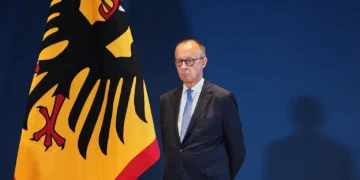
The political landscape across Europe is shifting beneath Berlin’s feet?! The historic electoral performance of the Alternative für Deutschland (AfD) in Saxony-Anhalt—securing roughly 44% of the vote—represents far more than a regional protest vote. It is a structural shock to the CDU-led framework under Chancellor Friedrich Merz and a fundamental challenge to the post-war consensus governing the Federal Republic.
As Chancellor Merz seeks to project stability across the European Union, the convergence of political fragmentation, industrial energy shock, and global diplomatic pushback raises an urgent question: Can a German government constrained by domestic paralysis and economic contraction truly offer a reliable leadership anchor to Europe?
1. Deindustrialization and the Fall of the Manufacturing Engine
For decades, German European leadership rested on fiscal discipline and export-driven industrial power. That economic foundation is now deteriorating rapidly. The loss of affordable pipeline energy following the severance of Russian gas imports severely eroded the low-cost manufacturing model that sustained heavy industry, chemicals, and automotive manufacturing.
Rather than adapting dynamically, Germany’s industrial flagships are shrinking or relocating production abroad. The crisis surrounding Volkswagen serves as a primary case in point[^1]. For the first time in its 87-year history, the automotive giant has considered closing domestic plants in Germany, canceling long-standing job security guarantees, and shifting focus outward. When the cornerstone of German industrial strength undergoes structural contraction, Berlin loses the financial capacity to act as Europe’s primary economic stabilizer.
2. Fiscal Orthodoxy and Poor Budgetary Policy
Exacerbating this structural industrial decline is Berlin’s rigid adherence to internal fiscal rules, most notably the constitutional Schuldenbremse (debt brake). Originally designed to prevent public overspending, the debt brake has evolved into a self-imposed straightjacket during a period that requires massive capital investment.
The federal government’s poor budgetary policy has starve-funded public infrastructure, digital networks, and green transition projects[^2]. Decades of underinvestment have left Germany’s rail system, power grids, and administrative infrastructure severely degraded compared to European peers. By prioritizing short-term fiscal austerity over long-term capital formation, German policymakers undercut the domestic platform necessary to drive European growth initiatives or finance collective European projects.
3. The Rejection at New York: The Diplomatic Cost of Militarization
Beyond domestic policy failures, Germany’s shrinking international authority was laid bare in New York, where it suffered a humiliating diplomatic setback by losing its bid for a non-permanent seat on the UN Security Council to Portugal and Austria[^3]. This defeat was not merely a procedural loss; it delivered a clear message from the international community—and particularly the Global South—that Berlin’s expanding defense spending and increasingly militaristic tone do not align with its traditional reputation as a constructive, multilateral mediator. Rather than reading the geopolitical room, the Chancellery in Berlin seems to have entirely missed this signal, doubling down on military expansion while alienating partners who expect diplomatic moderation rather than weaponized posture.
4. The Rearmament Paradox: Militarization Amid Stagnation
In response to shifted European security realities, Berlin announced the Zeitenwende (pivotal turn), establishing a €100 billion special defense fund (Sondervermögen) aimed at modernizing the Bundeswehr[^4]. However, this surge in defense spending reveals a deep strategic contradiction.
While billions are funneled into procurement—frequently directed toward foreign defence contractors to satisfy immediate transatlantic commitments—the broader domestic economic engine continues to stall. Militarization without a resilient industrial and technological backbone creates strategic fragility. Attempting to project military power and lead European defense initiatives while domestic infrastructure and core industrial sectors contract creates an unsustainable imbalance.
5. Transatlantic Alignment vs. Strategic Autonomy
The final constraint on German leadership under the Merz administration is its foreign policy posture. By consistently aligning its energy, trade, and diplomatic positions with Washington, Berlin has often sacrificed its direct long-term economic interests. Replacing pipeline gas with expensive American Liquefied Natural Gas (LNG) stabilized supply in the short term, but locked German industry into permanently higher input costs.
This reliance limits Germany’s ability to foster true “European strategic autonomy”—a concept championed by Paris but routinely undercut by Berlin’s military and geopolitical dependence on the United States.
Conclusion: Leadership or Strategic Paralysis?
Friedrich Merz inherits the mantle of European leadership at a time when traditional German leverage is severely eroded. Germany remains the largest economy in the European Union, but size alone does not grant the capacity to lead. A country constrained by coalition instability, bound by fiscal dogmatism, undergoing deindustrialization, and dependent on external security guarantees faces severe limits in providing a coherent direction for 27 member states.
Unless Berlin addresses its internal structural bottlenecks and defines an independent economic and security strategy, Chancellor Merz may find that Germany functions less as an anchor for Europe and more as a source of shared paralysis.
Footnotes
[^1]: The Volkswagen Precedent: In late 2024 and expanding into 2025/2026, Volkswagen AG revoked its 30-year-old employment protection agreement (Zukunftstarifvertrag) and signaled the necessity of closing at least two domestic manufacturing facilities in Germany due to high local energy prices, lagging EV competitiveness, and intense price competition from Chinese EV manufacturers.
[^2]: Budgetary Policy and the Debt Brake Crisis: Following the November 2023 Federal Constitutional Court (Bundesverfassungsgericht) ruling that declared the reallocation of €60 billion in unused emergency pandemic funds to the Climate and Transformation Fund unconstitutional, German budgetary policy has been characterized by sharp austerity measures, coalition infighting, and structural underfunding of core public infrastructure under the rigid constitutional Schuldenbremse.
[^3]: The UN Security Council Vote: In June 2026, Germany failed to secure a non-permanent seat on the UN Security Council for the 2027–2028 term, losing out to Western European peers Portugal and Austria. Analysts interpreted the result as a broad diplomatic rebuke against Berlin’s rigid transatlantic alignment and rearmament messaging over diplomatic engagement.
[^4]: The Defense Special Fund (Sondervermögen): In 2022, Germany established a constitutional €100 billion off-budget fund specifically allocated to rearm the Bundeswehr. Critics point out that despite these immense military allocations, the broader industrial base is suffering structural contraction, and standard defense budget allocations remain constrained by general budgetary limits once the special fund expires.
© 2026 Argumentum