












































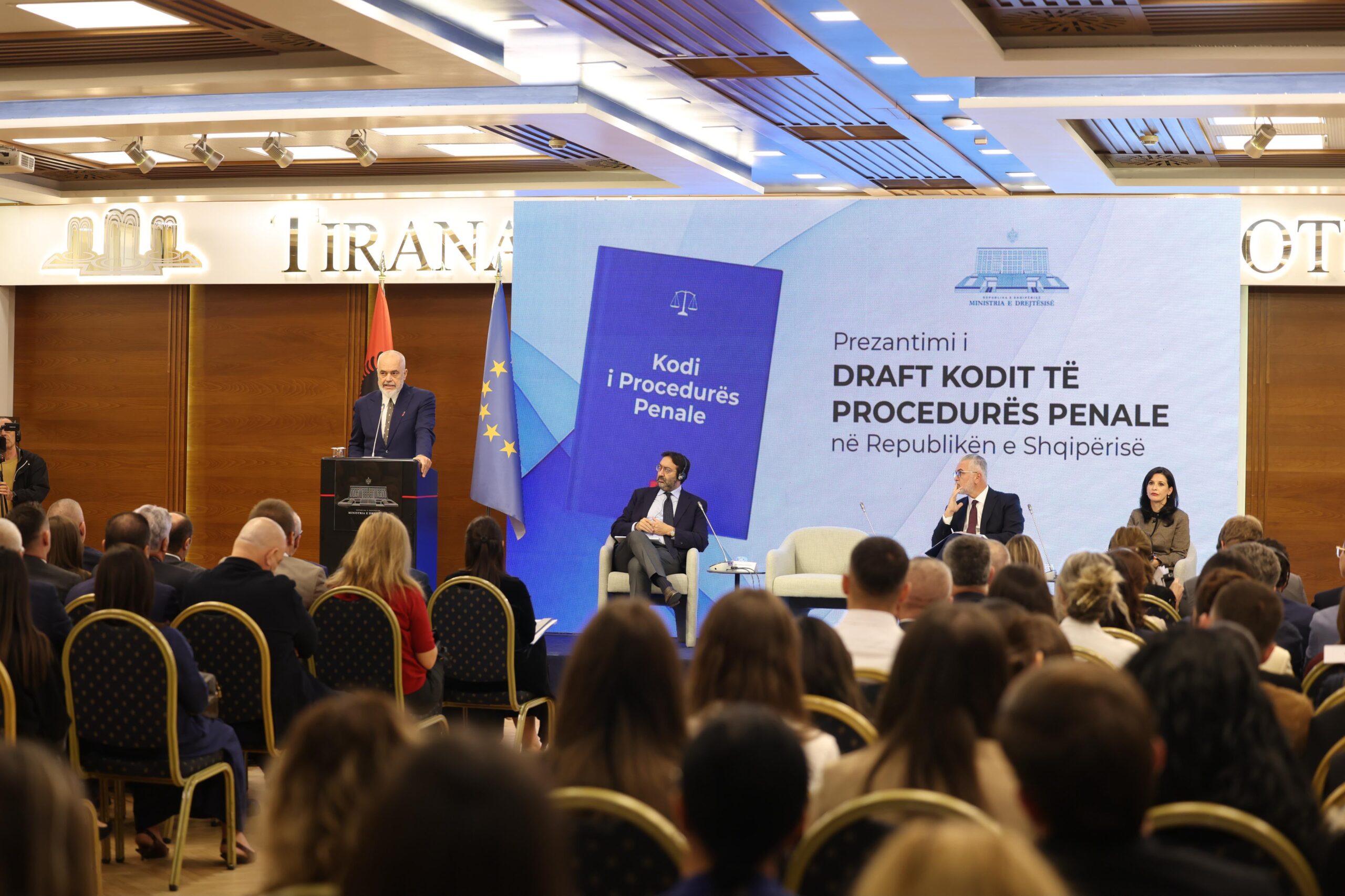
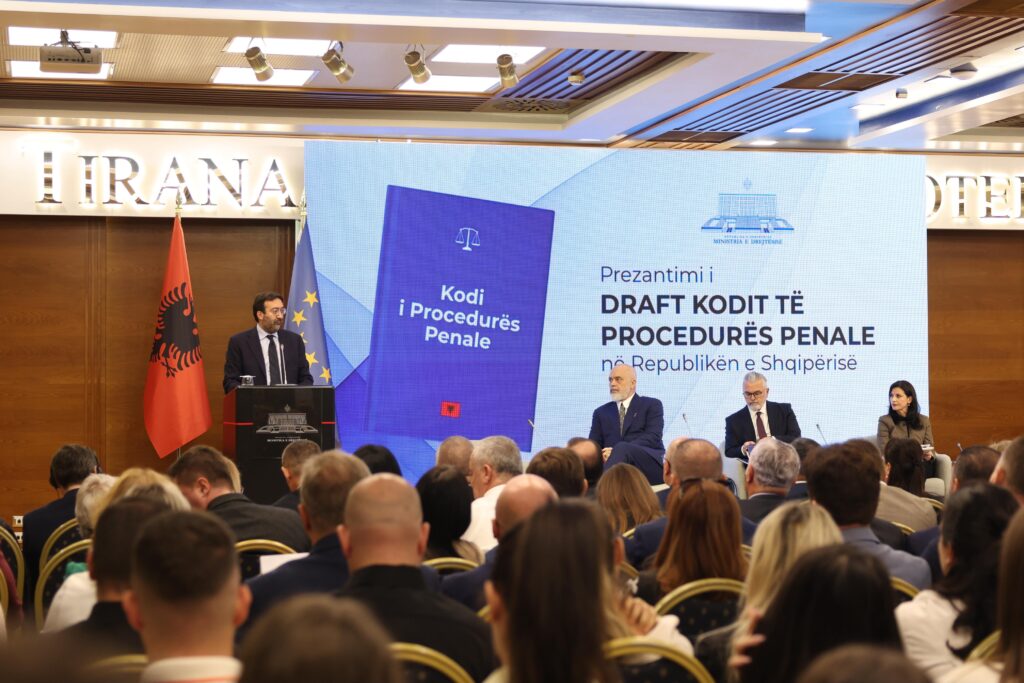
A new draft of amendments to Albania’s Criminal Procedure Code was presented today in Tirana, proposing significant changes to the rules governing pre-trial measures, defense rights, judicial oversight, privacy and the protection of victims.
The package, drafted with the participation of Albanian and European experts and under the supervision of the Council of Europe, aims to strengthen procedural safeguards and oversight over the exercise of power in criminal proceedings, placing legality, proportionality and respect for fundamental rights at the center.
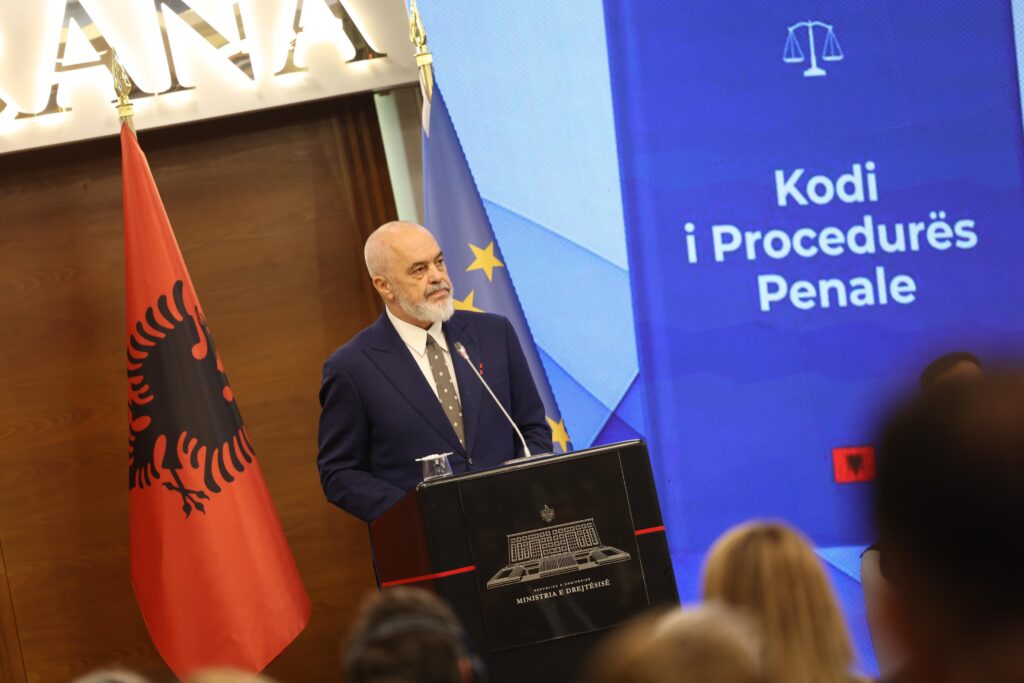
The proposed amendments were presented in the presence of Prime Minister Edi Rama, Gianluca Esposito, Director General for Human Rights and Rule of Law at the Council of Europe, Minister of Justice Toni Gogu, as well as Albanian and international experts.
The draft addresses a broad range of issues, from the use of pre-trial measures and strengthening the role of the defense to rules governing questioning, access to electronic data, the presumption of innocence and the protection of victims.
Pre-Trial Measures
For offences carrying a maximum sentence of up to three years, restrictive measures would, as a rule, no longer be imposed. For offences carrying a maximum sentence of less than five years, detention in prison would no longer be allowed. Neither a person’s silence nor their refusal to admit the charges could be used as evidence of dangerousness. The risk must be concrete, current and supported by facts relating to the individual concerned. The court must explain why less restrictive measures would not be sufficient.
Whenever detention is imposed, the court must also consider a financial guarantee, calculated according to the person’s actual financial circumstances, with necessary exceptions concerning risks to evidence, serious violent crimes, terrorism, offences against the constitutional order and cases falling under the jurisdiction of the Special Court against Corruption and Organized Crime.
The prosecutor must report to the court every month on whether the grounds for the security measure continue to exist.
Mothers with children up to six years of age, fathers or guardians where the mother is deceased or unable to provide care, persons over 70, seriously ill persons and individuals undergoing therapeutic programmes would no longer be treated without regard to their specific personal circumstances.
Equality Between the Defense and the Prosecution
Defense lawyers would have the right to conduct their own investigations, take statements, request documents, carry out technical verifications and engage experts. Materials collected by the defense would be submitted directly to the judge and assessed according to the same standards of legality and relevance as prosecution evidence.
A person would have unrestricted access to the evidence on which their deprivation of liberty is based and would receive the complete case file free of charge before the case is sent to trial.
Prosecutors would have an explicit obligation to investigate circumstances that exonerate or favor the person under investigation. The role of a prosecutor in a democratic state is not simply to secure a conviction, but to establish the truth.

Safeguards During Questioning
A person could not be summoned as a witness and effectively treated as a suspect without access to a lawyer and the relevant procedural safeguards. Anyone summoned by the Prosecutor’s Office or the police, including as a person with knowledge of the facts, would have the right to appear with a lawyer, with that right explicitly stated in the summons.
Where suspicion already existed at the time of questioning, statements obtained under a different procedural status could not subsequently be used against that person.
Questioning and key investigative actions would be subject to mandatory audio and video recording. The current qualification “when possible” would be removed from the Code.
For the first time, the draft would explicitly state that statements or information obtained through torture, inhuman treatment or degrading treatment are absolutely inadmissible.
Privacy and Mobile Phones
A mobile phone is no longer simply a means of communication. It contains an extensive record of a person’s life, including communications, photographs, movements, financial information and personal relationships.
Accordingly, the seizure of a device could not constitute an unlimited authorization to access everything stored on it. Police and prosecutors could seize the device, but opening, copying or processing its contents would require prior judicial authorization.
The court’s decision would have to specify the device, categories of data, applications, time period and search criteria. In urgent cases, which would also be narrowly defined by law, the action would have to be reviewed by a court within 48 hours.
Any data obtained outside the scope of the authorization would be inadmissible, while material extracted that is unrelated to the investigation would have to be destroyed.
The same principle would apply to intercepted communications. Only communications relevant to the investigation, including those favorable to the person concerned, should be transcribed. The private lives of people unrelated to the alleged offence could not be turned into usable material, an instrument of pressure or media content.
The collection of biological samples and the storage of genetic profiles would also be regulated comprehensively for the first time, requiring informed consent or a court decision, the presence of defense counsel and mandatory destruction following a final acquittal.
The Beginning and End of Investigations
The proposed changes would give investigations a verifiable starting point, a clearly defined subject and an endpoint.
Proceedings would have to be registered on the day the prosecutor becomes aware of the offence, rather than when the prosecutor considers it appropriate. The person concerned would have the right to know that proceedings have been registered against them and to ask the court to verify the date.
If another offence emerges during an investigation, it would have to be registered separately as such. Investigations kept hidden for years and used as a continuing shadow over an individual would no longer be compatible with the principles of the rule of law.
Cases sent to trial would also have to meet a higher threshold. The current criterion of “sufficient evidence” would be replaced by the standard of a “reasonable expectation of conviction”. The prosecutor would have to weigh both incriminating and exculpatory evidence and demonstrate why there is a realistic prospect of a conviction.
Criminal proceedings should not themselves become a form of punishment where the evidence cannot reasonably support a finding of guilt.
Presumption of Innocence
The proposed changes would extend the presumption of innocence beyond the courtroom, making it a standard governing the conduct of public institutions.
The publication of intercepted communications beyond the portions cited in the reasoning of a judicial decision would be prohibited, as would the publication of identifying information about victims without their consent, images of persons subject to physical restraints, and decisions imposing security measures beyond the limits established by law.
Prosecutors, police officers, lawyers and other professionals legally required to maintain confidentiality would face responsibility for breaches of that obligation.
The language used in official documents would also have to respect the presumption of innocence. No person could be presented as guilty before a final court decision. Where this principle is violated, the person concerned would have access to a rapid mechanism for correcting the official act.
Stronger Protection for Victims of Domestic Violence and Sexual Crimes
The package would also strengthen protections for victims. In cases involving domestic violence and sexual crimes, new measures would include removal of the defendant from the home and restrictions on approaching or contacting the victim, with a minimum distance of 1,000 meters and the possibility of electronic monitoring.
Where such removal leaves the family without the means of subsistence, the court could order a periodic payment in its favor.
The identity of victims would be protected and their ability to participate in proceedings strengthened. Their right to be heard would also be reinforced.
Decisions in chambers concerning liberty and individual rights could no longer be taken through a procedure without the parties being informed. The parties would have to be notified, allowed to submit arguments and given the opportunity to be heard, including remotely where provided for by law.
At the request of the defendant or victim and with the authorization of the court, hearings could also be broadcast live, subject to safeguards protecting the rights of third parties and victims.
Changes Concerning Special Court Judges and SPAK Prosecutors
The draft legislation provides that the Special Court against Corruption and Organized Crime would not have jurisdiction to hear charges against one of its own judges or against a prosecutor of the Special Prosecution Office, where the alleged offences fall outside the court’s specific jurisdiction.
In such cases, jurisdiction would pass to the courts of general jurisdiction.
Changes to Proceedings in Chambers
A general rule would be introduced for proceedings conducted in chambers: the parties would have to be notified at least ten days in advance, would be allowed to submit written arguments and would have the right to be heard, including through remote connection in cases provided for by law.
Violation of these safeguards could result in the proceedings being declared invalid.
At the same time, the draft explanatory report provides for greater public access to proceedings. Hearings could be broadcast live at the request of the defendant or victim and with the authorization of the court, while the rules governing public access would also be extended to appellate proceedings.
© 2026 Argumentum