
































By Zlatko Kramarić*
We probably would not have reviewed this (intriguing) book of notes on Tito by the well-known Serbian writer (and politician) Dobrica Ćosić had we not, while following the elections for President of the Republic of Croatia, heard chanting at one of the campaign headquarters, upon the announcement of the (expected) results: “Tito, Tito…!” The candidate to whom these shouts were addressed did not distance himself, by a single gesture, from this symbolic association of his politics with the politics of JBT! We are not sure that those present in the hall were aware of what they were doing. We might, like that famous heretic, say: “Forgive them, God, for they know not what they do…!”
But this very fact that “Tito is still alive” (after JBT’s funeral in Belgrade in May 1980, D. Ćosić wrote: “Tito was buried, but he did not die”; and this recent frenzied chanting of a dead man’s name at a political celebratory gathering in Zagreb shows that this writer was entirely right, because only in these unfortunate parts of the world do the dead continue to live after death) says a great deal about the political and moral relations within Croatian society, about an extremely schizophrenic state of that society. Perhaps this schizophrenia is best confirmed by some serious books that have been published in Croatia in recent years.
Clearly, this “schizophrenia” requires a far more serious analysis than this brief review of the book, which, incidentally, was published in Belgrade, in a neighboring country with which, among other things, we are connected by the “likeness and (non)deeds” of JBT!
We have previously reviewed several books about Tito. Here, first and foremost, we mean our highly critical review of D. Pilić’s “Tito Through Krleža’s Eyes” (Ljevak, 2020), as well as the book by the German-Croatian historian Marie-Janine Calic, “Tito – The Eternal Partisan” (Fraktura, 2022). We will only recall that, among other things, in those reviews we concluded that neither of these books brought anything that we did not already know about JBT. More or less, they were correct and thorough catalogues of previous knowledge about JBT’s life and work. This observation applied particularly to the book “Tito – The Eternal Partisan”, which was, after all, written for a German audience that knows very little or almost nothing about JBT, so the author had to repeat/recycle a whole series of “general and familiar places” from Tito’s biography that do not represent any particular novelty to our public!
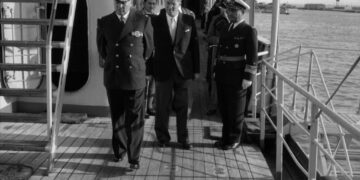
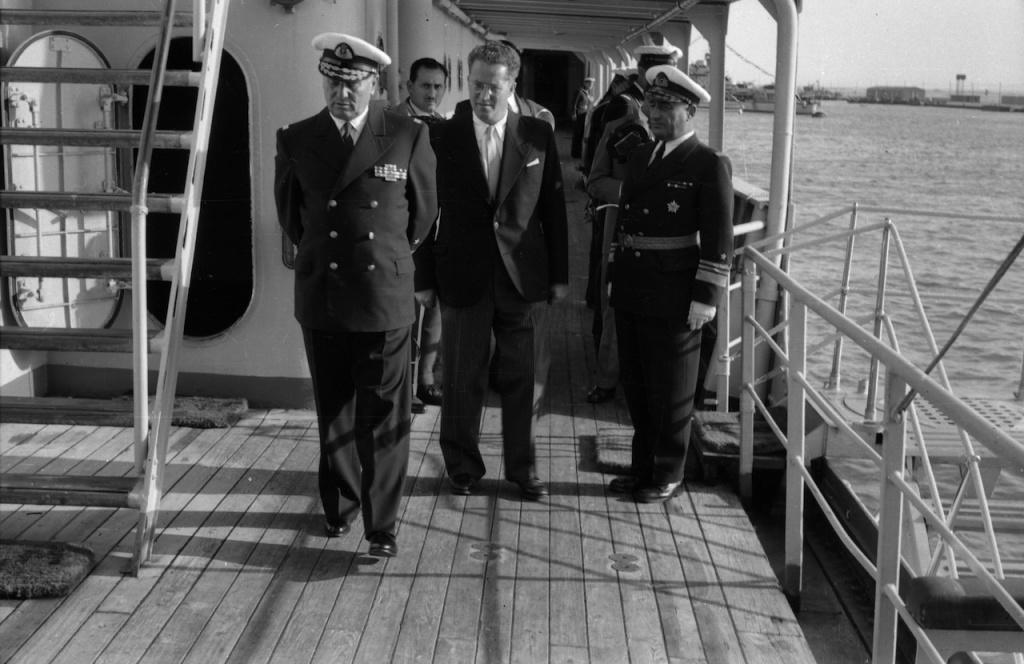
Likewise, we cannot say that these notes by D. Ćosić bring anything that we did not already know about JBT. Perhaps our possible “lack of knowledge” concerns several “affairs”/“incidents”/“juicy details” that occurred during Tito’s historic journey aboard the school ship Galeb, a voyage on which D. Ćosić was also one of the more important passengers, a member of the highest Yugoslav delegation, and which he duly and meticulously recorded and, in his familiar manner, albeit with a respectable time distance, when all the important events had already taken place and the principal actors had died, cynically commented upon. And, incidentally, he denounced some of them as well. However, this fact says more about the author himself than about those whom he gossips about after a decent passage of time.
We believe it is a well-known fact that, in his earliest youth, D. Ćosić was not only a communist but also a great admirer of Tito’s “person and work”, but that after some time this love slowly but surely began to lose its original strength. The complete collapse of this youthful love and ideological intoxication came after the political fall of Aleksandar Ranković in 1966. After that year, former love turned into open hatred, because Dobrica Ćosić would become one of the fiercest ideological opponents and critics of Tito’s policies. And “The Book on Tito” is, in fact, a book about “love and hatred”, about the authentic character of “Serbian communism”, which is nothing other than, more or less, cleverly concealed “Serbian chauvinism”. We must admit that in exposing his own political metamorphosis D. Ćosić was brutally honest. He concealed nothing. It is enough to read his inaugural address from 1976, delivered when he was elected a full member of SANU, and everything concerning this metamorphosis will become crystal clear! At that moment, he reminded us of a husband who, after thirty years of marriage, tells his wife that he has a mistress whom he loves more than her and that it would be best for them to separate.
This book, too, offers a detailed account of the author’s strange political trajectory – from a fanatical Serbian peasant-Bolshevik to a Serbian nationalist, “father of the nation”, ideologue of Greater Serbian politics, fierce critic of “self-management socialism”, “brotherhood and unity”, “the policy of non-alignment”, the “cult of personality”/“Youth Relay”, a “state dissident”…, and he would succinctly sum up his enormous disappointment in one of his notes: “I believed that he had been completely overcome by the vanity of a Habsburg front soldier and communist convict. At its peak, Tito’s revolutionary life acquired a monarchist, operatic, kitschy style; the leader of a peasant and poor people dressed elegantly like a man of fashion and a nouveau riche; he lived in Brioni (and for several months a year – Z. K.’s note), immoderately and luxuriously, as if he were an early wealthy man” (p. 65).
Dobrica Ćosić’s book about Tito was one of the indispensable bibliographical sources for us when writing our book on JBT, “Even After Tito – Tito”, and we are convinced that it deserves the attention of the Croatian public. This still does not mean that we have a positive opinion of Dobrica Ćosić’s political and literary activities. When it comes to this writer’s literary-political practice, we largely share the opinion of another writer, M. Kovač. We have nothing to add to that opinion, but we continue to wonder whether it is possible that, before this latest political metamorphosis, D. Ćosić was one of the fiercest critics of the decline and belittling of Serbian culture, in which the “celebrated” Serbian battles of the Great War had, by the 1960s, become part of tavern musical culture, so that as early as 1965 this writer would, among other things, write the following sentences: “…March on the Drina, the march with which one generation, the generation of partisan fathers, a people’s army, a liberation army, all bloodied, marched into the history of the world, toward its supreme national achievement, that military march, that honorable and costly victorious song, became the tavern closing-time song of an entire nation, the ‘tush’ of Serbia’s tavern bands. The lyrical sorrow for the homeland and freedom of Serbian and Yugoslav (sic! – Z. K.’s note) soldiers from Corfu, with an altered, that is, Serbified text, became the song of a tipsy, over-singing youth… And let us not devalue the tradition and the moral and cultural values of our serious, tormented and hard-working people.”
Footnotes
1. D. Ćosić, The Book on Tito, Laguna, Belgrade, 2024.
2. Dobrica Ćosić was, for a short time, the (unsuccessful) President of the Federal Republic of Yugoslavia, from 1992 to 1993. A great writer, whom Zoran Đinđić described as nothing less than the Serbian Thomas Mann (an utterly inappropriate comparison, which, first of all, is not even literary justified, because Th. Mann’s work reaches a universal aesthetic and philosophical level /about which we have also written in this book/, whereas D. Ćosić’s oeuvre is contaminated by the basest, chauvinistic national narratives. Th. Mann took a critical attitude toward German society during the Nazi dictatorship, often doing so from a self-ironic perspective, whereas D. Ćosić was an active participant in all suspect ideological and state-building projects, was impressed by the unlimited power of the repressive state apparatus, and defended and justified criminals, A. Ranković, R. Karadžić…) he allowed Slobodan Milošević, essentially an average party apparatchik who, through a combination of fortunate circumstances, became the key figure in Serbian politics in the 1980s and 1990s, to outmaneuver him and to make an ugly game of the figure of the “father of the nation”, as Serbian nationalists liked to call D. Ćosić. Naturally, this sycophancy was not without calculation. He was a writer who was also the author of several famous statements about the character of the Serbian nation. One of them is that Serbs lie above all creatively, and another, even more famous one, that Serbs are a people accustomed to regularly losing in peacetime everything they gain in wars. And that this idea about creative lying really works is demonstrated in the most convincing possible way by today’s Serbian media, various tabloids and TV stations such as Informer, Pink and Happy, in their truly fantastic absurdities about Croatian secret services being directly involved in organizing student demonstrations throughout Serbia, about Serbs ruling China for two hundred years, about Buddhism originally being a Serbian religion, about Russians actually being Serbs… Admittedly, it must be acknowledged that these student demonstrations have shaken Aleksandar Vučić’s regime to some extent. One of the more amusing quips by Serbian students is their offhand observation that A. V. is not responsible for most things in Serbia at all. And that is where all the positive story ends, because the students, just like the regime, believe that Kosovo is the “heart of Serbia”…
3. Dejan Jović wrote the book “An Introduction to Yugoslavia” (Fraktura), while his colleague (they work at the same faculty, the Faculty of Political Science in Zagreb), Mirjana Kasapović, wrote “Goodbye, Post-Yugoslavism! A Contribution to the Demythologization of Croatian Politics and Society” (ŠK, 2024), and we too fit quite well into this schizophrenic narrative with our book “Even After Tito – Tito”, HSN, Zagreb, 2025.
4. Both of these reviews were published on the website of Glas Slavonije Magazine, in the section “The Ambassador’s Choice”.
5. This concerns the arrogant behavior of Tito and Jovanka and several “minor” quarrels with V. Mićunović and L. Koliševski, who believed that Tito did not pay them as much attention as their positions warranted. Tito conducted all conversations with his hosts during that journey independently, without any consultations with his closest associates, because he did not attach much importance to their opinions. This journey was a “one-man show”, intended to promote JBT as the leading figure of the Non-Aligned Movement! And the African leaders he visited (some of whom M. Kasapović calls “Nazis among the non-aligned”) enthusiastically participated in his (self-)promotion. Everyone else aboard that ship was merely an extra; this remark also applies to D. Ćosić, who were supposed to be living witnesses to his (divine) greatness.
6. It is the famous ship that forms part of the history of socialist Yugoslavia. The ship became famous precisely because of that journey to Africa, at the beginning of 1962. After the collapse of Yugoslavia, the ship “Galeb” became the property of Croatia, unlike the ship “Jadran”, which the Montenegrins took from us. The ship “Galeb” is currently in the port of Rijeka. The City of Rijeka, and probably the state as well, invested substantial funds in its restoration. Although it has been restored, no one, absolutely no one, shows even a basic interest in putting the ship to some use – tourism, hospitality, a museum… Quite simply, it seems that even the City of Rijeka is unable to put the ship to any respectable use! And it still needs to be maintained! Sometimes we have the impression that JBT is smiling sweetly at us “from the other world”!
7. All the main characteristics of the concept of the cult of personality are, of course, applicable to the cult of personality of Josip Broz Tito as well. Tito, as a symbol of an era and a regime, emerged from the Second World War as a victor and, as a consequence, became the leader of communist Yugoslavia, remaining in power for 35 years. Given his achievements in the aforementioned war, the reputation he built among his comrades-in-arms and the people, and the people’s disappointment with the previous ruler, it was not difficult for Tito, as the hero who defeated the occupier, or rather for the propaganda apparatus of the Communist Party of Yugoslavia, to build a cult of personality around him. Throughout his rule, the construction of the cult of personality was so intense, which is not surprising given the organization of the state and the fact that in each of the Yugoslav republics one city bore his name, as did major streets in some cities, schools, barracks, etc. Over time, he as a person became more important than the state he led, and as his cult of personality weakened, Yugoslavia itself weakened as well. One consequence of the successful construction of the cult of personality among the population was the emotional attachment of the Yugoslav people to their president, which was particularly expressed when his death was announced and is attested to by a quotation from Pero Simić and Zvonimir Despot: “With tears and wails, millions of Yugoslavs saw him off. Many suffered for him more and more painfully than they had for their closest relatives. They did not even suspect that in mourning him they were also mourning themselves and Yugoslavia.” He was buried at the House of Flowers in Belgrade. (Vinka Klišmanić, The Cult of Personality of Josip Broz Tito, 2022.) The term “cult of personality” was first used by N. S. Khrushchev in a report at the closed session of the 20th Congress of the Communist Party of the Soviet Union (1956), in which he designated the glorification of J. V. Stalin and the entire system of political, propaganda and repressive measures that served this glorification, particularly during the final two decades of Stalin’s rule, as a cult of personality. This period was also called the “era of the cult of personality”. In this sense, the cult of personality came to be differentiated as a particular form of autocratic rule characteristic of all totalitarian (as well as some authoritarian) regimes of the 20th century (fascism, Nazism, communism).
8. Dobrica Ćosić represents a paradigmatic example of radical political-intellectual metamorphoses. As a long-standing participant in the communist establishment, after the Brioni Plenum in July 1966 he would overnight become a militant national ideologue. Yet this transition did not mean that he abandoned the ambition of an intellectual who has a sacred obligation to participate in shaping the collective destiny of his own nation. On the contrary, that ambition merely shifted into a new, nationalist/Greater Serbian political framework. A similar pattern applies to many other Bolsheviks/communists, such as Mihajlo Marković, Vasilije Krestić, Vuk Drašković…, who began their political careers as convinced Marxists/internationalists and ended them within a national, Greater Serbian narrative, sincerely believing that an intellectual has the right and duty to politically direct processes in Serbian society. It is important to emphasize here that we too consider changes in certain political and other views a normal occurrence. After all, only idiots never change their minds! However, we have serious objections to all those who, not so long ago, changed their convictions and opinions and now claim that they have actually always thought what they think today, that is, that there is no difference whatsoever between what is thought “now” and what was thought “before”!
9. In the text “The Death of the Author and the Birth of the Nation: Literary Postmodernism and Nationalism in Serbia”, Goran Lazičić of the Institute of Slavic Studies in Graz summarized the ideas from Ćosić’s novel: “Already in the previous decade – the most influential example being Dobrica Ćosić’s tetralogy of novels Time of Death (1972–1979) – one can trace the beginnings of the key positions and stereotypes of nationalism that would later crystallize as the dominant ideology in society: the exceptionalism of the Serbian people in history, above all in terms of sacrifice and suffering; eternal encirclement by enemies and the struggle for survival; international politics as an ‘all-encompassing anti-Serbian conspiracy’; Yugoslav unification as a fatal mistake, as a political project doomed to failure from the outset; the crystallization of the figure of domestic traitors as foreign mercenaries; members of other nations and religions are viewed exclusively as a threat, leading to national autism in which the Other is always and only the Enemy; a conscious choice of war and suffering as a choice of the heavenly kingdom.” All the ideas listed above continue to dominate Serbian society today, because there has never been a reckoning with the legacy of the Milošević era, especially with the ideology that left behind ruins, mass graves and immeasurable human suffering. Worst of all, the reproduction of that ideology and its dogmas continues unabated, not only through the mass media but also through education.
10. M. Kovač: “Dobrica Ćosić, the Fateful Father of the Nation”, Peščanik, April 2009.
11. D. Ćosić, “On Civilization, Nation and the Other” (1965), in: D. Ćosić, Hope and Action, Filip Višnjić, Belgrade, 2000, p. 371. His critical observations clearly confirm that even during socialist Yugoslavia the authorities’ attitude toward Serbia’s role in the Balkan Wars and the First World War/Great War was positive. Thus N. Makuljević, in the book “Memory and Manipulation”, XX vek, Belgrade, 2026, says that “a strong personal relationship and vivid memory of participation in the war and family destinies probably (…) during the 1950s and 1960s characterized a significant part of the citizens of Serbia. Serbian monarchs, as well as the monument heritage and memorial complexes from the territory of the Republic of Macedonia, where important battles of the Balkan Wars and the First World War took place and numerous memorials were located, were removed from official memory. The focus of memory was directed toward the courage and suffering of soldiers and the civilian population. In this way, a kind of construction of continuity of the Serbian libertarian spirit was established, which was confirmed and continued during the national liberation struggle in the Second World War.” (p. 24)
*Zlatko Kramarić is a Croatian publicist, author, and diplomat, currently serving as Ambassador to Albania. Formerly a university professor and politician, he is known for his work in literature, cultural studies, and regional history.
© 2026 Argumentum