





































Author: Gurakuç Kuçi – Senior Researcher at the Institute for Hybrid Warfare Studies “OCTOPUS” and Professor at Universum College
State borders have historically served not only as administrative demarcations, but also as geostrategic instruments of control and influence. In many cases, in order to create durable barriers between two political or national spaces, a third ethnic group has been deliberately positioned in border areas. This approach aims to generate permanent tensions, justify political or security interventions, and establish long-term pressure zones.
Such cases are not identical in form, but they follow the same operational principle. Russia has applied this model in Donbas, Crimea, Abkhazia, and South Ossetia, while Serbia has done so in northern Kosovo. In all these instances, demography, identity narratives, and borders function as intertwined geostrategic levers.
These approaches constitute forms of hybrid warfare, built on long-term preparation rather than ad hoc actions. In this sense, hybrid warfare has facilitated nationalism’s operational role, transforming it from an ideology into a tool. Demography, nationalist narratives, and control of border spaces form a functional trinity of this strategy.
The Case of Vevcani as a Narrative Indicator
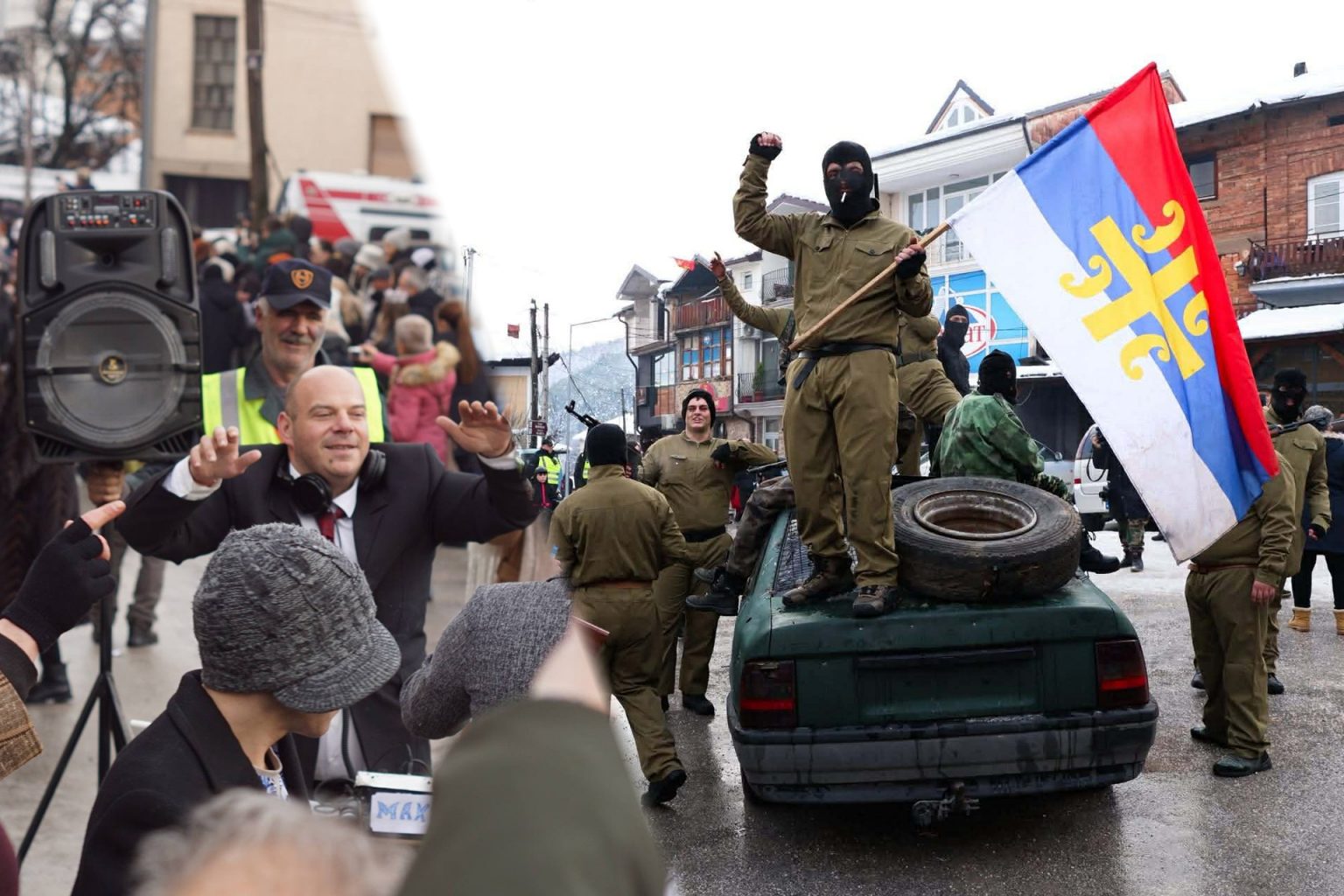
Within this analytical context, the case of the Municipality of Vevcani in North Macedonia and the celebrations accompanied by Serbian nationalist-chauvinist slogans must also be examined. Vevcani is a municipality with a Macedonian Orthodox majority, administratively separated from Struga in 2004, and located near the border with Albania, approximately 8–10 km away, with direct geographic links toward Pogradec and Tirana.
In September 1991, less than two weeks after Macedonia declared independence from Yugoslavia, Vevcani symbolically proclaimed independence through a local referendum. This act was not recognized, but it remains indicative of a local tradition of symbolic rebellion.
Recent developments, however, place Vevcani within a new narrative context. On January 13 and 14, during the traditional Carnival of St. Basil, a centuries-old ritual associated with the New Year according to the Julian calendar, the Serbian nationalist-chauvinist song “Ko to kaže, ko to laže, Srbija je mala” was heard being sung.
During the 1990s, this song was chanted by Serbian military, police, and paramilitary formations during the wars in Kosovo, Croatia, and Bosnia and Herzegovina. Its presence at a traditional festival does not constitute direct evidence of an organized Macedonian state strategy, but it does function as an indicator of the penetration of an expansionist narrative into spaces within North Macedonia that remain insufficiently controlled.
From Local Incidents to a Regional Model of Amplification
The Vevcani case, however, is not an exception. It aligns with a chain of documented incidents across the region: graffiti in Kolasin bearing the message “when the army returns to Kosovo,” inscriptions in Budva such as “Kosovo is Serbia” and “he who dies for Kosovo never dies,” as well as open genocidal chants against Albanians during a basketball match in Kumanovo, including “gas chambers for Albanians” and “pure Macedonia”.
These cases function as social amplifiers of a persistent anti-Albanian narrative, disseminated through graffiti, sports, festivals, and cultural rituals. This is characteristic of the psychological and societal pressure phase of hybrid warfare, where the objective is not immediate escalation, but the gradual normalization of hate and conflict discourse.
These developments indicate a systematic effort to transform anti-Albanianism from an extremist stance into a widespread regional discourse, particularly at moments when the regime in Belgrade faces internal political pressure and international delegitimization. The export of tension serves as a tool for crisis displacement and for testing the limits of regional and international response.
Albanians represent one of the key geopolitical factors in the Western Balkans that obstruct the realization of Russo-Serbian hegemonic projects aimed at securing strategic access to the Adriatic. For this reason, the normalization of anti-Albanian discourse through hybrid forms should not be treated as a local provocation, but as a direct threat to public order, regional stability, and long-term security.
© 2026 Argumentum