



















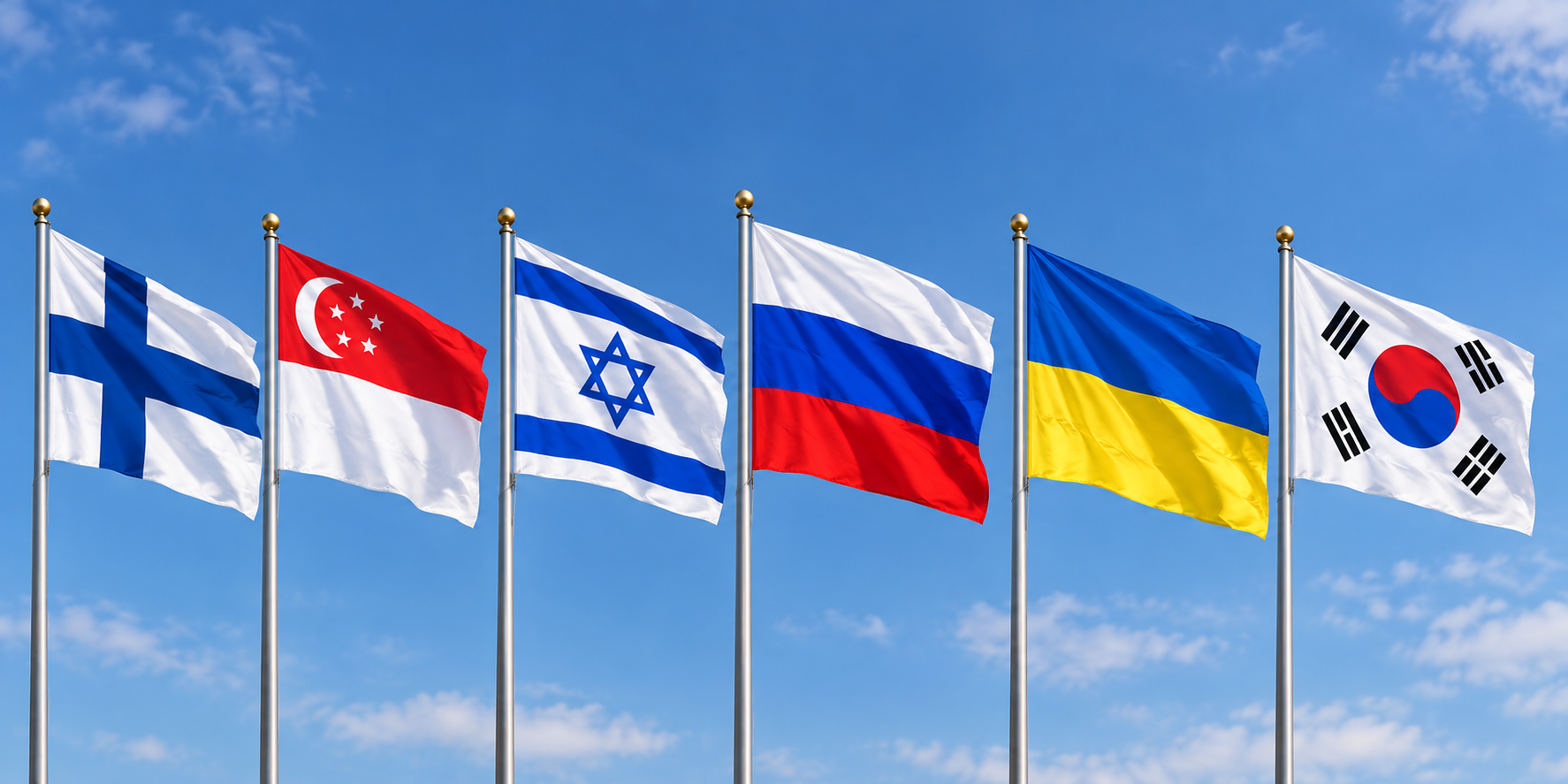
Finland, Singapore, Israel, Ukraine, and South Korea have, as a difference from the majority of European countries, kept draft for decades. Their experiences should now be taken as an example.
With Russia being on the brink of launching a direct military assault on other European countries, reintroduction of mandatory military service across Europe is likely a matter of months rather than years.
However, bringing back the military draft carries an unavailable sense of reinvention, as though the continent were the first political space in history forced to answer the question of who owes the state their labor, their years, and potentially their lives in defense of our freedom, independence, and permanent peace.
But make no mistake: this is not the case.
Finland has been answering it since the interwar period, Israel since 1948, Singapore since its founding, South Korea since the armistice line was drawn, and Ukraine — the newest and most brutally instructive member of this club — since February 2022.
What Europe requires is not a committee tasked with designing a conscription model from a blank sheet of paper, but the far less glamorous work of synthesis: taking the discrete pillars of an already-tested architecture, each honed under its own historical pressure, and assembling them into a coherent whole.
Finland — The Discipline Of The Whole Society
Finland’s model rests on a doctrine, not merely a manpower statistic, though the statistic is itself striking. Finland’s reserve force of 280,000 troops can mobilize swiftly, drawn from an entire reserve of about 900,000 — a figure that, relative to a population of 5.5 million, has no meaningful European equivalent.
But the number is downstream of “Kokonaismaanpuolustus” (English: “Total Defence”), a doctrine that treats the armed forces as merely the most visible expression of a societal commitment running through hospitals, telecommunications firms, food logistics, and private industry alike.
The country has tested and prepared wartime agreements with private firms — over 1,000 contracts — to ensure industry and businesses can shift to wartime production or service support if needed, while volunteer structures such as the National Defence Training Association draw tens of thousands of civilians annually into courses that blur the line between soldier and citizen.
The result is a society in which conscription is not an imposition tolerated grudgingly but an institution around which civic identity is organized; homeland defence willingness in Finland stands at around 80 percent, among the highest in Europe. And while Europe cannot import Finnish geography or Finnish history, it can definitely import the underlying premise: conscription functions only when embedded in a whole-of-society framework, not bolted onto an otherwise indifferent civilian sphere.
Israel — The Courage To Conscript (Almost) Everyone
Israel offers the second and most politically uncomfortable lesson, precisely because Israel itself has repeatedly failed to apply it consistently. Compulsory service for both men and women has long been presented as the hallmark of Israeli conscription, and the civilian dividend of that universal service — particularly through the technical corps — is real and well documented: Unit 8200 is credited with playing a key role in developing Israel’s high-tech know-how, contributing to the country having the highest concentration of startups per capita in the world, with alumni networks feeding directly into firms such as Wiz, Check Point, and Palo Alto Networks.
That is the part of the Israeli model worth studying closely: the deliberate channeling of military technical training into a civilian innovation economy, rather than treating conscription as a sealed, wasted parenthesis in a young person’s productive life.
What must not be imported, however, is Israel’s chronic failure to apply its own principle evenly and indiscriminately. Exemptions for ultra-Orthodox seminary students date back to 1948, when the state’s first prime minister exempted a small number of students so they could devote themselves to religious study, an arrangement that has since expanded as the community grew to more than 13 percent of the population and become a permanent source of civic resentment and legal crisis, with Israel’s High Court repeatedly ruling that blanket exemption lacks any legal basis without the political system managing to enforce that ruling.
Additionally, Israel similarly leaves its Arab citizens outside the conscription system almost entirely, an exemption implemented through informal directive rather than a particular law and that has remained the case despite the fact that Arabs account for roughly 20% of the country’s entire population, which translates to approximately 2 million Israeli citizens.
Europe’s task is therefore to take only half of Israel’s example: universal conscription of women alongside men, yes; the carving-out of entire communities by religion or ethnicity, absolutely not. A conscription system that exempts categories of citizens by identity rather than by individual fitness for service does not strengthen the social contract underlying Total Defence — it corrodes it, and Israel’s own decades-long crisis over the Haredi exemption is the clearest cautionary tale available.
Singapore — Spending The Money Where It Matters The Most
Singapore’s National Service demonstrates a narrower but no less important principle: conscripts are worth outfitting properly. Where many European militaries have historically treated conscripts as an afterthought equipped with whatever surplus hardware remained in storage, the Singapore Armed Forces have built a reputation for supplying recruits with modern equipment and, crucially, for solving the geographic constraint that limits any small, dense country’s ability to train realistically.
Singapore signed a pact granting its troops greater access to Australian training areas for 25 years, an agreement under which the number of SAF troops training in Australia was set to grow from 6,600 to 14,000, with training stays extended to 18 weeks.
Beyond Australia, the SAF’s overseas training areas have steadily expanded to include India, Germany, South Africa, Thailand, Taiwan, and the United States, a deliberate strategy of buying and negotiating terrain that the home country cannot itself provide.
European states, collectively possessing far more territory than Singapore, have simply never needed to think this way — but a continent training conscripts to fight a war of Ukrainian intensity should not assume its own training grounds and its own equipment stocks are automatically adequate. Bilateral training-access agreements among European states, and possibly with partners further afield, deserve the same deliberate design Singapore applied out of necessity.
Ukraine — Learning From The Only War That Currently Matters
No component of this proposed synthesis is more urgent, or more available, than the one offered by Ukraine, because Ukraine is simultaneously the model and the beneficiary.
Ukraine has shifted from being a recipient of NATO training to exporting hard-won expertise in drone warfare, counter-UAS operations, and electronic warfare to allied armies that had studied these subjects only in doctrine, never under fire.
During NATO’s Hedgehog exercise in Estonia, ten Ukrainian drone operators simulated the destruction of seventeen armoured vehicles and effectively neutralized two NATO battalions in roughly half a day, exposing precisely the gap in alliance readiness that European rearmament is meant to close.
Ukrainian military experts assess that up to 80 percent of a given unmanned-systems mission’s success is owed to the skill and adaptability of the pilot rather than the system itself, an insight with direct implications for how European conscripts ought to be trained: not as operators of a fixed piece of hardware, but as adaptable soldiers cycling through rapidly iterating tactics.
Denmark deployed specialists for joint exercises with Ukraine on countering drone threats, and Poland signed a memorandum establishing a working group on drone warfare cooperation after Russian drones violated its airspace.
European conscription reform that does not build a standing pipeline for its recruits to train alongside, or under, Ukrainian instructors — ideally including rotations that expose personnel to genuine front-adjacent conditions — squanders the single most valuable and most perishable form of expertise currently available anywhere on the continent.
South Korea — Never Asking For A Permission To Rearm
The final pillar of a truly effective European defense policy doesn’t concern recruits but their weapons, or, better said, their supply.
South Korea’s defense-industrial base was built out of the anxiety following Richard Nixon’s 1969 withdrawal of American troops, and the resulting doctrine of self-reliant defense has produced a robust military industry that is now capable of supplying much of NATO’s eastern flank.
And this is something that is already happening. South Korea recently signed a $13.7 billion contract to supply Poland with K9 self-propelled howitzers, K2 main battle tanks, and FA-50 fighter jets, with production facilities established in Poland itself, while combined sales at South Korea’s four major defense companies were projected to reach $37 billion this year, nearly four times their 2021 level.
The claim of total self-sufficiency should not be overstated — South Korea still imported a meaningful share of global arms in 2020–2024, with 86 percent of those imports coming from the United States — but the trajectory is unmistakably toward domestic mass production, and the speed advantage is decisive: deliveries to Poland began within months, far faster than European or American suppliers typically manage.
A conscript army is only as effective as the industrial base that arms it, and Europe’s conscription debate cannot be separated from its parallel, unfinished debate about rebuilding the continent’s own capacity to produce artillery shells, armored vehicles, and munitions at the tempo a peer war demands.
Assembling The Synthesis
None of these five states offers a perfect or flawless template, and honesty requires naming the tradeoffs alongside the achievements. Finland’s model depends on a societal cohesion built over decades that cannot be conjured by legislation alone. Israel’s civilian-tech dividend cannot be separated from an occupation and a permanent-war footing most European electorates would neither accept nor need. Singapore’s overseas-training model requires diplomatic capital and financial outlay European states have rarely bothered to commit.
Ukraine’s expertise is a wartime windfall whose relevance will fade as tactics evolve, and importing it responsibly means building durable institutional pipelines now, not treating a handful of memoranda as sufficient. South Korea’s industrial model took half a century of sustained state investment to mature. But the individual components — societal integration, universal and consistently enforced conscription without carve-outs for religious or ethnic constituencies, properly equipped recruits with negotiated access to realistic training terrain, structured exposure to Ukraine’s battlefield-tested unmanned-systems doctrine, and a serious, state-backed push toward domestic mass production of matériel — are neither mutually exclusive nor beyond the administrative competence of the European Union’s member states, individually or in coordinated fashion.
What is required is the will to admit that none of this needs to be invented, only assembled and, where politically inconvenient, imposed without exception.
Europeans should learn that wars are not won by countries that spent the peace reinventing wheels others had already built and tested under fire.
© 2026 Argumentum