















After three years without a confirmed U.S. ambassador, Eric Wendt arrives in Tirana at a moment when regional security, institutional developments and Albania’s role within NATO are taking on renewed significance.
Editor’s Note
Eric Wendt’s arrival in Tirana marks more than the end of a lengthy diplomatic vacancy. It comes at a moment when Albania’s relationship with the United States is increasingly intertwined with questions of security, institutional resilience and the country’s role within the wider Euro-Atlantic architecture.
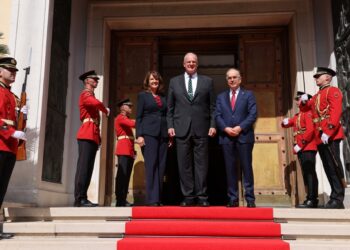
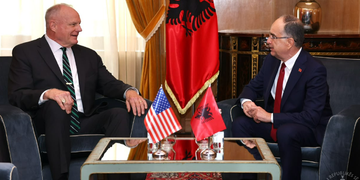
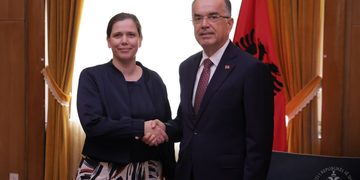
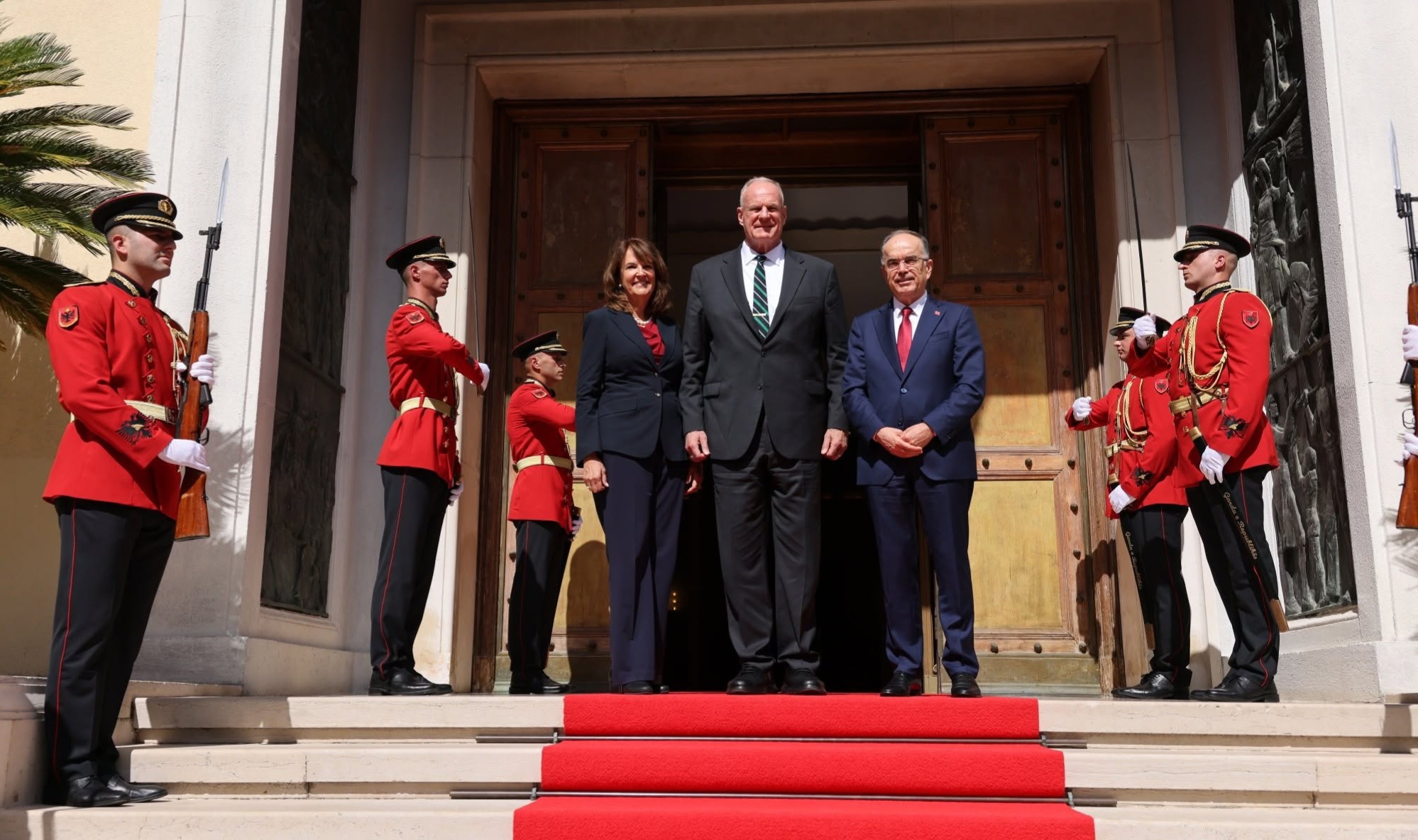
Following the end of Yuri Kim’s tenure in 2023, Albania went nearly three years without a confirmed U.S. ambassador. On September 26, Wendt presented his credentials to President Bajram Begaj, formally beginning a mandate at a particularly sensitive moment for Albania and the Western Balkans.
Albania is a NATO member and an EU candidate country, while its geographic position and political role increasingly place it within broader discussions on security and stability in the Western Balkans.
At home, however, the political environment remains highly contested. For more than four months, protests in Tirana have brought citizens and activists into the streets, initially over development issues and the Zvërnec project before expanding into broader political and institutional demands, including calls for Prime Minister Edi Rama to resign. The opposition has supported the protests.
This provides an important context for Wendt’s mandate. How the new ambassador engages with a government that remains Washington’s institutional counterpart, an opposition seeking political change, independent institutions and a society expressing growing dissatisfaction will shape the political environment in which his tenure unfolds.
From Diplomacy to Security
Wendt brings a profile that differs significantly from that of a traditional career diplomat.
A retired U.S. lieutenant general with more than three decades of military service, he has held senior positions within the U.S. military and NATO and served as commander of NATO Special Operations Headquarters from 2019 to 2021. Earlier in his career, he served as U.S. Security Coordinator for Israel and the Palestinian Authority and was involved in coordinating an eight-nation coalition.
His background inevitably places security and defense cooperation high on the agenda.
But security in today’s European environment extends beyond military capabilities. It also encompasses institutional resilience, the rule of law, democratic stability and a state’s ability to withstand strategic pressure.
In his Senate confirmation testimony, Wendt highlighted defense and security cooperation alongside the rule of law, the fight against corruption and organized crime, and stronger economic ties.
His military background, therefore, does not necessarily point to a narrowly defined security mandate. Rather, it may indicate a broader understanding of how political stability, institutional credibility and national security increasingly intersect.
Albania as a Western Balkan Hub
The significance of the new mandate also extends beyond Albania’s borders.
The Western Balkans remain a region where questions surrounding Kosovo, Serbia, Bosnia and Herzegovina, and the wider process of Euro-Atlantic integration continue to intersect with the interests of major international actors.
For Albania, NATO membership has transformed its position. The country is no longer simply a beneficiary of collective security, but also a contributor to it.
That raises a broader question for Tirana: what role can Albania play within the region’s security architecture?
For Washington, the answer is relevant not only to bilateral relations but also to the wider stability of the Western Balkans. Wendt’s mandate will therefore inevitably be viewed through both lenses: the relationship between Washington and Tirana, and Albania’s contribution to the region in which it is situated.
Institutions and the Security Dimension
Another important element of the relationship is Albania’s institutional development.
The United States has invested heavily in Albania’s judicial reform, while the work of the Special Prosecution Office, SPAK, and the country’s new justice institutions has become increasingly significant in its political life.
Investigations and legal proceedings involving political and public figures have given the issue of justice an additional political dimension.
For Washington, this creates a delicate balance: supporting judicial independence and institutional reform while avoiding the perception of becoming an actor in Albania’s domestic political confrontation.
Every statement from the U.S. Embassy is therefore likely to be read by more than one audience — the government, opposition parties, judicial institutions, civil society and the wider public.
The challenge is not simply to support institutions, but to maintain confidence in the principle that those institutions must operate independently.
A New Relationship with Albanian Politics
Albania’s political polarization adds another layer to the ambassador’s mandate.
The government remains the central institutional interlocutor for the United States and an important partner on security and foreign policy. At the same time, an American ambassador operates within a much wider political and social landscape that includes opposition parties, independent institutions, civil society, academia and the media.
Maintaining communication across these different constituencies is particularly important in a political environment where public debate increasingly extends beyond parliament and into the streets.
For Wendt, the challenge will be to engage with Albania as a state while also understanding the broader society in which its institutions operate.
The NATO Summit and the Regional Moment
The timing of Wendt’s arrival is also significant because Albania is preparing to host a NATO summit following the Alliance’s meeting in Ankara. NATO Secretary General Mark Rutte confirmed in July that the next summit would take place in Albania, although the exact date had not yet been set.
For Tirana, the summit represents an opportunity to place Albania more prominently on the Alliance’s political agenda.
For Washington, it will be another occasion to discuss NATO’s priorities, European security and the distribution of responsibilities among allies.
For Wendt, this means that Albania’s bilateral relationship with the United States and its role within NATO will increasingly overlap.
What to Watch During the Tenure
Several areas will offer a clearer indication of the direction of the new U.S. engagement in Albania.
Defense and security cooperation will remain central, particularly as the regional security environment continues to evolve.
The U.S. approach to judicial reform and the independence of Albania’s institutions will also remain closely watched.
So will Washington’s relationship with Albania’s political forces and its broader engagement with civil society and the public.
Beyond Albania, attention will focus on Tirana’s role in the Western Balkans, particularly regarding Kosovo and Serbia, as well as Albania’s positioning within NATO ahead of the Alliance’s summit.
These issues will provide a practical measure of how the new ambassador’s mandate develops.
Ultimately, Eric Wendt’s tenure will unfold at the intersection of domestic politics, relations with the United States and a changing geopolitical context for Albania and the Balkans.
His challenge will not only be to understand Albania’s institutions and political actors, but also the reality beyond them: a society seeking greater trust in its institutions and a country seeking to consolidate its role in the region.
This may prove to be the first test of his tenure: to build a lasting relationship with official Tirana without losing touch with the Albania beyond its institutions.
© 2026 Argumentum