


























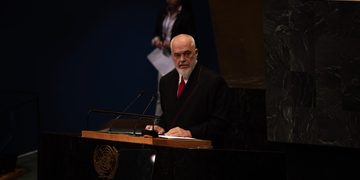













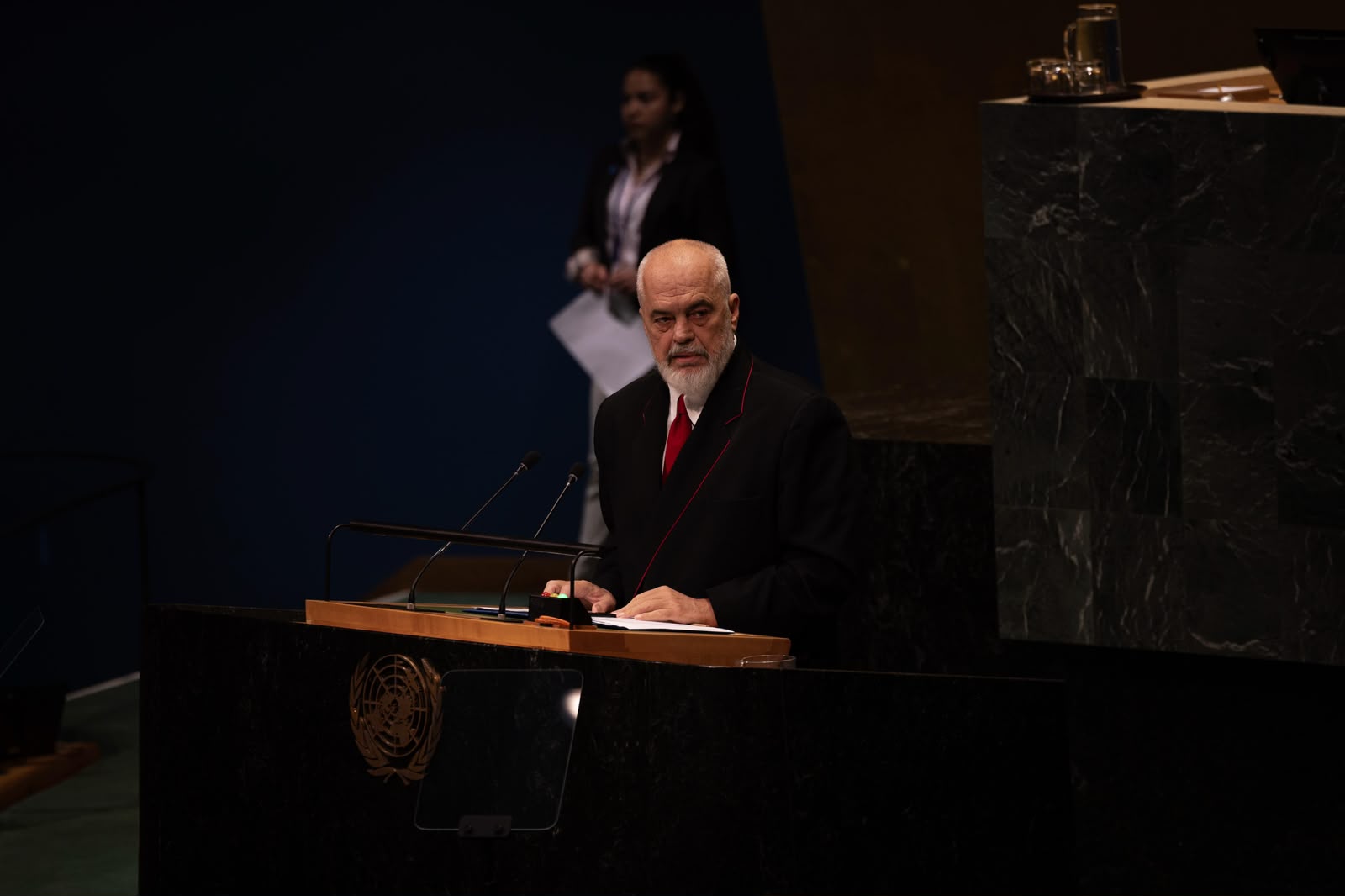
Albanian Prime Minister Edi Rama used his address to the United Nations General Assembly to focus on artificial intelligence, information manipulation and the protection of democracy, arguing that the technology is already reshaping how citizens receive information and form political judgments.
Rama said the main danger is not that artificial intelligence will stop obeying humans, but that “it will obey the wrong human beings perfectly.” He structured his speech around three questions: what AI does instead of humans, what it does to people, and who gains the power to reach and influence them.
A central part of the speech was Diella, Albania’s AI minister. Rama said Albania introduced AI into government in an effort to make public services more accessible, procedures more transparent and the state more accountable. He stressed, however, that consequential public decisions must remain subject to human and legal responsibility.
Rama also highlighted what he called the “Flamingo Revolution”, describing a fabricated narrative about an alleged Israeli invasion of the Albanian coast. According to Rama, the false story was personalized and distributed through channels trusted by citizens, targeting different fears and emotional reactions.
He argued that AI is changing the nature of political manipulation by allowing false narratives to be tailored to individual voters rather than distributed uniformly to an entire population. In his view, this creates a new challenge for democratic societies because citizens can be exposed to entirely different versions of reality.
Rama rejected calls to halt or slow the development of AI, arguing that democracies cannot afford to stop while authoritarian states, criminal networks and other actors continue developing the technology. Instead, he called for transparent, verifiable and accountable AI developed within democratic systems.
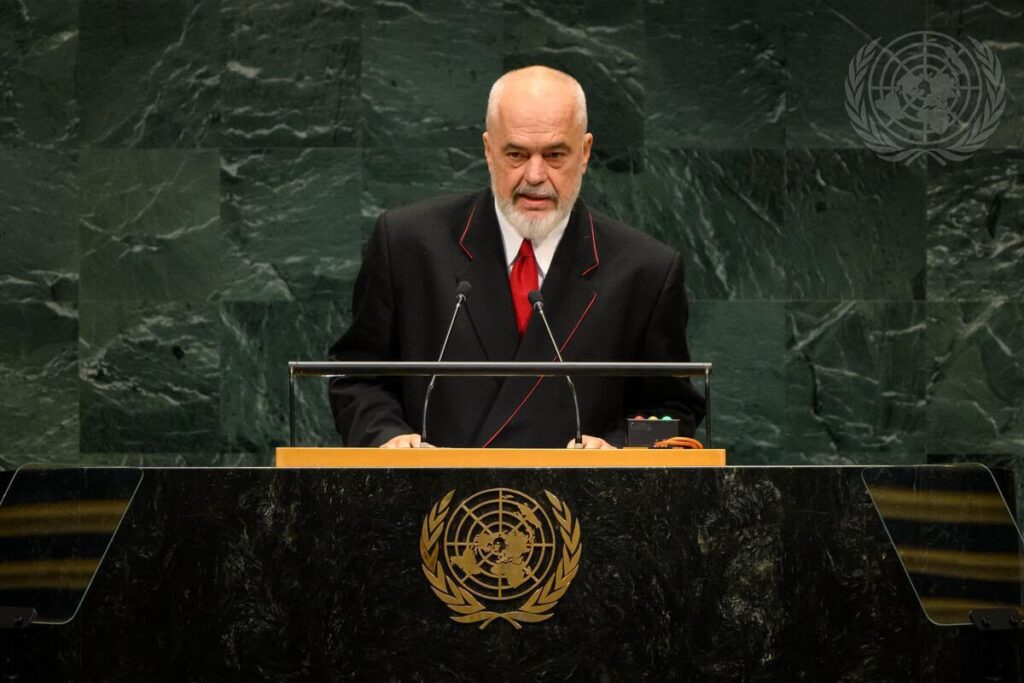
He also presented Albania’s planned “Digital Mirror”, an AI-based system intended to identify manipulation, test claims against authoritative information and detect coordinated patterns of disinformation. Rama said the system should not determine what citizens think, but provide greater transparency about what they are seeing and how information reaches them.
The Albanian prime minister called for an international compact on sovereign and democratic AI, including transparency over AI-generated political content, disclosure of who creates and finances political campaigns, accountability for public-sector AI decisions and cooperation among democracies to detect AI-driven manipulation.
“This is not ultimately a contest between humanity and machines. It is a contest between different human purposes, each amplified by machines,” Rama said.
He concluded with a broader warning about the future of democracy: “For ours, [the territory where freedom is threatened] will increasingly be the human mind.”
© 2026 Argumentum