




























Ambassador Arben Cici
For more than 150 days, citizens across Albania have been taking to the streets in protest against the current government and a political system established and consolidated over the long years of the post-communist transition.
The reasons that have brought citizens, young people, students, academics, parents and the elderly, into the streets are legitimate. The chants along the boulevard are powerful. The slogans, banners and memes are sharp, ironic and often more meaningful than many political statements.
Only Albanians or foreigners living in a different universe could claim not to understand the reasons behind this protest. Some have no ears to hear, others have no eyes to see, while some seem to have lost both in the twilight of the new deity, “Diella”.
But one thing must be understood: a civic protest is not an event measured solely by the number of participants on a particular day, the intensity of the chants or the spectacle of a confrontation on the boulevard. It is a social, political and moral process.
A civic protest is like a river. It changes with the seasons, with day and night, with the flow of its waters and the obstacles in its path. At times it surges, at times it calms down; sometimes it grows stronger, and sometimes it appears to fade. But that does not mean it dries up. Its springs remain there, deep beneath the ground, and even during the harshest drought, they find their way to bring to the surface the water that gives life to the earth and its vegetation.
A civic protest, too, may temporarily lose momentum. It may experience moments of fatigue, uncertainty, division and disappointment. It may face pressure from those in power, attempts at political appropriation, or the indifference of those who hope that time will eventually extinguish it.
Yet a temporary decline in mobilisation does not necessarily mean that the cause itself has weakened. Still less does it mean that public discontent has disappeared.
Why can a civic protest lose momentum?
1. The strategy of tension, provocation and repression
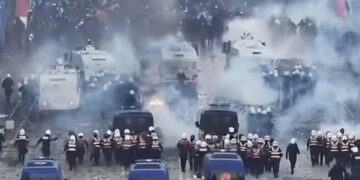
One of the greatest risks facing any civic movement is the shift of public attention away from the reasons behind the protest and towards incidents that may occur during it.
When public debate focuses exclusively on clashes, acts of violence or property damage, while the demands and underlying causes of the protest are pushed into the background, the cause itself risks losing visibility.
These phenomena are occurring in Albania:
✓ Provocations and infiltration: The presence of individuals who incite violence or irresponsible behaviour can undermine the peaceful character of a protest and create distorted perceptions of all its participants.
✓ Disproportionate use of force: Excessive police interventions, the extreme use of crowd-control measures and arbitrary detentions, both during and after protests, can generate fear and discourage civic participation.
✓ The trap of radicalisation: Faced with tension and provocation, some protesters may be tempted towards confrontation. This risks diverting attention from the original demands and alienating citizens who seek change through peaceful civic protest.
✓ Post-protest administrative measures: In an effort to maintain its monopoly on the use of force and delegitimise the protest, the government resorts to repressive measures, fines, arrests and pressure on parents and teachers.
The protest in Albania is facing all these challenges, not only in preserving its civic character and protecting its participants, but also in defending the legitimacy of its cause.
2. Attempts at political co-option and division
The 150-day civic movement has drawn its strength from beyond party-political divisions. It brings together citizens with different political convictions, united by common concerns and demands.
This is also where one of the protest’s greatest challenges lies.
✓ Political party appropriation: When an opposition political force attempts to identify the protest exclusively with its own electoral agenda, it risks alienating the large number of citizens who do not identify with that political force.
✓ Distortion of demands: When the original cause becomes overloaded with slogans, interests or political and other objectives that do not represent the majority of protesters, the message loses its clarity.
✓ Internal division: Differences over the organisation, representation and continuation of the protest may turn into conflicts that drain the movement’s energy.
This does not mean that the protest should oppose all forms of political cooperation or engagement with non-governmental organisations. It means that no one should have the right to treat the will of the citizens as political property or electoral capital.
The protest must remain greater than any political party or organisation, and more important than any individual interest.
3. Physical, financial and psychological exhaustion
A prolonged protest demands sacrifice. Sustained participation costs time, energy and money. For working people, families with limited incomes, students and young people, as well as those travelling from other parts of the country, this burden becomes even more significant.
Several difficulties emerge in this process:
✓ Physical and financial depletion: Repeated participation, travel expenses and lost working hours create real costs.
✓ The absence of immediate results: When demands go unanswered and the government continues to behave as though nothing is happening, a sense of helplessness begins to emerge.
✓ Lack of structure and representation: Civic movements without clear communication and representation mechanisms may struggle to coordinate their demands and maintain continuity.
✓ Internal divergences: Over time, differences emerge between those seeking solutions through negotiation and those advocating a firmer or more radical stance.
But fatigue is not surrender. Temporary silence is not acceptance. And the absence of an immediate victory does not make the cause of citizens taking to the streets of Albania any less just.
4. The battle for public perception and the role of the media
In modern societies, the battle for truth is fought not only in public squares but also in the media landscape.
The way a protest is reported has a direct impact on public perception and on its ability to gain broader support.
✓ Negative media framing: When attention focuses exclusively on incidents, while citizens’ demands are pushed into the shadows, a distorted and incomplete picture of reality emerges.
✓ Public opinion fatigue: Prolonged protests may cause frustration and disruption to everyday life. This is why civic movements must maintain communication with citizens and demonstrate that their cause is not directed against everyday life, but rather seeks to protect the common interest and the future we share.
✓ Loss of media attention: In an environment where news cycles move rapidly and where the government exercises control over most of the media, a protest may no longer remain at the centre of news coverage. Yet the absence of media attention does not mean that the problems which triggered the protest have been resolved.
Therefore, clear communication, the documentation of facts, transparency and the preservation of links with citizens, particularly through social media, are just as important as the physical presence of Albanian citizens in the streets.
These internal and external factors are not merely theoretical possibilities. They are challenges faced by many civic movements, and the civic protest in Albania is no exception.
Yet, beyond all of this, there is one fundamental fact that must not be overlooked:
The underlying reasons for the civic protest in Albania have NOT changed AT ALL!
Neither the protesters’ fatigue, nor the passing of time, nor the temporary decline in media attention, nor attempts to appropriate or discredit the protest can erase the reasons that brought citizens into the streets.
A civic protest should not be viewed as a sprint, where victory goes to whoever gathers the largest crowd on a single day. It is a test of democratic resilience. Its strength is measured not only by the number of people on the boulevard, but also by the determination not to allow what is unacceptable to become normal.
Therefore, the challenge facing Albanian citizens is not simply to continue protesting, but to preserve unity around their fundamental demands, civic independence and the belief that change is not a privilege granted by those in power, but a right that derives from the citizens themselves.
The Albanian government may ignore the protest. It may wait for it to lose momentum. It may hope that people will return to their homes and that everything will continue as before.
But it cannot claim that the problem has been solved simply because the boulevard happens to be empty on a particular day.
For a protest is not merely what we see in the square. It is also the discontent that remains within society, the awareness that grows, the unanswered questions and the determination not to accept injustice as the new normal.
A river may slow its flow. It may change its course. It may encounter obstacles. But as long as its springs remain alive, it will find its way to the sea once again.
The Albanian people demanding accountability are not a problem for democracy. They are democracy itself, demanding to function!
© 2026 Argumentum