







Dr. Gurakuq Kuçi
Professor at Universum College and external associate at ISLH “OCTOPUS”
An increase in Serbia’s infiltration into political and institutional life is expected in Kosovo. This activity within the framework of hybrid warfare is stated clearly by the director of Telekom Srbija, Vladimir Lucic, who, in an interview with Serbian media after returning from the US, declared that their expansion throughout Kosovo would be realised once the current government is brought down. Their openly stated aim is to become the leading telecommunications operator in Kosovo, also acquiring Albanian customers.
Exactly one year ago, to the very date, I warned that Telekom Srbija is a state structure used for control, manipulation, intimidation and deep interference in the institutional life of Kosovo and the region. Today, this is no longer merely an analytical assessment. The director of Telekom Srbija himself is publicly declaring the intention to expand throughout Kosovo, linking the implementation of this expansion to political changes in Pristina.
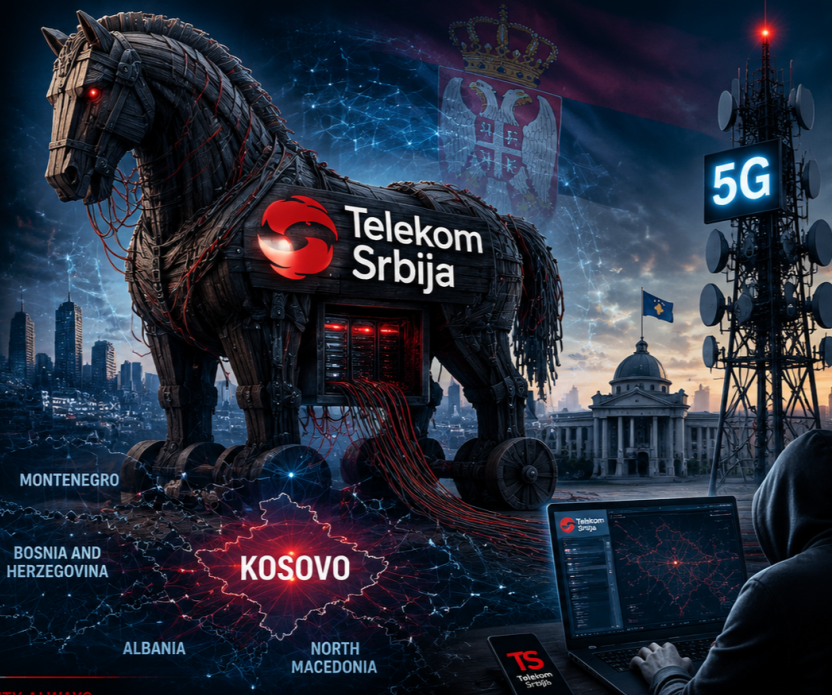
This strategy is an inseparable part of the expansion of the “Serbian World”, whereby the telecommunications sector is being used to secure control across the region where Serbia already has, or seeks to establish, a presence. In Montenegro, Telekom Srbija entered immediately after independence, in 2007, and today directly owns 51% of the shares through MTEL Podgorica, while the remaining 49% is held by MTEL Banja Luka, a company also controlled by Telekom Srbija. In Bosnia and Herzegovina, it controls around 65% of Telekom Srpske/MTEL Banja Luka, while in North Macedonia it obtained a licence in July 2021 through MTEL, beginning with television services before expanding into mobile telephony in 2022. Even the failed attempts demonstrate the same expansionist agenda: in 2018, its offer of around €60 million to purchase Telekom Albania was blocked by the Albanian government due to national security concerns, while in Kosovo its €155 million offer to purchase IPKO in 2020 failed to materialise.
Within Kosovo, through MTS d.o.o., which is 100% owned by Telekom Srbija, cable operators such as VGN Net and HERC International have been acquired, consolidating its presence in Serb-majority areas. At the broader regional level, this hegemony was reinforced through the €652 million agreement to purchase from United Group NetTV Plus, the EON Sat/Total TV satellite business in Serbia and North Macedonia, as well as several Sport Klub assets in the region. Telekom Srbija itself has declared this to be part of its strategy to become the leading company in the Western Balkans, with the aim of reaching €3 billion in revenue by 2030. In parallel, the same structure has expanded into Germany, Austria and Switzerland, initially targeting the diaspora in order to use it later as a base for broader penetration.
In Kosovo, this company has directly violated the 2015 Brussels Agreement by illegally expanding its network, employing personnel without Kosovo documents and sabotaging security institutions. MTS d.o.o. has functioned as a tool of Serbian intelligence: it deleted from its databases all evidence related to the murder of Oliver Ivanovic, concealed all data concerning the terrorist attack in Banjska, and assisted in concealing the traces of the other terrorist attack on the Iber-Lepenc canal. Its subversive nature was reconfirmed in 2025, when the bomb threat against the Assembly of Kosovo came from an MTS number. Likewise, in March 2025, BIRN Serbia journalists were targeted with Pegasus spyware through MTS numbers, while the BIA and Serbian police used Cellebrite devices to install NoviSpy on the phones of detained journalists.
The most dangerous mutation of Telekom Srbija is its presentation of itself as a “Western investor”. Lucic has built a sophisticated diplomatic shield through talks in Washington on the 5G network, artificial intelligence and financing from the Exim Bank. The aim is the realisation of the “Serbian World”, using the American shield to advance Serbia’s interests. Any restriction or regulatory measure that Pristina might impose on this strategy is immediately framed by Belgrade as obstruction of American investments and an attempt to create divisions between Kosovo and the US.
Therefore, Telekom Srbija is a digital “Trojan Horse” for the realisation of the “Serbian World” in the Western Balkans. To implement this project in Kosovo, as Lucic himself says, they need coordinated political steps in order to infiltrate Kosovo’s political and institutional life.
In the digital age, every type of investment must be viewed through a security framework, and this serves as a lesson for responding to hybrid warfare.
© 2026 Argumentum