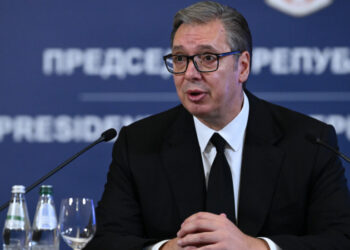




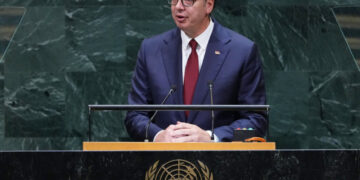









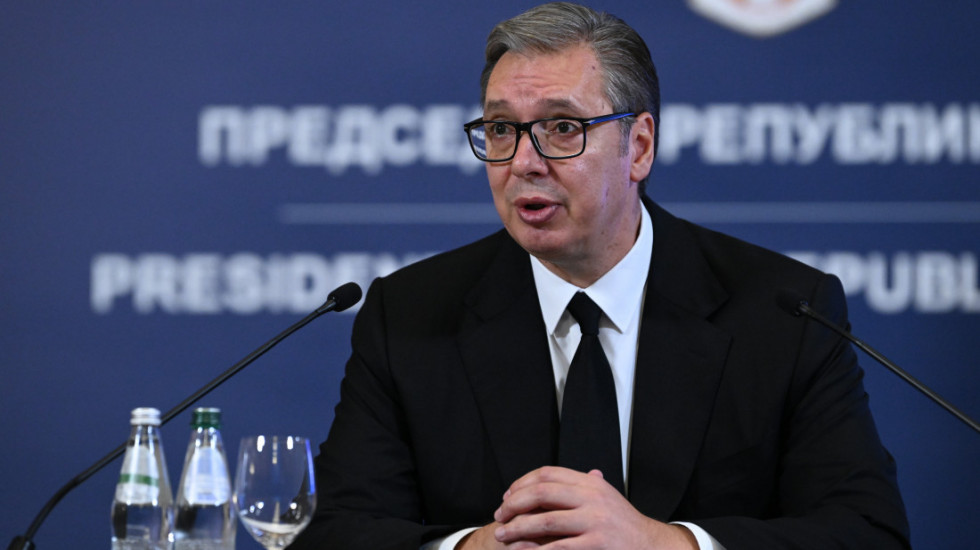
Serbia is entering an important political transition as it prepares for early parliamentary elections on 25 October 2026, following Aleksandar Vučić’s resignation as president on 27 September at the end of his second and final presidential term.
According to an analysis by the International Institute for Middle East and Balkan Studies (IFIMES), based in Ljubljana, the elections carry significance beyond the competition between political lists. They will also test how Serbia’s political system adapts to the end of Vučić’s presidency and whether his political influence will continue through a different institutional position.
Vučić has announced that he will stand for Prime Minister in the forthcoming parliamentary elections. His appointment, however, would depend on the election results and the formation of a new parliamentary majority. IFIMES argues that a possible move from the presidency to the premiership could change the formal institutional configuration without necessarily altering the country’s established political centre of gravity.
Elections at a political crossroads
The early elections come after more than a decade in which Vučić has remained the central figure in Serbian politics, first as prime minister and later as president.
IFIMES notes that Vučić has presented his record in terms of infrastructure development, economic growth, political stability, Serbia’s international standing and his ability to maintain relations with competing global powers. At the same time, the institute points to concerns raised by the European Commission regarding the rule of law, electoral reform, media pluralism, institutional independence and corruption.
The elections therefore take place against a broader debate about the future functioning of Serbia’s institutions.
One of the most important developments of Vučić’s final presidential term has been the prolonged student and civic protest movement that followed the November 2024 railway station tragedy in Novi Sad. According to IFIMES, the protests brought questions of institutional accountability, corruption, public-project management, media freedom and the functioning of state authorities to the centre of political debate.
The institute also stresses that interpretations of the protests remain politically contested. Vučić has attributed part of the unrest to outside influence and described it as a potential “colour revolution”, while opponents and sections of civil society have presented the mobilisation primarily as a demand for institutional accountability and political change.
A test for Serbia’s institutions
For IFIMES, the significance of the October election extends beyond the question of who will form the next government.
The institute identifies several interconnected questions facing Serbia: whether the change at the top of the state will produce a clearer separation between state institutions and party politics; whether the electoral process will enjoy sufficient confidence across the political and social spectrum; whether Serbia can continue its European path while maintaining relations with Russia and China; and whether the months of social mobilisation can create space for institutional dialogue between authorities, students, opposition forces and civil society.
These questions are particularly relevant as Serbia continues its EU accession process. IFIMES notes that the European Union has continued to focus on judicial reform, anti-corruption measures, media freedom and pluralism, and institutional checks and balances. The institute also points to the lack of significant progress in negotiations on Chapter 23 over more than four years.
Between Brussels, Moscow, Beijing and Washington
The elections will also take place within a complex foreign-policy environment.
During Vučić’s presidency, Serbia sought to maintain relations with several competing centres of global power. Belgrade has continued to pursue EU membership while refraining from imposing sanctions on Russia and maintaining political and economic relations with China.
IFIMES describes this approach as a form of “strategic redundancy”, whereby Serbia maintains several political, economic and diplomatic channels simultaneously. According to the analysis, this has provided Belgrade with considerable diplomatic room for manoeuvre, while also increasing expectations and pressure from its international partners.
The European Union, meanwhile, has continued to emphasise good-neighbourly relations, regional cooperation, alignment with the EU’s Common Foreign and Security Policy and reforms necessary for the accession process. Rule of law, media freedom and electoral reform remain among the issues highlighted by Brussels.
Kosovo remains central
Another major issue facing the next government will be relations with Kosovo.
IFIMES describes Kosovo as one of the most important pressure points in Serbia’s foreign and security policy. During his final presidential term, Vučić continued to balance international pressure, dialogue with Pristina and domestic political expectations.
The future political configuration in Belgrade will therefore have implications for the continuation of the Belgrade–Pristina dialogue and the implementation of commitments linked to Serbia’s European integration process. The European Union has reiterated the importance of the dialogue and the implementation of the Ohrid Agreement for regional security and Serbia’s European path.
What comes after the election?
The central issue identified by IFIMES is whether Serbia’s political transition will represent a substantive institutional change or primarily a change in the formal position occupied by its most influential political figure.
Vučić can no longer seek another presidential term under Serbia’s constitutional limit of two terms. But his announced candidacy for prime minister means that the end of his presidency does not necessarily signify the end of his political involvement.
The October election will therefore help determine the new parliamentary majority and the composition of the next government, while also providing an indication of how Serbia’s political institutions respond to the transition.
IFIMES concludes that the long-term question is whether Serbia can develop stronger and more autonomous institutions whose authority carries greater weight than that of any individual political centre. The institute stresses that the formation of a new Serbian government after the elections should take place peacefully and democratically, with full respect for the election results and constitutional institutions, regardless of who occupies the country’s highest offices.
For Serbia, the 25 October parliamentary elections thus represent not only a change in the electoral calendar, but a test of the country’s institutional capacity at the beginning of a new political phase.
© 2026 Argumentum