



































Asst. Prof. Dr. Gurakuç Kuçi – Professor at UNI College and External Associate at ISLH OCTOPUS
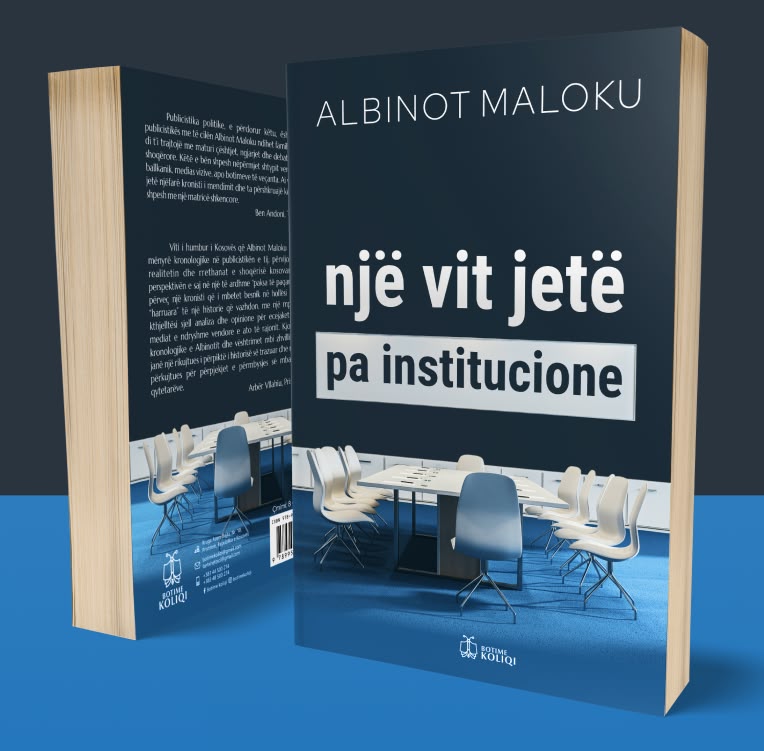
Review of the book Një vit jetë pa institucione, by Albinot Maloku
Books that document and analyse political processes constitute an important instrument for preserving institutional and democratic memory. Beyond documenting events, they provide opportunities to understand the behaviour of political actors, the relationship between promises and results, as well as the development of democratic culture. In this sense, the book “One year life without institutions” (Një vit jetë pa institucione), by political scientist Albinot Maloku, represents a contribution to the documentation and interpretation of political developments in Kosovo. Through his analytical approach, the author creates what may be considered a kind of qualitative index of democracy, not in the sense of statistical measurement, but of identifying the processes, contradictions and practices that characterise its functioning.
The value of the work lies in two interrelated dimensions. From a scholarly perspective, Maloku’s analyses provide material for the political science study of institutional processes, the behaviour of political entities and the relationships between power and democracy. From an informational perspective, the book serves as a form of political memory for researchers, journalists, students, politicians and the wider public. This approach makes the work significant beyond the period it addresses, demonstrating the need to develop in Kosovo a tradition of documenting and critically assessing political processes, at least after every four-year governing cycle.
Power, Responsibility and the Contradictions of Democracy
One of the central issues Maloku addresses is the distinction between acquiring power and the ability to exercise it. The author highlights the contradiction between the ambition of political entities to come to power and their capacity to translate that power into institutional functioning and concrete results. In this context, he also problematises the excessive concentration of power, considering it in relation to the need for consensus, responsibility and respect for the principles of constitutional democracy.
Particularly significant is the author’s position that democracy cannot be understood solely through the number of votes in the Assembly. According to Maloku, the implementation of promises and the functioning of institutions require a deeper understanding of democracy, in which political consensus constitutes an essential element for institutional stability and the avoidance of unnecessary polarisation. In this way, the author demonstrates an understanding of the distinction between electoral legitimacy and the responsibility of governance.
Another value of the book lies in its treatment of the transformation in the behaviour of political entities as they move from opposition into power and vice versa. Maloku highlights the relativisation of positions, changes in narratives and the formation of political constructs that do not always correspond to proclaimed principles. This approach makes the book useful for understanding how institutional position influences the positions and actions of a political entity. The author also touches upon the psychological dimension of victory and defeat, in which electoral triumph can produce excessive self-confidence, while defeat can produce rejection and political antagonism.
In discussing governance, Maloku also attaches importance to the relationship between political loyalty and institutional professionalism. The problematisation of dismissals, appointments and professional disappointment arising from employment processes highlights the lack of consistent standards of meritocracy. Within this framework, the author also addresses the phenomenon of migration, linking this social problem to citizens’ prospects and trust in the country’s institutions. These discussions extend the analysis beyond party competition, towards the consequences that political practices produce in social life.
Political Narrative and the Distortion of Public Debate
Another important dimension of the work is the examination of the relationship between political narrative and reality. Maloku identifies the contradiction between electoral promises and their fulfilment, showing that political communication can become a substitute for the results of governance.
The author also addresses the distinction between ideology and political affect. Through this perspective, he enables an understanding of behaviour in which support for a political entity or leader rests more on emotional identification than on the rational assessment of policies. Also situated within this context are labelling, divisions, the relativisation of positions and the use of law as an instrument of patriotic narrative.
Maloku’s discussions of political communication and the influence of social media deserve particular attention. The author highlights the gap between narratives produced in the digital sphere and political reality, touching upon the problem of information bubbles and propaganda. He also notes the contradiction between avoiding critical media and making frequent appearances on communication channels that allow greater control over the message. Within this framework, the electoral instrumentalization of the diaspora is also discussed as a mobilising element that is not necessarily directly linked to the fulfilment of governing promises.
Diplomacy Between Agreements and Results
Kosovo–Serbia relations and the role of the European Union occupy a substantial place in Maloku’s discussions. The author adopts a critical stance towards diplomatic ambiguity, the lack of transparency in the dialogue and agreements that do not contain clear mechanisms for implementation and responsibility.
In discussing the Franco-German Plan and the normalisation processes, Maloku calls into question the effectiveness of agreements that continue the political process without guaranteeing the resolution of the problem. He opposes ambiguity in diplomatic formulations and supports the need for a definitive solution, rather than temporary stabilisation and political symbolism.
The author’s criticism of the European Union also concerns its inability to take major decisions in the processes of integration and normalisation. Maloku argues that Western policy towards Serbia, through efforts to keep it oriented towards the West, creates room for manoeuvre for Belgrade. In this context, he points out that Serbia’s implementation of agreements remains linked to international pressure.
The author’s critical position also extends to the obstacles to Kosovo’s membership of the Council of Europe, while the lack of transparency and accountability in the dialogue is treated as a problem that also requires responsibility from domestic institutions. For Maloku, diplomacy must be assessed on the basis of concrete results and implementation mechanisms, not merely statements and the continuity of meetings.
Final Assessment
“Një vit jetë pa institucione” represents a valuable contribution to analytical public affairs writing and Kosovo’s political memory. The strength of the work lies in Maloku’s attempt to interpret political developments through the relationship between power, institutions, narratives and democratic responsibility.
From an academic perspective, the book should be regarded as an interpretative and documentary source and a qualitative index.
On the other hand, the significance of Maloku’s analyses is not confined to the immediate topical relevance of the events. They make it possible to compare the positions of political entities across different periods and to assess the relationship between promises, decisions and results. It is precisely here that the book acquires value as reference material for researchers, students, journalists and political actors themselves.
In conclusion, Maloku’s work demonstrates the importance of critically documenting democratic processes, reminding us that the quality of democracy is determined not only by the winner of elections, but by how power is exercised, institutions function and public responsibilities are fulfilled. In this sense, the book serves not only as a form of political memory of a particular period, but also as a reference for assessing political behaviour and institutional responsibility in the future.
© 2026 Argumentum