





• SHQIPËRI
  • KOSOVË
  • MAQEDONIA E VERIUT
  • MALI I ZI
  • Revista në PDF
8 June, 2026
  • Home
  • OP/ED

    Pierre Nora and the institution of memory we lack in Eastern Europe

    The Blueprint of a Diplomatic Debacle: Analyzing Germany’s Historic UNSC Loss

    Cyber Attribution, Corruption, and the False-Flag Question in Albania’s 2022 Alleged Iranian Cyberattack

    Between Russia, Iran and Europe: Azerbaijan as a balancing power in the South Caucasus

    The Zero-Tariff Gate: Sovereignty as a Service in the Sino-African Corridor

    Albania vs. the Sea/ Marginal Notes on A. Leka’s Novel The Hidden Side of the Albanian Socialist Garden

    May 9 and the long shadow of a Letter: Is Europe still Schuman’s Project?

    The Arbnesh of Zadar: A living memory of Albanian identity on the Adriatic coast

    Science Diplomacy and Academic Freedom: A strategic nexus for contemporary diplomacy

  • Interview

    Exclusive Interview with Oleksandr Tyshchenko: A 40-Year Legacy of Chernobyl, Nuclear Risks, and Global Responsibility

    INTERVIEW: ZLATKO KRAMARIĆ – THOUGHTS ON THE OLD CONTINENT

    EXCLUSIVE / Ukrainian Ambassador to Albania, Volodymyr Shkurov: “Ukraine wants peace, but not at the expense of its freedom and independence”

    EXCLUSIVE| Ambassador Tayyar Kagan Atay: Türkiye and Albania, a Strategic Partnership Rooted in Shared Heritage and a Common Vision for the Future

    “Diplomacy, Not War”: Palestinian Ambassador to Albania Calls for Justice, Peace, and Global Action for Gaza

    Exclusive: “Even After Tito – Tito”/ Ambassador Zlatko Kramarić on Authoritarian Legacies and Democracy’s Future in the Balkans

    The Conclusion of the Diplomatic Mission / Ambassador Dancho Markovski: Strengthening Albania-North Macedonia Relations for a Shared European Future

    A Century of Diplomatic Relations Between Albania and Russia: Exclusive Interview with the Russian Ambassador to Albania, H.E. Alexey Zaytsev

    Exclusive/ The chairman of the Freedom Party, Ilir Meta: “The will of the citizens will triumph in Albania, as it did in North Macedonia”

  • Realpolitik

    IBAR? ”Sufficiently! Much ado about nothing! Shart contrasts in Beijing! Where is the exit?!

    Neither peace nor war! Peace with bombs?! IBAR in autumn?! Not another Hormuz in Taivan! 

    IBAR – a springing board or an obstacle? Can we catch the EU Negotiation train 2027? When the dress makes the news!  EU electoral April  ends in a draw 1:1!  

    The European Parliament building in Strasbourg, France with flags waving calmly celebrating peace of the Europe. July 12, 2020.

    EU 2027 or 2037! Even half membership failed! No exit strategy!     

    What next?

    “With diplomatic velvet“! Major question marks! In Washington yes, but  in the White House NO! A strange dinner in Brussels!

    From a great ‘apple of disaccord’ to a  point of  cooperation! A bad start! The strange absence in Davos!

    5 lessons from the American 3 January! Don’t count the chicken before they are hatched! Will NATO freeze in Greenland? Wrong diplomatic messages!

    German Chancellor Friedrich Merz, European Commission President Ursula von der Leyen, Ukraine's President Volodymyr Zelenskiy, U.S. Special Envoy Steve Witkoff and Jared Kushner, son-in-law of U.S. President Donald Trump line up for a family photo opportunity at the Chancellery in Berlin, Germany, December 15, 2025.    REUTERS/Lisi Niesner/Pool

    A Strategy that could change the world! Europe in Berlin! Why an historic compromise? Only charm diplomacy in Athens!

  • Current Events

    Rama alleges ‘hybrid war’ behind protests against Kushner-linked coastal development

    BELGRADE, SERBIA - JUNE 18. 2020: Russian and Serbian flags on display during Russian Foreign Minister Sergei Lavrov's visit to the Liberators of Belgrade Memorial. Valery Sharifulin/TASS,Image: 533095429, License: Rights-managed, Restrictions: UWAGA! Zdjęcia zawierają oryginalny opis dostawcy (ITAR-TASS). Szczególnie w związku z agresją Rosji na Ukrainę mogą zawierać przekaz niezgodny z faktami. Zweryfikuj go przed publikacją, Model Release: no, Credit line: Valery Sharifulin / TASS / Forum

    Balkan Maskirovka: Why Moscow’s “Distancing” Is Only an Operation for the Survival of Vučić’s Regime

    Serbia – China 2026: Technological partnership, geopolitical positioning and a new phase of the Chinese presence in the Western Balkans

    The Digital Protectorate: How the EU AI Act Codified Silicon Valley’s Monopoly

    The 28th MFC Annual Conference in Durrës / Sulaj: Microfinance remains a key instrument for financial inclusion

    Serbia at the Crossroads of EU Integration and Geopolitical Balancing: IFIMES Analysis

    Tirana – €20 Million EU–Banking Agreement Boosts Albanian SMEs

    The Myth of Independence: How Chinese Efficiency is Rewriting the Constitution of Modern Geopolitics!

    Europe Yesterday and Today: Why 9 May Still Matters

  • Top News

    Rama alleges ‘hybrid war’ behind protests against Kushner-linked coastal development

    No End in Sight: Trump, Netanyahu and the Expanding Middle East War

    Tirana – €20 Million EU–Banking Agreement Boosts Albanian SMEs

    “EU4Municipalities II” Project, a Strategic Investment for Strengthening Municipalities and Accelerating Albania’s Path towards the EU

    Albania, Italy deepen defence ties with naval shipbuilding deal

    U.S. Embassy: Iran-Linked Groups May Target Americans and Iranian Opposition in Albania

    The Council of Albanian Ambassadors disappointed with the voting of the draft law on the foreign service in the parliamentary committees.

    Prime Minister Edi Rama Addresses Israel’s Knesset in Historic Special Session

    Kazakhstan’s Strategic Reform Agenda: Stability, Modern Governance, and Responsible Diplomacy

  • YOUR VOICE
  • Shqip
No Result
View All Result
Argumentum
  • Home
  • OP/ED

    Pierre Nora and the institution of memory we lack in Eastern Europe

    The Blueprint of a Diplomatic Debacle: Analyzing Germany’s Historic UNSC Loss

    Cyber Attribution, Corruption, and the False-Flag Question in Albania’s 2022 Alleged Iranian Cyberattack

    Between Russia, Iran and Europe: Azerbaijan as a balancing power in the South Caucasus

    The Zero-Tariff Gate: Sovereignty as a Service in the Sino-African Corridor

    Albania vs. the Sea/ Marginal Notes on A. Leka’s Novel The Hidden Side of the Albanian Socialist Garden

    May 9 and the long shadow of a Letter: Is Europe still Schuman’s Project?

    The Arbnesh of Zadar: A living memory of Albanian identity on the Adriatic coast

    Science Diplomacy and Academic Freedom: A strategic nexus for contemporary diplomacy

  • Interview

    Exclusive Interview with Oleksandr Tyshchenko: A 40-Year Legacy of Chernobyl, Nuclear Risks, and Global Responsibility

    INTERVIEW: ZLATKO KRAMARIĆ – THOUGHTS ON THE OLD CONTINENT

    EXCLUSIVE / Ukrainian Ambassador to Albania, Volodymyr Shkurov: “Ukraine wants peace, but not at the expense of its freedom and independence”

    EXCLUSIVE| Ambassador Tayyar Kagan Atay: Türkiye and Albania, a Strategic Partnership Rooted in Shared Heritage and a Common Vision for the Future

    “Diplomacy, Not War”: Palestinian Ambassador to Albania Calls for Justice, Peace, and Global Action for Gaza

    Exclusive: “Even After Tito – Tito”/ Ambassador Zlatko Kramarić on Authoritarian Legacies and Democracy’s Future in the Balkans

    The Conclusion of the Diplomatic Mission / Ambassador Dancho Markovski: Strengthening Albania-North Macedonia Relations for a Shared European Future

    A Century of Diplomatic Relations Between Albania and Russia: Exclusive Interview with the Russian Ambassador to Albania, H.E. Alexey Zaytsev

    Exclusive/ The chairman of the Freedom Party, Ilir Meta: “The will of the citizens will triumph in Albania, as it did in North Macedonia”

  • Realpolitik

    IBAR? ”Sufficiently! Much ado about nothing! Shart contrasts in Beijing! Where is the exit?!

    Neither peace nor war! Peace with bombs?! IBAR in autumn?! Not another Hormuz in Taivan! 

    IBAR – a springing board or an obstacle? Can we catch the EU Negotiation train 2027? When the dress makes the news!  EU electoral April  ends in a draw 1:1!  

    The European Parliament building in Strasbourg, France with flags waving calmly celebrating peace of the Europe. July 12, 2020.

    EU 2027 or 2037! Even half membership failed! No exit strategy!     

    What next?

    “With diplomatic velvet“! Major question marks! In Washington yes, but  in the White House NO! A strange dinner in Brussels!

    From a great ‘apple of disaccord’ to a  point of  cooperation! A bad start! The strange absence in Davos!

    5 lessons from the American 3 January! Don’t count the chicken before they are hatched! Will NATO freeze in Greenland? Wrong diplomatic messages!

    German Chancellor Friedrich Merz, European Commission President Ursula von der Leyen, Ukraine's President Volodymyr Zelenskiy, U.S. Special Envoy Steve Witkoff and Jared Kushner, son-in-law of U.S. President Donald Trump line up for a family photo opportunity at the Chancellery in Berlin, Germany, December 15, 2025.    REUTERS/Lisi Niesner/Pool

    A Strategy that could change the world! Europe in Berlin! Why an historic compromise? Only charm diplomacy in Athens!

  • Current Events

    Rama alleges ‘hybrid war’ behind protests against Kushner-linked coastal development

    BELGRADE, SERBIA - JUNE 18. 2020: Russian and Serbian flags on display during Russian Foreign Minister Sergei Lavrov's visit to the Liberators of Belgrade Memorial. Valery Sharifulin/TASS,Image: 533095429, License: Rights-managed, Restrictions: UWAGA! Zdjęcia zawierają oryginalny opis dostawcy (ITAR-TASS). Szczególnie w związku z agresją Rosji na Ukrainę mogą zawierać przekaz niezgodny z faktami. Zweryfikuj go przed publikacją, Model Release: no, Credit line: Valery Sharifulin / TASS / Forum

    Balkan Maskirovka: Why Moscow’s “Distancing” Is Only an Operation for the Survival of Vučić’s Regime

    Serbia – China 2026: Technological partnership, geopolitical positioning and a new phase of the Chinese presence in the Western Balkans

    The Digital Protectorate: How the EU AI Act Codified Silicon Valley’s Monopoly

    The 28th MFC Annual Conference in Durrës / Sulaj: Microfinance remains a key instrument for financial inclusion

    Serbia at the Crossroads of EU Integration and Geopolitical Balancing: IFIMES Analysis

    Tirana – €20 Million EU–Banking Agreement Boosts Albanian SMEs

    The Myth of Independence: How Chinese Efficiency is Rewriting the Constitution of Modern Geopolitics!

    Europe Yesterday and Today: Why 9 May Still Matters

  • Top News

    Rama alleges ‘hybrid war’ behind protests against Kushner-linked coastal development

    No End in Sight: Trump, Netanyahu and the Expanding Middle East War

    Tirana – €20 Million EU–Banking Agreement Boosts Albanian SMEs

    “EU4Municipalities II” Project, a Strategic Investment for Strengthening Municipalities and Accelerating Albania’s Path towards the EU

    Albania, Italy deepen defence ties with naval shipbuilding deal

    U.S. Embassy: Iran-Linked Groups May Target Americans and Iranian Opposition in Albania

    The Council of Albanian Ambassadors disappointed with the voting of the draft law on the foreign service in the parliamentary committees.

    Prime Minister Edi Rama Addresses Israel’s Knesset in Historic Special Session

    Kazakhstan’s Strategic Reform Agenda: Stability, Modern Governance, and Responsible Diplomacy

  • YOUR VOICE
  • Shqip
No Result
View All Result
Argumentum
No Result
View All Result
Home ENGLISH

No ‘anti-Albanian Vector’ in Russian Diplomacy

24 February, 2020
in ENGLISH, In Focus
A A
Share on FacebookShare on Twitter

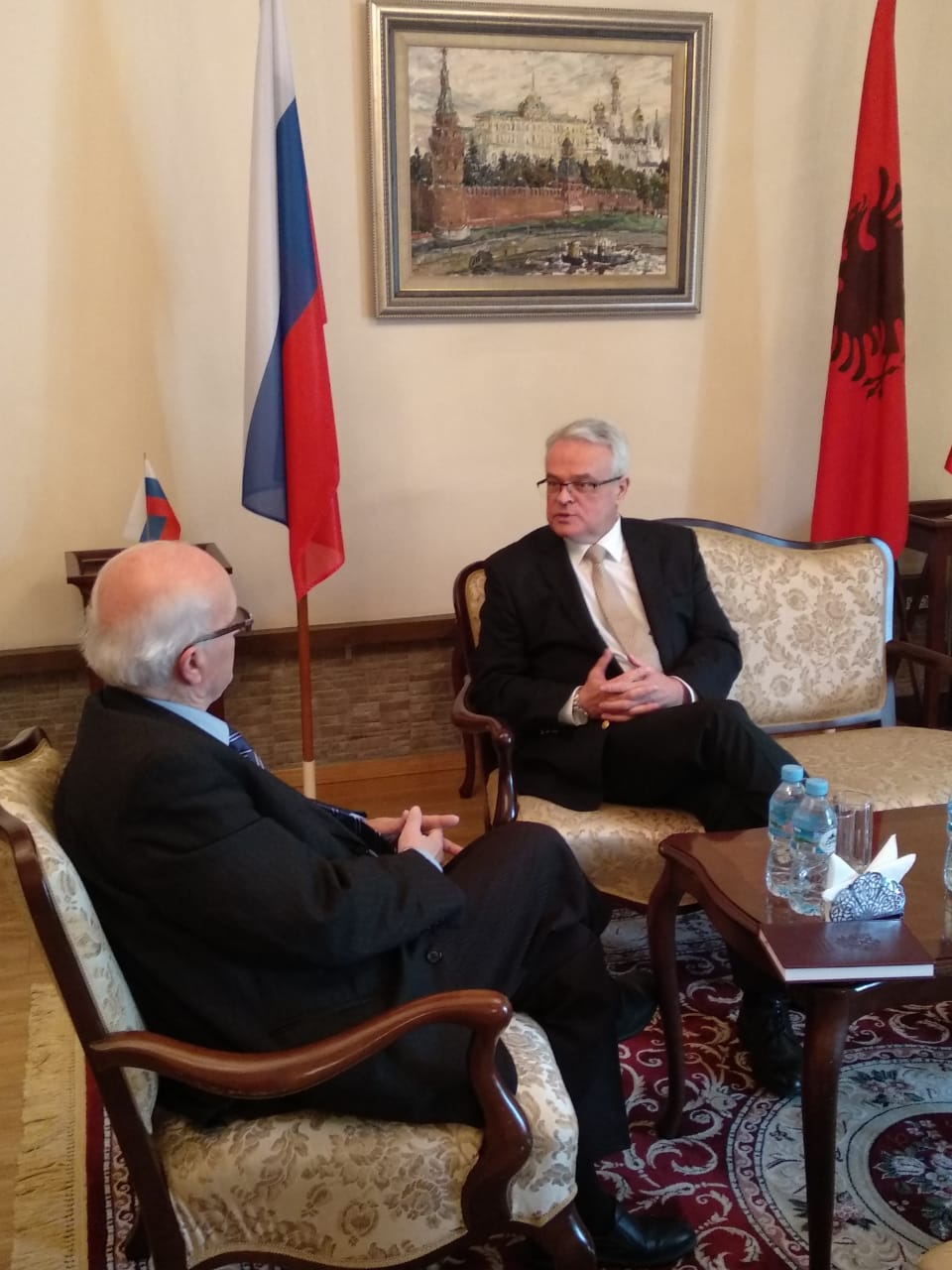
Asked on what Russian archives reveal on the history of Russian-Albanian relations, the Ambassador said they preserve reports of Russian diplomats in Podgorica, Bitola and Skopje on the liberation struggle of the Albanian people before 1912.

By Genc Mlloja

Senior Diplomatic Editor

The new Russian Ambassador to Albania, Mr. Mikhail Afanasiev, who replaced predecessor Aleksander Karpushin, recently had a conversation with Albanian Daily News, unveiling some of the priorities of his tenure in Albania. We also spoke about the Diplomat’s Day, which is marked in Russia on every February 10th. Afanasiev said that this event has been marked from the date of the establishment of the Ministry of Foreign Affairs in 1802. But, according to him, the history of the Russian diplomatic service is much longer being created by Czar Ivan the Terrible back in 1549.


“The core of the diplomatic personnel of the Foreign Ministry has always included representatives of the intellectual and creative elite. Russian diplomacy cherishes the service of classics of the Russian literature such as poets Alexander Pushkin, Fedor Tyutchev and Alexei Tolstoy or playwright Alexander Griboedov. Nowadays we have a lot of poets, writers, artists and connoisseurs of history and world culture among Russian diplomats,” he said.


Asked on what Russian archives reveal on the history of Russian-Albanian relations, the Ambassador said they preserve reports of Russian diplomats in Podgorica, Bitola and Skopje on the liberation struggle of the Albanian people before 1912.


“On that basis, Saint Petersburg made a fateful decision to recognize the independence of Albania at the London Conference of 1913,” he said, adding that Russian diplomats maintained close contacts with senior officials of a young state before and during the World War I. “In particular, the Foreign Minister of the Russian Empire, Sergey Sazonov was a friend of the Prime Minister of Albania, Turkhan-Pasha Permeti, who served as Ottoman Ambassador to St. Petersburg before returning to Albania. After the creation of the USSR, Soviet diplomats had been for a long time seeking to establish relations with Albania, which, however, became possible only in 1934. Then the Italian occupation of Albania followed (the delegation of the USSR to the League of Nations was one of the few which strongly condemned this act).The Soviet government praised the contribution of Albanian partisans to the fight against fascism and nazism. The USSR was the only among the three major Allies who established relations with the post-war Tirana. The corresponding note was handed over by the Soviet representative on November 10, 1945. After that the brightest period of our friendship began, and lasted until 1961.”


According to Mr. Afanasiev, Russian diplomats have worked hard to restore the old ties after the signing of the Protocol on the normalization of relations between the USSR and the People’s Socialist Republic of Albania in 1990.

Ambassador’s main priorities

Unveiling some of the main priorities during his ambassadorial tenure as Moscow’s top envoy to Tirana, Mr. Afanasiev eyed consolidation of the achieved results and further development of bilateral relations in all key areas: political, economic and humanitarian.
Ambassador Mikhail Afanasiev started his mission in Albania in November 2019 when he presented credentials replacing his predecessor Mr. Aleksander Karpushin.

 
“I hope that a desire to build relations on a pragmatic and mutually beneficial basis will prevail on the Albanian side as well,” he said, noting, however, that the political dialogue is currently undergoing a difficult period. The Ambassador was reluctant on the adoption of the resolution “Foreign Interventions in the Electoral Process and Disinformation in the National Democratic Processes” by the Albanian parliament.
The resolution in question, which was adopted on December 5, 2019, mentions how there are influences from foreign public and non-public actors in Albania. These, according to it, are influencing decision-making in Albania and exerting pressure on democratic values. Russia was mentioned as a “source of disinformation in the region, Europe and beyond”. The resolution met criticism by some lawmakers, including former Foreign Minister Ditmir Bushati, who said that there are no parliaments in Europe which deal concretely with names of states.  


Ambassador Afanasiev gave assurances that the allegations about a certain “anti-Albanian vector” of the Russian foreign policy spread in the media and speeches of some politicians are groundless. “Russia’s desire to develop friendly relations with all the states in the region can hardly be classified as “hostile actions”, and disagreements as to the status of Kosovo should be leveled through dialogue and consultations, rather than confrontation, and of course not through establishment of artificial barriers on the way to mutually beneficial cooperation,” he said.


However, the Ambassador liked to believe in positive dynamics. “This year, Russia and Albania have a chance to improve the situation. Albania assumed the role of the OSCE Chair. This means greater intensity of contacts between the parties, an exchange of views on various issues of not only a pan-European, but also bilateral nature. I hope this will help our countries to better understand each other,” he said, congratulating Albania on this crucial mission.


Wishing Tirana good luck in this difficult task he believed that the Prime Minister and Foreign Minister Mr. Edi Rama will have an opportunity to discuss in detail with the Russian side in Moscow as the OSCE Chairperson-in-Office at the end of February.
It is reported by OSCE official sources that Mr. Rama will travel to Moscow on February 26 this year something which was confirmed by the Ambassador, too, during the talk.  

Cultural diplomacy

Asked about the role of cultural diplomacy as a means to bring people closer to each other, the Ambassador said that it is precisely the area in which cooperation between Russia and Albania is sustainable. He revealed that Russian musical groups regularly visit Albania and the participation of Russian performers in the festivals in Albania has already become a good tradition.
The worldwide known ‘Swan Lake’ was performed by artists of St. Petersburg State Ballet on ice in Tirana on November 16, 2019 for the first time.


In the meantime he said: “It’s particularly nice that Albanian artists are visiting Russia – last year the Albanian singer Inis Neziri won the popular “New Wave” song festival. I remember the success of an outstanding Albanian tenor, Saimir Pirgu on the stage of the Bolshoi Theatre in Moscow, who performed the main part in “La damnation de Faust” by Hector Berlioz.”


Further on the Ambassador recalled his visit to a filming set of a joint Russian-Albanian film with the working title “Gjirokaster” which tells the tragic fate of the Soviet women and their Albanian husbands, who were repressed here after the breakdown of Soviet-Albanian relations. “I hope this film will continue the tradition of cooperation between our filmmakers, started by the famous picture “Skanderbeg- the Great Warrior of Albania”, he said. Meanwhile he spread the news that Albanian students could still benefit from the Russian government program on scholarships providing for free studies at Russian universities and institutes.
Last year, Russian Embassy granted 50 scholarships – an absolute record for the entire time of its existence, and on the other hand it is still running free language courses which, according to the Ambassador, are very popular in Albania. “However, we are concerned about the fate of the Russian language department at the University of Tirana, which is actually on the verge of closure. While observing a widespread revival of interest in learning Russian in Europe, winding it down at the university, in our opinion, does not meet the needs of Albania in training qualified interpreters for work in state, commercial and international structures.”

‘Bilateral economic cooperation doesn’t cause joy’

Answering a question on the aspect of the economic cooperation Mr. Afanasiev said the state of the economic cooperation between Russia and Albania does not cause joy. “Mutual trade after the fall in 2015 has been steadily growing, exceeding now 100 million euros. However, it goes mainly through intermediaries,” he said, but, according to information provided by him, nowadays there is not a single Russian company operating in Albania. “Though, as far as I know, over the past ten years a number of large Russian stakeholders have been interested in entering the local market; there was even an isolated case when one Russian company was present in the mining sector for a short time. However, the investment climate for them is far from being favorable, not to mention the direct squeezing out under the pretext of a “threat from Russian investments” for the Albanian national security.”


Nevertheless, the Ambassador was hopeful for the situation to change and as he said the Embassy will make every effort to develop economic cooperation, enhance the activities of the bilateral Intergovernmental Commission and protect the interests of Russian business in this country. However, he added that now the ball is on the Albanian side.

‘Russia isn’t “interfering” in WB’

Referring to the Western Balkans Ambassador Afanasiev said Russia is not “interfering” anywhere. “We are talking about our interest, that is totally legal. I stress: historically we have had close ties with all countries of the region since their independence,” he said.


“Russia reacted and influenced the resolution of crises; at certain times, it was the key economic and political partner of most of the Balkan countries. You may be surprised, but even today the Russian and EU Foreign Affairs bodies hold regular expert consultations on the integration of the Western Balkans and EU enlargement (COWEB and COELA), that is a clear indicator of our active role in the region,” said the Ambassador. According to him, many problems of the Western Balkans are common in the wider macro-region of Southeast and Eastern Europe. “There are economic, social and demographic challenges, which, in the absence of due attention, risk to become “time bombs.” That is why Russia, like the rest of Europe, is interested in a stable and sustainable development of the region, preventing bursts of chauvinism and possible hotbeds of regional conflicts, peacefully resolving the existing differences.”

First time in Albania…

It was Mr. Afanasiev’s first ‘landing’ in Albania last November and, as he commented, he had already had the most positive impression of the country. “Over the past few months, my spouse and I visited different parts of Albania, and it helped us to appreciate a huge natural, historical and, therefore, tourist potential of these places. We`ve been to the wonderful cities of Gjirokastra and Kruja, we saw Durres before and after the tragic events,” he said.


Speaking on future plans he revealed that they will visit the great centers of Albanian culture – Berat, Korca and Shkodra. “I have heard about the beauties of the Albanian Riviera. I would like to study in more detail the life and culture of Albanians, who retained their unique features despite the upheavals of a complex history. I admire the sympathy and hospitality of local residents, the unique atmosphere of small towns, cafes and restaurants, which is so difficult to meet today due to the modern trends of globalization and unification. It is nice that Albanians treat our country with warmth despite sometimes unfriendly political rhetoric.”
Mr. Afanasiev expressed the hope that in his capacity of Russian Ambassador he will be able to strengthen the existing bridges of friendship between the two people and build new ones “We have all the prerequisites for that,” the Ambassador said in conclusion of the talk. /ADN
Tags: ALbaniaMihail Afanasievrussia ambasador

Related Posts

ENGLISH

The View from Tirana: Navigating the Intra-European Split for Digital Sovereignty

8 June, 2026
Current Events

Rama alleges ‘hybrid war’ behind protests against Kushner-linked coastal development

5 June, 2026
ENGLISH

Pierre Nora and the institution of memory we lack in Eastern Europe

5 June, 2026

Follow US

Subscribe

Receive Argumentum Magazine by Email

Last Posts

The View from Tirana: Navigating the Intra-European Split for Digital Sovereignty

8 June, 2026

Rama alleges ‘hybrid war’ behind protests against Kushner-linked coastal development

5 June, 2026

Pierre Nora and the institution of memory we lack in Eastern Europe

5 June, 2026
BELGRADE, SERBIA - JUNE 18. 2020: Russian and Serbian flags on display during Russian Foreign Minister Sergei Lavrov's visit to the Liberators of Belgrade Memorial. Valery Sharifulin/TASS,Image: 533095429, License: Rights-managed, Restrictions: UWAGA! Zdjęcia zawierają oryginalny opis dostawcy (ITAR-TASS). Szczególnie w związku z agresją Rosji na Ukrainę mogą zawierać przekaz niezgodny z faktami. Zweryfikuj go przed publikacją, Model Release: no, Credit line: Valery Sharifulin / TASS / Forum

Balkan Maskirovka: Why Moscow’s “Distancing” Is Only an Operation for the Survival of Vučić’s Regime

5 June, 2026

The Blueprint of a Diplomatic Debacle: Analyzing Germany’s Historic UNSC Loss

4 June, 2026
Argumentum

“Argumentum”, një proces intelektual …

Contact Us

[email protected]
[email protected]
[email protected]

Follow Us

Media Partner

Register

Receive Argumentum Magazine by Email
  • Home
  • Privacy Policy
  • About Us
  • Contact

© 2022 Argumentum. All Rights Reserved. | NUIS: L91415033Q

Welcome Back!

Login to your account below

Forgotten Password? Sign Up

Create New Account!

Fill the forms bellow to register

*By registering into our website, you agree to the Terms & Conditions and Privacy Policy.
All fields are required. Log In

Retrieve your password

Please enter your username or email address to reset your password.

Log In

Add New Playlist

No Result
View All Result
  • Home
  • OP/ED
  • Interview
  • Realpolitik
  • Current Events
  • Top News
  • YOUR VOICE
  • Shqip

© 2022 Argumentum. All Rights Reserved. | NUIS: L91415033Q

This website uses cookies. By continuing to use this website you are giving consent to cookies being used. Visit our Privacy and Cookie Policy.