






• SHQIPËRI
  • KOSOVË
  • MAQEDONIA E VERIUT
  • MALI I ZI
  • Revista në PDF
10 August, 2026
  • Home
  • OP/ED

    Between Political Calculation and Retreat: Croatian Communists at the End of an Era

    The West is buying time, but to whom is it giving it?

    27 July 1941 – A Site of Memory Between War, Revolution and Europe

    The cult of Saint Veneranda / Saint Pren(d)a / Saint Premte / Saint Paraskeva among Albanians

    The Self-Inflicted Decoupling: How U.S. Immigration Policy Is Ceding the Tech Edge to China

    The Blueprint Does Not Stop at the Drina

    The Underlying Logic behind China’s Economic Success

    Do Not Misuse the U.S. Declaration of Independence to Justify the Narrative of Insurrection in Albania

    The visit that changed Albania’s strategic future

  • Interview

    Exclusive Interview with Oleksandr Tyshchenko: A 40-Year Legacy of Chernobyl, Nuclear Risks, and Global Responsibility

    INTERVIEW: ZLATKO KRAMARIĆ – THOUGHTS ON THE OLD CONTINENT

    EXCLUSIVE / Ukrainian Ambassador to Albania, Volodymyr Shkurov: “Ukraine wants peace, but not at the expense of its freedom and independence”

    EXCLUSIVE| Ambassador Tayyar Kagan Atay: Türkiye and Albania, a Strategic Partnership Rooted in Shared Heritage and a Common Vision for the Future

    “Diplomacy, Not War”: Palestinian Ambassador to Albania Calls for Justice, Peace, and Global Action for Gaza

    Exclusive: “Even After Tito – Tito”/ Ambassador Zlatko Kramarić on Authoritarian Legacies and Democracy’s Future in the Balkans

    The Conclusion of the Diplomatic Mission / Ambassador Dancho Markovski: Strengthening Albania-North Macedonia Relations for a Shared European Future

    A Century of Diplomatic Relations Between Albania and Russia: Exclusive Interview with the Russian Ambassador to Albania, H.E. Alexey Zaytsev

    Exclusive/ The chairman of the Freedom Party, Ilir Meta: “The will of the citizens will triumph in Albania, as it did in North Macedonia”

  • Realpolitik

    The Summit of Unity! Think of peace and prepare for war! It’s only the start to the end! Just a pause between two wars!

    Peace with war diplomacy! The protest,  image and tourism! Why this silence from the EU Commission and Council? A deal or a pause?

    Just kind words  in Tivat! Where is the peace!? A deal yes, peace No!What is happening with USA and  EU?  5 elections but no solution!

    IBAR? ”Sufficiently! Much ado about nothing! Shart contrasts in Beijing! Where is the exit?!

    Neither peace nor war! Peace with bombs?! IBAR in autumn?! Not another Hormuz in Taivan! 

    IBAR – a springing board or an obstacle? Can we catch the EU Negotiation train 2027? When the dress makes the news!  EU electoral April  ends in a draw 1:1!  

    The European Parliament building in Strasbourg, France with flags waving calmly celebrating peace of the Europe. July 12, 2020.

    EU 2027 or 2037! Even half membership failed! No exit strategy!     

    What next?

    “With diplomatic velvet“! Major question marks! In Washington yes, but  in the White House NO! A strange dinner in Brussels!

  • Current Events

    Council of Albanian Ambassadors Raises Concern Over Serbian Plan to Alter the Ibër River

    Digitalisation in the modern era as a “Trojan horse” for hybrid warfare

    The four days that changed history

    Bury Those You Killed

    The Serbian Consulate in Shkodra: A Diplomatic Step or a Project with Political Implications?

    Chinese Embassy in Albania Marks PLA’s 99th Anniversary, Reaffirms Commitment to Peace and Bilateral Cooperation

    Croatian Foreign Minister’s Visit to Tirana/Albania and Croatia Strengthen Their Strategic Partnership as Zagreb Reaffirms Support for Albania’s European Union Membership

    Albanian Parliament Approves $302 Million U.S. Military Financing Loan, Opposition Boycotts Session

    The cult of Saint Veneranda / Saint Pren(d)a / Saint Premte / Saint Paraskeva among Albanians

  • Top News

    Council of Albanian Ambassadors Raises Concern Over Serbian Plan to Alter the Ibër River

    Rama: Foreign Information Manipulation Has Become One of the Greatest Threats to Democracy and European Security

    The Council of Albanian Ambassadors condemns chauvinistic rhetoric by Serbian officials and calls for diplomatic action

    NATO at Ankara 2026: Strategic Rebalancing Between Russia Deterrence, Turkey’s Rise, and National Interests

    Daniel Serwer: A Bad War Ending Badly May Still Be Good News

    Friedrich Merz, Keir Starmer, António Costa, Donald Trump, Emmanuel Macron, Mark Carney, Ursula von der Leyen, Giorgia Meloni and Sanae Takaichi

    G7 Leaders Gather in Évian Amid Global Uncertainty, Focus on Security, Economy and International Cooperation

    Russian Ambassador in Tirana: “Without a Strong and Sovereign Russia, the Creation of a Just World Order Is Impossible”

    “The Flamingo Revolution”: Day 10 of Protests in Albania Draws International Attention

    Rama alleges ‘hybrid war’ behind protests against Kushner-linked coastal development

  • YOUR VOICE
  • Shqip
No Result
View All Result
Argumentum
  • Home
  • OP/ED

    Between Political Calculation and Retreat: Croatian Communists at the End of an Era

    The West is buying time, but to whom is it giving it?

    27 July 1941 – A Site of Memory Between War, Revolution and Europe

    The cult of Saint Veneranda / Saint Pren(d)a / Saint Premte / Saint Paraskeva among Albanians

    The Self-Inflicted Decoupling: How U.S. Immigration Policy Is Ceding the Tech Edge to China

    The Blueprint Does Not Stop at the Drina

    The Underlying Logic behind China’s Economic Success

    Do Not Misuse the U.S. Declaration of Independence to Justify the Narrative of Insurrection in Albania

    The visit that changed Albania’s strategic future

  • Interview

    Exclusive Interview with Oleksandr Tyshchenko: A 40-Year Legacy of Chernobyl, Nuclear Risks, and Global Responsibility

    INTERVIEW: ZLATKO KRAMARIĆ – THOUGHTS ON THE OLD CONTINENT

    EXCLUSIVE / Ukrainian Ambassador to Albania, Volodymyr Shkurov: “Ukraine wants peace, but not at the expense of its freedom and independence”

    EXCLUSIVE| Ambassador Tayyar Kagan Atay: Türkiye and Albania, a Strategic Partnership Rooted in Shared Heritage and a Common Vision for the Future

    “Diplomacy, Not War”: Palestinian Ambassador to Albania Calls for Justice, Peace, and Global Action for Gaza

    Exclusive: “Even After Tito – Tito”/ Ambassador Zlatko Kramarić on Authoritarian Legacies and Democracy’s Future in the Balkans

    The Conclusion of the Diplomatic Mission / Ambassador Dancho Markovski: Strengthening Albania-North Macedonia Relations for a Shared European Future

    A Century of Diplomatic Relations Between Albania and Russia: Exclusive Interview with the Russian Ambassador to Albania, H.E. Alexey Zaytsev

    Exclusive/ The chairman of the Freedom Party, Ilir Meta: “The will of the citizens will triumph in Albania, as it did in North Macedonia”

  • Realpolitik

    The Summit of Unity! Think of peace and prepare for war! It’s only the start to the end! Just a pause between two wars!

    Peace with war diplomacy! The protest,  image and tourism! Why this silence from the EU Commission and Council? A deal or a pause?

    Just kind words  in Tivat! Where is the peace!? A deal yes, peace No!What is happening with USA and  EU?  5 elections but no solution!

    IBAR? ”Sufficiently! Much ado about nothing! Shart contrasts in Beijing! Where is the exit?!

    Neither peace nor war! Peace with bombs?! IBAR in autumn?! Not another Hormuz in Taivan! 

    IBAR – a springing board or an obstacle? Can we catch the EU Negotiation train 2027? When the dress makes the news!  EU electoral April  ends in a draw 1:1!  

    The European Parliament building in Strasbourg, France with flags waving calmly celebrating peace of the Europe. July 12, 2020.

    EU 2027 or 2037! Even half membership failed! No exit strategy!     

    What next?

    “With diplomatic velvet“! Major question marks! In Washington yes, but  in the White House NO! A strange dinner in Brussels!

  • Current Events

    Council of Albanian Ambassadors Raises Concern Over Serbian Plan to Alter the Ibër River

    Digitalisation in the modern era as a “Trojan horse” for hybrid warfare

    The four days that changed history

    Bury Those You Killed

    The Serbian Consulate in Shkodra: A Diplomatic Step or a Project with Political Implications?

    Chinese Embassy in Albania Marks PLA’s 99th Anniversary, Reaffirms Commitment to Peace and Bilateral Cooperation

    Croatian Foreign Minister’s Visit to Tirana/Albania and Croatia Strengthen Their Strategic Partnership as Zagreb Reaffirms Support for Albania’s European Union Membership

    Albanian Parliament Approves $302 Million U.S. Military Financing Loan, Opposition Boycotts Session

    The cult of Saint Veneranda / Saint Pren(d)a / Saint Premte / Saint Paraskeva among Albanians

  • Top News

    Council of Albanian Ambassadors Raises Concern Over Serbian Plan to Alter the Ibër River

    Rama: Foreign Information Manipulation Has Become One of the Greatest Threats to Democracy and European Security

    The Council of Albanian Ambassadors condemns chauvinistic rhetoric by Serbian officials and calls for diplomatic action

    NATO at Ankara 2026: Strategic Rebalancing Between Russia Deterrence, Turkey’s Rise, and National Interests

    Daniel Serwer: A Bad War Ending Badly May Still Be Good News

    Friedrich Merz, Keir Starmer, António Costa, Donald Trump, Emmanuel Macron, Mark Carney, Ursula von der Leyen, Giorgia Meloni and Sanae Takaichi

    G7 Leaders Gather in Évian Amid Global Uncertainty, Focus on Security, Economy and International Cooperation

    Russian Ambassador in Tirana: “Without a Strong and Sovereign Russia, the Creation of a Just World Order Is Impossible”

    “The Flamingo Revolution”: Day 10 of Protests in Albania Draws International Attention

    Rama alleges ‘hybrid war’ behind protests against Kushner-linked coastal development

  • YOUR VOICE
  • Shqip
No Result
View All Result
Argumentum
No Result
View All Result
Home ENGLISH

Serbian Officials Double Down on Ethnic Insult, Stoking Tensions with Albanians

9 October, 2020
in ENGLISH, English OP/ED
A A
Share on FacebookShare on Twitter
By Bekim Bislimi, Ljudmila Cvetkovic, Andy Heil
Serbia and its neighbors Kosovo and Albania have descended into a bitter diplomatic ruckus after officials in Belgrade invoked a slur against ethnic Albanians and spoke degradingly of efforts to find the remains of victims of internecine Balkan conflict two decades ago.
Serbian Defense Minister Aleksandar Vulin has used the word “shiptar” to refer to Albanians at least six times in official communiques over the past month, including in Kosovo, Serbia’s former province.
It is a perversion of the Albanian word for the Albanian language, “Shqiptar.”
Vulin used the term again after a joint annual meeting between the Albanian and Kosovar governments at which Serbia’s defense minister accused Tirana of pursuing “Greater Albania” policies that threaten regional peace, including by posing in front of an irredentist flag.
Both Kosovo and Albania are predominantly ethnic Albanian.
“Shiptars are allowed to unite and seize other people’s territories, but Serbs are not allowed to unite even in their own country,” Vulin was quoted as saying on the Defense Ministry’s website on October 2. “You cannot forbid Serbs to do the things that you allow Shiptars [to do].”
He added that Albanian Prime Minister Edi Rama would be remembered more for “torn socks” than for bright ideas, and that he lacked “a brain.”
Also last week, Serbian Foreign Minister Ivica Dacic posed the question to a Happy TV interviewer: “What shall we do with the Serbs who are showing where Albanians are buried all over Serbia?”
Serbia and Kosovo fought a bloody war in the late 1990s that eventually drew in Western powers to protect ethnic Albanians from Yugoslav military and security forces.
The fighting in 1998-99 killed thousands and left many hundreds presumed dead but still unaccounted for after they were taken away, in some cases by Serbian police and paramilitary forces.
In July, Belgrade and Pristina each expressed a desire for the other to open their respective wartime archives — including Serbian police files and documents from the guerrilla Kosovo Liberation Army (UCK) — to help locate missing persons from that conflict.
Vulin’s and Dacic’s statements elicited shock and anger in Pristina and Tirana, as well as a demand that Serbian President Aleksandar Vucic distance himself from the ministers’ comments.
On October 3, attendees of a closed-door meeting between NGO representatives and Vucic said the Serbian president helped honor ethnic Albanian and other victims of the Kosovo war.
Participants said afterward that Vucic stood and took part in a moment of silence for ethnic Albanians killed by Serbian forces and whose remains were found in a mass grave at Batajnica, near Belgrade.
But Vucic later sidestepped questions about Vulin’s and Dacic’s comments, saying he didn’t follow every statement out of Tirana and Pristina…
Not A New Problem
The verbal sparring has highlighted persistent public ridiculing by Serbian officials and media of Albanians, who make up a small minority in Serbia but are huge majorities in neighboring Kosovo and Albania.
Throughout much of the Balkans, such animosities continue to hamper reconciliation and regional integration decades after ethnically fueled Balkan conflicts that killed more than 100,000 people across the former Yugoslavia.
The term for Albanians in Serbian and Croatian is “Albanac.”
“Shiptar” came from simply dropping the “q” from the Albanian endonym. It is routinely used by some Balkan Slavs, in particular, to denigrate ethnic Albanians as somehow inferior or primitive.
In some ways akin to “Negro” or even the historically abusive “n” word in the United States, “shiptar” is also sometimes used among Albanians themselves.
Asked by a rights activist to rule on its use by Serbian media, the country’s commissioner for protection of equality and a Belgrade court concluded in 2018 that the word was offensive and defamatory.
The appellate court regarded it as hate speech that implied its subject was working to undermine Serbian national interests and ordered the tabloid involved to pay damages of under 900 euros (about $1,050).
But the decision legally discredited any argument that it was not a pejorative.
Serbia’s former commissioner for protection of equality, Brankica Jankovic, told RFE/RL’s Balkan Service this week that use of the slur was an indisputable violation of the law.
Sociologist Shemsi Krasniqi says that pejoratives for ethnic Albanians are widespread enough among Serbs to seem akin to “culture” or “normalcy” but “is neither one nor the other in the true sense of the word.”
There are an estimated 50,000 or so ethnic Albanians in Serbia, many of them in and around the cities of Bujanovac and Presevo.
Ethnic Albanians once lived throughout Yugoslavia as part of leader Josip Broz Tito’s concept of “brotherhood and unity” weaving the different parts of the country together.
But the mood has changed since Yugoslavia began disintegrating in 1991.
The plaintiff in the 2018 decision establishing it as hate speech, , told RFE/RL this week that “the verdict isn’t enough for society to change.”
“Society must want to change, want to establish contacts with Albanians,” Mitic said. “The first and most basic step for this would be to stop calling them by derogatory names.”
Serbia’s steadfast refusal to recognize Kosovo’s 2008 declaration of sovereignty lies at the heart of a handful of thorny European and UN integration problems for both countries.
Milazim Krasniqi, a journalism professor at the University of Pristina, called the use of the phrase a result of the failure to expunge fascistic aspects of public and political discourse in Serbian media.
He believes that is a result of the European Union’s and Kosovo’s inability to call out such language, in part because they are preoccupied with their own internal problems.
“Kosovo has not created mechanisms to oppose and denounce this fascist discourse that comes from the Serbian media and politics,” Krasniqi said. “On the other hand, the European Union has entered a cycle of its own internal crisis, including the problems with Brexit and then the [coronavirus] pandemic.”
He contrasted that with what he suggested was many Kosovar Albanians’ abandonment of an objectionable term, “shkijet,” for Serbs.
Krasniqi called it one of the results of a “difficult process of “decontaminating nationalist and extremist discourse” among Kosovo’s some 2 million people.
Bitter Backdrop
The Serbian barbs have come at a time when analysts suggest Belgrade is putting up roadblocks to a robust resumption of the Serbia-Kosovo dialogue to normalize relations.
Serbia’s steadfast refusal to recognize Kosovo’s 2008 declaration of sovereignty lies at the heart of a handful of thorny European and UN integration problems for both countries.
One of the most recent sticking points is reportedly Belgrade’s demand that Serb-majority municipalities in Kosovo have a representative at the negotiating table.
Vulin’s and Dacic’s insults have also come as acting Serbian Prime Minister Ana Brnabic is preparing to introduce a new cabinet following the national populist Serbian Progressives’ (SNS) victory in a contentious national election in June that was boycotted by much of the opposition.
It is unclear whether either man will be included in the new government.
But the chairwoman of the Belgrade-based Committee of Lawyers for Human Rights (YUCOM), an NGO, said she didn’t expect Vucic or any other SNS members to change their behavior based on the complaints.
“When he says ‘Albanian’ [in talking about] Kosovar Albanians, he’s not actually addressing them at all, but rather his [own] electorate,” YUCOM’s Katerina Golubovic said of Vucic.
She likened Vucic and other government officials’ policies to those of nationalist firebrand Vojislav Seselj, who returned from imprisonment for ethnically fueled crimes against humanity committed in the 1990s to lead his Radical Party to 23 seats in the Serbian parliament in 2016.
“He is someone who continues to build his policy on exactly what Vojislav Seselj did, and this is a policy of incitement and hatred,” Golubovic told RFE/RL’s Balkan Service.
Inviting Anger
After Dacic’s comments on locating war victims’ remains, Kosovar President Hashim Thaci, a former guerrilla fighter in Kosovo’s war of independence from Belgrade in the late 1990s, accused Serbia’s government of maintaining its “fascist policies [toward] #Kosovo.”
He said “such actions harm the dialogue” aimed at normalizing relations between Serbia and Kosovo and “undermine our joint efforts for reconciliation.”
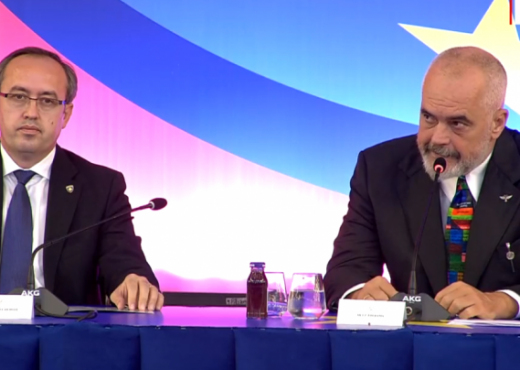
Kosovar Prime Minister Avdullah Hoti expressed his government’s “deep disappointment” with Serbian officials “who openly continue to show a lack of respect for the victims of the recent war in Kosovo and their families, who desperately look for their relatives abducted by Serbian forces.”
Vulin repeated his “shiptar” slur one day after an annual joint meeting of the Albanian and Kosovar governments in Tirana on October 2 under the banner “Together Without A Border,” seemingly as a riposte to the show of mutual support between the two predominantly ethnically Albanian states and any implications that they might one day unite.
Hoti had repeated a sporadically expressed desire to obviate practical aspects of the Albanian-Kosovar border and share the Albanian port of Durres with landlocked Kosovo.
Rama said on October 6 that the Foreign Ministry was conveying a verbal note to the Serbian ambassador in Tirana to say such an “insult” would not be tolerated and that “no loose mouth in the Serbian government” can damage Albania’s government.
On October 7, the Serbian Foreign Ministry summoned Albania’s ambassador to Belgrade to give him a note of “the strongest protest” regarding statements at the Tirana meeting including “above all the one concerning the abolition of the border between Albania and Kosovo and Metohija,” the latter a historical term for a region of southwestern Kosovo that contains a large number of monastic estates controlled by the Serbian Orthodox Church in the Middle Ages.
In between, the verbal and diplomatic spat has included Rama demanding unsuccessfully that Vucic apologize for Vulin’s comment and Kosovar Foreign Minister Meliza Haradinaj-Stublla calling out Vulin for “xenophobic speech” that deserves “strong punishment because of the shameful and chauvinistic actions of the Serbian government.”
Vulin responded dismissively by saying he was simply following that group’s own, chosen label.
“When they throw the word ‘Shiptar’ out of their language, whatever they start calling themselves, I will call them that,” Vulin said. “Until then, I will respect their customs and language, and I will respectfully call Shiptars what they call themselves — Shiptars.”
Haradinaj-Stublla reiterated that the term was “racist, insulting, and discriminatory towards Albanians.”
Vulin fired back, using the epithet to suggest the Albanian foreign minister was simply ashamed of her ethnicity and “should not be angry with me.”
Ethnologist Shemsi Krasniqi, who also works at the University of Pristina, told RFE/RL’s Balkan Service that Serbian politicians have employed such pejoratives for decades in the Albanian context.
“This is then installed even among the population and citizens and then a kind of gap is created, a kind of major barrier, which is very difficult to overcome,” Krasniqi said. “This holds them hostage, too, because they are misplaced in relation to us and cannot understand reality.”
The resulting failure to see things as they are, he said, is a major obstacle to fixing the problem.
“They do not seem to understand that time has changed, the era has changed. It is another time and both the language and the discourse must change,” Krasniqi said./RFE, October 9, 2020

Tags: RamaVucicvulin

Related Posts

ENGLISH

Between Political Calculation and Retreat: Croatian Communists at the End of an Era

10 August, 2026
ENGLISH

The West is buying time, but to whom is it giving it?

10 August, 2026
Current Events

Council of Albanian Ambassadors Raises Concern Over Serbian Plan to Alter the Ibër River

10 August, 2026

Follow US

Subscribe

Receive Argumentum Magazine by Email

Last Posts

Between Political Calculation and Retreat: Croatian Communists at the End of an Era

10 August, 2026

The West is buying time, but to whom is it giving it?

10 August, 2026

Council of Albanian Ambassadors Raises Concern Over Serbian Plan to Alter the Ibër River

10 August, 2026

The Loyalty Test

9 August, 2026

Global Geopolitics in Transition: Climate, Conflict and the Search for Peace

8 August, 2026
Argumentum

“Argumentum”, një proces intelektual …

Contact Us

[email protected]
[email protected]
[email protected]

Follow Us

Media Partner

Register

Receive Argumentum Magazine by Email
  • Home
  • Privacy Policy
  • About Us
  • Contact

© 2022 Argumentum. All Rights Reserved. | NUIS: L91415033Q

Welcome Back!

Login to your account below

Forgotten Password? Sign Up

Create New Account!

Fill the forms bellow to register

*By registering into our website, you agree to the Terms & Conditions and Privacy Policy.
All fields are required. Log In

Retrieve your password

Please enter your username or email address to reset your password.

Log In

Add New Playlist

No Result
View All Result
  • Home
  • OP/ED
  • Interview
  • Realpolitik
  • Current Events
  • Top News
  • YOUR VOICE
  • Shqip

© 2022 Argumentum. All Rights Reserved. | NUIS: L91415033Q

This website uses cookies. By continuing to use this website you are giving consent to cookies being used. Visit our Privacy and Cookie Policy.