











• SHQIPËRI
  • KOSOVË
  • MAQEDONIA E VERIUT
  • MALI I ZI
  • Revista në PDF
4 June, 2026
  • Home
  • OP/ED

    Cyber Attribution, Corruption, and the False-Flag Question in Albania’s 2022 Alleged Iranian Cyberattack

    Between Russia, Iran and Europe: Azerbaijan as a balancing power in the South Caucasus

    The Zero-Tariff Gate: Sovereignty as a Service in the Sino-African Corridor

    Albania vs. the Sea/ Marginal Notes on A. Leka’s Novel The Hidden Side of the Albanian Socialist Garden

    May 9 and the long shadow of a Letter: Is Europe still Schuman’s Project?

    The Arbnesh of Zadar: A living memory of Albanian identity on the Adriatic coast

    Science Diplomacy and Academic Freedom: A strategic nexus for contemporary diplomacy

    Serbia and Kosovo between new regional alliances and old geopolitical patterns

    Hungarian Writers and the European Spirit: Between Central Europe, Auschwitz, and Inner Exile

  • Interview

    Exclusive Interview with Oleksandr Tyshchenko: A 40-Year Legacy of Chernobyl, Nuclear Risks, and Global Responsibility

    INTERVIEW: ZLATKO KRAMARIĆ – THOUGHTS ON THE OLD CONTINENT

    EXCLUSIVE / Ukrainian Ambassador to Albania, Volodymyr Shkurov: “Ukraine wants peace, but not at the expense of its freedom and independence”

    EXCLUSIVE| Ambassador Tayyar Kagan Atay: Türkiye and Albania, a Strategic Partnership Rooted in Shared Heritage and a Common Vision for the Future

    “Diplomacy, Not War”: Palestinian Ambassador to Albania Calls for Justice, Peace, and Global Action for Gaza

    Exclusive: “Even After Tito – Tito”/ Ambassador Zlatko Kramarić on Authoritarian Legacies and Democracy’s Future in the Balkans

    The Conclusion of the Diplomatic Mission / Ambassador Dancho Markovski: Strengthening Albania-North Macedonia Relations for a Shared European Future

    A Century of Diplomatic Relations Between Albania and Russia: Exclusive Interview with the Russian Ambassador to Albania, H.E. Alexey Zaytsev

    Exclusive/ The chairman of the Freedom Party, Ilir Meta: “The will of the citizens will triumph in Albania, as it did in North Macedonia”

  • Realpolitik

    IBAR? ”Sufficiently! Much ado about nothing! Shart contrasts in Beijing! Where is the exit?!

    Neither peace nor war! Peace with bombs?! IBAR in autumn?! Not another Hormuz in Taivan! 

    IBAR – a springing board or an obstacle? Can we catch the EU Negotiation train 2027? When the dress makes the news!  EU electoral April  ends in a draw 1:1!  

    The European Parliament building in Strasbourg, France with flags waving calmly celebrating peace of the Europe. July 12, 2020.

    EU 2027 or 2037! Even half membership failed! No exit strategy!     

    What next?

    “With diplomatic velvet“! Major question marks! In Washington yes, but  in the White House NO! A strange dinner in Brussels!

    From a great ‘apple of disaccord’ to a  point of  cooperation! A bad start! The strange absence in Davos!

    5 lessons from the American 3 January! Don’t count the chicken before they are hatched! Will NATO freeze in Greenland? Wrong diplomatic messages!

    German Chancellor Friedrich Merz, European Commission President Ursula von der Leyen, Ukraine's President Volodymyr Zelenskiy, U.S. Special Envoy Steve Witkoff and Jared Kushner, son-in-law of U.S. President Donald Trump line up for a family photo opportunity at the Chancellery in Berlin, Germany, December 15, 2025.    REUTERS/Lisi Niesner/Pool

    A Strategy that could change the world! Europe in Berlin! Why an historic compromise? Only charm diplomacy in Athens!

  • Current Events

    Serbia – China 2026: Technological partnership, geopolitical positioning and a new phase of the Chinese presence in the Western Balkans

    The Digital Protectorate: How the EU AI Act Codified Silicon Valley’s Monopoly

    The 28th MFC Annual Conference in Durrës / Sulaj: Microfinance remains a key instrument for financial inclusion

    Serbia at the Crossroads of EU Integration and Geopolitical Balancing: IFIMES Analysis

    Tirana – €20 Million EU–Banking Agreement Boosts Albanian SMEs

    The Myth of Independence: How Chinese Efficiency is Rewriting the Constitution of Modern Geopolitics!

    Europe Yesterday and Today: Why 9 May Still Matters

    “EU4Municipalities II” Project, a Strategic Investment for Strengthening Municipalities and Accelerating Albania’s Path towards the EU

    Eight Years in the Service of Identity: The Journey of the Montenegrin Community in Albania

  • Top News

    No End in Sight: Trump, Netanyahu and the Expanding Middle East War

    Tirana – €20 Million EU–Banking Agreement Boosts Albanian SMEs

    “EU4Municipalities II” Project, a Strategic Investment for Strengthening Municipalities and Accelerating Albania’s Path towards the EU

    Albania, Italy deepen defence ties with naval shipbuilding deal

    U.S. Embassy: Iran-Linked Groups May Target Americans and Iranian Opposition in Albania

    The Council of Albanian Ambassadors disappointed with the voting of the draft law on the foreign service in the parliamentary committees.

    Prime Minister Edi Rama Addresses Israel’s Knesset in Historic Special Session

    Kazakhstan’s Strategic Reform Agenda: Stability, Modern Governance, and Responsible Diplomacy

    Trump Invites Rama to Peace Board, Prime Minister: Proud of Albania

  • YOUR VOICE
  • Shqip
No Result
View All Result
Argumentum
  • Home
  • OP/ED

    Cyber Attribution, Corruption, and the False-Flag Question in Albania’s 2022 Alleged Iranian Cyberattack

    Between Russia, Iran and Europe: Azerbaijan as a balancing power in the South Caucasus

    The Zero-Tariff Gate: Sovereignty as a Service in the Sino-African Corridor

    Albania vs. the Sea/ Marginal Notes on A. Leka’s Novel The Hidden Side of the Albanian Socialist Garden

    May 9 and the long shadow of a Letter: Is Europe still Schuman’s Project?

    The Arbnesh of Zadar: A living memory of Albanian identity on the Adriatic coast

    Science Diplomacy and Academic Freedom: A strategic nexus for contemporary diplomacy

    Serbia and Kosovo between new regional alliances and old geopolitical patterns

    Hungarian Writers and the European Spirit: Between Central Europe, Auschwitz, and Inner Exile

  • Interview

    Exclusive Interview with Oleksandr Tyshchenko: A 40-Year Legacy of Chernobyl, Nuclear Risks, and Global Responsibility

    INTERVIEW: ZLATKO KRAMARIĆ – THOUGHTS ON THE OLD CONTINENT

    EXCLUSIVE / Ukrainian Ambassador to Albania, Volodymyr Shkurov: “Ukraine wants peace, but not at the expense of its freedom and independence”

    EXCLUSIVE| Ambassador Tayyar Kagan Atay: Türkiye and Albania, a Strategic Partnership Rooted in Shared Heritage and a Common Vision for the Future

    “Diplomacy, Not War”: Palestinian Ambassador to Albania Calls for Justice, Peace, and Global Action for Gaza

    Exclusive: “Even After Tito – Tito”/ Ambassador Zlatko Kramarić on Authoritarian Legacies and Democracy’s Future in the Balkans

    The Conclusion of the Diplomatic Mission / Ambassador Dancho Markovski: Strengthening Albania-North Macedonia Relations for a Shared European Future

    A Century of Diplomatic Relations Between Albania and Russia: Exclusive Interview with the Russian Ambassador to Albania, H.E. Alexey Zaytsev

    Exclusive/ The chairman of the Freedom Party, Ilir Meta: “The will of the citizens will triumph in Albania, as it did in North Macedonia”

  • Realpolitik

    IBAR? ”Sufficiently! Much ado about nothing! Shart contrasts in Beijing! Where is the exit?!

    Neither peace nor war! Peace with bombs?! IBAR in autumn?! Not another Hormuz in Taivan! 

    IBAR – a springing board or an obstacle? Can we catch the EU Negotiation train 2027? When the dress makes the news!  EU electoral April  ends in a draw 1:1!  

    The European Parliament building in Strasbourg, France with flags waving calmly celebrating peace of the Europe. July 12, 2020.

    EU 2027 or 2037! Even half membership failed! No exit strategy!     

    What next?

    “With diplomatic velvet“! Major question marks! In Washington yes, but  in the White House NO! A strange dinner in Brussels!

    From a great ‘apple of disaccord’ to a  point of  cooperation! A bad start! The strange absence in Davos!

    5 lessons from the American 3 January! Don’t count the chicken before they are hatched! Will NATO freeze in Greenland? Wrong diplomatic messages!

    German Chancellor Friedrich Merz, European Commission President Ursula von der Leyen, Ukraine's President Volodymyr Zelenskiy, U.S. Special Envoy Steve Witkoff and Jared Kushner, son-in-law of U.S. President Donald Trump line up for a family photo opportunity at the Chancellery in Berlin, Germany, December 15, 2025.    REUTERS/Lisi Niesner/Pool

    A Strategy that could change the world! Europe in Berlin! Why an historic compromise? Only charm diplomacy in Athens!

  • Current Events

    Serbia – China 2026: Technological partnership, geopolitical positioning and a new phase of the Chinese presence in the Western Balkans

    The Digital Protectorate: How the EU AI Act Codified Silicon Valley’s Monopoly

    The 28th MFC Annual Conference in Durrës / Sulaj: Microfinance remains a key instrument for financial inclusion

    Serbia at the Crossroads of EU Integration and Geopolitical Balancing: IFIMES Analysis

    Tirana – €20 Million EU–Banking Agreement Boosts Albanian SMEs

    The Myth of Independence: How Chinese Efficiency is Rewriting the Constitution of Modern Geopolitics!

    Europe Yesterday and Today: Why 9 May Still Matters

    “EU4Municipalities II” Project, a Strategic Investment for Strengthening Municipalities and Accelerating Albania’s Path towards the EU

    Eight Years in the Service of Identity: The Journey of the Montenegrin Community in Albania

  • Top News

    No End in Sight: Trump, Netanyahu and the Expanding Middle East War

    Tirana – €20 Million EU–Banking Agreement Boosts Albanian SMEs

    “EU4Municipalities II” Project, a Strategic Investment for Strengthening Municipalities and Accelerating Albania’s Path towards the EU

    Albania, Italy deepen defence ties with naval shipbuilding deal

    U.S. Embassy: Iran-Linked Groups May Target Americans and Iranian Opposition in Albania

    The Council of Albanian Ambassadors disappointed with the voting of the draft law on the foreign service in the parliamentary committees.

    Prime Minister Edi Rama Addresses Israel’s Knesset in Historic Special Session

    Kazakhstan’s Strategic Reform Agenda: Stability, Modern Governance, and Responsible Diplomacy

    Trump Invites Rama to Peace Board, Prime Minister: Proud of Albania

  • YOUR VOICE
  • Shqip
No Result
View All Result
Argumentum
No Result
View All Result
Home ENGLISH

The Great Powers’ Competition in The Middle East and North Africa (MENA) in the First Half of the XXI Century

23 November, 2020
in ENGLISH, English OP/ED
A A
Share on FacebookShare on Twitter

By Corneliu Pivariu *

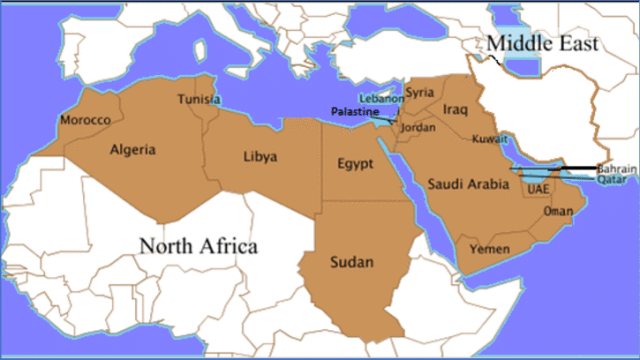
The current landscape of the Middle East and North Africa (MENA), after all the political, military and geopolitical evolutions the Arab world went through during the last two decades provides the image of a venue placed at the centre of a complex and conflictual geostrategic area targeted by an ample offensive of the outside interferences which intensity is comparable only to the colonial period of the process of crystallization of the Arab world’s nation states.

After the end of the Cold War and the provisional establishment of the monopolarism in the world order the Arab community’s concern for the issue of its collective security devolved into a regressive path and the said concept of collective security was replaced by a sustained orientation of the Arab states towards national isolationism, towards the devaluation of the old unionist vision of the “joint Arab action”. Consequently, such an option exhibited progressively led to the dilution of the security potential of each Arab state with direct negative impact on the idea of establishing and bolstering the collective security.

One may assess that, as never before, the Arab community of the Middle East, its state and socio-political entities are in a situation of being targeted by an outstanding amount of outside challenges and threats manifested simultaneously and in a competitive manner from numerous directions of the regional and extra-regional political geography. And that either directly or by proxies or by conjectural alliances with regional state and non-state players as it can be easily traced today when looking at the political map of the area.

Iran, Turkey, the Russian Federation, the United States, Great Britain and France are acting militarily and politically in Syria; Iraq hosts Iranian, American and Turkish presence while Libya is targeted by Russian, Turkish, French and Italian interests and Iran and Saudi Arabia are waging a brutal war by proxies in Yemen; France gets ready for a comeback to Lebanon on humanitarian and solidarity reasons and so on and so on.

On this background, mention should be made on Syria which has a particular geopolitical importance in the Middle East and where a regime – the Assad one, believed to vanish soon after the so-called Arab Spring broke out in 2011 celebrated, on November 13, 50 years since the family rules the country. Bashar al-Assad who took over completely unprepared Syria’s leadership 20 years ago witnessed during the last 10 years the civil war that ravaged the country. Keeping the Assad’s regime in power when the loyalist army was almost annihilated was possible as a result of Russia’s and Iran’s (with the Lebanese Hezbollah, its loyal ally) military and of other nature interventions. The final price the Assad regime will pay for that backing is almost visible yet the evolutions in Syria will depend also on other regional or geopolitical players, even if the Kremlin appears now as being the main winner.

A fierce and substantial arms race is unfolding since many years in the Arab region with its Mashreq and Maghreb, whereby states such as Saudi Arabia (first place with 3.84 bill $), Egypt (the fifth place with 1.48 bill $), Algeria (the sixth place with 1.32 bill $), the United Arab Emirates (the eighth place with 1.1 bill $), Qatar (the ninth place with 816 mil $) are all among the  frontrunners of the military equipment purchasers. So, five of the first ten arms importers globally are from MENA (2018 figures). That is not an exclusive consequence of some of the Arab states’ involvement in the various regional conflicts which torch the Middle East but express the states’ acute feeling of insecurity when the tensions among the regional states intensify and the number of non-state actors strongly armed and used as proxies in the wars and conflicts increases.

This situation is more or less compensated by the dependence on the military presence (air, land and naval bases etc) of the great regional and global powers which balance to different degrees the Arab defense and security shortcomings and represent, at the same time, a factor of restricting the “protected” states’ national sovereignty and of impeding the autonomy of the military institutions of the respective regional states.

The numerous regional conflicting fractures and fault lines will represent in the future too not only tension sources but also an competitive attraction point for the great players and the emerging powers on the regional and global chessboard.

Temporizing the processes of solving chronic conflicts such as the Palestinian problem, in spite of the recent American successes concerning the normalization of the relations with Israel by the United Arab Emirates, Bahrein and the Sudan will contribute to that, too.

As far as the Palestinian cause is concerned, a cause that was used more in time by many Arab countries for attaining their own strategic goals, I note the recent criticism addressed to the Palestinian leaders by the Saudi prince Bandar bin Sultan bin Abdulaziz who said: „The Palestinian cause is a just cause but its advocates are failures, and the Israeli cause is unjust but its advocates have proven to be successful. There is something that successive Palestinian leadership historically share in common: they always bet on the losing side, and that comes at a price”. Is it really about the exhaustion of those fighting for the Palestinian cause? Or it is heralding something bigger.

The change of the US administration could bring some moderation and a relative cooperation climate and rationalism in the competition among the great powers for regional control and influence with positive effect as regards the coming back to the fore of the “Nuclear Treaty“ (JCPOA) with Iran and the advancement toward peace in Syria, Iraq, Libya and Yemen.

The future of the security situation and the rush for energy resources in the Eastern Mediterranean remain in limbo.

China’s political, diplomatic, economic and strategic offensive in the MENA area will continue with possible great strategic surprises.

One may assess for the time being that the regional powers – Turkey, Israel, Saudi Arabia, Iran – have antagonistic or conflicted relations including with other geopolitical powerful players and that further complicates the situation in the region. Russia, Turkey, Iran seem to be the stage winners and, on a long run, Israel as always.

Let us monitor the developments in Lebanon, the revelator of the situation in the Middle East; when the country will evolve positively and in an irreversible way, the stability in the Middle East will be achieved. However, major changes will take place in the MENA region during the next 30 years, be it only due to the global economic, scientific and social developments.

The text was presented at the International Conference Post –Pandemic: A new Order or a new Chaos? The Middle East and North Africa Perspectives. – Webinar, Bucharest – ROMANIA 19 November 2020, organized by MEPEI and EURISC Foundation./IFIMES

*Member of IFIMES Advisory Board and
Founder and the former CEO of the INGEPO Consulting
 

Tags: africaArgumentumifimesmena

Related Posts

Current Events

Serbia – China 2026: Technological partnership, geopolitical positioning and a new phase of the Chinese presence in the Western Balkans

1 June, 2026
ENGLISH

IBAR? ”Sufficiently! Much ado about nothing! Shart contrasts in Beijing! Where is the exit?!

1 June, 2026
ENGLISH

How Alkida Lushaj is redefining democratic inclusion globally

31 May, 2026

Follow US

Subscribe

Receive Argumentum Magazine by Email

Last Posts

Serbia – China 2026: Technological partnership, geopolitical positioning and a new phase of the Chinese presence in the Western Balkans

1 June, 2026

IBAR? ”Sufficiently! Much ado about nothing! Shart contrasts in Beijing! Where is the exit?!

1 June, 2026

How Alkida Lushaj is redefining democratic inclusion globally

31 May, 2026

Cyber Attribution, Corruption, and the False-Flag Question in Albania’s 2022 Alleged Iranian Cyberattack

30 May, 2026

The Digital Protectorate: How the EU AI Act Codified Silicon Valley’s Monopoly

30 May, 2026
Argumentum

“Argumentum”, një proces intelektual …

Contact Us

[email protected]
[email protected]
[email protected]

Follow Us

Media Partner

Register

Receive Argumentum Magazine by Email
  • Home
  • Privacy Policy
  • About Us
  • Contact

© 2022 Argumentum. All Rights Reserved. | NUIS: L91415033Q

Welcome Back!

Login to your account below

Forgotten Password? Sign Up

Create New Account!

Fill the forms bellow to register

*By registering into our website, you agree to the Terms & Conditions and Privacy Policy.
All fields are required. Log In

Retrieve your password

Please enter your username or email address to reset your password.

Log In

Add New Playlist

No Result
View All Result
  • Home
  • OP/ED
  • Interview
  • Realpolitik
  • Current Events
  • Top News
  • YOUR VOICE
  • Shqip

© 2022 Argumentum. All Rights Reserved. | NUIS: L91415033Q

This website uses cookies. By continuing to use this website you are giving consent to cookies being used. Visit our Privacy and Cookie Policy.