














At the end of the previous century political as well as economical implications made the enlargement of the Community a priority issue, finding easier to increase the membership than to improve the political profile. It was furthermore evident that the United Kingdom would have opposed any steps towards a political union.
European union was always perceived as the group of nations with the same status. They were and still are equally represented in the Council, each member state has its commissioner and has the relative number (according to their population) of their members of the EU parliament. De facto the conditions of stable and effective EU are well defined and preservable balance of power among the member states is formally guaranteed. We are talking about One – block EU.
According to Henry Kissinger, the balance of power works best if at least one of the following conditions pertains:
- First, each nation must feel itself free to align with any other state, depending on the circumstances of the moment.
- Second, when there are fixed alliances but a balancer sees to it that none of the existing coalitions becomes predominant.
- Third, when there are rigid alliances and no balancer exists, but the cohesion of the alliances is relatively low so that, on any given issue, there are either compromises or changes in alignment.
Considering Kissinger`s conditions for the prosperous and internationally important EU at least one of three conditions for the functioning of the balance of power among EU members should be fulfilled. Such European Union would be One-block and not Two-block EU.
Nordic Council: The Nordic Council is the official body for formal inter-parliamentary co-operation. Formed in 1952, it has 8 members from Denmark, Finland, Iceland, Norway, Sweden, the Faroe Islands, Greenland and Åland.
Baltic Assembly: The Baltic Assembly (BA) is regional organization that promotes intergovernmental cooperation between Estonia, Latvia and Lithuania. The organisation was formed after the decision to establish it was made in Vilnius on 1 December 1990. It attempts to find a common position in relation to many international issues, including economic, political and cultural issues. The decisions of the assembly are advisory.
Benelux: Benelux, is a politico-economic union and formal international intergovernmental cooperation of three neighbouring states in western Europe: Belgium, the Netherlands and Luxembourg. The name was first used to name the customs agreement that initiated the union (signed in 1944).
There are some other less visible organizations among EU members, but some states do not belong to any such an alliance, for instance Ireland, Malta, Spain, Portugal, France, Germany.
Until the cohesion of the alliances is relatively low so that, on any given issue, there are either compromises or changes in alignment, Two-block EU can not emerge.
There were some examples of trying to establish a separate block of the EU states, sometimes with the support of some foreign country. This would lead the European construction straight toward disintegration, as some could also take advantage of it.
China promoted the idea of creating alliance 16 + 1. 16 states of central and eastern Europe (Albania, Bosnia and Herzegovina, Bulgaria, Croatia, Estonia, Hungary, Latvia, Lithuania, North Macedonia, Montenegro, Poland, Czech Republic, Romania, Serbia, Slovakia, Slovenia) plus China would strengthen the economic links between China and central and eastern Europe. The format was founded in 2012 in Budapest to push for cooperation of the “16+1” (the 16 CEE countries and China). China was interested in investments in infrastructures, in renewable energies and in agriculture. In the 2013 heads of government of central and eastern Europe met the Chinese Prime Minister Li Keqiang. Later this group evolved in 17 + 1, joining Greece in 2019. Although the initiative 17+1 initially had some successful projects, like railway on the line Greece-Hungary corridor and the investment in the Port Thessaloniki, EU succeeded to somehow moderate Chinese influence on the EU unity. Nations belonging to the group17+1 feel themselves free to align with any other state, depending on the circumstances of the moment. Lately, some countries are thinking to leave this alliance. In March 2021, the Lithuanian National Radio and Television (LRT) reported that in February, the Lithuanian parliament agreed to leave what was previously Chinas 17+1 format. Foreign minister Gabrielius Landsbergis said the cooperation between Beijing and Lithuania has brought “almost no benefits”. (Radio, 2021) This initiative is definitely not challenging the unity of the EU.
The Three Seas Initiative, is a forum of twelve states in the European Union, along a north–south axis from the Baltic Sea to the Adriatic Sea and the Black Sea in Central and Eastern Europe. The Initiative aims to create an Intermarium-based (Late middle age system of governing region between Baltic to Adriatic and Black Sea) regional dialogue on various questions affecting the member states. The member states are Austria, Bulgaria, Croatia, Czech Republic, Estonia, Hungary, Latvia, Lithuania, Poland, Romania, Slovakia, and Slovenia, and met for their first summit in 2016, in Dubrovnik. This initiative is supported by the USA. The Three Seas initiative brings together every year 12 member countries. The initiative is focusing on funding of cross-border infrastructure projects especially in the field of energy and transport and digitalisation. We cannot exclude the possibility that behind the idea of creating this alliance there is the idea of creating a separate block of eastern members of the EU, creating the tampon zone between the western part of the EU and Russian federation. But the cohesion of this alliance is too low to be able to lead the EU towards the Two-block EU.
After Janez Janša became the president of Slovenian government, Slovenia became strong supporter of the Visegrad policy. At this moment it seems that Slovenia de facto became the member of this group.
Lately, countries of the Visegrád have some problems with the EU Commission and the EU Parliament, concerning the values of the EU. Due to strong pressure from specific countries, in which the effects of the corona pandemic were very grave and which were threatened with very serious economic consequences, talks on provision of assistance were organized. The main impediments to brokering an agreement were the disagreements between Netherland and Italy regarding conditioned assistance from the European Stabilization Mechanism (ESM) and the divergence of the stances of the South and the North on the issue of joint debt. Nevertheless, the EU managed to find a way to a solidarity-based assistance, and the common problem (pandemic) has at least led to some convergence of interests, if not also united member countries. However, an important element of this assistance is that some member countries strongly advocate the idea that the assistance should be conditioned with compliance with European values.
Naturally, the accurate definition of European values is rather debatable, but it is related, inter alia, to the freedom of media, free and fair elections, rule of law, respect of human dignity and rights, etc. Although such conditions have not yet been formalized, bearing in mind the stances of the richest member countries, it is not impossible that they will be effective at the practical level. Talking about the European values, it was more than evident that it was the issue of the Visegrád countries, especially Poland and Hungary. The Visegrád alliance is somehow challenging the EU unity. In the field of the freedom of media, free and fair elections, rule of law, respect of human dignity and rights, this alliance seems to be rigid and as no strong balancer exists, so that, on those issues, there are no compromises or changes in alignment.
The third Kissinger`s condition is not totally fulfilled and it could lead the EU towards two blocs EU. A zero-sum game may develop in which any gain of one side is conceived as a loss for the other. Mounting tensions become inevitable.
The strongest tool in the hands of the EU to achieve the rule of law and democracy in the EU is imposing the conditions for the distribution of the EU funds. But the president of the EU Commission Ursula von der Leyen is following her promise, given on the occasion of her presentation before getting her position that she intends to diminish the confrontation with Poland and Hungary. Sometimes, economic interests are overruling the defence of the basic EU values. European Commission warned Poland and Hungary to respect freedom of speech, to organize fair elections, to strive for free and independent media, to have politically independent judiciary. But the market for the products from Germany, France and other most developed European countries is so important that those countries would not be ready to lose it at the account of the European values. At this moment, there is no effective balancer in the EU. Knowing it, the four leaders of important political groups in the EU Parliament (Manfred Weber, EPP; Iratxe Garcia Pérez, S&D; Dacian Cioloş, Renew Europe; Ska Keller and Philippe Lamberts, Green/liberals) wrote the letter (October 2020) to the EU Commission and the European Council emphasising that the EU values are not on sale.
Traditionally, the UK played the role of the European balancer, but they opted to leave the EU. The only countries which have the ability to be the balancer are Germany and France. At this moment they seem to try to play this role but yet they haven`t been very successful.
If the EU Parliament together with some important and economically strong members is not successful in balancing the Visegrád group, the way towards the Double-speed EU will be opened. After the elections in the USA where Donald Trump was replaced by Joseph Biden, we could expect that the policy of diminishing the power of the EU will probably be changed.
Under the presidency of Donald Trump, USA supported the activities of the Visegrád group. It seems that the reason for it is the creating of the tampon zone between the EU and Russian federation and, at the same time, to split the EU in two parts, thus diminishing the power of the EU. Together with the support of Brexit, it is evident, that the policy of diminishing EU power de facto follows the idea towards “Make America first”. Immediately after the election of Joseph Biden as the new US president, there were a lot of expectations that this policy was going to be changed. But soon it became clear that we can see the weakening of Transatlantic link, clear orientation of the USA towards Asia. It became more evident after the signing the defence treaty among USA, United Kingdom and Australia. (Žerjavič, 2021)
At the end of 20th century countries of the Western Balkans believed that they would become the members of the EU in visible future. There was no idea of creating regional alliances because in the EU, such alliances would not be necessary. But now the countries of the Western Balkans do not expect to become the members of the EU in visible future although officially they do not say it, and the need of the regional cooperation resulted in the creation of some alliances in this region.
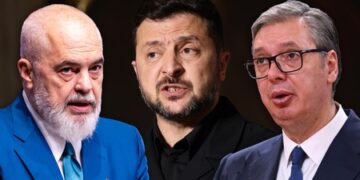
Serbian President Aleksandar Vučić (SNS), Prime Minister of North Macedonia Zoran Zaev (SDSM) and Prime Minister of Albania Edi Rama (PS) signed on 9 October 2019 in Novi Sad a Joint Declaration of intent to establish a “Mini Schengen” among the three states. The joint declaration envisages elimination of border controls and other barriers, which should facilitate movement in the region by 2021. It would also enable citizens of the three countries to travel in the region using only an identification card and find employment anywhere in the region on the basis of their professional qualifications. The signed declaration should help the Western Balkans region to start functioning on the basis of four key freedoms on which the European Union is founded – freedom of movement of people, capital, goods and services. The initiative is open also for other Western Balkans countries: Bosnia and Herzegovina, Montenegro and Kosovo. It was stressed that the respective initiative is not a compensation or alternative to membership of the countries in the region in the EU. But in fact, it replaces some advantages of freedoms which enjoy the EU members. De facto this initiative is a compensation of the EU membership.
Also, North Macedonia is following similar policy. They intend to foster better relations among neighbouring countries, although they were not very successful. Of course, they would like to enter the EU as soon as possible. But nevertheless, they signed some important agreements: Ohrid agreement, Prespa agreement, and they changed the name of the country and became North Macedonia.
The participation of the important political personalities at the 16th Bled Strategic forum and the content of discussions seemed to pave the way towards eastern part of the Europe working together. (Forum, 2021) Forum focused on the future of Europe and the call to increase its resilience. The topics of discussion touched on the priorities of the second Slovenian Presidency of the Council of the European Union, which takes place under the “Together. Resilient. Europe” slogan.
The Western Balkan countries strive to enter the EU, the EU with the democratic values, typical for the founding members. If the EU becomes a Two-block EU, the Western Balkan countries would enter into the eastern part of the EU, a very different alliance with more autocratic values, with less respect of the human rights and less freedom of media, not respecting the rule of law and independent judiciary. Is there still any sense to enter such an alliance?
The Two-block EU is not a good option, neither for the EU nor for the entire world. We should preserve the united EU and do our best that it becomes politically stronger and economically more successful.
/IFIMES
Ljubljana/Brussels, 10 December 2021