


















(An Essay on the Spirit of Europe)
By Zlatko Kramarić*|ARGUMENTUM
Abstract
This text examines two philosophical perspectives on Europe: Husserl’s idea of Europe as a spiritual–rational project of universality, and Agamben’s conception of post-historical Europe as a space of the state of exception and biopolitical control. The essay compares Husserl’s vision of the renewal of spirit with Agamben’s diagnosis of the end of the European political and philosophical project, while also incorporating the perspectives of authors who interpret Europe through the experience of the camp and the Holocaust (Améry, Bauman, Arendt). In the tension between the “idea” and the “end,” a new possibility emerges for understanding Europe — not as an empire of reason, but as a community that acknowledges its own fragility and limits.
1. Husserl’s Idea of Europe as a Spiritual Project
When Edmund Husserl delivered his famous 1935 lecture Die Krisis des europäischen Menschentums und die Philosophie in the midst of the European crisis of spirit, his “idea of Europe” was not a geographical concept but a spiritual-historical project. For Husserl, Europe represents a teleological form of the life of the spirit, a continuity of rationality stretching from Greek philosophy to modern science.
This continuity, rooted not in a mere cultural heritage but in a constant striving for universal truth, makes Europe a unique phenomenon in history. Husserl therefore calls for a “return from objectivism to subjectivity” — to that sphere in which the original meaning of truth as the living experience of the world is renewed.
For Husserl, Europe is not a fact but a task — a “spiritual form” that must be continually reflected upon and renewed. The crisis of Europe arises when it forgets its foundation in critical thinking and rational self-awareness, when its science turns into technique and its philosophy into ideology. In this sense, the spirit of Europe is not a legacy but an ongoing obligation to preserve the possibility of universality and truth in a world sinking into relativism and particularisms.
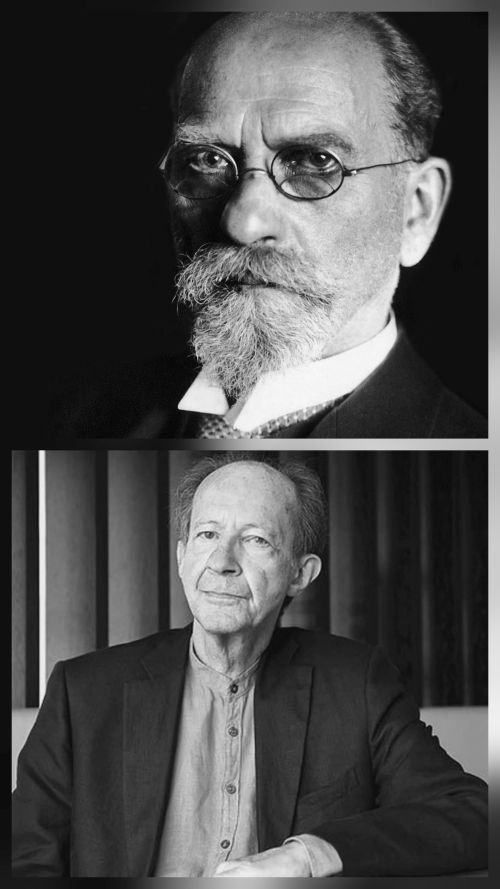
2. Agamben’s Post-Historical Europe
Giorgio Agamben, almost a century later, inherits Husserl’s concern but radically transforms it. In his works — especially Mezzo senza fine and L’uso dei corpi — Europe no longer appears as a project of spirit but as the site of an epochal ending and the failure of political rationality.
While Husserl believed in Europe’s renewal through a return to philosophy, Agamben sees Europe as a laboratory of biopolitical mechanisms that have erased the boundary between life and law, between human being and citizen.
If for Husserl Europe was a metaphysical project of universal rationality, for Agamben it has become a space of the state of exception — a continent that has replaced its spiritual idea with an apparatus of power. He recognizes that European universalism, in its modern forms, often becomes an instrument of exclusion: camps, borders, refugee regimes, security laws. In these, Agamben sees the symptom of what he calls “the post-historical condition of Europe” — where history no longer moves toward an ideal but circulates within endless administrative mechanisms.
3. Europe from the Perspective of the Camp
Agamben’s reflection is not a solitary voice. As Jean Améry wrote in his Essays on the Camp, “European humanism was extinguished in the smoke of the crematoria.” The camp, for him, was the negative epic of Europe — the place where faith in Enlightenment reason and human autonomy vanished.
Similarly, Zygmunt Bauman, in Modernity and the Holocaust, demonstrates that the Holocaust was not an exception but a product of modernity itself — of its rationality, bureaucracy, and organized coldness. In short: a purely administrative act.
Hannah Arendt, in The Origins of Totalitarianism, speaks of “administrative evil,” the moment when rationality separated from conscience. Even Ernst Nolte, from a different standpoint, recognized the camp as a modern form of political violence arising not from barbarism but from the very logic of historical progress.
Thus, the camp becomes the dark mirror of Husserl’s idea of Europe: if for Husserl Europe was the space of universal consciousness, then for Améry and Bauman it became the space of universal dehumanization.
In this reversal, the camp emerges as the antithesis of the European spirit — the site where the limits of rationality and moral self-understanding are exposed. Agamben sees here “the center of the political space of modernity”: the camp is not the past but a paradigm, the architectural and symbolic foundation of a Europe that fears its own history.
Was not the creation of Goli Otok, the Yugoslav labor camp for those who supported the Cominform Resolution, an example of the same mechanism — born of a regime’s fear of its own (criminal) past? “Either we liquidate them, or they will liquidate us!” — the dilemma was banal, the answer radical.
4. Between the Idea and the End
Yet between Husserl and Agamben — between the idea and the camp — there lies an invisible link: both conceive Europe not as an empirical fact but as a spiritual event. For Husserl, it is the event of reason’s self-understanding; for Agamben and Améry, the event of civilization’s self-annihilation.
Husserl’s “idea of Europe” represents the possibility of meaning; Agamben’s “post-Europe” represents the possibility of its end. But precisely within this tension — between spirit and emptiness, memory and forgetting — there opens a space for renewed reflection: can Europe once again find its justification, not as an empire of reason but as a community that recognizes its own fragility?
Perhaps, as Agamben suggests, the only way out of Europe’s crisis is a return to life not reduced to function — to what he calls “pure use.” In this sense, the spirit of Europe might be renewed not through another rational project, but through an ethic of modesty, responsibility, and measure — the very sophrosyne that Greek philosophy, Husserl’s archetype of Europe, once revered.
Epilogue: Europe After the Camp
If the camp was the nadir of European history, then every new Europe — political and spiritual — must think from that depth. Between ashes and ideals, between memory and forgetting, Europe can no longer speak in the tone of grandeur. Its voice must be quiet, aware of its fragility — perhaps even penitential. For we Europeans are not absolved of the capacity for evil.
In a world that has lost metaphysical certainty, Husserl’s idea of Europe can survive only if it embraces Agamben’s lesson: that true spirit is measured not by the magnitude of projects but by the ability to protect what is human in its vulnerability.
Perhaps the new Europe is precisely this — a Europe of remembrance, a Europe of measure, a Europe that has learned to be silent before its camps and to speak only when it finds a language that does not exclude.
Today, Europe stands between Husserl’s idea and Agamben’s prophecy — between the memory of spirit and the experience of its disappearance. And perhaps it is precisely this tension, this irreconcilable space in between, that still makes Europe possible. For, as Husserl warned, its fate depends on the ability to see in crisis not an end, but a challenge — and, despite everything, to reinvent itself as a space of meaning.
In this quieter yet morally deeper space, Europe may still endure — not as a triumph, but as a testimony to the possibility of meaning after the collapse of meaning.
Notes on the Authors
Edmund Husserl (1859–1938) – German philosopher and founder of phenomenology; author of The Crisis of European Sciences and Transcendental Phenomenology.
Giorgio Agamben (b. 1942) – Italian philosopher known for his concepts of homo sacer and the state of exception.
Jean Améry (1912–1978) – writer and essayist, Holocaust survivor, author of At the Mind’s Limits.
Zygmunt Bauman (1925–2017) – Polish-British sociologist, author of Modernity and the Holocaust.
Hannah Arendt (1906–1975) – political philosopher, author of The Origins of Totalitarianism.
*Zlatko Kramarić is a Croatian publicist, author, and diplomat, currently serving as Ambassador to Albania. Formerly a university professor and politician, he is known for his work in literature, cultural studies, and regional history.
© 2025 Argumentum