











By Zlatko Kramarić*| ARGUMENTUM
Abstract / Editorial Summary
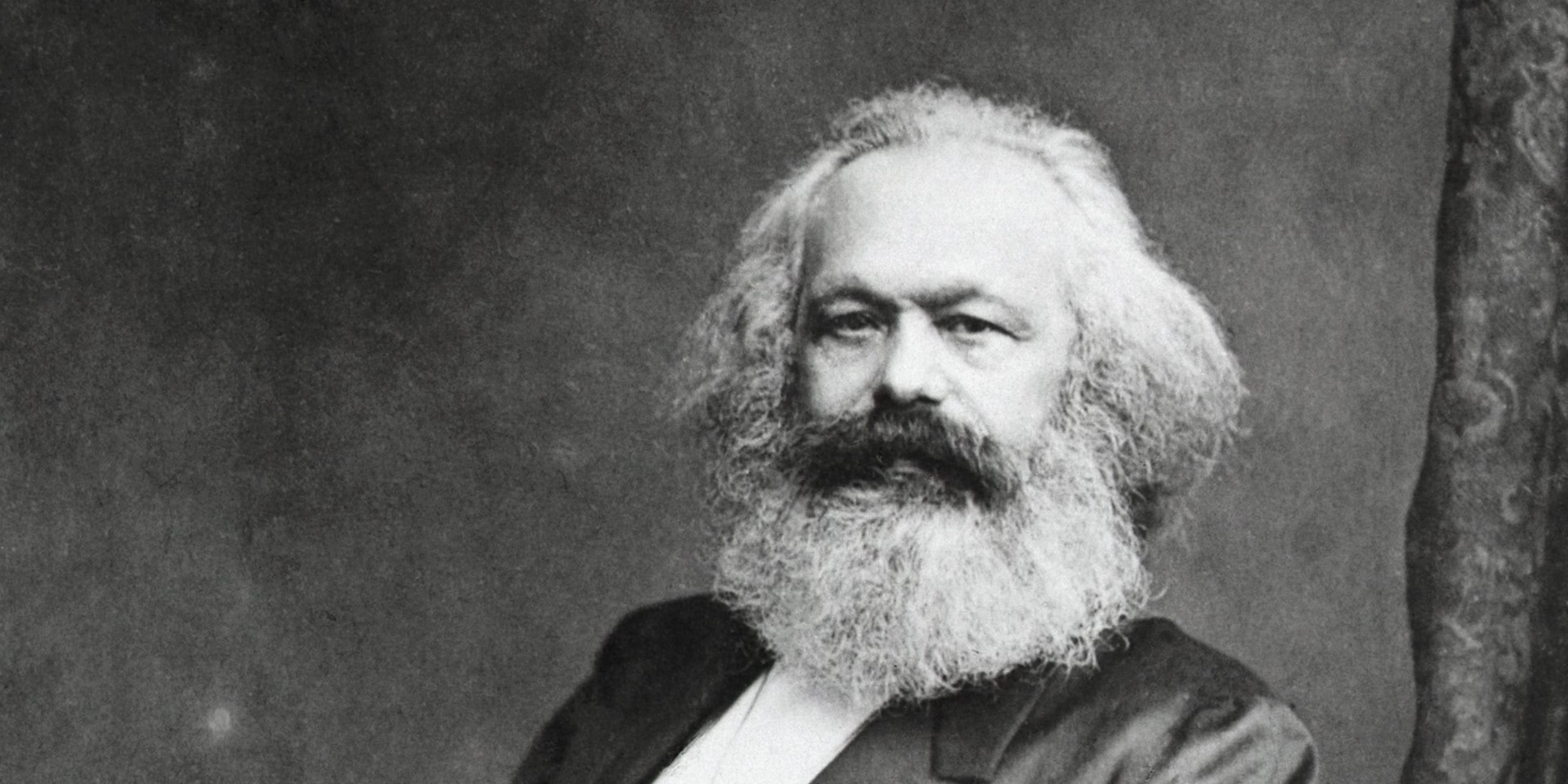
This article situates Karl Marx within the long arc of the European intellectual tradition, arguing that Marx is both its inheritor and its most radical critic. While deeply influenced by classical rationalism, Christian universalism, Enlightenment humanism and German idealist philosophy, Marx transforms these traditions through a materialist critique of capitalist modernity. The essay examines how this transformation shaped subsequent trajectories of European thought — notably the Frankfurt School, Western post-Marxism, and postcolonial theory — and evaluates the extent to which these successors remained faithful to Marx or significantly modified his ideas. By exploring Marx’s dual role as custodian and challenger of the European spirit, the article outlines how Marxism became a central mechanism of European self-reflection and self-critique from the nineteenth century to the present.
1. Introduction: Marx at the Heart of the European Spirit
Few thinkers in modern history have been as deeply rooted in the European spirit — and at the same time as radically opposed to its self-image — as Karl Marx. His work stands at the crossroads of Europe’s most powerful intellectual currents:
ancient rationalism, with its trust in the intelligibility of the world;
Christian universalism, with its belief in the equal dignity of all human beings;
Enlightenment humanism, with its insistence that society can be transformed by human agency;
German idealism, especially Hegelian dialectics, with its conception of history as a process of unfolding contradictions.
Marx does not reject these traditions. Instead, he carries them to their logical conclusion — and in doing so, exposes their internal tensions. His originality lies not in departing from the European spirit, but in revealing that Europe’s own philosophical foundations demand a materialist, historical and emancipatory reconsideration of society.
2. Marx as the Culmination of European Intellectual Traditions
2.1 Classical rationality and the demystification of society
From ancient Greece, Marx inherits the conviction that reality is intelligible through rational inquiry. Capital is, in this sense, a continuation of the European tradition of philosophical analysis, applying scientific reasoning to the economic and social structures of the modern world.
Marx’s critique of political economy can be read as the most ambitious European attempt to unmask the hidden logic of society — in line with Spinoza, the Enlightenment encyclopedists and Hegel.
2.2 Christian universalism and the moral horizon of equality
Although Marx explicitly rejected theological explanations, his thought remains indebted to the Christian idea that all human beings share a common dignity. Marx secularises this moral horizon: the possibility of emancipation becomes a historical, not spiritual, task. His concept of “species-being” echoes Christian anthropological universalism, now reframed in materialist terms.
2.3 Enlightenment humanism and the belief in self-emancipation
Marx radicalises Enlightenment optimism about human agency. Freedom is no longer a philosophical ideal; it must be realised through concrete transformation of social conditions. In this sense, Marx stands in direct continuity with Kant’s call for public reason and with Rousseau’s critique of political inequality — but he grounds both in historical-material analysis rather than in abstract principles.
2.4 German idealism and the dialectical structure of history
The influence of Hegel is decisive. Marx inherits Hegel’s vision of history as a dialectical movement of contradictions — but he “turns it upside down” by rooting these contradictions in relations of production rather than in the development of Spirit.
Thus, Marx is not an antagonist of European philosophy: he is one of its most coherent outcomes.
3. Marx’s Originality: A Materialist Reversal of the European Spirit
What makes Marx unique within the European tradition is not his continuity with it, but the direction in which he pushes it. Marx performs what may be called a materialist inversion of the European spirit:
3.1 Materialist turn
Ideas are no longer the engine of history; they arise from material conditions. This reverses the idealist assumption — but retains the European commitment to systematic explanation.
3.2 Critique of capitalism as critique of European modernity
Marx sees capitalism not merely as an economic system but as the dominant form of European civilisation. His critique therefore becomes a critique of the West’s own self-understanding.
3.3 Emancipation universalised
Marx transforms the European promise of universal freedom into a global project, transcending national and continental boundaries. The proletariat is not a European class; it is a universal class formed under global capitalism.
3.4 Philosophy becomes praxis
Marx internalises the European notion of critique but insists that critique must produce change. The famous dictum that philosophers have only interpreted the world is Europe’s own rationalism pushed to its final consequence.
4. Marx’s Intellectual Successors: Fidelity, Modification, Transformation
Marx’s legacy unfolds in at least three major streams of twentieth- and twenty-first-century thought. Each modifies parts of Marx’s framework while remaining connected to his critical impulse.
4.1 The Frankfurt School: From Economy to Culture
Adorno and Horkheimer
Adorno and Horkheimer reinterpret Marx through the lens of cultural modernity. In Dialectic of Enlightenment, they argue that the Enlightenment rationality celebrated by Marx becomes instrumentalised in advanced capitalist societies.
They depart from Marx by expanding domination beyond the economic structure into psychology, culture and technology.
They continue Marx by showing that modern forms of domination are historically produced and interconnected.
Herbert Marcuse
Marcuse blends Marx with Freud, analysing repression within consumer societies. Capitalism now pacifies individuals not only economically but also psychologically, by shaping desires and needs.
Walter Benjamin
Benjamin brings Marx into the domains of aesthetics, temporality and memory. His concept of “now-time” (Jetztzeit) reinterprets historical materialism as a sudden interruption, not a linear process.
Jürgen Habermas
Habermas retains Marx’s emancipatory horizon but shifts its foundation from labour to communication. Democratic legitimacy, he argues, requires free, rational discourse — but this discourse is impossible without material equality.
Habermas moves beyond Marx, yet preserves the universalist and emancipatory core of the European spirit that Marx radicalised.
4.2 Western Post-Marxism: From Class to Discourse
Louis Althusser
Althusser redefines ideology as a material practice enacted through state apparatuses. He rejects Marx’s early humanism and shifts focus from class agency to structural determination.
Ernesto Laclau and Chantal Mouffe
Laclau and Mouffe argue that social identities are contingent and politically constructed. Class is no longer a naturally privileged agent of history. Political struggle becomes a contest of discourses and hegemonies.
Post-Marxism therefore:
modifies Marx’s ontology of class;
extends his insights on ideology and power;
retains the notion that society is shaped by conflict and contradiction.
4.3 Postcolonial Marx: Decentring Europe
Frantz Fanon
Fanon exposes the psychological and existential dimensions of colonial domination, linking race, violence and capitalist exploitation. He universalises Marx’s concept of alienation in contexts Marx never analysed.
Edward Said
Said uses Marx’s concept of ideology to analyse cultural imperialism (Orientalism) as a discursive formation that produces non-European Otherness.
Dipesh Chakrabarty
Chakrabarty calls to “provincialize Europe,” arguing that Marx’s universal history remains tied to European developmental narratives. Yet he affirms that Marx remains indispensable for understanding global capitalism.
Postcolonial thought criticises Marx’s Eurocentrism, but also depends on Marxist tools to analyse global inequality.
5. Conclusion: Marx as Europe’s Critic and Custodian
Marx is inseparable from the European spirit because he embodies its deepest commitments:
the belief that history is intelligible;
the conviction that human freedom is possible;
the imperative of critique;
the demand for universalism.
But he also exposes the contradictions that prevent Europe from fulfilling these ideals. Marx is, therefore, not only the last great system-builder of European philosophy; he is its most persistent critic — the conscience through which Europe interrogates itself.
His successors modify, reinterpret or challenge him, yet they all continue the European gesture of self-critical reflection, the defining feature of Europe’s philosophical legacy.
Marx remains the European spirit thinking against itself — and thereby remaining faithful to its highest vocation.
Notes on Key Authors
Max Horkheimer (1895–1973) — founder of Critical Theory; focused on authoritarianism and instrumental rationality.
Theodor W. Adorno (1903–1969) — developed negative dialectics and critique of the culture industry.
Herbert Marcuse (1898–1979) — synthesised Marx and Freud; major influence on 1968 movements.
Walter Benjamin (1892–1940) — merged Marxism, theology and aesthetics; theory of history and memory.
Jürgen Habermas (1929– ) — theorist of communicative action and deliberative democracy.
Louis Althusser (1918–1990) — structuralist Marxism, ideological state apparatuses.
Ernesto Laclau (1935–2014) & Chantal Mouffe (1943– ) — hegemonic discourse theory; radical democracy.
Frantz Fanon (1925–1961) — decolonisation, racial subjectivity, liberation struggles.
Edward Said (1935–2003) — Orientalism; critique of Western representations.
Dipesh Chakrabarty (1948– ) — postcolonial theory; multiple modernities.
Selected Bibliography
Primary Works by Marx
Capital, Vols. I–III
The German Ideology
Theses on Feuerbach
Economic and Philosophic Manuscripts of 1844
Secondary Literature on Marx
Isaiah Berlin, Karl Marx
Leszek Kołakowski, Main Currents of Marxism
Shlomo Avineri, The Social and Political Thought of Karl Marx
David Harvey, A Companion to Marx’s Capital
Wolfgang Streeck, How Will Capitalism End?
Nancy Fraser, Fortunes of Feminism
Frankfurt School
Horkheimer & Adorno, Dialectic of Enlightenment
Herbert Marcuse, One-Dimensional Man
Jürgen Habermas, The Theory of Communicative Action
Post-Marxism and Postcolonial Studies
Louis Althusser, On Ideology
Ernesto Laclau & Chantal Mouffe, Hegemony and Socialist Strategy
Edward Said, Orientalism
Frantz Fanon, The Wretched of the Earth
Dipesh Chakrabarty, Provincializing Europe
*Zlatko Kramarić is a Croatian publicist, author, and diplomat, currently serving as Ambassador to Albania. Formerly a university professor and politician, he is known for his work in literature, cultural studies, and regional history.
© 2025 Argumentum