

'/%3E%3C/svg%3E)

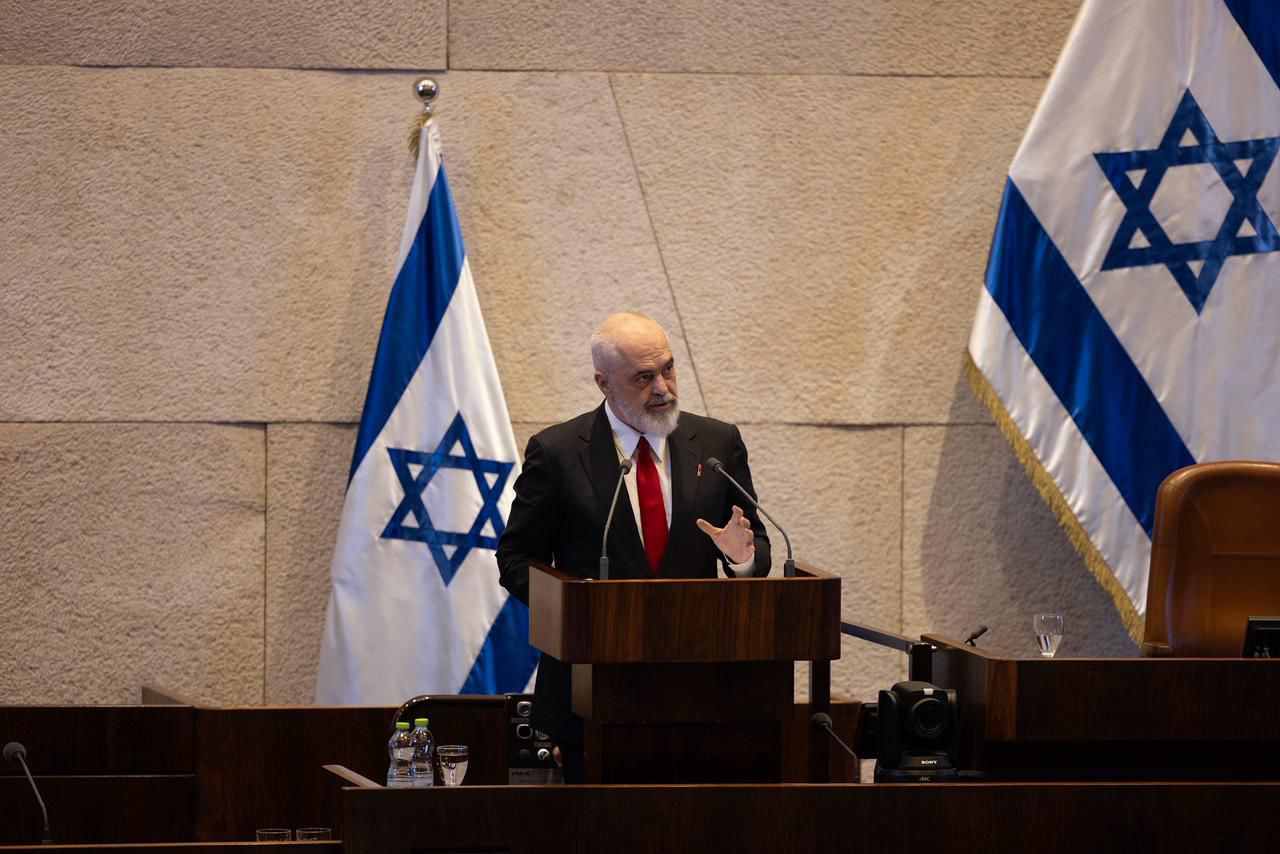
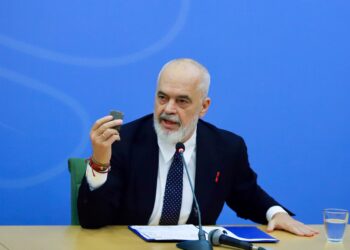
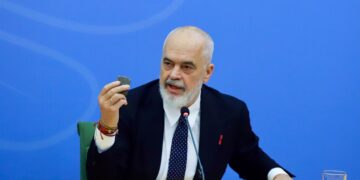
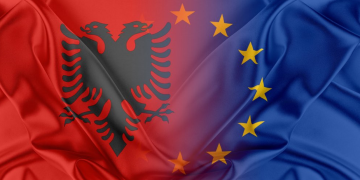
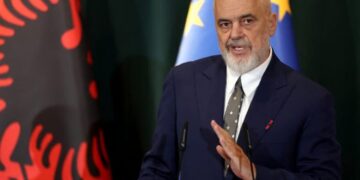
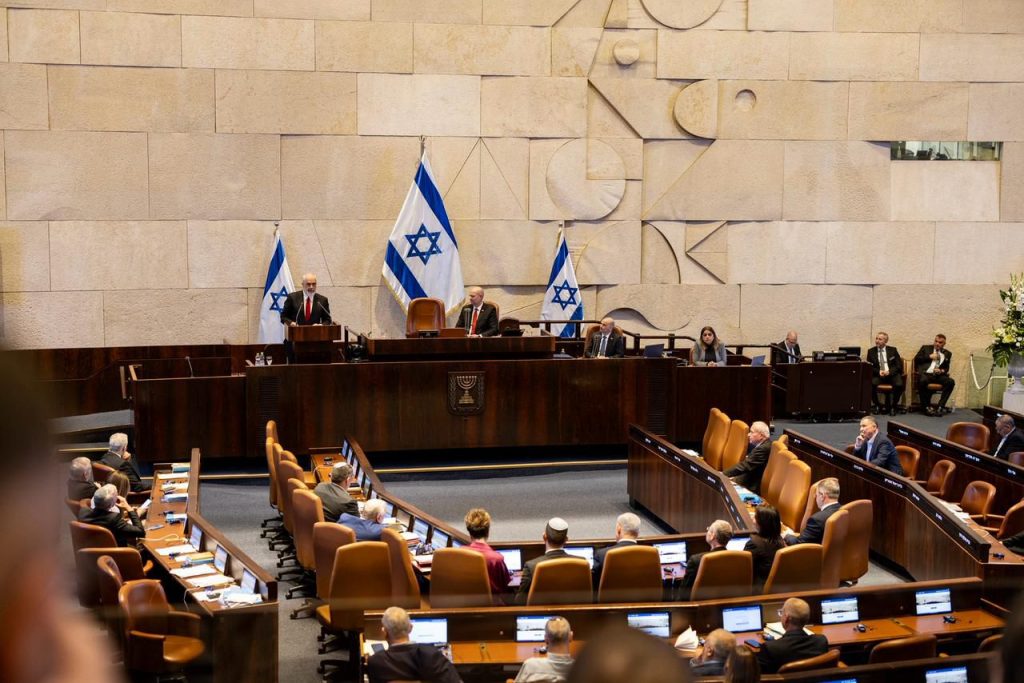
Prime Minister Edi Rama of Albania addressed the Knesset, Israel’s parliament, on Monday in a special session held under a rare protocol reserved for a limited number of foreign leaders. In his address, Rama reflected on Albania’s historic protection of Jews during the Holocaust, reaffirmed his country’s strong ties with Israel, and called for peace rooted in memory, moral responsibility, and shared humanity amid the ongoing war in Gaza.
The full text of Prime Minister Edi Rama’s address follows below:
***
I am still not entirely certain that I am truly standing on the very floor beneath my feet, the same floor from which the most honoured guests of this State have addressed this House. And although modesty has never been my most reliable virtue, I confess that I struggle to believe that I deserve such an immense distinction.
But, I am quite sure that Albania, which I represent with pride, and the people of my nation, who stood as few others did for the Jewish people, truly deserve every respect from the State of Israel. And so did the highly distinguished Presidential Medal of Honour that His Excellency President Herzog, a noble and faithful friend of Albania, bestowed upon me.
“Peace and the mercy of God Almighty be upon you—and may peace be for us all, God willing.”
These were the words with which a human lighthouse of courage and reconciliation, a leader whose life and death were shaped by the relentless pursuit of peace, President Anwar Sadat – of Egypt, may his memory be blessed -opened his historic address to the Knesset from this very place.
He continued:
“Peace for us all on Arab land and in Israel as well, and in every part of this vast world, so burdened by bloody conflicts, torn by sharp contradictions, and threatened again and again by destructive wars launched by man to annihilate his fellow man. For amid the ruins of what humanity has built and the remains of its victims, there emerges neither victor nor vanquished. The only vanquished is man, God’s most sublime creation.”
Words spoken under this roof, drawn from the heart of a general raised in war who, after waging his own, stunned the world by leading his country toward a peace agreement with Israel.
Nearly half a century later, they resonate with the same force and the same urgency as when they were first pronounced.
Honourable Mr President
Mr. speaker,
Mr Prime Minister
Leader of the Opposition
Ladies and gentlemen of the Knesset,
I could not find better words with which to begin my own address, and to steady my breath against the very real emotion I knew I would feel in this special place, and if Mossadhad not yet informed, I can inform you that my knees are trembling, and there is another reason my knees are trembling to be fully sincere with you, i knew that also speaking here would feel like a speech delivery exam having to deliver it in front of one of the top five speakers in the world president Netanyahu.
I will do my best, dear Bibi, to survive your judgment, fully aware that I’m the second speaker after Trump that you cannot simply avoid listening to.
Allow me now to express, with calmer breath, to the speaker of the house, to the prime minister and the leader of the opposition, my deepest and most heartfelt gratitude for welcoming me here today.
Thank you all, I can’t be more grateful.
And returning to my speech, allow me to add something personal, because I have been learnt that among Jews, everything becomes personal.
I am not Muslim, I am Catholic. My better half is Muslim. Our two older children from earlier chapters of our lives are Christian Orthodox. And the youngest, our eleven-year-old boy, will decide for himself one day, but given his uncontainable excitement whenever he is told that we might make wishes at the Western Wall, the possibility that he may yet choose to become Jewish is not far-fetched at all, and that would be fine with us, just as it would absolutely fine to be muslim or to be christian.
But do not be mistaken. This small family portrait is not a unique eccentricity.
It is, in truth, a normal Albanian story. The same is true of our four traditional religious communities, which celebrate each other’s important days, and of their leaders, who gather regularly, as they did to accompany President Herzog when he laid a wreath at our Holocaust memorial in Tirana, during his historic visit as the first-ever Israeli head of state to land in Albania.
It is a spirit forged across centuries of hardship, occupation and poverty.
It was this same spirit that brought Albanians of all faiths into the streets to welcome and greet Pope Francis when he visited our country and, with his gentle and saintly voice, corrected the label we often used. No, said the Holy Father, yours is not religious tolerance. It is a religious fraternity, because it rests not on patience, but on the quiet certainty that faith is not weakened by the presence of another faith; it is strengthened by it.
We proudly count seventy-three Albanians of all faiths recognised as Righteous Among the Nations, whose memory shines within the walls of human dignity at Yad Vashem.
And with the same pride, we will soon open our first museum dedicated to the protection and salvation of Jews in the city of Vlora, Albania’s largest medieval city, where in the sixteenth century, Jews fleeing persecution in the West made up more than half of its population.
Our young people, and the many guests who come from all over the world to visit our beautiful country, where the number of Israeli tourists last year grew far faster than from any other nation, will see with their own eyes and hear with their own ears how small Albania was always a safe refuge for Jews long before our era, and how ordinary Albanians made that very small place the only country on Europe’s map to emerge from the Second World War with more Jews than it had when it entered it.
No one else in Europe can claim such a historical clean sheet, with not a single Jew handed over to the Nazis. No one better than Albania can bear witness to a simple truth, that being Muslim and being antisemitic are not bound together by faith in God, but by its abhorrent betrayal.
And no greater honour, and heavier responsibility, than to bear witness to this truth here, in the heart of Israel, at a moment when the heartbreaking war in Gaza, through the unbearable suffering of innocent families, both Israeli and Palestinian, has opened a new window of opportunity for peace-building efforts to succeed.
There is no doubt that part of this great honour for me is to come here a few days after the Albanian Parliament ratified the decision to join President Trump in his efforts for peace and conflict resolution, and to make Albania a founding member of his Board of Peace, humbly contributing to the monumental task of turning that window into a new horizon of hope and prosperity for the people of Gaza and for the region.
Allow me to take you for a moment, far from Jerusalem, to the centre of our capital city, Tirana.
There is a tunnel beneath its heart.
It was built to torture enemies of the people and ultimately to withstand an attack from the United States or the Soviet Union, a paranoia poured into concrete by a regime that feared every light of freedom and held its own people hostage in an open-air prison. This vivid memory has always made me feel sorry for respected and well-meaning internationals who rightly described Gaza as an open-air prison, but failed to identify the true jailer of the people of Gaza.
They mistook the finger for what it was pointing at and, in doing so, failed to recognize that the jailer of Gaza is Hamas, no one else but Hamas: its ideology of terror against its own people and toward the Jewish nation, its totalitarian dogma that no Palestinian life is worth living until the State of Israel is annihilated and the last Jew is driven from the Holy Land. Therefore, until Hamas is fully dismantled, its two million prisoners will not be free, and no peace will endure.
Today, that tunnel in Tirana has been transformed into a space dedicated to the victims of those who originally constructed it. And I wish with all my heart that a few of the countless tunnels of terror Hamas built, where the hostages taken on 7 October were killed, raped, tortured, and reduced to twenty-first-century human replicas of the prisoners in Nazi Germany’s extermination camps, will be preserved as part of the new Gaza reconstruction plan and later as defining testimony in favour of lasting peace among the Two States.
They should stand as tunnels of collective memory and healing, where both the hellish suffering of the hostages and the enormous loss of Palestinian lives, who were turned into the most terrifying defence infrastructure made of human flesh, may serve as eternally lit candles of forgiveness without forgetting and as a permanent call to all that such horrors which must never happen again.
As you descend the stairs of the Tirana tunnel, a sentence in neon light by Primo Levi watches over you: Those who forget their past are condemned to relive it.
We engraved this very familiar name in light on the wall, and I invoke him here not to create any impossible parallel between the industrial extermination of the Jewish people, an unparalleled crime in the history of humanity, and the tragic suffering inflicted by our brutal communist regime on countless innocent Albanians branded “enemies of the people.”
I bring Primo Levi together with our own tunnel of memory to reassure you that we Albanians know the pain of history’s grave wounds, and to reassure those in the West who hold a very different view from mine about Gaza as an open-air prison that we Albanians learned, in ways difficult to imagine, what happens when ideology becomes a god, when the state becomes an altar, and when people become sheep to be exploited or individuals stripped of their humanity to instill fear.
There is a profound history that binds our peoples together.
The culminating chapter, of course, is the dark time of the Holocaust.
But our shared legacy stretches back centuries: Jews arriving on our shores after the destruction of the Temple; Sephardim fleeing the Reconquista; families seeking refuge in our land again and again whenever Europe embarked on one of its oldest and darkest journeys of the mind, the impulse to hate Jews.
In the 1930s, an American Jew sent to Europe as part of an observation mission, Leo Eton, wrote in a report to the United States Congress that Albania stood out in Europe, documenting our country as a possible place of settlement for Jews fleeing Central and Eastern Europe. He noted that religious pluralism in Albania functioned in practice, not symbolically: Muslims, Orthodox Christians, Catholics, and Jews lived within a framework in which religion did not determine trust among citizens, and Albania, he emphasised, could be underlined a suitable country for Jewish refuge, where no legal or social barriers to Jewish life existed.
It was precisely during those prewar years, as antisemitism was rising across Europe, that Albania went so far as to recognise the observance of the Sabbath as a human right of the Jewish community, becoming a unique country in our part of the world by legally binding both public and private employers to respect that right.
And during the Holocaust, when the Nazi envoy Hermann Neubacher demanded lists of Jews and their gold, our representatives replied with a sentence that deserves to be carved in stone: You can have the gold. Not the Jews. The gold was theirs to take. The Jews were ours to protect.
That is not a legend. That is Albania.
And if you want the explanation for this miracle, you do not need a political theory or a rabbi, although I know rabbis can explain the most difficult things with the simplest words and can even foresee miracles.
But no, you need only one sentence from our first written law, the medieval Code of Honour: The house of the Albanian belongs to God and the guest. Not the guest you invite, but the guest who knocks on your door, the stranger who needs help. Betraying that guest is an unforgivable crime. It stains your reputation with shame and punishes you with exclusion from the life of the community.
Better to die than give up your guest. And since Jews happened to be Albania’s guests when the most fearsome machinery of death humanity had ever created reached our land, for Albanians, and first and foremost for Muslim Albanians, who then formed an overwhelming majority, the choice was cruelly simple: we would rather die than give up our Jews.
This luminous chapter of Albanian history, it carries a message of pressing relevance for today’s world that must be reminded again and again of what Hannah Arendt taught us with ruthless clarity. Evil is often not demonic or spectacular, but ordinary at the risk of being so. It is simply banal.
The tragedy of the Holocaust was not only the cruelty of a few, but it was also the passivity of the many. But in one small country, our country, the opposite happened. Our people were poor; they lacked power, armies, or strategic borders. But they possessed something infinitely more precious for that moment in history. The ability to see a human face and recognise a moral obligation.
When others delivered their Jewish neighbours to the authorities, Albanians delivered them to safety. When obedience became the silent ally of evil, our grandparents chose the perilous path of responsibility.
And in doing so, they kept a corner of Europe human at a time when humanity itself was disappearing day after day.
This story is not an ornament displayed to impress others. It is a compass we must follow if we wish to remain worthy of the gift of life granted to us by the same God, and to make something worthy of that gift on this earth, so that our children and their children will not suffer tomorrow because of what we lack the courage to face today or fail to learn from yesterday.
That is why Albania was among the first countries in Europe to pass new legislation against antisemitism, why we have integrated Holocaust education into our school curricula, and why we are building two particular cultural spaces inspired by the gravitational force of the shining examples set by our Muslim and Christian grandparents who risked their lives to save Jewish lives.
But this is not only about Jews. This is about humanity.
And not humanity as a generic word, but our humanity.
This is why, for many years now, Albania has offered protection to several thousand Iranian citizens whose opposition to the butchers of Tehran placed their lives in grave danger.
It was not without risk for us, and it is not today. To remain human when one’s humanity is under pressure is never without danger. On the contrary. And because we took that risk, some years ago, Albania suffered a massive cyberattack directed from Iran, aimed at destroying our entire digital public infrastructure. We resisted it. They did not prevail.
We were told by powerful friends not to overreact because they are big and dangerous. But we gave Iranian embassy personnel twenty-four hours to leave the country and severed even the thin ties we had with the Khomeinist Republic, which I will never describe as Islamic, because Islam is love and humility, while Khomeinism is hate and death.
And it is not written here, but I simply want to do what Bibi does all the time: step outside the prepared text and say the following.
A friend of ours, whose husband is Iranian, told me that just a few days ago, in a market in Tehran, people were present when a fire was set, and the market was surrounded by killers. The people had two choices: either to burn in the flames inside the market, or to be killed at the doors.
But my question is this: How is this possible?
How is it that, while global media speak of 30,000 people killed in three days, there is not a single gathering in any square around the world against the Ayatollahs, calling for the end of this regime?
Of course, this is a question that does not require an answer from you. You already know the answer.
And as we offered protection to those targeted by the mullahs of Tehran, Albania also became a sanctuary for several thousand others targeted by the mullahs of Kabul during the chaos created by the disorderly withdrawal of coalition forces from Afghanistan.
When many others, larger and wealthier, turned their backs, perhaps because the best and brightest of Kabul society were not white enough or were too Muslim for them, we were blessed to engage in the most extraordinary network of solidarity I have ever seen.
Finance, logistics, and connections were assembled overseas like a hurricane. And it was not the U.S. government that organised it. It was American citizens from every walk of life and from across political divides, who mobilized their humanity to save lives through an astonishing chain of hands forming a triangle between the United States, Albania, and Qatar, where the Qatari foreign minister at the time, today’s Prime Minister Mohammed bin Abdulrahman, became a kind of control tower of hope and turned Doha airport into an escape route toward life for thousands of people who were welcomed with compassion in Albania.
Let me assure you that I am not here, God forbid, to lecture anyone. Not only because small countries like mine do not lecture but are lectured all the time, but also because I believe that those who lecture Israel from afar run a serious risk of being not merely unfair, but fundamentally unjust.
Nevertheless, I strongly believe that seeking peace is never about how bad or unreliable the other side has been, but about how faithful one chooses to remain to one’s own values.
The stunning peace agreement between Israel and the UAE, in which a one-of-a-kind world leader such as Sheikh Mohammed bin Zayed broke with long ages of conflict and taught the world by example that, if we remember that God is on our side and also on the other side, and are brave enough to realize that under heaven’s eye we are all on the same side of peace, then peace is not merely a possible path toward the future, it is the only possible avenue of the future.
More than that, I firmly believe that what makes this new window of opportunity unique is what I call the Florence moment of the Middle East. What is happening in your neighbourhood resembles, in my eyes, what occurred in Europe when visionary leadership inspired by modernity and beauty turned Florence into the cradle of the Renaissance. Israel is no longer alone in seeking transformation, innovation, and global leadership for the future in this part of the world.
From the streets of Riyadh to the green oases of Abu Dhabi and the vibrant waterfronts of Doha, one can feel a mesmerising wind of change that has little to do with the old caricature of gilded spectacle in the desert. Saudi Arabia, under its driven and visionary young leader, whose traits recall Lorenzo the Magnificent of Florence, is changing at breathtaking speed. The UAE has placed itself at the forefront of global leadership on the green agenda, while Qatar, led for over a decade by its young and farsighted Emir, Sheikh Tamim bin Hamad Al Thani, has made an extraordinary leap onto the world stage and, thanks also to the defining role played by his sister, Sheikha Al Mayassa, is becoming a major laboratory for next-generation urban and lifestyle transformation. The common denominator among your Arab neighbours is a drive to modernise in every direction and to beautify at every step, and together they are making Europe’s old and marvellous playground look suddenly cautious and dim.
How can this extraordinary story of a bright future being written in the desert coexist with the great open wound of a conflict that has brought such prolonged suffering and destruction, a wound that remains in the heart of the Middle East like a trap capable of swallowing the very greatness now being built around it? It is impossible to sustain both for long.
Therefore, I sincerely hope that the Abraham Accords will continue, and I hope that perhaps, by looking at a bloody past through the eyes of a brighter future rather than the other way around perhaps by looking at the past through the eyes of that brighter future, rather than the other way around, this region as a whole may, as the UAE and a few others already have, not only show that peace is possible, but that peace can elevate all peacemaking nations almost as a miracle within the realm of the Abrahamic faiths.
Albania could not feel more blessed than to count both Israel and the Arab countries among its close friends, and Turkiye too. We seek to deepen these relationships, and we stand firm in our readiness to participate, together with our Arab brothers and others, in the coming international stabilisation force in Gaza.
The generous time you have allowed me to occupy this very special place is now drawing to an end. And as I opened with the words of an Arab martyr for peace addressed to this house, let me close with the words of a Jewish martyr for peace, Prime Minister Yitzhak Rabin, may his memory be a blessing, spoken to Israelis and Palestinians precisely thirty years ago from this very place where I stand today:
From the depths of our hearts, we call upon all citizens of the State of Israel, certainly those who live in Judea, Samaria, and the Gaza Strip, as well as Palestinian residents, to give the establishment of peace a chance, to give an end to acts of hostility a chance, to give another life a chance, a new life. We appeal to Jews and Palestinians alike to act with restraint, to preserve human dignity, to behave fittingly, and to live in peace and security.
We are embarking upon a new path which could lead us to an era of peace, to the end of wars.
May the memory of those who perished be a blessing.
May the courage of those who refused to comply remain a compass.
May the State of Israel be safe for eternity.
May Palestinians live with dignity in their own state.
And may our two small nations, immense in spirit, remain bound not only by history, but by a shared commitment to keep humanity human.
© 2026 Argumentum