







• SHQIPËRI
  • KOSOVË
  • MAQEDONIA E VERIUT
  • MALI I ZI
  • Revista në PDF
19 August, 2026
  • Home
  • OP/ED

    Between Political Calculation and Retreat: Croatian Communists at the End of an Era

    The West is buying time, but to whom is it giving it?

    27 July 1941 – A Site of Memory Between War, Revolution and Europe

    The cult of Saint Veneranda / Saint Pren(d)a / Saint Premte / Saint Paraskeva among Albanians

    The Self-Inflicted Decoupling: How U.S. Immigration Policy Is Ceding the Tech Edge to China

    The Blueprint Does Not Stop at the Drina

    The Underlying Logic behind China’s Economic Success

    Do Not Misuse the U.S. Declaration of Independence to Justify the Narrative of Insurrection in Albania

    The visit that changed Albania’s strategic future

  • Interview

    Exclusive Interview with Oleksandr Tyshchenko: A 40-Year Legacy of Chernobyl, Nuclear Risks, and Global Responsibility

    INTERVIEW: ZLATKO KRAMARIĆ – THOUGHTS ON THE OLD CONTINENT

    EXCLUSIVE / Ukrainian Ambassador to Albania, Volodymyr Shkurov: “Ukraine wants peace, but not at the expense of its freedom and independence”

    EXCLUSIVE| Ambassador Tayyar Kagan Atay: Türkiye and Albania, a Strategic Partnership Rooted in Shared Heritage and a Common Vision for the Future

    “Diplomacy, Not War”: Palestinian Ambassador to Albania Calls for Justice, Peace, and Global Action for Gaza

    Exclusive: “Even After Tito – Tito”/ Ambassador Zlatko Kramarić on Authoritarian Legacies and Democracy’s Future in the Balkans

    The Conclusion of the Diplomatic Mission / Ambassador Dancho Markovski: Strengthening Albania-North Macedonia Relations for a Shared European Future

    A Century of Diplomatic Relations Between Albania and Russia: Exclusive Interview with the Russian Ambassador to Albania, H.E. Alexey Zaytsev

    Exclusive/ The chairman of the Freedom Party, Ilir Meta: “The will of the citizens will triumph in Albania, as it did in North Macedonia”

  • Realpolitik

    The Summit of Unity! Think of peace and prepare for war! It’s only the start to the end! Just a pause between two wars!

    Peace with war diplomacy! The protest,  image and tourism! Why this silence from the EU Commission and Council? A deal or a pause?

    Just kind words  in Tivat! Where is the peace!? A deal yes, peace No!What is happening with USA and  EU?  5 elections but no solution!

    IBAR? ”Sufficiently! Much ado about nothing! Shart contrasts in Beijing! Where is the exit?!

    Neither peace nor war! Peace with bombs?! IBAR in autumn?! Not another Hormuz in Taivan! 

    IBAR – a springing board or an obstacle? Can we catch the EU Negotiation train 2027? When the dress makes the news!  EU electoral April  ends in a draw 1:1!  

    The European Parliament building in Strasbourg, France with flags waving calmly celebrating peace of the Europe. July 12, 2020.

    EU 2027 or 2037! Even half membership failed! No exit strategy!     

    What next?

    “With diplomatic velvet“! Major question marks! In Washington yes, but  in the White House NO! A strange dinner in Brussels!

  • Current Events

    Democracy Cannot Be Governed by Noise

    Council of Albanian Ambassadors Raises Concern Over Serbian Plan to Alter the Ibër River

    Digitalisation in the modern era as a “Trojan horse” for hybrid warfare

    The four days that changed history

    Bury Those You Killed

    The Serbian Consulate in Shkodra: A Diplomatic Step or a Project with Political Implications?

    Chinese Embassy in Albania Marks PLA’s 99th Anniversary, Reaffirms Commitment to Peace and Bilateral Cooperation

    Croatian Foreign Minister’s Visit to Tirana/Albania and Croatia Strengthen Their Strategic Partnership as Zagreb Reaffirms Support for Albania’s European Union Membership

    Albanian Parliament Approves $302 Million U.S. Military Financing Loan, Opposition Boycotts Session

  • Top News

    Council of Albanian Ambassadors Raises Concern Over Serbian Plan to Alter the Ibër River

    Rama: Foreign Information Manipulation Has Become One of the Greatest Threats to Democracy and European Security

    The Council of Albanian Ambassadors condemns chauvinistic rhetoric by Serbian officials and calls for diplomatic action

    NATO at Ankara 2026: Strategic Rebalancing Between Russia Deterrence, Turkey’s Rise, and National Interests

    Daniel Serwer: A Bad War Ending Badly May Still Be Good News

    Friedrich Merz, Keir Starmer, António Costa, Donald Trump, Emmanuel Macron, Mark Carney, Ursula von der Leyen, Giorgia Meloni and Sanae Takaichi

    G7 Leaders Gather in Évian Amid Global Uncertainty, Focus on Security, Economy and International Cooperation

    Russian Ambassador in Tirana: “Without a Strong and Sovereign Russia, the Creation of a Just World Order Is Impossible”

    “The Flamingo Revolution”: Day 10 of Protests in Albania Draws International Attention

    Rama alleges ‘hybrid war’ behind protests against Kushner-linked coastal development

  • YOUR VOICE
  • Shqip
No Result
View All Result
Argumentum
  • Home
  • OP/ED

    Between Political Calculation and Retreat: Croatian Communists at the End of an Era

    The West is buying time, but to whom is it giving it?

    27 July 1941 – A Site of Memory Between War, Revolution and Europe

    The cult of Saint Veneranda / Saint Pren(d)a / Saint Premte / Saint Paraskeva among Albanians

    The Self-Inflicted Decoupling: How U.S. Immigration Policy Is Ceding the Tech Edge to China

    The Blueprint Does Not Stop at the Drina

    The Underlying Logic behind China’s Economic Success

    Do Not Misuse the U.S. Declaration of Independence to Justify the Narrative of Insurrection in Albania

    The visit that changed Albania’s strategic future

  • Interview

    Exclusive Interview with Oleksandr Tyshchenko: A 40-Year Legacy of Chernobyl, Nuclear Risks, and Global Responsibility

    INTERVIEW: ZLATKO KRAMARIĆ – THOUGHTS ON THE OLD CONTINENT

    EXCLUSIVE / Ukrainian Ambassador to Albania, Volodymyr Shkurov: “Ukraine wants peace, but not at the expense of its freedom and independence”

    EXCLUSIVE| Ambassador Tayyar Kagan Atay: Türkiye and Albania, a Strategic Partnership Rooted in Shared Heritage and a Common Vision for the Future

    “Diplomacy, Not War”: Palestinian Ambassador to Albania Calls for Justice, Peace, and Global Action for Gaza

    Exclusive: “Even After Tito – Tito”/ Ambassador Zlatko Kramarić on Authoritarian Legacies and Democracy’s Future in the Balkans

    The Conclusion of the Diplomatic Mission / Ambassador Dancho Markovski: Strengthening Albania-North Macedonia Relations for a Shared European Future

    A Century of Diplomatic Relations Between Albania and Russia: Exclusive Interview with the Russian Ambassador to Albania, H.E. Alexey Zaytsev

    Exclusive/ The chairman of the Freedom Party, Ilir Meta: “The will of the citizens will triumph in Albania, as it did in North Macedonia”

  • Realpolitik

    The Summit of Unity! Think of peace and prepare for war! It’s only the start to the end! Just a pause between two wars!

    Peace with war diplomacy! The protest,  image and tourism! Why this silence from the EU Commission and Council? A deal or a pause?

    Just kind words  in Tivat! Where is the peace!? A deal yes, peace No!What is happening with USA and  EU?  5 elections but no solution!

    IBAR? ”Sufficiently! Much ado about nothing! Shart contrasts in Beijing! Where is the exit?!

    Neither peace nor war! Peace with bombs?! IBAR in autumn?! Not another Hormuz in Taivan! 

    IBAR – a springing board or an obstacle? Can we catch the EU Negotiation train 2027? When the dress makes the news!  EU electoral April  ends in a draw 1:1!  

    The European Parliament building in Strasbourg, France with flags waving calmly celebrating peace of the Europe. July 12, 2020.

    EU 2027 or 2037! Even half membership failed! No exit strategy!     

    What next?

    “With diplomatic velvet“! Major question marks! In Washington yes, but  in the White House NO! A strange dinner in Brussels!

  • Current Events

    Democracy Cannot Be Governed by Noise

    Council of Albanian Ambassadors Raises Concern Over Serbian Plan to Alter the Ibër River

    Digitalisation in the modern era as a “Trojan horse” for hybrid warfare

    The four days that changed history

    Bury Those You Killed

    The Serbian Consulate in Shkodra: A Diplomatic Step or a Project with Political Implications?

    Chinese Embassy in Albania Marks PLA’s 99th Anniversary, Reaffirms Commitment to Peace and Bilateral Cooperation

    Croatian Foreign Minister’s Visit to Tirana/Albania and Croatia Strengthen Their Strategic Partnership as Zagreb Reaffirms Support for Albania’s European Union Membership

    Albanian Parliament Approves $302 Million U.S. Military Financing Loan, Opposition Boycotts Session

  • Top News

    Council of Albanian Ambassadors Raises Concern Over Serbian Plan to Alter the Ibër River

    Rama: Foreign Information Manipulation Has Become One of the Greatest Threats to Democracy and European Security

    The Council of Albanian Ambassadors condemns chauvinistic rhetoric by Serbian officials and calls for diplomatic action

    NATO at Ankara 2026: Strategic Rebalancing Between Russia Deterrence, Turkey’s Rise, and National Interests

    Daniel Serwer: A Bad War Ending Badly May Still Be Good News

    Friedrich Merz, Keir Starmer, António Costa, Donald Trump, Emmanuel Macron, Mark Carney, Ursula von der Leyen, Giorgia Meloni and Sanae Takaichi

    G7 Leaders Gather in Évian Amid Global Uncertainty, Focus on Security, Economy and International Cooperation

    Russian Ambassador in Tirana: “Without a Strong and Sovereign Russia, the Creation of a Just World Order Is Impossible”

    “The Flamingo Revolution”: Day 10 of Protests in Albania Draws International Attention

    Rama alleges ‘hybrid war’ behind protests against Kushner-linked coastal development

  • YOUR VOICE
  • Shqip
No Result
View All Result
Argumentum
No Result
View All Result
Home ENGLISH

Science Diplomacy and Academic Freedom: A strategic nexus for contemporary diplomacy

27 April, 2026
in ENGLISH, English OP/ED
A A
Share on FacebookShare on Twitter

Arben Cici,

Ambassador

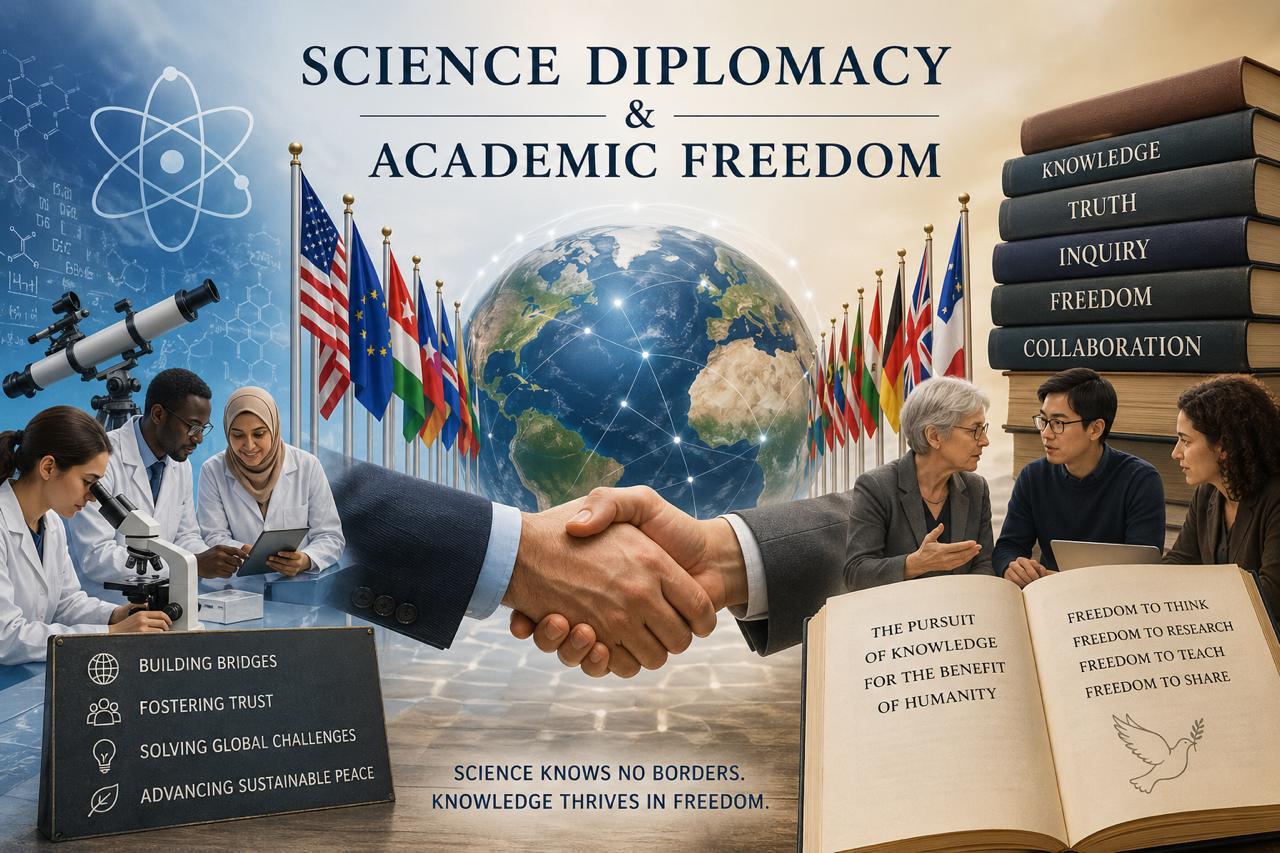
In an increasingly interconnected and complex international system, diplomacy is no longer confined to traditional political negotiation. It has expanded into domains where knowledge, expertise, and innovation play a decisive role. Within this transformation, the relationship between science diplomacy and academic freedom has emerged as a crucial pillar of modern international engagement. There is, in fact, a strong and mutually reinforcing relationship between the two: without academic freedom, science diplomacy loses credibility; without science diplomacy, academic freedom lacks global reach. This interdependence positions both as strategic assets in the conduct of contemporary diplomacy. This deep interdependence shapes how states build trust, influences international agendas, and addresses transnational challenges

Science diplomacy refers to the use of scientific cooperation among nations to address common challenges and to foster constructive international partnerships. It operates at the intersection of science, technology, and foreign policy, encompassing three main dimensions: “science in diplomacy” (informing foreign policy with scientific advice), “diplomacy for science” (facilitating international scientific collaboration), and “science for diplomacy” (using scientific cooperation to improve international relations).

Academic freedom, on the other hand, refers to the autonomy of scholars and researchers to pursue knowledge, conduct research, teach, and publish without undue interference or restriction from any national or international political power. It guarantees intellectual independence and is a fundamental principle of higher education and scientific progress, ensuring that research remains independent, critical, innovative and credible.

The combination of these two concepts is not accidental. Science diplomacy depends fundamentally on the openness, credibility, integrity, and independence guaranteed by academic freedom while academic freedom gains international relevance, visibility, protection, and global influence through diplomatic channels.

Fields of cooperation and the importance of this relationship

The interaction between science diplomacy and academic freedom is most visible in international research, academic mobility, and foreign policy advice. Cross-border scientific partnerships require environments where ideas can circulate freely, making academic freedom a prerequisite for meaningful collaboration. Universities and research institutions serve as platforms for sustained international dialogue, while scholars act as informal ambassadors of knowledge and culture.

Another important area is foreign policy advice. Governments increasingly rely on independent academic expertise to inform diplomatic decision-making. Evidence-based policies enhance the legitimacy and effectiveness of diplomatic action, especially on issues such as climate change, public health, and new technologies, but also on international law and the history of international relations.

Diplomatic benefits and strategic use

Diplomacy does not merely benefit passively from this relationship; it actively leverages it as a strategic asset. If the link between science diplomacy and academic freedom weakens, diplomacy loses one of its most credible and low-conflict instruments. The importance of this relationship today can be understood through several key dimensions.

First, it builds trust and credibility. Science diplomacy relies on open and impartial research, protected by academic freedom, to build international trust. The growth of soft power is linked to legitimacy, and states that support academic freedom demonstrate openness and credibility, increasing their influence without resorting to coercive means.

Second, it enables the exchange of knowledge. Academic freedom allows the free flow of ideas across national and state borders, which is the fundamental mechanism of science diplomacy. The diplomacy of smart countries, in practice, uses this connection by funding joint research programs, promoting academic exchanges, integrating science advisors into foreign policy, using universities as neutral spaces for dialogue, protecting academic freedom, and supporting open science initiatives and data sharing.

Third, it contributes not only to the mitigation of conflicts, but also to their prevention, thereby influencing regional or global stability. Independent researchers, through academic networks and long-term relationships between them, increase trust between countries and become bridges and platforms that can maintain dialogue even in times of political tension, acting as informal diplomatic channels.

Fourth, it increases the capacity for regional and global problem-solving, enabling international cooperation that traditional diplomacy cannot achieve alone. Regional and global challenges, such as climate, pandemics, health, and artificial intelligence, require free and unrestricted cooperation in research.

Fifth, it creates an evident advantage for diplomatic policymaking by relying on evidence and facts. Diplomats who rely on independent science to negotiate on complex bilateral, regional, or global issues seem to be the most successful. Thanks to scientific knowledge, this form of soft authority, and a common language that transcends ideological and political divides, a neutral ground for dialogue and negotiation is created. Science therefore has a powerful, albeit silent, role in diplomatic processes.

Last but not least, academic experience and the power of science bring a special form of expertise to diplomacy. Experience in scientific research, critical analysis and interdisciplinary cooperation enable researchers to offer long-term perspectives and innovative solutions. Unlike political actors who operate within the short-term constraints of domestic politics, this experience transcends those limitations to offer a long-term vision, solely in the benefit of national interests. Intergovernmental and interstate treaties (cross-border cooperation, trade, maritime, cultural agreements, strategic pacts, etc.), accessions to international organizations or conventions do not succeed in the spotlight, the red carpet or official photos, nor in social media posts and wooden language, or jokes, but in the depth, strength, and seriousness of prior coordination through scientific diplomacy and academic freedom.

Implications for small countries: The case of Albania

For small countries like Albania, the strategic use of the relationship between scientific diplomacy and academic freedom is particularly important. In the absence of hard power, these countries can rely on knowledge, education, and innovation to increase their international influence.

By strengthening academic freedom and investing in scientific research, Albania can increase the credibility of its academic community. Involvement in international research networks and diplomatic initiatives enables the country to contribute to global discussions and build strategic partnerships.

Academic mobility and international cooperation also increase the country’s soft power. Researchers and students become carriers of national intellectual capital, strengthening Albania’s presence in the international arena.

Through science diplomacy, Albania can “punch above its weight,” influencing international agendas and building collaborations that go beyond traditional diplomatic capacities.

Ultimately, the relationship between science diplomacy and academic freedom is essential in today’s world. Academic freedom gives science diplomacy its credibility, while science diplomacy provides academic freedom with global reach and influence. Together, they form a powerful nexus that strengthens trust, fosters cooperation, and improves diplomatic practice.

Albania, as a small country with limited resources, does not have the luxury of failing to fully exploit the potential offered by the combination of scientific diplomacy and academic freedom. On the contrary, it should turn this into a strategic advantage, especially on its path toward European integration. A more proactive approach requires the design of a comprehensive and “absorptive” strategy that integrates academic expertise into foreign policy processes. The reconceptualization of the Diplomatic Academy of the Ministry for Europe and Foreign Affairs as a functional structure with a contemporary mindset would enable proactive communication with academic, scientific, and university circles at home and abroad for the benefit not only of the professional and qualitative preparation of young diplomats, but also of the creation of a diplomatic culture based on knowledge, critical analysis, and international interaction.

Through the interaction “scientific diplomacy & academic freedom,” Albania, in particular, could build a more strategic, more effective, and more future-oriented diplomacy, increase its international credibility, and position itself more dynamically in integration processes and in the global arena to serve its national interests in the long term.

/Argumentum.al

© 2026 Argumentum

Related Posts

ENGLISH

In Search of Lost Childhood and Land [1]

17 August, 2026
ENGLISH

The Ibar River Should Carry Water, Not Nationalist Politics

12 August, 2026
ENGLISH

Between Political Calculation and Retreat: Croatian Communists at the End of an Era

10 August, 2026

Follow US

Subscribe

Receive Argumentum Magazine by Email

Last Posts

Democracy Cannot Be Governed by Noise

19 August, 2026

In Search of Lost Childhood and Land [1]

17 August, 2026

The Ibar River Should Carry Water, Not Nationalist Politics

12 August, 2026

Between Political Calculation and Retreat: Croatian Communists at the End of an Era

10 August, 2026

The West is buying time, but to whom is it giving it?

10 August, 2026
Argumentum

“Argumentum”, një proces intelektual …

Contact Us

[email protected]
[email protected]
[email protected]

Follow Us

Media Partner

Register

Receive Argumentum Magazine by Email
  • Home
  • Privacy Policy
  • About Us
  • Contact

© 2022 Argumentum. All Rights Reserved. | NUIS: L91415033Q

Welcome Back!

Login to your account below

Forgotten Password? Sign Up

Create New Account!

Fill the forms bellow to register

*By registering into our website, you agree to the Terms & Conditions and Privacy Policy.
All fields are required. Log In

Retrieve your password

Please enter your username or email address to reset your password.

Log In

Add New Playlist

No Result
View All Result
  • Home
  • OP/ED
  • Interview
  • Realpolitik
  • Current Events
  • Top News
  • YOUR VOICE
  • Shqip

© 2022 Argumentum. All Rights Reserved. | NUIS: L91415033Q

This website uses cookies. By continuing to use this website you are giving consent to cookies being used. Visit our Privacy and Cookie Policy.