
























By Zlatko Kramarić*|ARGUMENTUM
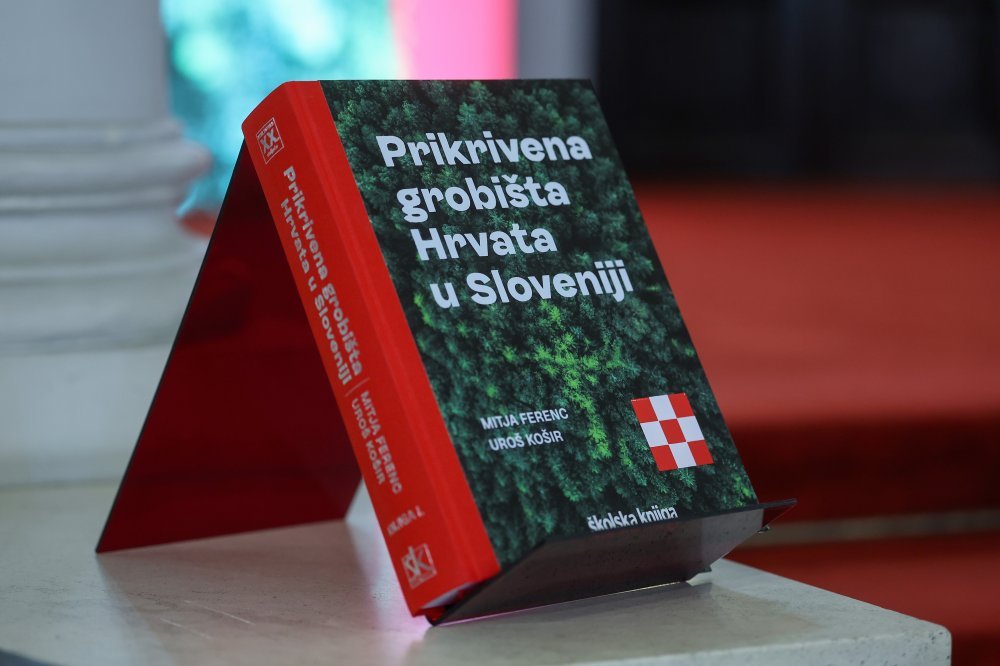
The monograph presents a systematically documented investigation of post-war concealed mass graves on the territory of Slovenia, focusing primarily on the suffering of Croats at the end of and immediately after the Second World War. Methodologically, it is a work that combines archaeological field findings, forensic analysis, topographic documentation, and historiographical contextualization. It is precisely such an interdisciplinary approach that constitutes the book’s greatest value, because instead of interpretative speculation, the authors offer materially grounded data, site cartography, and an overview of research procedures that allow the verification of their (harrowing) findings.
In this way, the book enters a space where science and public memory inevitably intersect. It is here that its social relevance begins: it does not remain merely an inventory of the horrific execution sites of our traumatic past (stemming from the criminal decisions of the new communist authorities to kill tens of thousands of people—civilians, women, and children—after the end of all military operations, without any judicial procedure), but becomes a document of a long-standing regime of silence, of the administrative and political obstacles that prevented the investigation of these “uncomfortable episodes” of the communist past. This resulted in tensions between forensic truth and official/party narratives about these terrible post-war events. It is therefore not surprising that a sense of fear and ontological insecurity became a hallmark of a totalitarian regime, in which the consequences of the Red Terror, partisan crimes, Bleiburg and the Way of the Cross, Goli Otok, and systematic liquidations of the “class enemy” had to remain unspoken.
In the foreword, Ante Žužul sets out a strong normative premise: he interprets the phenomenon of hidden mass graves as a symptom of the moral and political legacy of Yugoslav communism. His text functions as an ethical introduction, rhetorically elevating the issue to the level of a civilizational question—the right of victims to identity, a grave, and recognition. In that sense, the foreword is suggestive and mobilizing; it introduces the reader to the topic through categories of responsibility, debt toward innocent victims (including the author’s own uncle, who was only nineteen years old, yet that fact alone was enough for Simo Dubajić to have the young man killed without trial), and historical justice. It is inconceivable that Croatian—and not only Croatian—youth could be killed and that such mass murder of innocent people should be considered normal, or reduced by some historians to an “excess” of the new authorities, as if there had been no plan, as if “some comrades simply went too far.” Available documents, however, suggest the opposite: these unnecessary killings were indeed planned, and were known to Josip Broz Tito, Aleksandar Ranković, Vladimir Bakarić, Edvard Kardelj, Milovan Đilas, and others. When discussing the differences between fascism and communism—between two totalitarian systems—from the perspective of the victim there are no essential differences, least of all ethical ones.
At the same time, precisely because of its strong value-oriented tone, the foreword may function as an interpretative framework preceding the empirical material and potentially directing the reception of what the book contains. For scholarly discourse, this is an ambivalent gain: on the one hand, it heightens awareness of the ethical dimension of research; on the other, it risks having methodologically neutral material read through a pre-established teleology. Yet this tension is less a weakness of the book than a symptom of a broader debate on how to write about traumatic histories in the post-Yugoslav space.
In the afterword, Robin Harris shifts the focus toward a European horizon. His text interprets the findings of Ferenc and Košir as part of a wider continental confrontation with totalitarian legacies. In this sense, the afterword forms a bridge between local empiricism and European memory culture, emphasizing the need for institutional transparency, archival openness, and a comparative perspective. For readers who critically reflect on the “European spirit” as a normative framework of political modernization, Harris’s approach raises a key question: can European integration be credible without symmetrical recognition of all traumatic experiences of the twentieth century? The afterword thus functions as an interpretative epilogue situating the book within the broader project of European memory politics. Harris also suggests that this book represents an important step toward a more official and comprehensive examination of a part of history that has long been marginalized or systematically suppressed.
Ferenc and Košir demonstrate a high level of research discipline: precise locational records, documentation of stratigraphy, and systematic presentation of findings enable the reader to distinguish facts from interpretations. This level of empirical reliability makes the book a reference work for further research. Precisely because the empirical foundation is so strong, however, the interpretative layer calls for further pluralization of perspectives. The historical context of post-war violence is complex and multidimensional; future studies should therefore more strongly incorporate a comparative framework of Southeastern Europe and further elaborate the relationship between political order, wartime transition, and patterns of retribution. This would reduce the risk of scientific material being reduced to a one-directional narrative scheme.
In light of recent analyses of jubilees and memory practices in the Balkans, this monograph may be read as a study of the transformation of silence into knowledge. It shows how memory politics is shaped not only through commemorations and symbols, but also through archaeological work, archives, and institutional will. The book thus offers a model of how empirical research can become the foundation of a public ethics of remembrance.
Hidden Mass Graves of Croats in Slovenia are simultaneously a scholarly inventory and a memorial challenge. The strength of the work lies in its empirical precision and interdisciplinarity; its public importance derives from its call for recognition and transparency. The foreword and afterword provide a strong normative and European framework, while also opening a debate about the limits of interpreting traumatic histories. They supply a context that helps us understand not only the data, but also the moral and historiographical weight of the subject. Ultimately, the book encourages further research and an open historical discussion about disrupted memories.
In this intersection of science and ethics, the book confirms a fundamental intention also present in our essays on the European spirit (Argumentum, Tirana, 2026): political modernity is not only an institutional order, but also a society’s capacity to make its own past an object of knowledge rather than silence. We in Croatia remained silent for far too long, and, as things currently stand, we are convinced that even the Homeland War and all its derivations will have to be reread and reinterpreted—not least because, if “others” were to explain what happened in these regions during the 1990s, future generations might once again require new researchers to uncover the documentary truth about that extraordinary period.
*Zlatko Kramarić is a Croatian publicist, author, and diplomat, currently serving as Ambassador to Albania. Formerly a university professor and politician, he is known for his work in literature, cultural studies, and regional history.
© 2025 Argumentum