

























By Zlatko Kramarić*|ARGUMENTUM
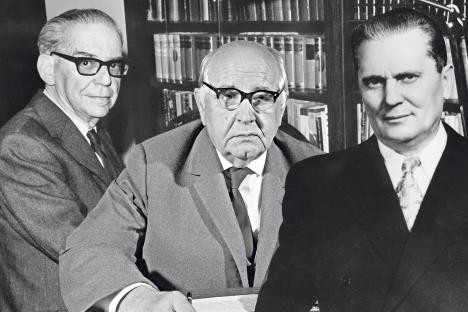
The Austro-Hungarian Monarchy (1867–1918) was a complex political, cultural, and economic entity that simultaneously shaped and constrained national and individual identities. Three key South Slavic figures – Josip Broz Tito, Miroslav Krleža, and Ivo Andrić – developed their positions amidst tensions between the central court, modernization impulses, and peripheral localities. Their experiences reflect the multi-layered life within the empire, intertwining bureaucracy, science, arts, urbanization, and social inequality.
1. Political Framework and 1848
The year 1848 marked the beginning of modern political tensions: revolutions in Vienna, Prague, and Budapest, demands for national rights, constitutional reforms, and economic liberalization. These revolutions exposed limitations of central authority, while highlighting the potential of civil society and public intellectual life.
Tito, though born later, internalized centralism and discipline, shaping his organizational model of socialist Yugoslavia^[1].
Krleža experienced political authoritarianism as restrictive for Slavic intellectuals, yet recognized the importance of high cultural standards and intellectual freedom^[2].
Andrić analyzes the tension between imperial center and peripheral Bosnia, where political order meets local customs and identities^[3].
The court and bureaucracy shaped the trio’s political sensibilities, creating a contrast between order and freedom, discipline and creativity, reflected in their later works and political projects.
2. Cultural Horizons: Literature, Psychoanalysis, Music, and Architecture
Literature and Philosophy
Robert Musil (The Man Without Qualities) and Hermann Broch (The Sleepwalkers) analyze modern fragmentation and existential dilemmas^[4].
Franz Kafka (The Trial, The Castle) illustrates bureaucratic absurdity, echoing imperial everyday life known to Krleža and Andrić.
Karl Kraus critiques public opinion and media; Krleža internalizes this in his cultural criticism.
Stefan Zweig chronicles psychological complexity, modeling introspective narrative styles later adopted by Andrić.
Psychoanalysis
Sigmund Freud: unconscious dynamics, power relations, and repressed desires shape understanding of identity and social control^[5].
Otto Weininger: gender and character theories contrast with traditional values, influencing Krleža’s and Andrić’s critical reflection.
Music and Architecture
Gustav Mahler and Richard Strauss epitomize Central European cultural sophistication, resonating with urban modernity.
Adolf Loos and the Secession movement influenced urban aesthetics; Loos’s dictum “Ornament is crime” resonates in Krleža’s urban modernist critique.
Science and Urbanization
Imperial cities (Vienna, Prague, Budapest) were centers of industrial modernization, infrastructure, and academic life, providing models of rational social organization – internalized by Tito, while Krleža and Andrić focused on human and peripheral perspectives.
3. Economic Structure and Social Inequalities
The empire featured significant economic stratification:
Industrial and cultural centers vs. agrarian peripheries.
Urbanization, infrastructure, and taxation policy.
Tito views imperial modernization as a template for later socialist reorganization.
Krleža critiques inequality and bureaucratic dominance.
Andrić depicts the conflict of tradition and modernization in peripheral provinces.
4. Literary Works and Imperial Influence
Krleža: Povratak Filipa Latinovicza – critique of centralism and cultural elite, reflecting imperial order vs. local resistance^[6].
Andrić: The Bridge on the Drina – portrays imperial administrative order and Balkan identity pluralism.
Tito: biographical data (working-class background, experience of centralism) show internalization of discipline and modernization models.
Conclusion
Austro-Hungary, with its political apparatus, cultural wealth, and economic complexity, shaped the horizons of Tito, Krleža, and Andrić.
Tito internalized discipline and rational modernity.
Krleža balances fascination with critical skepticism.
Andrić synthesizes center-periphery perspectives.
Their relationship to the empire reflects the Slavic encounter with Central European hegemony, where modernizing fascination meets emancipatory and cultural resistance.
Bibliography
1. Banac, Ivo. The National Question in Yugoslavia. Ithaca: Cornell University Press, 1984.
2. Marović, Hrvoje. Miroslav Krleža and Austro-Hungarian Critical Horizons. Zagreb: HAZU, 2005.
3. Dulić, Tomislav. Andrić and Imperial Bosnia. Belgrade: Službeni glasnik, 2010.
4. Musil, Robert. The Man Without Qualities. London: Picador, 1995; Broch, Hermann. The Sleepwalkers. New York: Viking, 1985; Kafka, Franz. The Trial. London: Penguin, 2009; Kraus, Karl. The Last Days of Mankind. London: Pushkin Press, 2010; Zweig, Stefan. The World of Yesterday. London: Pushkin Press, 2009.
5. Freud, Sigmund. The Interpretation of Dreams. New York: Basic Books, 2010; Weininger, Otto. Sex and Character. London: Routledge, 2003.
6. Krleža, Miroslav. Povratak Filipa Latinovicza. Zagreb: Znanje, 1932.
7. Andrić, Ivo. Na Drini ćuprija. Zagreb: Prosvjeta, 1945.
8. Loos, Adolf. Ornament and Crime. Vienna: 1908.
*Zlatko Kramarić is a Croatian publicist, author, and diplomat, currently serving as Ambassador to Albania. Formerly a university professor and politician, he is known for his work in literature, cultural studies, and regional history.
© 2025 Argumentum