














By Zlatko Kramarić*
In Mediterranean culture, the sea is not merely a geographical fact, but rather a civilizational principle. The Mediterranean is recognized through a culture of navigation, movement, exchange, ports, trade, dialogue, and the constant mixing of identities. From ancient Greece and Rome to the Venetian and Dubrovnik traditions, the sea has never separated spaces, but has always connected distant and diverse regions. It has created a sense of openness toward the Other, toward the world, toward the idea of travel and communication, which often ends in endless, and sometimes meaningless, “chatter”!
In that sense, Mediterranean culture is not simply a “culture by the sea,” but above all a culture of cities and ports, trade, and the circulation of goods, people, and ideas. Pluralism and hybrid identities are the hallmark of this culture, which is unimaginable without irony and hedonism. Although this irony and mockery of others’ flaws often crosses the boundaries of bourgeois propriety, this still does not mean that the Mediterranean lacks the “Central European” sense of moderation. Yet even that sense has its limits, because life in the Mediterranean unfolds in the square, on the waterfront, in the street, in cafés, in ports, beneath trees… Mediterranean cities are extensions of the living room. In these cities, a person is never alone. One is always surrounded by other people. The boundary between the private and the public is softer than in northern Europe.
In Croatian Dalmatia, Greece, or southern Italy, lively and noisy conversations in the street are almost a social institution. That is why many outsiders have the impression that people in the Mediterranean only enjoy themselves, talk a lot, and work little or not at all.[1] But this is because people in the Mediterranean live toward the horizon, while those in Scandinavia live toward the interior.[2] Scandinavian culture is therefore associated with concepts such as “hygge” — the warmth of home, intimacy, and the security of enclosed space. In the Mediterranean, by contrast, there are terraces, harbors, wine, and endless late-night conversations. The Mediterranean is not a space of silence but of cacophony: ports, marketplaces, church bells, seagulls, songs… It is precisely in this noise that its culture emerges, from the collision of languages, civilizations, and rhythms of life. The cacophony of the Mediterranean is not the collapse of order, but proof that differences still live side by side.[3]
In the Mediterranean, excess sound is accepted as a sign of life. This is why authors such as Fernand Braudel see the Mediterranean as a “world of long duration,” while Predrag Matvejević speaks of the Mediterranean as a space where “civilizations touch, but also permeate one another.” The symbolic dimension of the sea is particularly important. Continental civilizations often produce closed political and identity models, whereas the sea relativizes every idea of a “solid” border. A sailor always knows that beyond the horizon there is another world. This is why Mediterranean cultures are often less dogmatic, more skeptical, far more flexible, and more open to every idea of difference.
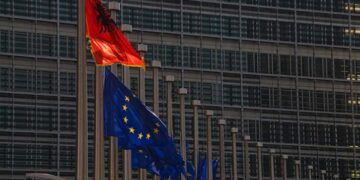
The question of Albania is particularly interesting precisely because Albania geographically belongs to the Mediterranean, yet throughout history it only partially participated in the Mediterranean cultural model. This fact can be explained relatively simply. One must always bear in mind that Albania was for centuries an Ottoman province. There is nothing inherently negative in this fact. However, unlike the Croatian Dalmatian cities, Venice, or Thessaloniki, much of Albania for centuries was not part of the maritime-Mediterranean world/ecumene, but instead belonged — administratively and mentally — to the Ottoman-Balkan continental world, to the culture of mountains, blood, honor, and clan. Thus, the sea could not become the center around which a national identity might form. The national symbol was the eagle, not a fish from the sea. The pastoral element was far more present in the everyday life of the Albanian people. This is especially visible in Albanian folklore. That folklore is the product of a mountainous pastoral world, tribal organization, and warrior culture (weapons as symbols of identity, male circle dances, epic singing accompanied by the lahuta, a northern Spartan aesthetic…). [4]
Admittedly, Tirana is not very far from the sea and is relatively well connected to Durrës, Albania’s largest port. The city’s climate is sub-Mediterranean, yet this fact did not substantially influence social relations in Albanian society. It should also be noted that Tirana became the capital only in 1920, after the Albanian state had been proclaimed in 1912. Until then, Tirana had been a relatively small oriental town without the strong urban tradition possessed by cities such as Shkodër or Korçë. One could say that the modern state de facto “invented” its capital. Tirana largely emerged through political decision and the urban imagination of Italian architects. Therefore, it is not surprising that some claim that Tirana’s main boulevard was created before the city itself.[5]
Furthermore, Albania did not possess a strong urban maritime tradition. Albania failed to develop a continuity of autonomous Mediterranean cities such as Dubrovnik, Split, Venice, Genoa, Trieste, or Thessaloniki. Durrës is indeed an important historical city, but it never became the bearer of a broader Mediterranean urban consciousness.
The communist period of Albanian history must also be taken into account. During the period of complete isolation, Enver Hoxha’s regime did everything possible to sever every connection with Mediterranean culture and tradition, so that “Albanians lived by the sea, but not with the sea.” During that period, the sea became a border and a wall, rather than a space of free communication. While for Italians, Greeks, or Croats the sea represented an opening toward the world, for Albanians it was for decades a forbidden zone. In this way, the fundamental Mediterranean impulse toward openness was interrupted.
The sea also changes the very notion of time. Continental and northern societies organize time linearly, insisting on work, schedules, efficiency, and precision. The Mediterranean world, by contrast, experiences time cyclically, following the rhythm of the day, the sun, the wind, and the arrivals and departures of ships.
Likewise, Albanian national identity was formed primarily through questions of survival, tribal-regional structures, and continental Balkan conflicts. Mediterranean culture presupposes a certain stability of urban life, because without such stability it is impossible to organize free trade and constant exchange.
In Albania, the mountains were more important than the sea. In times of danger, people could more easily hide in the mountains and escape enemies. As already mentioned, the eagle is Albania’s national symbol, and it is therefore understandable that the key Albanian imaginary is tied mainly to the northern highlands, the Kanun,[6] and closed communities, rather than to ports and cosmopolitan maritime culture.
Nevertheless, it would be wrong to conclude that Albania today lives outside the Mediterranean world. Considerable efforts by the state to reconnect Albania with its seas are clearly visible. The idea of a “return to the sea” can be recognized in a whole range of economic activities, from the accelerated development of the ports of Durrës and Vlorë (as Croatian citizens, we may observe that these ports are developing faster even than the port of Rijeka) and their accompanying infrastructure, to the strong influence of the Italian lifestyle, a kind of (neo-)Mediterraneanization of life in Albania, and the intensive — at times uncontrolled — development of tourism on both Albanian seas, the Ionian and the Adriatic.
One could even say that Albania today is undergoing a process of belated Mediterraneanization — an attempt to rediscover that dimension of openness which history had long suppressed. Here lies an interesting paradox: Albania may be geographically Mediterranean, but in mentality and politics it has been far more Balkan-continental than Mediterranean. Precisely for this reason, the question of the sea in the Albanian case is more a matter of civilizational choice than of geography itself.
Footnotes
[1] This is why Mediterranean cultures are often slower, but also less alienated. They have a different relationship toward work and leisure. Fernand Braudel already observed that the Mediterranean is a civilization of duration and rhythm, not merely of economics.
[2] In northern Europe, life most often unfolds inside the home, by the fireplace, in silence and within the discipline of enclosed space. It is therefore understandable that a different, largely Protestant ethic developed in Scandinavia, based on the cult of silence, privacy, distance, and seriousness. It is enough to watch almost any Ingmar Bergman film to understand this world. We especially recommend Fanny and Alexander.
[3] The Mediterranean is perhaps the only space where noise can possess warmth, and disorder a human face.
[4] Unlike northern Albania, in the southern regions, especially around Vlorë and Sarandë, a Mediterranean spirit is noticeable, expressed through polyphonic singing, more open dance forms, rhythms connected with Greece and southern Italy, and a softer, Aegean cultural sensibility. Yet within the Albanian national imagination, the northern pastoral element still predominates.
[5] This thought refers to the monumental city boulevard containing the most important state institutions — the broad representative axis that practically anticipated the modern capital before Tirana truly became a major urban center. Two well-known Italian architects, Armando Brasini and Gherardo Bosio, deserve credit for this project.
[6] The Kanun — especially the one associated with Lekë Dukagjini — is not merely a legal code, but contains within it an anthropological model of society. In this document, honor, one’s word, revenge, hospitality, and masculine courage are more important than state institutions. This is characteristic of the pastoral-warrior cultures of the Balkans and the Caucasus.
*Zlatko Kramarić is a Croatian publicist, author, and diplomat, currently serving as Ambassador to Albania. Formerly a university professor and politician, he is known for his work in literature, cultural studies, and regional history.
© 2026 Argumentum