



















By Gurakuç Kuçi –
Senior Researcher at the Institute for Hybrid Warfare Studies “OCTOPUS” and Professor at Universum College
This is the greatest paradox of Serbian policy toward Kosovo: Vucic requests “protection for Serbs in Kosovo” from KFOR and NATO, while Belgrade itself protects and relativizes people linked to organized crime, attacks against KFOR, the terrorist attack in Banjska, and the destabilization of northern Kosovo.
One cannot demand security for a community while, at the same time, giving political protection to structures that produce terrorism affecting all communities.
The case of Milan Radoicic and Zvonko Veselinovic is not merely a criminal story. It is the way organized crime, state nationalism, and Vucic’s politics merge into a single mechanism of pressure against Kosovo.
Let us take the facts one by one.
- Radoicic is suspected of killing 106 Albanian civilians and mistreating 300 others in Gjakova. In April 2025, the Basic Court in Pristina issued an arrest warrant for Radoicic and 19 other persons suspected of war crimes in Gjakova.
- Before Vucic and the SNS came to power, Serbian institutions had identified Radoicic and Veselinovic as figures linked to criminal networks involving drugs, weapons, oil, usury, and money laundering. The U.S. Department of the Treasury later described Veselinovic’s network as a criminal organization involved in the trafficking of goods, money, narcotics, and weapons between Kosovo and Serbia.
- Radoicic and Veselinovic are also linked to the 2018 murder of Oliver Ivanovic, since the indictment in Kosovo described them as leaders of an organized criminal group that, according to the prosecution, bore responsibility for the murder.
- In 2021, Radoicic and Veselinovic were placed under U.S. sanctions together with persons and companies linked to them. OFAC stated that the network was involved in corruption and the illicit trafficking of goods, money, narcotics, and weapons.
- On May 29, 2023, violent Serbian groups attacked KFOR troops in Zvecan, leaving 30 peacekeepers injured, 11 Italians and 19 Hungarians. KFOR described these attacks as unprovoked. It was later reported that a Hungarian soldier suffered a leg amputation as a result of the injuries sustained.
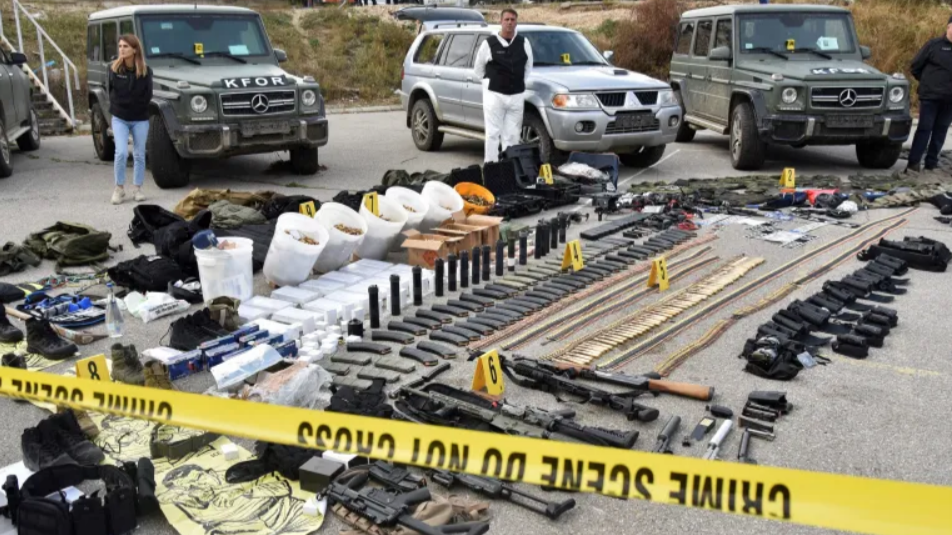
- On September 24, 2023, the armed group in Banjska attacked the Kosovo Police, killing Sergeant Afrim Bunjaku, after which three Serbian attackers were also killed. Milan Radoicic admitted responsibility for the events in Banjska through his lawyer, Goran Petronijevic. In Serbia, he was temporarily arrested, but was later released.
- In December 2023, Interpol issued an international arrest warrant for Radoicic in connection with the attack in Banjska.
- In September 2024, Kosovo’s Special Prosecution filed an indictment against 45 persons for the attack in Banjska, including Milan Radoicic. The indictment included terrorism, violation of the constitutional order, financing of terrorism, and money laundering.
- Even after the indictment for the attack in Banjska, Serbian institutions continued to finance networks linked to this case. Radio Free Europe/Radio Liberty revealed that the company “Rad 028”, owned by Radulle Stevic, who is under U.S. sanctions and is accused in Kosovo of involvement in the Banjska case, has won million-euro contracts from Serbian institutions. Since the beginning of 2026 alone, this company has concluded ten contracts worth over one million euros, while during 2025 it had won more than 30 contracts worth over 6.4 million euros. According to Kosovo’s indictment, Stevic, through his companies, had helped Milan Radoicic launder money. This shows that Belgrade’s connection with the Banjska network is not only political and propagandistic, but also financial and institutional.
U.S. Ambassador Jeffrey Hovenier described Radoicic as a criminal and called for him to be brought before justice. Former U.S. envoy Gabriel Escobar also called for accountability for Banjska and emphasized that there had been financial and organizational links with the Serbian state.
The European Parliament condemned the attack in Banjska and called for the perpetrators to be held accountable. On June 3, 2026, the European Parliament’s Committee on Foreign Affairs, AFET, expressed regret that Serbia has not prosecuted those responsible for the attack in Banjska, particularly Milan Radoicic, and called on Serbia to cooperate with Kosovo in bringing the perpetrators to justice.
In October 2025, the United Kingdom called in the UN Security Council for Serbia to play its role in bringing to justice those responsible for Banjska, including Milan Radoicic. In April 2026, the United Kingdom reiterated the call for accountability and called for justice also for the attacks against KFOR and the Kosovo Police in May 2023.
NATO Secretary General Mark Rutte also called on Serbia to ensure accountability for the attack in Banjska and for the attack against KFOR troops in Zvecan.
The German Embassy and representatives of partner countries have repeatedly called for accountability for the attack in Banjska. The German Ambassador to Kosovo has emphasized that Radoicic and all those involved in Banjska must be brought before justice.
Most recently, Vucic again came to Radoicic’s defense, saying that he is not being pursued “for crime”, but “for Kosovo and Metohija”. This is not a random statement, but political protection for a figure who has been sanctioned by the United States, is wanted by Interpol, has been indicted in Kosovo, and has admitted responsibility for Banjska. Meanwhile, the reporting by Radio Free Europe/Radio Liberty shows that Serbian institutions continue to give million-euro contracts to companies linked to persons accused over Banjska. Therefore, the protection is not only verbal; it also appears in public money, tenders, and state contracts.
Therefore, when Vucic requests “protection for Serbs in Kosovo”, the real question is this: protection from whom?
From Kosovo’s institutions, which demand order and law?
Or from the criminal and paramilitary structures that Belgrade itself has fed, protected, and used for years?
Kosovo Serbs are not endangered by justice. They are endangered by Belgrade’s political instrumentalization, by criminal structures that speak in their name, and by a regime that sells violence as patriotism.
Security is not built by protecting criminals.
Peace is not built by amnestying attacks against KFOR, the Kosovo Police, and the constitutional order.
And justice cannot be selective: either Radoicic and his network are brought before justice, or Serbia openly admits that organized crime is part of its state policy toward Kosovo.
When a state does not prosecute networks of violence, but continues to feed them with public contracts, the problem is no longer only organized crime. The problem is the state that uses crime as a political instrument.
This is the real dividing line: not between Serbs and Albanians, but between justice and crime.
© 2026 Argumentum