



































'/%3E%3C/svg%3E)

TIRANA, Albania — When a group of residents, environmental activists, and civil society advocates gathered at the end of May to oppose construction works in the Zvërnec and Pishë Poro areas, few could have predicted that their demonstration would evolve into one of Albania’s largest civic movements in recent years.
Ten days later, the protests not only continue but have expanded far beyond a local environmental dispute. They have become a broader confrontation over Albania’s model of economic development, government transparency, and the future of the country’s natural heritage.
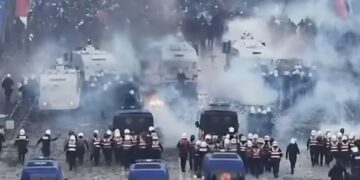
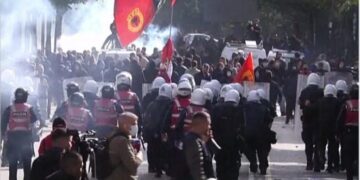
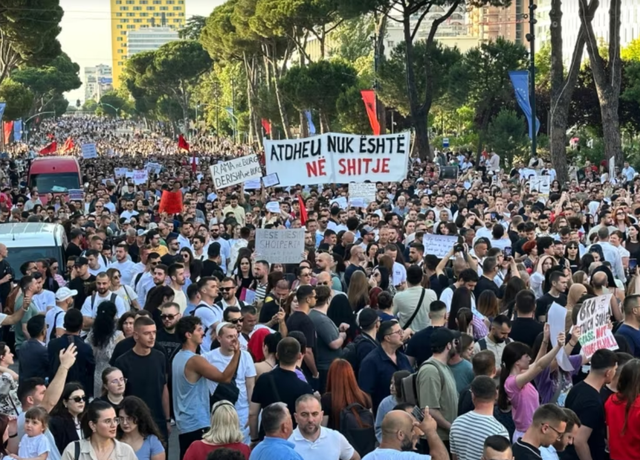
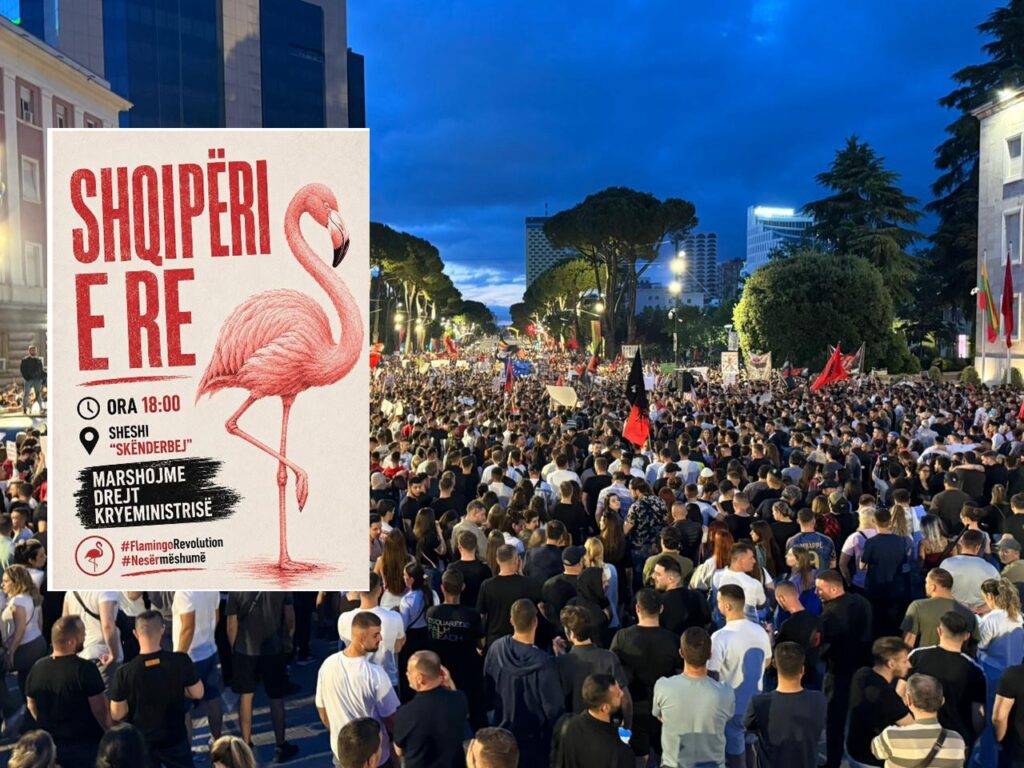
In Tirana, citizens continue to gather each evening in Skanderbeg Square before marching toward the Prime Minister’s Office, chanting slogans against the government, corruption, and what they describe as the privatization of public assets. Similar demonstrations have been reported in Vlora, Korça, Elbasan, and other cities across the country.
What began as a reaction to an incident in which a protester was allegedly dragged away by private security personnel at the Zvërnec project site quickly developed into a nationwide movement. Footage of the incident spread rapidly across social media, fueling public outrage.
Why Are People Protesting?
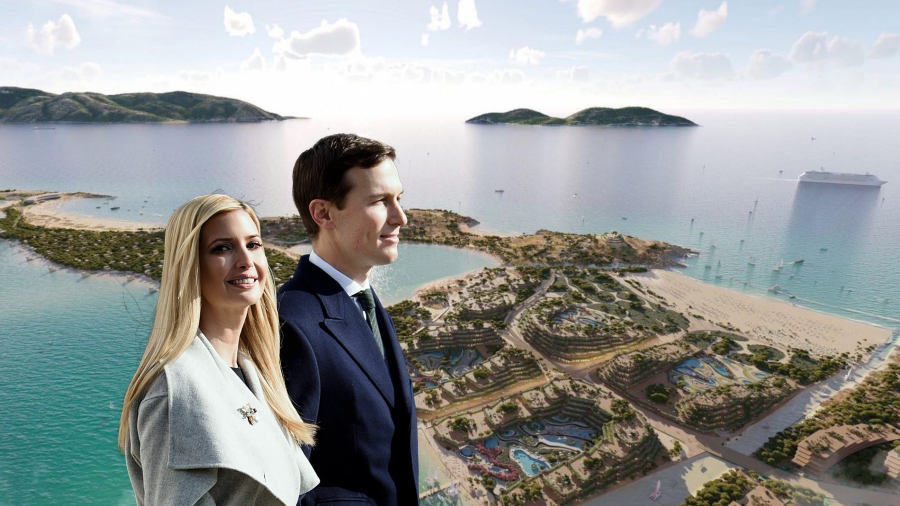
At the center of the controversy is a tourism development project involving Sazan Island and the coastline opposite it, near the Narta Lagoon and Zvërnec.
The project is linked to Jared Kushner, founder of Affinity Partners and son-in-law of Donald Trump. It has been promoted as one of the largest tourism investments in Albania’s history, with plans for luxury resorts, villas, marinas, and new infrastructure along the country’s southern coast.
The Albanian government has described the project as a historic opportunity for economic growth and the development of high-end tourism.
Critics, however, argue that the development is planned in one of the most environmentally sensitive areas of Albania’s Adriatic coastline.
The Narta Lagoon and surrounding wetlands provide an important habitat for flamingos, pelicans, sea turtles, and hundreds of migratory bird species. Environmental groups warn that any significant damage to the ecosystem could be irreversible.
How Did the “Flamingo Revolution” Begin?
The pink flamingo has become the defining symbol of the movement.
Appearing on banners, posters, memes, and social media campaigns, the flamingo has come to represent resistance to development in protected areas and the defense of Albania’s natural environment.
International media outlets including Reuters, Le Monde, Politico, CBS News, and Sky News have reported on the movement, which activists and observers have increasingly referred to as the “Flamingo Revolution.”
In many ways, the flamingo has become what the tree was during the Gezi Park protests in Turkey or what the Valbona Valley became for Albania’s environmental campaigns: a symbol of civic resistance.
From Environmental Concerns to Politics
As the protests have grown, their focus has expanded beyond the project itself.
Demonstrators in Tirana have chanted slogans such as:
- “Albania is not for sale”
- “Rama to prison, Berisha to prison”
- “Albania belongs to Albanians”
- “No to oligarchs”
These messages suggest that many participants view the Zvërnec dispute as part of a broader problem involving corruption, lack of transparency, and the concentration of power within public institutions.
Activists have outlined five key demands:
- Repeal amendments to the Protected Areas Law;
- Repeal the Strategic Investors Law;
- Cancel the Mountains Package legislation;
- Repeal amendments to the Cultural Heritage Law;
- The resignation of the government.

Brussels Takes Notice
For the first time, the issue has clearly moved beyond Albania’s domestic political debate.
The European Commission stated this week that it is closely monitoring developments in the Vjosa–Narta area and has called on Albania to comply with European environmental standards.
Commission spokesperson Guillaume Mercier warned that Albania should avoid actions that could undermine its obligations under the European Union accession process.
The statement represents the strongest response from European institutions so far regarding the project.
According to analysts, the fact that Brussels is addressing the issue publicly indicates that it is no longer viewed merely as a local dispute over tourism development.
The Government’s Position
Prime Minister Edi Rama has consistently defended the project.
He has argued that the investment could transform Albanian tourism and position the country among the Mediterranean’s leading luxury destinations.
According to the government, the project will not move forward without the required legal procedures and environmental assessments.
Rama has also argued that Albania cannot afford to reject major international investments and must remain open to foreign capital.
Investigations and Controversies
Alongside the protests, the Special Anti-Corruption Structure (SPAK) is reviewing issues related to land ownership and administrative procedures connected to the planned investment areas.
The review focuses on land documentation, administrative decisions, and procedures carried out in recent years concerning the development of the area.
No final decision has yet been announced, but the existence of the investigation has increased both public and media interest in the case.
A Battle Over the Future of Albania’s Coastline
Beyond day-to-day politics, the protests have raised a question that is likely to remain at the center of public debate long after the demonstrations end:
What model of development should Albania pursue?
Should the country’s coastline be developed through large-scale resorts and multi-billion-dollar investments?
Or should its most environmentally sensitive areas be preserved in their natural state?
Supporters of the project point to jobs, economic growth, and modernization.
Opponents point to biodiversity, environmental protection, and the public interest.
Caught between these competing visions, the “Flamingo Revolution” has become far more than an environmental protest. It has evolved into a broader civic debate about how Albanians envision the future of their country.
As the demonstrations enter their second week, one thing appears certain: the battle over Zvërnec, Narta, and Sazan is no longer merely a local issue. It has become a story attracting attention from Brussels, Washington, and major international media outlets.
One journalistic note: if you plan to publish this, claims such as “Day 10 of protests,” “Reuters and other outlets call it the Flamingo Revolution,” “the European Commission statement,” and details about SPAK investigations should be independently verified before publication.
© 2026 Argumentum