














• SHQIPËRI
  • KOSOVË
  • MAQEDONIA E VERIUT
  • MALI I ZI
  • Revista në PDF
19 October, 2026
 
  • Home
  • OP/ED

    THE GREEN BERETS LAND IN TIRANA

    Some Myths Simply Refuse to Die

    UN Monologue: Why Kosovo Cannot Respond to Serbia’s Accusations

    The War That Was Waged Before the War

    The Structural Impasse: Can Merz Offer a Leadership Anchor to Europe?

    Will Europe Finally Ditch the Poisonous Myth of Perpetual Peace?

    Resolution 522 – When the U.S. Congress Honored Skanderbeg

    The Reconfiguration of Maritime Governance: Structural Hegemonic Decline and the Arctic Pivot

    Between Political Calculation and Retreat: Croatian Communists at the End of an Era

  • Interview

    Exclusive Interview with Oleksandr Tyshchenko: A 40-Year Legacy of Chernobyl, Nuclear Risks, and Global Responsibility

    INTERVIEW: ZLATKO KRAMARIĆ – THOUGHTS ON THE OLD CONTINENT

    EXCLUSIVE / Ukrainian Ambassador to Albania, Volodymyr Shkurov: “Ukraine wants peace, but not at the expense of its freedom and independence”

    EXCLUSIVE| Ambassador Tayyar Kagan Atay: Türkiye and Albania, a Strategic Partnership Rooted in Shared Heritage and a Common Vision for the Future

    “Diplomacy, Not War”: Palestinian Ambassador to Albania Calls for Justice, Peace, and Global Action for Gaza

    Exclusive: “Even After Tito – Tito”/ Ambassador Zlatko Kramarić on Authoritarian Legacies and Democracy’s Future in the Balkans

    The Conclusion of the Diplomatic Mission / Ambassador Dancho Markovski: Strengthening Albania-North Macedonia Relations for a Shared European Future

    A Century of Diplomatic Relations Between Albania and Russia: Exclusive Interview with the Russian Ambassador to Albania, H.E. Alexey Zaytsev

    Exclusive/ The chairman of the Freedom Party, Ilir Meta: “The will of the citizens will triumph in Albania, as it did in North Macedonia”

  • Realpolitik

    Long live the UN! A prewarned decision! A  G – 2? Putin in Miami!

    Montenegrin diplomatic blunder! Small Cyprus without great hopes! 4 blocks of Enlargement challenges! Political earthquake in Germany!

    Belgrade, Zelensky and the Consulates! The European Pact takes water! Drone in Leipzig and hybrid war! Why a  ceasefire is needed in September

    The Summit of Unity! Think of peace and prepare for war! It’s only the start to the end! Just a pause between two wars!

    Peace with war diplomacy! The protest,  image and tourism! Why this silence from the EU Commission and Council? A deal or a pause?

    Just kind words  in Tivat! Where is the peace!? A deal yes, peace No!What is happening with USA and  EU?  5 elections but no solution!

    IBAR? ”Sufficiently! Much ado about nothing! Shart contrasts in Beijing! Where is the exit?!

    Neither peace nor war! Peace with bombs?! IBAR in autumn?! Not another Hormuz in Taivan! 

    IBAR – a springing board or an obstacle? Can we catch the EU Negotiation train 2027? When the dress makes the news!  EU electoral April  ends in a draw 1:1!  

  • Current Events

    Ten Police Officers Injured in Attack on Police Station in Albania’s Capital

    Albanian PM Rama: Violent Protests Challenge EU Accession Goal for 2030

    Albania Police Chief Alleges Protest Violence Orchestrated by Organisers at Home and Abroad

    Albanian PM Rama Rules Out Resignation Amid Escalating Protests

    EU Gives Green Light to the Provisional Closure of Albania’s Chapter 20 Negotiations

    Balkan Business Forum in Tirana: Albania and Türkiye Seek to Expand Investment and Regional Economic Cooperation

    Albania’s Parliament Approves Territorial Reform, Reducing Municipalities from 61 to 46

    Von der Leyen in Skopje: North Macedonia Belongs in Europe, Mickoski Seeks Fair EU Accession Process

    Von der Leyen in Pristina: “The Hague Verdict Must Be Respected, Nothing Can Rewrite Kosovo’s History”

  • Top News

    Albania’s Student Protests Enter Sixth Day as Clashes with Police Intensify; Rama Rules Out Resignation

    Albania Student Protests Spread to Multiple Cities as Clashes Escalate

    NATO to Hold Annual Nuclear Deterrence Exercise Steadfast Noon in Italy

    Albania’s Parliament Approves Territorial Reform, Reducing Municipalities from 61 to 46

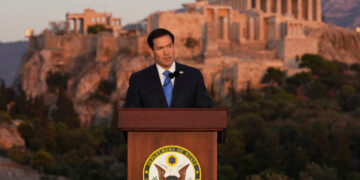
    US Secretary of State Marco Rubio speaks at the Pnyx hill, where ancient Athenians held democratic assemblies, with the ancient Parthenon temple atop the Acropolis in the background, in Athens, Greece October 7, 2026.   Mark Schiefelbein/Pool via REUTERS

    Rubio in Athens: When History Becomes Political Doctrine

    Albanian PM Rama to U.S. Democrats: “Don’t Come to Albania to Take Revenge on Trump”

    Albania’s Top Diplomat Ferit Hoxha at Berlin Process: “EU Enlargement Is a Strategic Investment in Europe’s Security”

    From Pre-Trial Measures to the Presumption of Innocence: What Changes in Albania’s Criminal Procedure Code

    Eric Wendt in Tirana: A New U.S. Mandate at a Turning Point for Albania and the Balkans

  • YOUR VOICE
  • ARGUMENTUM MAGAZINE
  • Shqip
No Result
View All Result
Argumentum
No Result
View All Result
Home ENGLISH

Between Russia, Iran and Europe: Azerbaijan as a balancing power in the South Caucasus

21 May, 2026
in ENGLISH, English OP/ED
A A
Share on FacebookShare on Twitter

Few countries in Eurasia have been forced to simultaneously balance Russian pressure, Iranian suspicion, a strategic partnership with Turkey and European energy interests. Azerbaijan is one of them.

By Marjana DODA

In today’s international context, where there is increasing talk of a multipolar world with major power centers such as the United States, China and Russia, the role of middle-sized countries is often underestimated. However, Azerbaijan is one of those cases where geography and energy have transformed it into a significant actor that goes beyond its size.

This rise is related not only to Baku’s pragmatic foreign policy, but also to its considerable energy resources and strategic geographical position. Its importance has increased especially after the European energy crisis caused by the war in Ukraine, when alternative gas supply corridors gained new strategic weight. In this context, projects such as the Southern Gas Corridor pipeline, along with its TANAP and TAP segments, have made Azerbaijan an important link in Europe’s energy diversification efforts.

Although it is not often seen as a “coveted” territory to the same extent as other global regions, the fact that Azerbaijan is located between powers such as Iran and Russia shows that it has managed to survive their influence and pressure, while maintaining a significant degree of strategic autonomy.

Through diplomatic balancing, energy cooperation, and a role in Eurasian trade corridors, Azerbaijan is trying to consolidate itself as a significant actor in the new regional geopolitical architecture.

Azerbaijan is located at one of the most congested geopolitical crossroads of Eurasia. Small in size but with considerable strategic weight, it is located at the point where rival regional orders overlap.

Over the past two decades, Azerbaijan has developed a distinctive response to this challenge through what is often called “multi-vector diplomacy,” a strategy that aims to engage with rival powers in parallel, deepening relationships where it is beneficial, and avoiding strategic dependencies where they become dangerous.

Today, this strategy is facing its greatest pressure since the country’s independence.

The Iran-Israel standoff is intensifying. Russia is recalibrating its position after the war in Ukraine. The Middle East remains volatile, while the West’s attention is fragmented by multiple crises. Yet paradoxically, the more volatile the region becomes, the more important Azerbaijan’s balancing model seems.

A State on the Edge of Geopolitical Systems

Azerbaijan’s foreign policy cannot be understood without considering its geography. It is at once an energy producer in the Caspian, a power in the South Caucasus, and a transit state connecting Europe with Asia.

To the north lies Russia, still the most influential actor in the security architecture of the South Caucasus. Although Moscow’s attention has focused on Ukraine, its influence on regional security and transport networks remains profound.

To the south lies Iran, a neighbor with long-standing historical and cultural ties but increasingly tense political relations. These tensions have been exacerbated by Azerbaijan’s close relations with Turkey and particularly its growing cooperation with the United States and Israel, which Tehran perceives through an increasingly sensitive security prism.

To the west lies Turkey, Azerbaijan’s closest strategic partner. After the Karabakh war in 2020, this relationship has shifted from cultural proximity to a structured security alliance, becoming the main pillar of Baku’s external balance.  The Shusha Declaration is a landmark agreement on allied relations signed between Azerbaijan and Türkiye on June 15, 2021. It elevates the two countries’ strategic partnership to a formal alliance, committing them to joint military cooperation, mutual defense assistance, and close integration in the defense industry.

As for mutual defense, the declaration, which was ratified by both parliaments and has the force of law, stipulates that in the event of a threat or act of aggression by a third state against the independence, sovereignty, or territorial integrity of either country, both nations will hold joint consultations and provide necessary mutual assistance.

Further afield, the European Union and the United States appear primarily as economic and energy actors, with a strong interest in diversifying supplies, but with a limited role in the regional security architecture. In these conditions, a complete alignment with a single bloc would create dangerous dependence. Although Baku is in talks with the United States and some EU capitals on possible cooperation in security and military areas.

For this reason, Azerbaijan has built a strategy of flexibility: it cooperates in parallel with actors who are often in tension with each other, without becoming a direct part of their conflicts.

This position places the country in a space where the boundaries between security, energy and politics are blurred. On the one hand, it is located next to an Iran that is increasingly tense in relation to the West and Israel; on the other hand, it is part of an energy corridor that supplies Europe and that has taken on even greater importance after the recent global energy crises.

In this sense, Azerbaijan is not simply a gas exporter or a post-Soviet state in transition, but a point of equilibrium in a regional system characterized by persistent uncertainty.

This interdependence between constraints and opportunities shapes the way Azerbaijan positions itself towards each of the actors that define its strategic environment.

Turkey: The Anchor Relationship

Among Azerbaijan’s foreign partnerships, none is more structurally important than Turkey.

This relationship is not simply diplomatic. It is military, strategic, economic, cultural and increasingly institutional.

Joint military exercises, defense coordination, and growing political integration have made the partnership a cornerstone of Azerbaijan’s security doctrine.

Turkey’s political and diplomatic support during the 2020 Karabakh war was crucial. It changed regional perceptions of the balance of power and strengthened Ankara’s role as Baku’s main strategic guarantor. As with a number of other countries Azerbaijan has also benefited from technical assistance and armament supply of Türkiye based on commercial terms.

Unlike other foreign policy vectors, this relationship does not balance in the same way with rival poles. It functions as a stabilizing anchor for the entire system.

Even the most flexible balancing strategy needs at least one most reliable partner.

For Azerbaijan, that partner is Turkey.

Russia: Pragmatism under Limitation

Relations with Russia are more complex.

Moscow remains too important to ignore, but also too historically intrusive to be fully trusted.

Azerbaijan’s approach is therefore characterized by managed pragmatism: avoiding direct confrontation but also resisting strategic dependence.

Trade, transport corridors, and regional security coordination continue, despite broader geopolitical uncertainties. Yet beneath the surface, there is a mutual caution.

Russia sees the South Caucasus as part of its traditional sphere of influence. Azerbaijan, meanwhile, looks equal partnership with Russia based on mutual interests and respect for sovereignty.

Both countries are doing much better in economic and cultural exchange rather than political one. Baku strives to maintain good-neighborly relations with all of its neighbors, including Russia.

Iran: Geography and Suspicion

If Turkey represents Azerbaijan’s strongest external partner, Iran periodically may represent its delicate neighborhood challenge.

The two countries share a long border, deep historical ties, and considerable ethnic and cultural overlap. However, modern relations are characterized more by strategic distrust than by closeness.

Tehran’s concerns are clear: Azerbaijan’s close ties with Israel, its expanding alliance with Turkey, and the possibility of growing foreign influence near Iran’s northern border. Iranian officials have also viewed the gradual Azerbaijan–U.S. rapprochement during the Trump administration with increasing suspicion. From Tehran’s perspective, initiatives such as the proposed Trump Route for International Peace and Prosperity (TRIPP) corridor project were not merely economic or transport initiatives, but part of a broader geopolitical shift that could facilitate a longer-term American strategic presence in the South Caucasus, directly along Iran’s northern frontier. Iranian analysts increasingly interpreted closer U.S.–Azerbaijan cooperation, combined with Turkey’s growing regional role and Israel’s strong security ties with Baku — as a development that could reduce Iran’s traditional influence in the region and strengthen the presence of rival powers near its borders.

Baku, on the other hand, remains wary of Iranian political pressure, border tensions, and periodic coercive signals.

The result is a relationship dictated by necessity, not trust.

Geography forces engagement. Politics limits trust.

As Iran–Israel tensions intensify, this dynamic becomes even more fragile. Azerbaijan’s foreign partnerships are increasingly interpreted by Tehran through a security prism, increasing the risk of miscalculation.

Israel and the West: Capability Without Alignment

Azerbaijan’s relationship with Israel is among its most strategically important and politically sensitive partnerships.

Cooperation in military technology, intelligence, and energy has strengthened Azerbaijan’s defense capabilities and broadened its strategic options.

But every benefit carries a geopolitical cost.

From Tehran’s perspective, Azerbaijan’s ties with Israel pose a security challenge near Iran’s northern border. What Baku sees as pragmatic capacity-building, Iran increasingly interprets as strategic encirclement.

Relations with the European Union and the United States are more economic than military, focused primarily on energy exports, infrastructure links, and regional stability.

These relationships matter. But, unlike the partnership with Turkey, they do not form the core of Azerbaijan’s security architecture.

Azerbaijan as a manager of uncertainty

Azerbaijan can be understood as a state operating within a space where uncertainty is the normal state of the system, while stability appears more as a temporary result of external balances than as a sustainable reality. As President Ilham Aliyev suggests, stability in the Caucasus is not a given, but a continuous process of adaptation to changing circumstances.

In this context, Baku’s policy does not aim at regional dominance, but at maintaining a functional balance between external pressures and internal needs. This positions Azerbaijan as a balancing actor operating on the borders of several spheres of influence simultaneously.

However, this role carries a clear paradox: the more Azerbaijan’s importance in the energy and strategic infrastructure of the wider region increases, the greater its exposure to tensions and competition among surrounding powers. In this way, its function in the South Caucasus becomes a constant exercise in managing pressures, where the line between stability and crisis remains thin and fluid.

Middle-sized states rarely have the luxury of irreversible choices in foreign policy. They are forced to move between larger powers, taking advantage of the spaces that are created between them, but without becoming dependent on either. As geopolitical competition in Eurasia and the Middle East intensifies, this room for maneuver becomes increasingly limited.

In this context, the experience of Azerbaijan remains a significant example of how states in sensitive geopolitical areas try to maintain autonomy in an increasingly competitive system. However, despite regional challenges, its strategic position and economic development make it an important actor in the wider Eurasian region.

/Argumentum.al

© 2026 Argumentum

Related Posts

Current Events

Ten Police Officers Injured in Attack on Police Station in Albania’s Capital

18 October, 2026
ENGLISH

Albania’s Student Protests Enter Sixth Day as Clashes with Police Intensify; Rama Rules Out Resignation

18 October, 2026
Current Events

Albanian PM Rama: Violent Protests Challenge EU Accession Goal for 2030

18 October, 2026

Follow US

Subscribe

Receive Argumentum Magazine by Email

Last Posts

Ten Police Officers Injured in Attack on Police Station in Albania’s Capital

18 October, 2026

Albania’s Student Protests Enter Sixth Day as Clashes with Police Intensify; Rama Rules Out Resignation

18 October, 2026

Albanian PM Rama: Violent Protests Challenge EU Accession Goal for 2030

18 October, 2026

For those who offer or put themselves forward for dialogue and mediation

16 October, 2026

Albania Police Chief Alleges Protest Violence Orchestrated by Organisers at Home and Abroad

15 October, 2026
Argumentum

“Argumentum”, një proces intelektual …

Contact Us

[email protected]
[email protected]
[email protected]

Follow Us

Media Partner

Register

Receive Argumentum Magazine by Email
  • Home
  • Privacy Policy
  • About Us
  • Contact

© 2022 Argumentum. All Rights Reserved. | NUIS: L91415033Q

Welcome Back!

Login to your account below

Forgotten Password?

Retrieve your password

Please enter your username or email address to reset your password.

Log In

Add New Playlist

No Result
View All Result
  • Home
  • OP/ED
  • Interview
  • Realpolitik
  • Current Events
  • Top News
  • YOUR VOICE
  • ARGUMENTUM MAGAZINE
  • Shqip

© 2022 Argumentum. All Rights Reserved. | NUIS: L91415033Q

This website uses cookies. By continuing to use this website you are giving consent to cookies being used. Visit our Privacy and Cookie Policy.