



























Professor Arben Cici
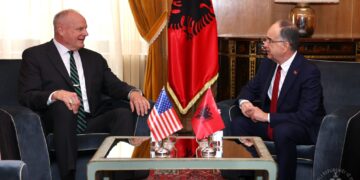
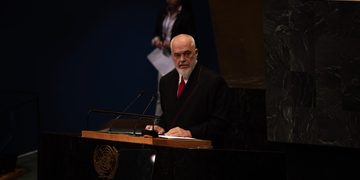
In recent hours, television screens have bombarded us with news that certain local figures, well-padded for years in their armchairs and privileges, have suddenly awakened to put themselves forward as mediators, dialogue facilitators, even declaring that “their door is always open” or reminding us that “we must not forget that we are all Albanians,” all in the name of resolving the crisis Albania is painfully experiencing.
In harmony with this shrill orchestration, several international institutions have also brought 1997 back to our attention, when, thanks to their mediation, Albania returned to its arduous version of normality.
To all these last-minute self-sacrificing figures and institutions, I would like to recall the following:
- Mediators or dialogue facilitators must be individuals and institutions of integrity, not by virtue of the law or the Constitution, nor because of the high political office bestowed upon them (rather than earned), but because of their political engagement and commitment, their conscience, their sense of responsibility, and their accountability throughout the entire period they spend enjoying the comfort of their armchairs.
- Mediators or dialogue facilitators must be impartial individuals and institutions, not because of the high office bestowed upon them (rather than earned), but because of their conduct throughout their exploitation of the privileges at their disposal.
- They must be accepted by the parties confronting one another in the current crisis. But they are not such figures, because throughout their political and institutional lives, whether long or short, they have remained entrenched in the trenches of power and have not even bothered to raise their heads to look at society and its citizens, let alone the students, school pupils, and their parents.
- These individuals do not deserve even to be heard, let alone trusted, because throughout their time in positions of power, whenever they have opened their mouths, they have uttered falsehoods. Most recently, they have even claimed to have been among the students of December 1990!
- These individuals did not even deign to utter a word throughout the 135 days of the exemplary protest staged by Albanian citizens. On the contrary, together with the pirouettes performed by their NGO counterparts, they mocked, scorned, and bullied all those who challenged the entire world through their conduct and their messages, messages that, unfortunately, never made it into a single office of the great pharaonic state.
- Astonishingly, these individuals and institutions have found their courage today, despite having been frightened only a few months ago by eggs thrown by ordinary people and having portrayed them as a national security threat and an unacceptable act of violence, with anti-national, anti-regional, anti-European, anti-American, and anti-global consequences.
- Albania is ablaze today, not for the same reasons that brought about the disastrous year of 1997, but for the same reasons that prompted the students of 1991, their parents, and the miners from the outskirts of Tirana to rise up.
- The mediators and international institutions involved in the disastrous year of 1997 began their efforts to stabilize Albania by exerting strong pressure on the government of the time, initially with the aim of calming the situation. As this pressure mounted, the government resigned, and a Government of National Stability was formed, headed by a prime minister who did not come from the previous government.
- The mediators and international institutions involved in the disastrous year of 1997 exerted multifaceted pressure on the government of the time, which was confronted with the anger of the citizens. Their pressure, directed specifically at the government, produced the desired result: the calming of the situation and a partial settlement between the two political camps (parties), but not the country’s long-term political stabilization.
- The mediators and international institutions of 2026 do not enjoy the same credibility among Albanian citizens as their counterparts did in the disastrous year of 1997. Today, they are viewed as accomplices in Albania’s political predicament, owing to their indulgence towards those in power and the governments of recent years.
- The mediators and international institutions of 2026 are not sufficiently trusted by Albanian citizens because they are accused of having invested exclusively in stabilitocracy, while neglecting democracy, compliance with the Copenhagen criteria, and the rule of law in Albania.
- Albania in 2026 does not need mediators and dialogue facilitators whose purpose is to preserve the status quo of political actors and prolong their political survival, under the absurd pretext that there is no one else available. Such an approach leaves problems concealed beneath the optimistic reports issued by international institutions and organizations.
- Resolving Albania’s 2026 crisis, which is, in fact, a crisis of those in power, does not call for “Crocodile diplomacy.” The Crocodile Restaurant in Strasbourg brought the bipartisan political crisis of 2010 to a partial resolution, leaving the underlying crisis unresolved, and the door open for their recurrences, along with all the problems that have persisted ever since. The electoral process continued to be plagued by even more problems, and once again, the losing political parties refused to recognize the results, responding in accordance with their respective party strategies.
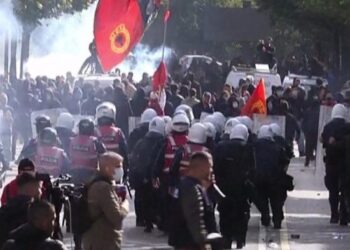
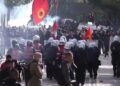
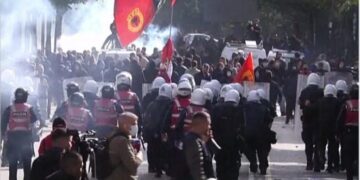
- Albania in 2026 does not need a second “Crocodile.” The Crocodile Restaurant in Strasbourg is far too small both to resolve the problems facing Albania in 2026 and to serve the expensive wine of 2010 to all those protesters who continue to inhale tear gas, with no expiry date, ever since the first days of their revolt on “Dëshmorët e Kombit” Boulevard.
- Today, this confrontation pits the future against the past, the citizen against politics, the university student and the high-school student against government officials and former government officials, parents and family members against MPs grown fat on corruption, and pensioners against the repressive machinery of the administration.
Therefore, before putting themselves forward for mediation and dialogue, Albanian and international individuals and institutions must first understand the essence of what is happening in Albania and the reasons behind this confrontation between the future and the past.
… because, as the French say: “Qui sème la misère récolte la colère!”
© 2026 Argumentum