



















• SHQIPËRI
  • KOSOVË
  • MAQEDONIA E VERIUT
  • MALI I ZI
  • Revista në PDF
11 July, 2026
  • Home
  • OP/ED

    The Underlying Logic behind China’s Economic Success

    Do Not Misuse the U.S. Declaration of Independence to Justify the Narrative of Insurrection in Albania

    The visit that changed Albania’s strategic future

    Pierre Nora and the institution of memory we lack in Eastern Europe

    The Blueprint of a Diplomatic Debacle: Analyzing Germany’s Historic UNSC Loss

    Between Russia, Iran and Europe: Azerbaijan as a balancing power in the South Caucasus

    The Zero-Tariff Gate: Sovereignty as a Service in the Sino-African Corridor

    Albania vs. the Sea/ Marginal Notes on A. Leka’s Novel The Hidden Side of the Albanian Socialist Garden

    May 9 and the long shadow of a Letter: Is Europe still Schuman’s Project?

  • Interview

    Exclusive Interview with Oleksandr Tyshchenko: A 40-Year Legacy of Chernobyl, Nuclear Risks, and Global Responsibility

    INTERVIEW: ZLATKO KRAMARIĆ – THOUGHTS ON THE OLD CONTINENT

    EXCLUSIVE / Ukrainian Ambassador to Albania, Volodymyr Shkurov: “Ukraine wants peace, but not at the expense of its freedom and independence”

    EXCLUSIVE| Ambassador Tayyar Kagan Atay: Türkiye and Albania, a Strategic Partnership Rooted in Shared Heritage and a Common Vision for the Future

    “Diplomacy, Not War”: Palestinian Ambassador to Albania Calls for Justice, Peace, and Global Action for Gaza

    Exclusive: “Even After Tito – Tito”/ Ambassador Zlatko Kramarić on Authoritarian Legacies and Democracy’s Future in the Balkans

    The Conclusion of the Diplomatic Mission / Ambassador Dancho Markovski: Strengthening Albania-North Macedonia Relations for a Shared European Future

    A Century of Diplomatic Relations Between Albania and Russia: Exclusive Interview with the Russian Ambassador to Albania, H.E. Alexey Zaytsev

    Exclusive/ The chairman of the Freedom Party, Ilir Meta: “The will of the citizens will triumph in Albania, as it did in North Macedonia”

  • Realpolitik

    Peace with war diplomacy! The protest,  image and tourism! Why this silence from the EU Commission and Council? A deal or a pause?

    Just kind words  in Tivat! Where is the peace!? A deal yes, peace No!What is happening with USA and  EU?  5 elections but no solution!

    IBAR? ”Sufficiently! Much ado about nothing! Shart contrasts in Beijing! Where is the exit?!

    Neither peace nor war! Peace with bombs?! IBAR in autumn?! Not another Hormuz in Taivan! 

    IBAR – a springing board or an obstacle? Can we catch the EU Negotiation train 2027? When the dress makes the news!  EU electoral April  ends in a draw 1:1!  

    The European Parliament building in Strasbourg, France with flags waving calmly celebrating peace of the Europe. July 12, 2020.

    EU 2027 or 2037! Even half membership failed! No exit strategy!     

    What next?

    “With diplomatic velvet“! Major question marks! In Washington yes, but  in the White House NO! A strange dinner in Brussels!

    From a great ‘apple of disaccord’ to a  point of  cooperation! A bad start! The strange absence in Davos!

  • Current Events

    When Algorithm Becomes the Most Powerful Manipulator: The Case of the Protests in Tirana

    NATO Summit in Ankara: Allies Adopt Declaration Reaffirming Collective Defence and Long-Term Security Commitments

    The Diplomacy of Gas and Algorithms: The Nuances of Official Tirana—Is It Breaking the European Taboo with Azerbaijan?

    Protection for Serbs, or Protection for Radoicic?

    The Architecture of Selective Sovereignty:Corporate Immunity, Technological Protectionism, and the Erosion of Credibility

    Montenegro’s Unfinished Transition

    The Paradox of Selective Capitalism: How Western Rule-Breaking Accelerates Its Own Systemic Demise

    A prestigious book on an emblem of Turkish state!

    Council of Albanian Ambassadors Backs Civic Protests, Calls for Transparency and Protection of National Interests

  • Top News

    NATO at Ankara 2026: Strategic Rebalancing Between Russia Deterrence, Turkey’s Rise, and National Interests

    Daniel Serwer: A Bad War Ending Badly May Still Be Good News

    Friedrich Merz, Keir Starmer, António Costa, Donald Trump, Emmanuel Macron, Mark Carney, Ursula von der Leyen, Giorgia Meloni and Sanae Takaichi

    G7 Leaders Gather in Évian Amid Global Uncertainty, Focus on Security, Economy and International Cooperation

    Russian Ambassador in Tirana: “Without a Strong and Sovereign Russia, the Creation of a Just World Order Is Impossible”

    “The Flamingo Revolution”: Day 10 of Protests in Albania Draws International Attention

    Rama alleges ‘hybrid war’ behind protests against Kushner-linked coastal development

    No End in Sight: Trump, Netanyahu and the Expanding Middle East War

    Tirana – €20 Million EU–Banking Agreement Boosts Albanian SMEs

    “EU4Municipalities II” Project, a Strategic Investment for Strengthening Municipalities and Accelerating Albania’s Path towards the EU

  • YOUR VOICE
  • Shqip
No Result
View All Result
Argumentum
  • Home
  • OP/ED

    The Underlying Logic behind China’s Economic Success

    Do Not Misuse the U.S. Declaration of Independence to Justify the Narrative of Insurrection in Albania

    The visit that changed Albania’s strategic future

    Pierre Nora and the institution of memory we lack in Eastern Europe

    The Blueprint of a Diplomatic Debacle: Analyzing Germany’s Historic UNSC Loss

    Between Russia, Iran and Europe: Azerbaijan as a balancing power in the South Caucasus

    The Zero-Tariff Gate: Sovereignty as a Service in the Sino-African Corridor

    Albania vs. the Sea/ Marginal Notes on A. Leka’s Novel The Hidden Side of the Albanian Socialist Garden

    May 9 and the long shadow of a Letter: Is Europe still Schuman’s Project?

  • Interview

    Exclusive Interview with Oleksandr Tyshchenko: A 40-Year Legacy of Chernobyl, Nuclear Risks, and Global Responsibility

    INTERVIEW: ZLATKO KRAMARIĆ – THOUGHTS ON THE OLD CONTINENT

    EXCLUSIVE / Ukrainian Ambassador to Albania, Volodymyr Shkurov: “Ukraine wants peace, but not at the expense of its freedom and independence”

    EXCLUSIVE| Ambassador Tayyar Kagan Atay: Türkiye and Albania, a Strategic Partnership Rooted in Shared Heritage and a Common Vision for the Future

    “Diplomacy, Not War”: Palestinian Ambassador to Albania Calls for Justice, Peace, and Global Action for Gaza

    Exclusive: “Even After Tito – Tito”/ Ambassador Zlatko Kramarić on Authoritarian Legacies and Democracy’s Future in the Balkans

    The Conclusion of the Diplomatic Mission / Ambassador Dancho Markovski: Strengthening Albania-North Macedonia Relations for a Shared European Future

    A Century of Diplomatic Relations Between Albania and Russia: Exclusive Interview with the Russian Ambassador to Albania, H.E. Alexey Zaytsev

    Exclusive/ The chairman of the Freedom Party, Ilir Meta: “The will of the citizens will triumph in Albania, as it did in North Macedonia”

  • Realpolitik

    Peace with war diplomacy! The protest,  image and tourism! Why this silence from the EU Commission and Council? A deal or a pause?

    Just kind words  in Tivat! Where is the peace!? A deal yes, peace No!What is happening with USA and  EU?  5 elections but no solution!

    IBAR? ”Sufficiently! Much ado about nothing! Shart contrasts in Beijing! Where is the exit?!

    Neither peace nor war! Peace with bombs?! IBAR in autumn?! Not another Hormuz in Taivan! 

    IBAR – a springing board or an obstacle? Can we catch the EU Negotiation train 2027? When the dress makes the news!  EU electoral April  ends in a draw 1:1!  

    The European Parliament building in Strasbourg, France with flags waving calmly celebrating peace of the Europe. July 12, 2020.

    EU 2027 or 2037! Even half membership failed! No exit strategy!     

    What next?

    “With diplomatic velvet“! Major question marks! In Washington yes, but  in the White House NO! A strange dinner in Brussels!

    From a great ‘apple of disaccord’ to a  point of  cooperation! A bad start! The strange absence in Davos!

  • Current Events

    When Algorithm Becomes the Most Powerful Manipulator: The Case of the Protests in Tirana

    NATO Summit in Ankara: Allies Adopt Declaration Reaffirming Collective Defence and Long-Term Security Commitments

    The Diplomacy of Gas and Algorithms: The Nuances of Official Tirana—Is It Breaking the European Taboo with Azerbaijan?

    Protection for Serbs, or Protection for Radoicic?

    The Architecture of Selective Sovereignty:Corporate Immunity, Technological Protectionism, and the Erosion of Credibility

    Montenegro’s Unfinished Transition

    The Paradox of Selective Capitalism: How Western Rule-Breaking Accelerates Its Own Systemic Demise

    A prestigious book on an emblem of Turkish state!

    Council of Albanian Ambassadors Backs Civic Protests, Calls for Transparency and Protection of National Interests

  • Top News

    NATO at Ankara 2026: Strategic Rebalancing Between Russia Deterrence, Turkey’s Rise, and National Interests

    Daniel Serwer: A Bad War Ending Badly May Still Be Good News

    Friedrich Merz, Keir Starmer, António Costa, Donald Trump, Emmanuel Macron, Mark Carney, Ursula von der Leyen, Giorgia Meloni and Sanae Takaichi

    G7 Leaders Gather in Évian Amid Global Uncertainty, Focus on Security, Economy and International Cooperation

    Russian Ambassador in Tirana: “Without a Strong and Sovereign Russia, the Creation of a Just World Order Is Impossible”

    “The Flamingo Revolution”: Day 10 of Protests in Albania Draws International Attention

    Rama alleges ‘hybrid war’ behind protests against Kushner-linked coastal development

    No End in Sight: Trump, Netanyahu and the Expanding Middle East War

    Tirana – €20 Million EU–Banking Agreement Boosts Albanian SMEs

    “EU4Municipalities II” Project, a Strategic Investment for Strengthening Municipalities and Accelerating Albania’s Path towards the EU

  • YOUR VOICE
  • Shqip
No Result
View All Result
Argumentum
No Result
View All Result
Home Current Events

When Algorithm Becomes the Most Powerful Manipulator: The Case of the Protests in Tirana

11 July, 2026
in Current Events, ENGLISH, In Focus
A A
Share on FacebookShare on Twitter

By Associate Professor Dr. Bledar Kurti

In modern democracies, there is a profound paradox. Today, we believe that politicians shape public opinion, while in reality it is increasingly algorithms that shape both politicians and crowds.

If the road to power once passed through political parties, television, and institutions, today it passes through a mathematical formula written on the servers of giant technology companies.

The algorithm does not vote. It does not run for office. It does not hold press conferences. Yet every day it decides what we will see, what will make us angry, whom we will admire, and whom we will hate.

In economics, it is often said that “demand creates supply.” In the digital age, the opposite is happening: the algorithm creates demand. Social media platforms were not designed to reward truth. They were built to maximize the amount of time users spend on their screens. Every extra second translates into advertising, revenue, and profit.

That is why the algorithm does not reward peace. It does not promote balanced arguments. It does not favor academic analysis. It rewards outrage. It promotes conflict. It amplifies emotion. Because emotions generate clicks, and clicks generate money.

This is no longer theory. Studies published in the scientific journal PNAS have shown that social media algorithms can disproportionately amplify political content, directly influencing what citizens see on their screens.

Likewise, other research on democracy and social media argues that platforms are no longer merely mirrors of public opinion, but actors capable of influencing the democratic process itself.

International examples are numerous. The Cambridge Analytica scandal revealed that millions of Facebook profiles were used to create personalized political messages during the U.S. presidential election and the Brexit referendum.

In the United States, recent studies have raised questions about how TikTok’s and X’s (formerly Twitter) algorithms favor or amplify certain types of political content.

In France, Germany, and Italy, political parties now have entire teams that analyze not only opinion polls but also the way platform algorithms function.

Politics no longer asks only, “What do citizens think?” Increasingly, it asks: “What will the algorithm like?”

In this context, protests are no longer merely physical events.

They are algorithmic events as well.

A protest with relatively few participants but thousands of viral videos can create the perception of a much larger movement. Conversely, a massive protest that fails to penetrate social media may appear as though it never happened at all.

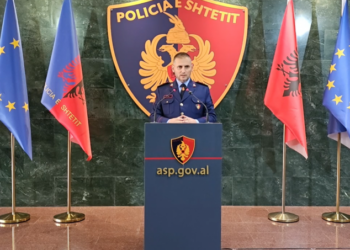
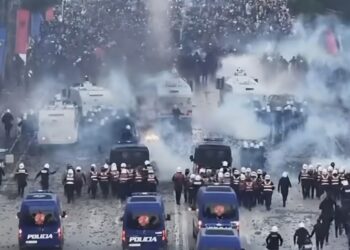
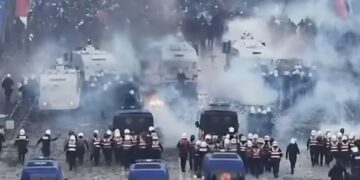
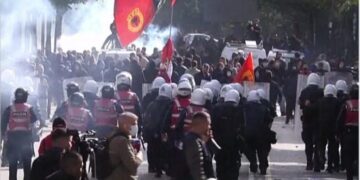
The recent protests in Tirana are illustrative of this new reality. Beyond the political debate over the causes and demands of the protesters, a significant part of the public discussion has focused precisely on the role of algorithms, social media, and the attention economy in spreading messages, mobilizing participants, and shaping public perceptions of the protests.

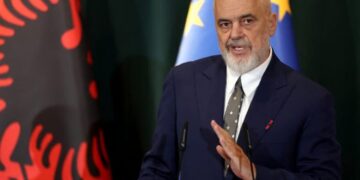
Prime Minister Edi Rama described this phenomenon as a “digital cyclone,” arguing that algorithms favor conflict and outrage, while critics countered that algorithms do not create public dissatisfaction but merely amplify it.

The truth is that, yes, algorithms can create dissatisfaction and magnify it. All it takes is one emotional video, and within hours it can be viewed by millions of people. A provocative statement can dominate the national debate. A slogan can become a political identity.

That is why today it is no longer enough to win the hearts of citizens.

One must also win the algorithm.

And this is where the greatest danger to democracy emerges.

If politicians begin speaking only about what the algorithm rewards, then politics loses its representative function and becomes an attention industry.

Decisions are no longer made on the basis of analysis, but on the basis of engagement. Not on truth, but on virality. Democracy is not measured by the number of “likes,” TikTok views, or Facebook shares. It is measured by citizens who think critically and by institutions that make decisions based on facts rather than algorithmic trends.

Ultimately, the challenge of the twenty-first century is not only to protect democracy from propaganda. It is also to protect it from the invisible mathematics that determines every day what we will see, what we will believe, and perhaps even how we will vote.

The protests in Tirana provide a clear illustration of how this invisible mathematics can create pathways toward anarchy and attempts to undermine the constitutional order. The use of emotion rather than reason to delegitimize the government, the opposition, parliament, and the judiciary leads nowhere and violates the fundamental constitutional principles of a republic.

And what happens next? 

What Socrates described as the “Ship of Fools.” On a ship in the middle of the sea, the helm is no longer taken by the one who knows how to navigate safely to shore, but by someone inexperienced—a demagogue or a clown—who, in today’s context, becomes a product of the algorithm and ultimately crashes the ship against the rocks.

An even more complex dimension is the intervention of foreign actors within this digital ecosystem. Today, it is no longer necessary to finance traditional media or send influence agents into the field. It is enough to understand how the algorithm works. Through coordinated networks of accounts, targeted advertising, anonymous pages, paid influencers, and disinformation campaigns, foreign state and non-state actors can amplify existing divisions within a society, increasing polarization and eroding trust in public institutions.

The cases of Russian interference in the 2016 U.S. presidential election, disinformation operations uncovered by the European Union, and influence campaigns attributed to actors from Iran and other countries demonstrate that algorithms have become a new instrument of geopolitical competition. The objective is not necessarily to persuade citizens to believe a particular idea, but to sow confusion, deepen divisions, and weaken trust in democracy.

Albania has also been visibly affected by this phenomenon. Our domestic public debate reached enormous dimensions across social media, creating opportunities for external actors to exploit it for their own strategic interests. One example was the photograph of a young Albanian girl, approximately six to eight years old, holding the red Albanian flag with the double-headed eagle on Tirana’s main boulevard. The image was reposted and widely circulated worldwide by Iranian-affiliated pages, accompanied by an anti-American message. 

Truth appears to have little value. Emotion, manipulation, amplification, noise, conflict, destruction, division, and confrontation—these are what the algorithm rewards. Success is achieved through the erosion of both society and the state.

Protect the Republic. Protect the constitutional order. Do not allow the algorithm to think on your behalf. Do not become part of the digital crowd. Inform yourself, question what you see, verify information, and remain a citizen who thinks critically. Democracy does not survive on viral emotions but on reason.

Republics do not fall only through weapons. They can also be weakened through the manipulation of the human mind. Protect your most precious freedom: the ability to think for yourself. Do not allow yourself to be used. Be responsible citizens, because only free and healthy thinking can safeguard democracy.

“I think, therefore I am,” wrote René Descartes.

Think, therefore be. Be free and responsible citizens who pursue nothing but the truth. Veritas. The truth shall set you free.

/Argumentum.al

© 2026 Argumentum

Related Posts

ENGLISH

The Underlying Logic behind China’s Economic Success

9 July, 2026
Current Events

NATO Summit in Ankara: Allies Adopt Declaration Reaffirming Collective Defence and Long-Term Security Commitments

8 July, 2026
In Focus

Albania will experience no development without democracy

8 July, 2026

Follow US

Subscribe

Receive Argumentum Magazine by Email

Last Posts

When Algorithm Becomes the Most Powerful Manipulator: The Case of the Protests in Tirana

11 July, 2026

The Underlying Logic behind China’s Economic Success

9 July, 2026

NATO Summit in Ankara: Allies Adopt Declaration Reaffirming Collective Defence and Long-Term Security Commitments

8 July, 2026

Albania will experience no development without democracy

8 July, 2026

The Diplomacy of Gas and Algorithms: The Nuances of Official Tirana—Is It Breaking the European Taboo with Azerbaijan?

7 July, 2026
Argumentum

“Argumentum”, një proces intelektual …

Contact Us

[email protected]
[email protected]
[email protected]

Follow Us

Media Partner

Register

Receive Argumentum Magazine by Email
  • Home
  • Privacy Policy
  • About Us
  • Contact

© 2022 Argumentum. All Rights Reserved. | NUIS: L91415033Q

Welcome Back!

Login to your account below

Forgotten Password? Sign Up

Create New Account!

Fill the forms bellow to register

*By registering into our website, you agree to the Terms & Conditions and Privacy Policy.
All fields are required. Log In

Retrieve your password

Please enter your username or email address to reset your password.

Log In

Add New Playlist

No Result
View All Result
  • Home
  • OP/ED
  • Interview
  • Realpolitik
  • Current Events
  • Top News
  • YOUR VOICE
  • Shqip

© 2022 Argumentum. All Rights Reserved. | NUIS: L91415033Q

This website uses cookies. By continuing to use this website you are giving consent to cookies being used. Visit our Privacy and Cookie Policy.