
























Dr. Jorgji KOTE
Member of the Council of Ambassadors of Albania
To write on this subject is a difficult mission, owing to the complexity of the challenges, crises, conflicts, interventions, wars, and countless diplomatic démarches in a perpetually volatile region such as the Middle East. Even more so when it comes to the South Caucasus, a region with an equally tangled geopolitical puzzle.
Consequently, Azerbaijan’s political and diplomatic leadership has constantly had to move along a thin wire of equilibrium, amid scenes, scenarios, and startling surprises, consequences of the clash of differing and sometimes even opposing Turkish, Israeli, Iranian, Russian, Syrian, European, and Chinese interests in the Middle East.
Let us highlight from the very outset that Aserbaijan devotes greater attention than others to its relations with the Gulf states, both as a region and with each country there and with Saudi Arabia in particular but not only. The commonalities in these relationships are understanding, political dialogue and business bonds, and those on natural gas and crude oil most specifically. Likewise, Aserbaijan is an active member of the Organization for Islamic Cooperation ( OIC). In that context, it has hosted several events, including the Islamic Solidarity Games in Baku from 12 – 22 May 2017 and others.
Thus, it is widely accepted that Azerbaijan stands out thanks to its careful policies and diplomacy, with particular emphasis on the triad-pragmatism, energy diplomacy, and strategic balancing, aimed at smoothing over and achieving convergence.
In recent years, thanks also to its diplomatic démarches, there have been several favorable geopolitical developments for the region and beyond, and especially for Azerbaijan.
Here we single out the victory in the 44-day war in 2020 and a day-long special military operation in 2023, finally restoring its territorial integrity and sovereignty over its whole internationally recognised territory, thus bringing the former Nagorno-Karabakh and 7 surrounding regions under control. The conclusion of this true odyssey was formalized on 8 August 2025 at the White House, at the end of the meeting between President Trump, President Aliyev, and Prime Minister Pashinyan, with the signing of the “Joint Declaration on the Peace Process between Azerbaijan and Armenia.” Nevertheless, guaranteeing a lasting peace between them depends on a constitutional change in Armenia, so that it no longer lays claim to territories such as Nagorno-Karabakh.
The other major event for Baku, after the “ice age” with the Biden Presidency, was the elevation of relations with the USA to a strategic level following President Ilham Aliyev’s meeting with President Trump in Washington on 7 August 2025. This was made possible thanks to the signing of the “Memorandum of Understanding on the establishment of the Working Group for the ‘Strategic Partnership Charter’” on 8 August. This was a notable achievement, since in the new geopolitical realities created in the South Caucasus, Azerbaijan was confirmed as a close and reliable partner of the USA.
Of special significance for Azerbaijan’s relations with the USA was the signing by President Trump on 7 August 2025 of the suspension of the « Freedom Support Act” and specifically “ Section 907” enacted by the US Congress in 1992. This legal act for which the Armenian Community in USA made a powerful lobying prohibited the US assistance to Aserbaijan, due to its alleged blockade against Armenia. Thus, Aserbaijan became the only single post-soviet state that has not received direct aid from the USA, which would facilitate the political and economic stability after its independence.
Albeit its previous suspension in 2001, thanks to the Aserbaijan’s support for the USA in its fight against international terrorism, Section 907 is still valid; however, most recently, the US policy had urged its abrogation, since it is not effective and it does not respond to the new strategic USA – Aserbaijan relations.
Meanwhile, the aggression against Ukraine has greatly weakened Russian influence in Baku and its support for Armenia; Russia even had to withdraw its peacekeepers from the Karabakh region of Azerbaijan.
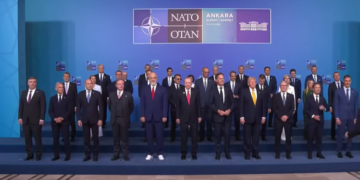
Another development with appreciable effects, especially for Azerbaijan, is the USA’s promotion of Türkiye’s geopolitical weight and role in the region and beyond, which was convincingly confirmed at the NATO Summit in Ankara on 7-8 July 2026.
A highly positive consequence for the Middle East and for Azerbaijan was the fall of Assad’s tyrannical regime in December 2024. Baku now has far greater convergence of interests with Syria on security, peace, and energy diplomacy- with new opportunities to position itself even better in the Middle East.
Thus, in his congratulatory message to the new Syrian leader Ahmed Al-Sharaa in February 2025, President Aliyev highlighted “the great opportunities for raising the level of relations” and invited him to visit Baku. Al-Sharaa made this official visit in July 2025 as part of his diplomatic tour of the region. During this period, Baku also reopened its embassy in Damascus, which had been closed in 2012.
As a principal and steadfast supporter of post-Assad Syria, Azerbaijan sent economic aid to Damascus as early as the first months of 2025.
The other most important development in these recent months was the military conflict between the USA/Israel and Iran, which has created new tensions and dynamics in this Region. Regarding its relations with Tehran, alongside numerous historical and human ties and convergences, Baku has encountered much opposition, reservation, and suspicion from Tehran. This is chiefly on account of its close strategic alliance with Türkiye, USA and certainly Israel, countries that are enemies and challengers of Tehran, which it views as a threat to its security. Nonetheless, Azerbaijan has consistently maintained measured and moderate positions, defending its sovereignty and its foreign-policy lines; it has continued to develop normal relations with Iran, especially in the economic and transport spheres, and so on.
Thanks to regular diplomatic consultations and top level visits they have also overcome grave incidents. Here we may single out the attack of a gunman in the internal premises of the Aserbaijan’s Embassy in Teheran, killing the Chif Guard and injuring some others. Aserbaijan’s government reacted vigorously against this “ terrorist act” as it considered it, even though the Iranian side justified it on personal family grounds. Finally, the killer was executed on 21 May 2025, which led to the normalization of their relations. The second serious incident occurred on 6 March 2026, when during the US/Israeli-Iran War, the latter attacked with four drones and damaged the airport, a school and many civilians in the autonomous enclave of Nackchivan in Aserbaijan. The latter responded vehemently through diplomatic channels. Baku closed temporarily tis Embassy in Teheran and re-opened it in April 2025 with a reduced staff and with the relevant security guarantees from the Iranian side.
Meanwhile, Azerbaijan is making every effort to keep its flanks secure with Russia as well. Their relations have cooled considerably following the downing of an Azerbaijani aircraft over Russian territory in December 2024, the bombing of its embassy in Kyiv three times during 2025, and incidents involving Azerbaijani citizens in Russia.
Even so, Azerbaijani diplomacy shows itself prudent, distancing but not antagonizing by increasing controls, especially over Russian soft power, while keeping communication channels open in every case. These are sound positions, because indeed, after the aggression in Ukraine, Russia lacks the capacity for a military campaign in the Caucasus, yet it still continues to pursue expansionist ambitions in that region.
Another danger from Russia is its cooperation with Iran to obstruct the peace process in the region; beginning with opposition to the construction of the Trump Peace Corridor, as well as through political and military provocations in the region.
Undoubtedly, one of the principal priorities of Azerbaijani diplomacy is the strategic partnership with Turkey, including the respective convergences and divergences.
Their close alliance began in 1992 with the motto “one nation, two states,” which embodies ethnic brotherhood, energy interdependence, and military cooperation. The latter rests on the Shusha Declaration, signed on 15 June 2021. The bilateral Defense Pact created on that basis was preceded by, and continued with, major Turkish military assistance during the 44-day second Karabakh War.
Alongside military and economic cooperation, the latter reflected especially in the Trans-Anatolian Natural Gas Pipeline (TANAP) and the Baku-Tbilisi-Ceyhan oil pipeline, indispensable points of energy transit into Europe, Turkey also provides Azerbaijan with the necessary diplomatic cover vis-à-vis Iran and Russia.
As mentioned at the outset, the NATO Summit in Ankara confirmed President Trump’s trust in Türkiye and President Erdoğan as a key actor and factor of stability in the Middle East. However, thanks to the strategic partnership with Azerbaijan, Turkish influence is expected to expand into the South Caucasus as well; this is in the interest of the USA, since it avoids or offsets their active and direct engagement in the region, in line with the American principle of “offshore balancing.”
Nonetheless, it must be emphasized that Baku does not see itself as an appendage of Turkish policy; on the contrary, it has its own identity, shaped over entire decades; thus the promotion of Türkiye within the hierarchy of Western countries is seen as a moment that creates new conveniences and opportunities for an even more active regional role for Azerbaijan.
It is worth emphasizing that, alongside the aforementioned convergence of values and interests between them, relations with Türkiye are to certain extent affected indeed, become a cause of friction on account of Azerbaijan’s strategic partnership with the State of Israel, as the other major priority of its diplomacy. In fact, Tel Aviv has established with Baku one of the strongest military and security alliances in the post-Soviet space. If Türkiye provides it with a regional security anchor, Israel offers Baku international bonuses and strategic flexibility. Moreover, alongside Türkiye, the Karabakh War was also strongly supported by Israel. Israeli drones and lethal munitions played a decisive role in breaking the Armenian defenses in that war. Azerbaijan buys 70 percent of its weapons from Israel. In return, Baku supplies Israel with up to 60 percent of its oil needs. Israel has created for Baku room for diplomatic maneuver and for ties with Washington.
The latter is of great value, stemming from Azerbaijan’s aim to repeal the above-mentioned Section 907. This is why Azerbaijan currently ranks among Israel’s most reliable friends in the Muslim world.
For this very reason, there have been various divergences between Ankara and Baku. Thus, President Erdoğan, in several speeches, has fetishized the Turkish role in the Azerbaijani victory in the 2020 War. Likewise, pro-government Turkish media have unjustifiably demanded greater gratitude from Azerbaijan for that assistance, and that its relations with Turkey take precedence over those with Israel.
Erdoğan also harbors suspicions that Israel might draw Azerbaijan into a broad regional confrontation against Iran, thereby increasing the risk of Türkiye’s involvement in it. Consequently, Ankara which seeks to avoid direct involvement views Israel’s regional conduct as a potential threat to its own interests. It is precisely in this context that Aliyev appears as a balancer and stabilizer of the strategic competition between his two close allies, as he has also successfully done years before.
As for Baku, its concern is that Israel including its opposition and lobbies in Washington is labeling Türkiye as the “new Iran” and as a “new rising threat,” which naturally places Azerbaijan in a difficult position vis-à-vis Türkiye.
Under these conditions, the question for Azerbaijan is what would happen if Israel were to clash with Türkiye. Nevertheless, this concern does not yet pose itself as a dilemma. Include into the text the position of Baku on intention of Tel-Aviv to recognise developments of 1915 as armenian genocide. Actually Baku has blocked it
Aserbaijan’s balancing diplomacy in- between Türkiye and Israel proved to be successful even most recently, in response to a bill from the Israeli Government in June which recognizes the Ottoman genocide in Armenia in 1915. Such a decision on an extremely sensitive issue was considered as a “serious concern” for diplomatic Baku. Thanks to the diplomatic efforts and mediation by President Aliyev, Prime Minister Netanyahu announced on 19 July that the said Bill was cancelled and it was deleted from the Kneset agenda; thus, it averted a new tension and conflict with effects for the entire region.
This is thanks also to the efforts of both countries to narrow the political and cultural gaps, focusing on strengthening the common Turkic identity, economic interdependence, and the interests of peace, stability, and security in the region.
Here it is worth emphasizing Baku’s valuable contribution in facilitating the rapprochement process between Türkiye and Israel; it has played this role behind the scenes in the normalization efforts of 2016, 2018, and 2021. The most important event in this regard was President Isaac Herzog’s visit to Ankara in April 2022 and the subsequent meetings between Erdoğan and the then Israeli Prime Minister, Yair Lapid, which led to the full restoration of diplomatic relations. After the freezing of relations between them, Azerbaijan has once again intervened as a mediator. President Aliyev, too, has publicly expressed the hope that “the ground for normalization and the areas of mutual interest between them may be found once more.” In April 2025 it was announced that Turkish and Israeli officials had met in Baku to establish a permanent line of communication and to put an end to the conflict in Syria. A few days later, confidential talks were held in Azerbaijan between Israeli and Syrian officials, with Turkish observers also present there.
Azerbaijan has also followed its typical balancing attitude vis à vis the Israeli and Palestinian war; as a strategic ally of the former but with the identity of a muslim country as well. In this regard, Baku has kept a neutral profile; it has not attented emergency summits on that conflict and it has not qualified Hamas as a terrorist organization. Meanwhile, Azerbaijan does not take part with troops in Gaza and it is not engaged in military regional conflicts; it holds that such conflicts should be settled by the countries of the region. Baku has also denied different media reports that Israel has allegedly attacked Iran with drones from Aserbaijani’s territory.
Meanwhile, as it was also confirmed in the meeting between President Aliyev and the Prime Minister of Palestine, Muhammad Mustafa in Baku on 16 July 2026, Azerbaijan is in favour of the estabishment of the Palestinian state according to the “ two states solution” with Eastern Jerusalem as its capital. It has provided support to the Palestinian Authority and different humanitarian aids; among others, it bears all the expenses of the Palestinian Embassy in Baku and it intends to open its own Representative Office in Ramallah. Likewise, Baku supports financially the stay and studies for 23 out of 37 Palestinian students that are abroad. Then, it envisages to build another secondary school there. As Premier Mustafa said during his meeting with President Aliyev, these bear testimony to the high level of their bilateral relations”
Finally, I join many renowned international political scientists and experts in concluding that, with its quiet yet fruitful diplomacy, Azerbaijan has confirmed itself as an effective Middle Power, with regional influence and resonance and beyond. It offers a positive example of overcoming the most difficult of situations; with diplomatic thinking, strategic patience, understanding, and tolerance, in close cooperation with major geopolitical actors and factors, especially with the USA and the EU, and through the consistent implementation of good-neighborly policies.
Consequently, it may be said without exaggeration that Azerbaijani policy and diplomacy constitute a solid guarantee for “a calm and secure voyage” through turbulent waters, both in the Middle East and in the South Caucasus.
© 2026 Argumentum