




















'/%3E%3C/svg%3E)

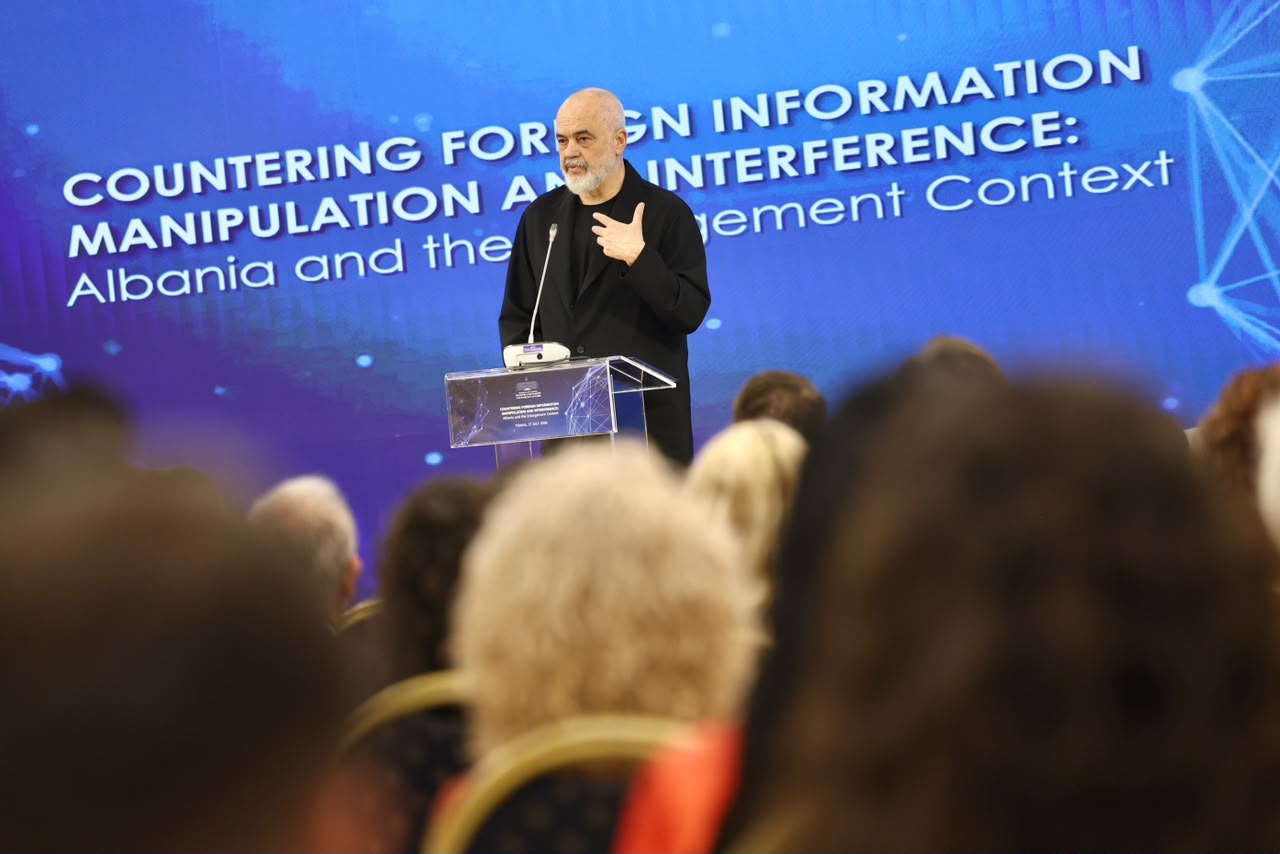
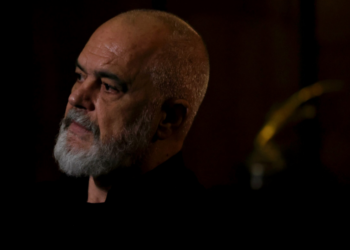
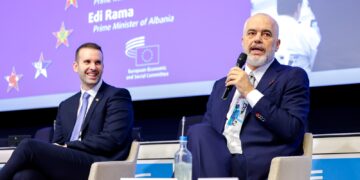
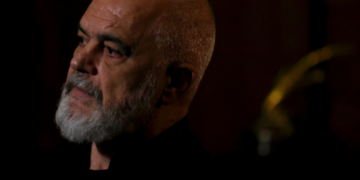
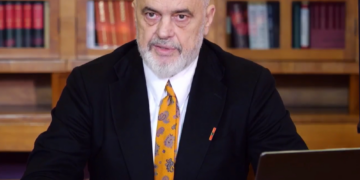
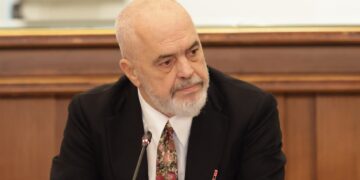
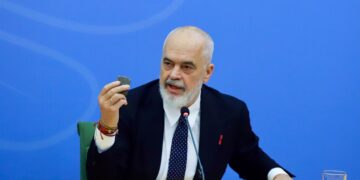
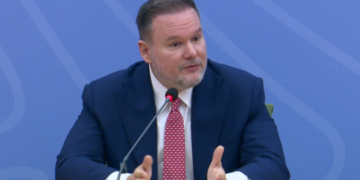
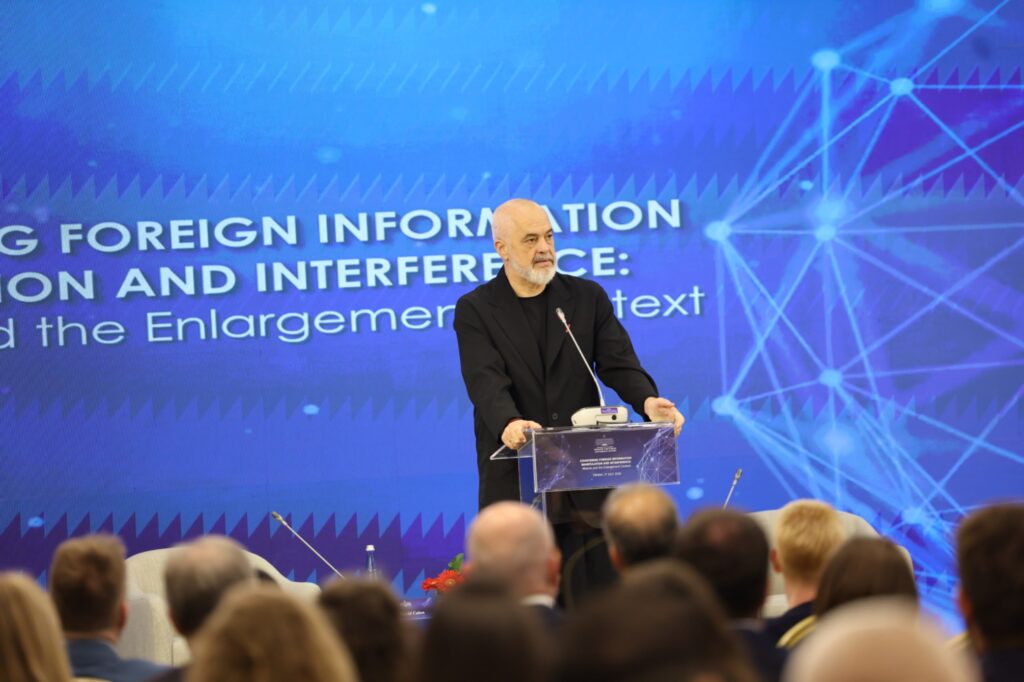
Albania has placed the fight against foreign information manipulation and interference at the center of its security and European integration agenda. Prime Minister Edi Rama addressed today the international conference “Countering Foreign Information Manipulation and Interference: Albania and the Enlargement Context,” organized by the Ministry for Europe and Foreign Affairs, warning that the battle for information has become one of the defining challenges for democratic societies.
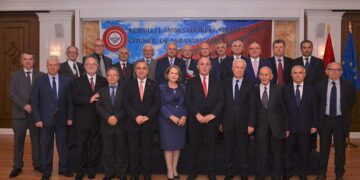
The conference brought together representatives of European institutions, allied countries, Albanian state institutions, media organizations, civil society, and the technology sector to discuss the growing impact of foreign influence operations on European democracies and security.
According to the Prime Minister, Albania, as a country advancing toward European Union membership and part of the Western Balkans enlargement process — finds itself on the frontline of these hybrid challenges, facing both cyber threats and coordinated information campaigns.
Opening the conference, Rama argued that modern security extends far beyond military capabilities and physical borders, warning that democratic societies are increasingly vulnerable to attacks targeting public perception and trust.
“Today, we must defend something invisible, yet every bit as vital: the space where our citizens form opinions, exercise judgment, and make their own free choices,” Rama said.
The Prime Minister stressed that power in the 21st century is no longer determined solely by military strength but also by the ability to shape narratives, exploit societal divisions, and undermine confidence in democratic institutions.
Drawing on the ancient story of Troy, Rama compared modern disinformation campaigns to the Trojan Horse, arguing that today’s threats rarely arrive openly but instead enter societies disguised as ordinary content shared through digital platforms.
According to him, foreign information manipulation spreads through viral content, deepfake videos, coordinated social media campaigns, and messaging applications, making it increasingly difficult to distinguish truth from falsehood.
Referring to Albania’s experience following the major cyberattacks against government institutions in recent years, Rama said the country has significantly strengthened its cyber defenses and now possesses one of Europe’s most advanced AI-supported cybersecurity systems.
However, he warned that protecting digital infrastructure alone is insufficient.
“Cybersecurity protects servers and state infrastructure, but the minds of citizens remain vulnerable every time they unlock their phones,” he said.
Democracy’s Openness Is Also Its Vulnerability
Rama emphasized that democracy’s greatest strength—its openness—is also what hostile actors seek to exploit.
He argued that foreign interference takes advantage of existing political and social divisions, using them as entry points for large-scale influence operations aimed at weakening democratic institutions from within.
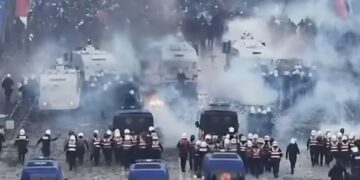
Addressing the vulnerabilities of open democracies, Prime Minister Rama referred to the so-called “Flamingo Revolution”, the ongoing protest movement against his government, as an example of how internal democratic tensions can create opportunities for broader information manipulation campaigns.
Rama argued that democratic societies are built on openness and debate, but this same openness can be exploited by actors seeking to deepen divisions and influence public perception.
“The so-called Flamingo Revolution is a stunning example of how a crack that of course was not created by our enemies became a path to get in and to exploit it with a very large-scale operation of trolls and avatars,” Rama said.
In his interpretation, the protests themselves were not created by external actors, but existing social and political disagreements could become a space where coordinated digital influence operations attempt to amplify tensions and shape narratives.
Enlargement Countries on the Front Line
The Prime Minister noted that countries seeking EU membership—including those in the Western Balkans, Ukraine, Moldova, and Georgia—are increasingly becoming targets of foreign information campaigns.
As Albania enters the final phase of negotiations for European Union membership, he described building resilience against hybrid threats as an essential part of the country’s European integration process rather than simply a technical or bureaucratic requirement.
“The closer a country gets to the European Union, the harder foreign actors strike,” Rama said, describing enlargement countries as being on the frontline of Europe’s broader struggle against hybrid threats.
He argued that Albania’s experience can contribute to strengthening the EU’s collective resilience by sharing lessons learned from confronting cyberattacks and coordinated disinformation campaigns.
Artificial Intelligence Creates New Challenges
Rama warned that artificial intelligence has dramatically accelerated the spread of manipulation, allowing false narratives to circulate globally within minutes through algorithm-driven platforms.
He suggested that democratic societies face a fundamental dilemma: how to protect freedom of expression while preventing hostile actors from exploiting digital platforms to manipulate public opinion.
According to the Prime Minister, a distinction must be made between freedom of speech and what he called “freedom of reach”—the unrestricted ability to amplify false or manipulative content to massive audiences through social media algorithms.
“The right to reach everyone by telling the most outrageous nonsense is not the same as the right to speak freely,” he argued.
Defending Democracy Without Limiting Freedom
Concluding his address, Rama said the challenge for democratic societies is to safeguard the information space without undermining democratic values or restricting legitimate freedoms.
He expressed hope that the conference would generate practical recommendations to help Albania and its European partners better respond to foreign information manipulation while preserving open and democratic societies.
“The question before us is whether truth can remain stronger than manipulation in the digital age,” Rama concluded.
© 2026 Argumentum