



















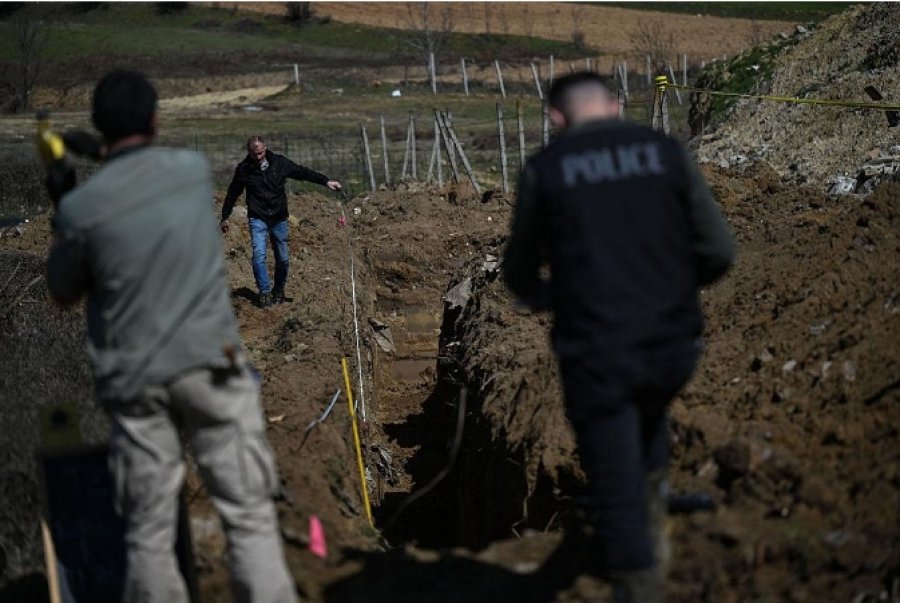
On 19 April 1999, in a valley in Zubin Potok, Serbian police looked at the bodies of twenty-three men and gave the killers an order: bury those you killed. In twenty-seven years, no organ of the Serbian state has opened a case into the killing. On 30 July 2026, one opened a case into the telling. The order was never rescinded. It was re-staffed.
On 19 April 1999, a group of Albanian civilians moving on foot toward Montenegro was stopped near the village of Kalludra e Vogël (Mala Kaludra), in the municipality of Zubin Potok. The account of what happened next exists because a Serb gave it, under his own name, to UNMIK investigators and the Kosovo Police on 7 February 2003, in Serbian, in detail. Ranko Tepavac, who spent the war in the neighboring village, stated that a local group led by a man he names, Jovica Utvić, from the village itself, stopped the civilians, took their money and valuables, and promised to let them continue toward Ulqin (Ulcinj). Then he ordered them to turn around, and when they did, he shot them. Twenty-three people were killed. The name is the statement’s, not a court’s; the man it names has never been charged, and nothing here should be read as a finding about him. Hold instead the fact that a named allegation has existed, in writing, in the language of the Serbian state, for twenty-three years. It will matter at the end.
Someone in the village then did what people do when there has been a killing. He informed the police. According to the statement, word reached the police in Mitrovica and in Zubin Potok, and officers came to the village. They saw the bodies of twenty-three men. They issued one order.
“Zakopajte te koje ste ubili.” Bury those you killed.
Read the sentence as a document, because it is one: the first official act of the Serbian state in the case of Kalludra e Vogël. Five words perform three functions. They record the killing as fact; no one orders the burial of men who are not dead. They identify the perpetrators, in the second person; the grammar itself names the addressees, those you killed. And they issue the state’s instruction, which is not arrest. It is burial. An investigation was opened, conducted and closed at the scene, in the time it takes to speak, and its finding was a work order. The crime scene became a job site, and the killers were assigned to the detail. Everything the Serbian state has done and declined to do in this case since has been execution of that order.
Nothing about it was improvised. The order was spoken in the same weeks in which the same ministry was running the concealment at industrial scale. The Hague record in the case of Vlastimir Đorđević, Serbia’s assistant interior minister, establishes that from the second week of April 1999, on at least six occasions, trucks carrying the bodies of Albanians killed by Serbian forces arrived at the police training center at Batajnica outside Belgrade, with further deliveries to the police center at Petrovo Selo, and that the decision to hide the bodies was taken at a meeting Slobodan Milošević held with his senior police officials. In 2001, 744 bodies were exhumed at Batajnica, 61 at Petrovo Selo, 84 from Lake Perućac. At least 52 more surfaced at Rudnica after 2013, and 17 at Kiževak in 2020: more than 900 people, dug out of Kosovo and hidden in Serbia. The central variant of the operation required refrigerated trucks, drivers, fuel, and four hundred kilometers of road. The local variant required a sentence. Same ministry, same weeks, same doctrine, which needs no name: no bodies, no crime. The trucks were already running when the order at Kalludra e Vogël was spoken. The officers who spoke it were not improvising a cruelty. They were applying policy at the appropriate scale.
I have spent years writing about this category of activity, in Bosnia and after, and the discipline of that work requires calling it what it is. Denial is not an opinion that settles over a country. It is an operation, with logistics, machinery, personnel and maintenance requirements, and it does not end when the war does. The proof site is Tomašica, the mine complex near Prijedor. The men, women and children killed around Prijedor in 1992 were buried there; in 1993 the grave was partially reopened by the army and the local police, and more than 350 bodies were trucked thirty-seven kilometers to a second pit at Jakarina Kosa, an operation of concealment performed on an operation of concealment. Tomašica stayed hidden for twenty-one years. It was found in 2013 only because a former soldier who had taken part in the cover-up disclosed the location to Bosnia’s Missing Persons Institute. He did so anonymously. The condition is not incidental. Everyone who holds a piece of this knowledge understands the price list. Until last week, the claim that the concealment continued as policy, rather than surviving as habit, was an inference from conduct. It could be alleged. Kalludra e Vogël is where it stopped being an allegation.
Follow the file. On 7 February 2003, the event, the location and a named perpetrator entered the official record, delivered by a Serb to the administration then responsible for justice in Kosovo. On 7 January 2013, the daily Zëri published Tepavac’s statement, and the record became public. The Humanitarian Law Center and its Kosovo counterpart, which published the fullest reconstruction of the case in 2024 and again this week over Nataša Kandić’s signature, state plainly that they possess no data showing UNMIK or the Kosovo Police conducted an effective investigation or checked the location. That sentence indicts the finders, and we will not soften it: information that could have opened this grave sat with the institutions of the protectorate and its successor for more than two decades, and the families paid for every year of it. But the two failures in this case are not the same failure, and the distinction is the piece’s subject. On one side, information received and not acted upon. On the other, information possessed and kept. Serbia’s own commissioner for the missing confirmed last week that the case has been documented since 2003 and that information was exchanged. In all the years of working groups and commissions, through the empty trench dug at Mala Jabuka in 2016, through the letter Kosovo’s commission sent to Belgrade in June 2023 asking for the archives of the army units, unanswered nearly a year later, the one thing that never crossed the table was the location. Under the convention on enforced disappearance that Serbia ratified in 2011, a disappearance continues as a crime for as long as the fate and whereabouts of the victims are concealed. A failure to investigate is a dereliction. Custody of the secret is the crime, still running.
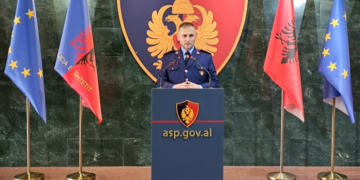
Then, on 28 July 2026, on the request of Kosovo’s Special Prosecution and the order of the Basic Court in Prishtina, excavators reached the valley, and the ground began to speak. Within two days, the apparatus that had not moved in twenty-seven years moved at full strength, in the only direction it has ever moved in this case. Serbia’s security service and its counterterrorism police arrested a man from Istog in Kraljevo on suspicion of espionage, holding him while a public prosecution decides his fate, and naming in their announcement, as the damage his alleged disclosures did to Serbia, the arrests of war crimes suspects in Kosovo. My colleague examined that announcement in “The Secret Serbia Prosecuted” and established what it concedes. Here it is enough to do the arithmetic. In twenty-seven years, in the case of Kalludra e Vogël, the Serbian state has produced, on any public record, zero proceedings for the murder, zero proceedings for the concealment, and one proceeding against the telling. For the state whose officers stood over the bodies on the first evening, what happened in the valley has never been a crime. The crime, on the face of the only case this file has ever generated, is that someone told the truth to Kosovo. A named allegation waited twenty-three years in that file for a prosecutor who never came; the ground answered the first day someone dug where the secret said not to.
Now set the tellers in a row, because the operation’s real target has always been them. Ranko Tepavac told the internationals in 2003, under his name, and was answered with silence. The soldier at Tomašica told in 2013, and the price of his safety was that no one would ever know his name. The man in Kraljevo, who holds the presumption of innocence in full and about whom almost nothing is known, is accused of telling, and his answer arrived as handcuffs on the evening news. And on 31 July, Nataša Kandić, who has spent her life assembling the record her state was built to erase, published the statement, the reconstruction and the twenty-three names, the surgeon and the teacher and the miner and the brothers, under a heading that answers the entire architecture of category in three words, people remember people, and wrote, in the first-person plural: for the killing, the hiding of the bodies and the decades of institutional concealment, we bear great shame. Two Serbs open and close this file, one with a statement, one with a ledger. Between them stands the state, and the state’s response to each teller is the policy, measured. Of the 6,065 people who went missing in this region between 1998 and 2000, 1,607 remain unaccounted for. Every one of those cases waits on someone who knows: a retired policeman, a man ordered to dig one night, a neighbor who saw the trucks. The operation’s current product is their silence, and the Kraljevo file is this quarter’s output.
The examiners will say who lies in the trench, and no one should run ahead of them; reports put the number recovered at six as we wrote, and identification is a matter of laboratories, not of politics. What is already established needs no forensics. On 19 April 1999, the Serbian state looked at twenty-three dead men and said: bury those you killed. On 30 July 2026, it said: telling is treason. Twenty-seven years apart, in the same voice, the same instruction, with only the tense updated and the personnel replaced, uniforms then, a prosecutor’s credentials and a service badge now. The order of 19 April 1999 has never been rescinded, and it has been disobeyed before, at Mala Jabuka in 2016, blindly, in the wrong ground, because the secret held. On 28 July, in the valley where it was issued, a court in Prishtina countermanded it, and for the first time in twenty-seven years the order was disobeyed in the one place it was ever meant to protect.
_________________
*Originally published in The Kosovo Dispatch. Written by Drizan Shala
© 2026 Argumentum