













































By Dr. Ermir I. Hajdini
Legal Analyst & University Lecturer
Political rhetoric in Washington and Brussels rarely misses an opportunity to condemn China’s state-led capitalism. The familiar core accusation states that Beijing floods domestic firms with unfair government subsidies, distorting global markets and undercutting Western competitors[^1].
This narrative is compelling—but also superficial hence structurally incomplete.
Recent data from the International Monetary Fund (IMF) and the Organisation for Economic Co-operation and Development (OECD) reveals a reality far more nuanced than political talking points suggest[^2]. The global trade debate has spent years obsessing over how much governments spend. The far more decisive question is where they spend it—and why Western political systems struggle so acutely with economic allocation discipline[^3].
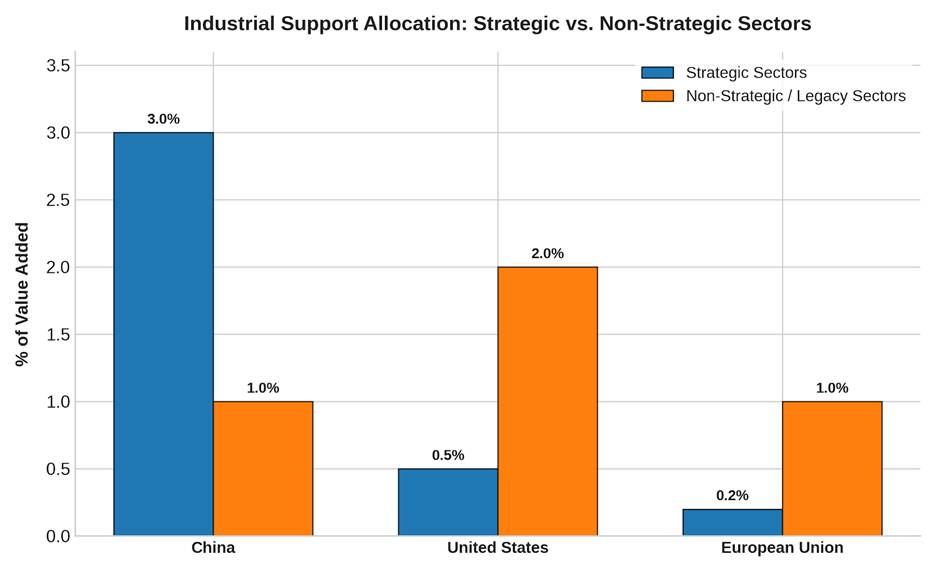
(Figures represent % of Value Added allocated via industrial support)
Debunking the Volume Myth
Measuring industrial support is notoriously slippery. Definitions vary widely across international institutions. The OECD’s broader metrics factor in below-market state lending, cheap credit, and sub-national financial vehicles, yielding significantly higher estimates for state-directed economies[^4]. The IMF uses a narrower gauge focusing primarily on direct grants, fiscal aid, and budget support[^5].
Yet even under the IMF’s narrower scope, the stark divergence in gross spending vanishes:
- China: Subsidies averaged 1.8% of value added between 2015 and 2023, peaking at over 2.5% in 2023[^6].
- United States: Government subsidies averaged 1.3% of value added over the same period[^7].
- European Union: Member states averaged 0.6% of value added[^8].
When measured against total gross output, China and the US stand neck-and-neck at approximately 0.5%[^9]. While a gap exists, it falls well short of the existential chasm routinely cited in policy debates.
The Public Choice Trap: Rent-Seeking vs. Strategic Investment
If overall subsidy levels are comparable, why is Chinese manufacturing dominating green technology, advanced electronics, and electric vehicle supply chains while Western initiatives stall?
Public Choice Theory provides the key explanation[^10]. In mature Western democracies, industrial policy is frequently hijacked by rent-seeking[1]—the expenditure of political and financial resources by established corporate lobbies to secure state protection, tax exemptions, or direct financial transfers without generating new productive output[^11]. Instead of competing on market efficiency or technical innovation, incumbent industries invest heavily in lobbying to guarantee public support.
This dynamic yields a severe pattern of regulatory capture, where the state institutions designed to guide economic policy end up serving the narrow interests of the dominant corporate lobbies they regulate[^12].
│ THE WESTERN RENT-SEEKING LOOP │
│ Corporate Profits ──► Political Lobbying ──► Protective Subsidies │
│ ▲ │ │
│ │ ▼ │
│ Low Innovation Market ◄── Entrenched Status Quo ◄── Tariff Barriers │
The resulting allocation of capital reflects political influence rather than strategic economic returns:
- The United States directs 2% of value added toward non-strategic sectors, leaving just 0.5% for critical, high-tech industrial manufacturing.
- The European Union allocates 1% to traditional, politically vocal sectors and a tiny 0.2% to strategic, high-growth industries.
- China flips this ratio, channeling roughly 3% of value added into high-complexity sectors (semiconductors, advanced machinery, renewables) and restricting non-strategic support to just 1%.
Shielding Inefficiency at the Expense of Productivity
When rent-seeking dictates public spending, government support functions as a defensive buffer for legacy industries rather than an offensive accelerator for emerging technology[^8].
Subsidies and protective tariffs won through effective lobbying create a safety net for unproductive firms. In an efficient market, underperforming enterprises must innovate or exit, freeing up talent and capital for higher-yielding ventures[^7]. Regulatory capture interrupts this process of creative destruction, producing “zombie enterprises” and entrenched legacy sectors that absorb public funds while depressing Total Factor Productivity (TFP)[8].
Furthermore, regulatory capture enables incumbent corporations to design compliance frameworks that raise entry barriers for smaller, more agile competitors—stifling the very startups where productivity breakthroughs typically originate[^9].
Meanwhile, IMF modeling shows that China’s concentrated, unencumbered investment in upstream scale economies is projected to boost its electronics exports by another 20% in short order.
Priorities Build Economies, Not Protectionism
Subsidies do not create advanced microchips, efficient power grids, or skilled workforces out of thin air. Uncompromising national priorities do.
While European and American governments spend political energy appeasing vocal interest groups, cutting fundamental research budgets, and delaying grid modernization, China’s industrial strategy concentrates capital, technical education, and supply chain density behind unified strategic objectives.
The uncomfortable truth for Western policymakers is clear: Beijing’s primary advantage is not that it spends endlessly more than everyone else, but that its state mechanism is free from the democratic rent-seeking trap that dissipates Western capital across politically connected legacy sectors.
The next decade of global economic competition will not be won by the government that spends the most money. It will be won by the system with the discipline to withstand special-interest lobbying and direct public capital where the future is being built.
Footnotes & References
[^1]: European Commission, State-Targeted Subsidies and Market Distortions in Global Trade, Trade Policy Directorate Discussion Paper, 2024.
[^2]: International Monetary Fund (IMF), Measuring Industrial Subsidies: Methodological Challenges and Empirical Findings, IMF Staff Discussion Note, 2024.
[^3]: OECD, Government Support and Global Supply Chains: Tracking Industrial Subsidies Across Major Economies, OECD Publishing, Paris, 2023.
[^4]: OECD, Below-Market Financing and State-Backed Credit in Global Industrial Competition, Trade Policy Paper No. 278, 2023.
[^5]: IMF, Fiscal Monitor: Capital Allocation, Subsidies, and Long-Term Productivity, Washington, D.C., 2024.
[^6]: IMF Database on Industrial Policy, Sectoral Value-Added Breakdown of Direct State Support (2015–2023), 2024.
[^7]: U.S. Congressional Budget Office (CBO), Federal Subsidies and Tax Expenditures in Manufacturing and Energy, 2024. [^8]: European Court of Auditors, State Aid Compliance and Industrial Subsidies Across EU Member States, Special Report, 2024.
[^9]: IMF / OECD Joint Policy Brief, Gross Output vs. Value Added: Re-evaluating Global Subsidisation Metrics, 2024.
[1] rent-seeking theory only became the subject of durable interest among economists and political scientists more than a century later after the publication of two influential papers on the topic by Gordon Tullock in 1967,[6] and Anne Krueger[7] in 1974.