

















By Zlatko Kramarić*
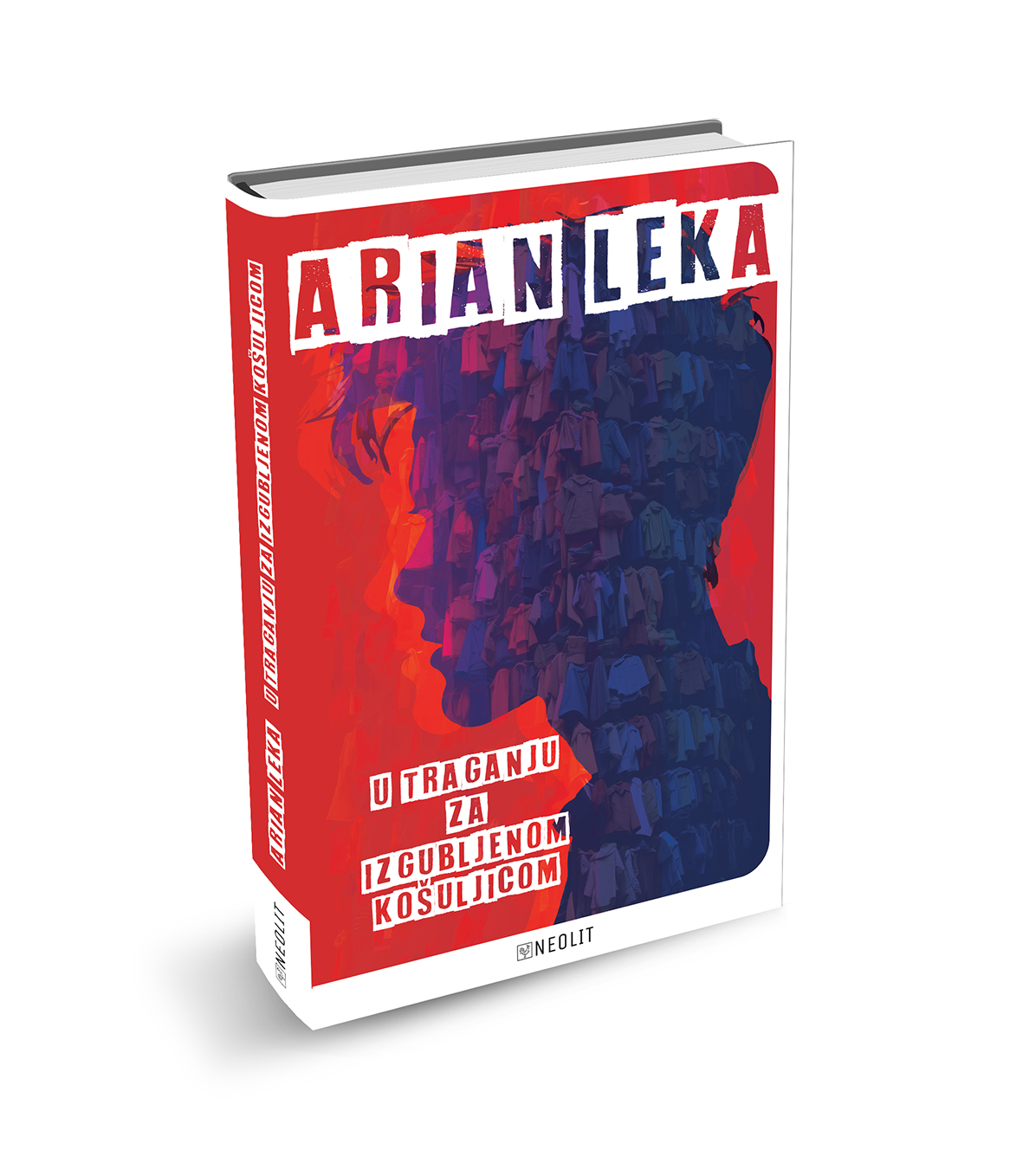
The novel “In Search of the Lost Little Shirt” by the Albanian writer A. Leka belongs to those works that cannot easily be confined within the boundaries of a single literary genre. The title itself suggests a search for something that is at once an object of memory, a trace of a particular time, and a sign of a lost world. Leka does not merely tell one story; through personal, family, and historical experience, he gradually opens a space in which private memory encounters the great ideological narratives of the twentieth century.
It is precisely this generic indeterminacy that is one of the novel’s distinctive features: it is a kind of hybrid novel, situated on the boundary between autobiographical prose, the family novel, historical reconstruction, memoir, and political-ideological essays. These layers do not appear as separate units; rather, they interpenetrate, so that personal memory becomes a way of reading history, while “great” history enters the intimate space of the individual. The ideological dimension is not merely background decoration or an accidental setting; it is tied to the traumatic experience of Albanian communism and, above all, to the legacy of Enver Hoxha, whose political system appears in the novel as one that shaped not only institutions and public life but penetrated deeply into everyday life, the family, memory, and the individual’s very conception of his own life.
That is why this novel is particularly interesting at the point where the literature of memory becomes a literature of coming to terms with ideology. Its hybridity is not a formal game, but corresponds to the very nature of the experience it describes: neither the past, nor personal memory, nor the trauma of an ideological age can be reduced to a single genre, a single perspective, or one final interpretation.
The novel “In Search of the Lost Little Shirt” by the Albanian writer Arian Leka is a novel about returning to childhood, to the 1960s. It is also the time of Enver Hoxha, the era of one of the most rigid communist dictatorships in Europe. Yet behind this first, autobiographical layer, other, much more serious themes gradually emerge. One of the most serious is certainly the question: what happens to personal memory when a society is subjected to the systematic ideological shaping of remembrance?
The very title of the novel evokes one of the great themes of European literature – the search for lost time. The author consciously refers to M. Proust’s celebrated novel “In Search of Lost Time”. In the French writer’s novel, the madeleine cake triggers involuntary, almost bodily memory, because the past does not return because we have decided to reconstruct it, but because some taste, smell, object, or gesture suddenly brings the narrator back into the present. Leka, however, transposes Proust’s literary matrix from the bourgeois world of early-twentieth-century French society into a completely different historical context, the confused and traumatic political space of Albania.[2][3]
If in Proust the madeleine is the doorway to lost time, in Leka it is the little shirt, an ordinary item of clothing. In this novel, the shirt does not function merely as an object connecting the narrator to his earliest childhood. Above all, it is a sign of the narrator’s original identity, something that precedes all the later identities that will be imposed upon him by his immediate family, existing social relations, the ruling ideology, state institutions…. This symbolism probably contains the deepest value of the book: the search for the lost little shirt gradually transforms into a search for that part of oneself that, at that time, had not yet been dressed in one of the many binding social and ideological uniforms. Clothing has a special, almost political meaning in this novel. The wardrobe in the family home likewise becomes a kind of archive of the past, containing various uniforms, Pioneer caps and scarves, different kinds of clothing, pictures of political heroes, and various objects that are no longer merely objects but visible traces/scars of a world that has since disappeared. The “political nature” of clothing is evident in the fact that in Hoxha’s time one could not choose what to wear. Such freedom of choice simply was not permitted. Only state institutions had the privilege of determining which uniform was to be worn in a given situation. At the same time, they controlled and prescribed fashion trends in Albanian society. Totalitarianism is, among other things, a system that seeks to produce precisely such uniformity – not only in dress, but also in thought, language, memory, and expectations.[4]
Personal memory is never entirely private. A person remembers his childhood, but he remembers it in a language he learned from others. He can thus remember his family, father, mother, grandmother, grandfather, and siblings relatively freely, but when it comes to remembering historical time, memory is no longer free; it is strictly controlled by the regime. In a totalitarian society, there is almost no boundary between private and collective memory. The totalitarian state does not want to control only the present. It also seeks to control the past, so that it can project the future with greater certainty. It wants to decide what will be remembered, who will be a hero and who, on the other hand, will be an enemy. It is the state that determines what will be treated in society as a crime and what will be understood as an expression of historical necessity. In Albania, the existence of camps for the re-education of “enemies of the people” was, over a long period, regarded as one of the necessary historical episodes in the realization of the “communist paradise”. The situation was no better in socialist, Tito’s Yugoslavia. There too, the camps served the same function. Their existence cannot be reduced to accidental historical excesses; rather, it should be interpreted as yet another indication that the historical inevitability of the system could not be avoided. Indeed, the system could survive precisely because it had succeeded in replacing political pluralism with a monopoly of ideology and the unlimited power of the repressive apparatus. The camp thus became the endpoint of a logic in which an opponent was no longer treated as a political rival, but as an “enemy” who had to be isolated, re-educated, or eliminated.[5][6]
Following from the above, we could conclude that the theme of Albanian isolation is one of this writer’s obsessive themes. In one of the motifs described, which has already attracted attention in the Croatian reception of the book, physical obstacles at sea – all those barrels that represented a kind of boundary toward the outside world – become a metaphor for life in Albania. But even more important is the author’s realization that physical boundaries are not the greatest evil. There are other, mental boundaries that weigh more heavily on many individuals than mere physical confinement. One of the fundamental characteristics of human beings is the desire to know and see what exists on the other side of a wall. Likewise, a person wants to know why that view is forbidden, why he cannot move freely, why he cannot say publicly what he truly thinks…
Freedom is therefore one of the fundamental leitmotifs of this novel. And not merely freedom of movement, but much more the freedom of thought, reading, speech, and the ability to compare one’s own world freely with other, unknown worlds.
The author attempts to resolve this frustration in an episode in which the home library becomes a symbolic battlefield between East and West. The books in the home library cease to be merely books. They become political signs par excellence. Thus Dostoevsky, Tolstoy…, are no longer merely Russian classics; they can become a serious political problem at the moment when Albania’s official relationship with the Soviet Union changes. Socialist Yugoslavia went through a similarly traumatic and tragic experience. In Yugoslavia, too, a radical change in relations with the Soviet Union/Stalin took place several years after the war, but Josip Broz resolved the dilemma more than elegantly: those who doubted his vision of the path toward a “better society” were simply sent on a somewhat longer “official trip”, to an abandoned island in the Adriatic Sea. On that island, those “doubting Thomases” who had publicly questioned the authority and political wisdom of the “great leader” were to be re-educated by their former comrades and fellow fighters, so that through this “gentle” process of re-education they might understand all their ideological and other errors.[7]
All these facts constitute the fundamental motive behind this writer’s return to the past, to the days of childhood. Yet he does not want merely to describe that return to his childhood. Above all, he returns to the past in order to analyze it with surgical precision, explain it, and ultimately understand it. But his return contains no elements of cheap, sentimental nostalgia, because he does not experience that past as a lost paradise. That past is at once beautiful and frightening. Childhood can be happy even when society is unfree. This is precisely one of the most difficult truths of memory: private happiness does not prove that the social system was good.[8][9]
In these details, the novel belongs to the poetics of the great European literature of memory, stretching from M. Proust and Th. Mann, through M. Kundera, I. Kertész, and D. Kiš, and, albeit in a different register, to W. G. Sebald. But the distinctive feature of A. Leka’s poetics lies in the fact that this writer does not set his private memories against collective history. His memories are precisely the place where they encounter “great”, official history. A. Leka’s literary work belongs to this tradition, but in his novels/essays he does not reproduce it in every detail. Ultimately, his subject is not vanished Central Europe, nor the suppressed French memory of occupation, but Albania, which for decades was a kind of blank spot in the European consciousness.[10]
A child growing up in a totalitarian society does not necessarily understand the political system in which he lives. At first, he senses it unconsciously. He senses it through prohibitions, meaningless rituals, strictly controlled school curricula, uniforms, official language, the silence of adults, the sudden disappearance of familiar people, neighbors, and family friends, and the vague feeling that there is a clear boundary between what is permitted and what is not. Only later, as an adult and in mature years, will he try to understand what, as a child, he could only sense.
In this detail, we also see the exceptional quality of this writer’s poetics, in which the adult narrator does not erase the child’s perspective, but tries to hear and understand it again. Albania under E. Hoxha in the book is not merely a historical backdrop. It is a kind of laboratory of totalitarian modernity. It is a society that does not merely want obedient citizens; it also wants to produce a particular image of reality. Totalitarian power does not merely say: “You must do this.” It goes much further and says: “You must believe that everything we are doing is true.”
That is precisely why books, reading, and language are so important in this writer’s world. If a person is deprived of the possibility of reading a different book, hearing a different voice, or imagining a different life, his reality gradually narrows. Reality slowly but surely turns into nothingness, which can disappear at any moment, collapsing into one of those “black holes”.
One of the most beautiful passages in this book is the episode about learning the alphabet, which “saved the narrator from becoming an automaton”. Almost the entire philosophy of this exceptionally valuable book is summed up in that sentence.[11]
But this does not mean that the author has written a political pamphlet against Hoxha’s regime. His method is much subtler. He shows how a great ideology enters small, everyday things. Clothing. The family. School. Children’s games. Books. A geographical map. The relationship to the sea – a space that exists before one’s eyes, visible and within reach, yet nevertheless not a free space. The sea is there, but one may not cross it. This is probably also the most precise metaphor/definition of totalitarianism: freedom exists, but it has been transformed, both physically and psychologically, into a forbidden space.[12]
Leka nevertheless does not remain confined to the Albanian experience. Quite the opposite. “In Search of the Lost Little Shirt” is not only a book about Enver Hoxha’s Albania. It is a book about twentieth-century Europe and its enduring struggle with its own political demons. Albanian experiences were for a long time light-years away from the European public. Yet this writer has no intention of making those experiences exotic in any way, as some Yugoslav artists did. He will bring these experiences into the common European space of memory. That is why it may be most accurate to read this book as a European novel of memory written from an Albanian perspective. The novel “In Search of the Lost…” could likewise be interpreted as one of the possible derivatives of remembrance, in which memory does not serve the sentimental preservation of the past, but memory as a form of responsibility.[13]
Leka does not want his childhood to become a museum piece. Nor does he want Albania to remain trapped in the image of Hoxha’s dictatorship. His ambition is much more demanding. He wants to show how an individual is shaped within history and how, later, from the perspective of an adult, he attempts to understand what he could not understand as a child. In this sense, the novel is also a book about the maturation of the individual and society. And perhaps about the maturation of Europe. For a Europe that does not understand the experience of its own peripheries does not understand itself either.
That is precisely why his book has particular value today. Europe cannot be built only on institutions, borders, and political declarations. It must also be built on the ability to make different experiences of the past part of a common conversation. The more intimate his “little stories” become, the more universal they become. The Albanian experience of totalitarianism has its specific features, but the question posed by the book is much broader: how truly our own is our identity, and how much of it is composed of other people’s stories that we have inherited?
And this writer has posed another, much more important question: can we ever free ourselves from the past if we do not first try to understand it?
Thus the search for the little shirt can ultimately also be read as a search for the lost “self”. (Although we must point out that the meaning of this novel should not be sought exclusively in finding the shirt; rather, its meaning lies above all in the search itself. We can never fully reconstruct our childhood, but we can reassemble its fragments: objects, smells, images, books, family stories, political events, silences, and voids. And it is precisely those voids that sometimes speak the loudest!) The narrator attempts to find what existed before he was dressed in all those later identities: familial, national, political, ideological. The little shirt thus becomes a kind of metaphysical object – something that preceded history itself! Instead of a conclusion
And the final image in this novel, of a boy trying to set a paper boat sailing across a geographical map, in our view represents the key to the writer’s entire body of work: even when they take the sea/freedom away from us, we must sail.
This is at once a poetic and political definition of literature. For literature begins precisely where ideologically permitted boundaries end. Therefore, this novel does not stop at reconstructing life in socialist Albania. In it, the author raises several very serious questions, probably the most important being: what happens to a society after the fall of a political regime that shaped its perception of reality for decades? In his answers, he also clearly declares his political views. Thus the novel examines the (negative) consequences of transition, the collapse of old authorities, the formation of a new-old social hierarchy, the phenomenon of migration, and the relationship with Europe. In this respect, the comparison with the post-Yugoslav experience is also invaluable.
A. Leka shows that Albania is not an isolated European case. It too went through its own transitional purgatory, with differences arising from the fact that it had survived a much more radical isolation than most of the former socialist countries. The book can therefore also be read as a conversation with the Croatian/European reader. We most often view Albanians as “others”, although their experience of socialism, transition, emigration, modernization, and European integration is in many respects comparable to our own. And this writer makes precisely such comparisons possible.
[1] A. Leka, In Search of the Lost Little Shirt, Neolit, Koprivnica, 2025.
[2] Embarking on the uncertain adventure of searching for (lost) time means that A. Leka, like M. Proust, was aware that he would have to answer a very complex question: what remains of us when time passes, when the world in which we grew up disappears, and when we have to ask ourselves again who we were before others told us who we should be?
[3] A. Leka is by no means a mere imitator of the French classic. He consciously enters into a great European literary theme – the search for lost time – but does so with a subtle postmodernist distance. “Leka begins his search ‘at the request’ (of the French publisher – Z.K.’s note), so the impulse comes ‘from outside’; he has no madeleine cake that could revive the past. While Proust ends his search with a reversal – he finds lost time in literature – Leka knows from the outset that he will not find his ‘lost little shirt’. And he will not find it not only because it belongs to the past, but also because he knows that he is writing a postmodernist text. Yet this does not mean that the search is futile,” V. Solar, The Meaning Lies in the Search Itself, Vijenac, no. 839.
[4] In her review of this novel, V. Solar pointed out that an autobiographical work must question the identity of the person about whom it writes. Accordingly, she concludes that the novel formally establishes a Lejeunean autobiographical pact with the reader – the author, narrator, and character are all named Arian Leka – but at the same time breaks it by questioning Leka’s very identity. And that identity is deeply connected to the society and state in which the author grew up and in which he still lives today – Albania.
[5] In socialist Yugoslavia, A. Ranković was, after Tito, the most powerful political figure in the party and state apparatus. This unlimited power stemmed from the fact that he controlled the repressive apparatus, the State Security Administration, colloquially known as UDBA. The fact that this power lasted until 1966, until the famous Brioni Plenum, after which it was merely dispersed, shows how deeply the security and repressive apparatus was embedded in the very structure of the Yugoslav communist state. Over time, this apparatus would become a hallmark of “state terrorism”, participating even beyond the country’s borders in the elimination of “enemies” – real ones, and even more so, imaginary ones!
[6] On this, see our text, Blood on Stone… (Tito Is Not So Easily Deceived), in the book The Critique of the Political Mind, Ljevak, Zagreb, 2022. In that text, among other things, we commented on the full genius of “anti-Stalinist Stalinism” (S. Stojanović): “In earlier times, schools taught us that, for Yugoslav communists, prisons in monarchist Yugoslavia were a kind of ‘red universities’. The liberal character of the prison regime in pre-war Yugoslavia is attested by many established facts, including that comrades in Lepoglava were not prevented from organizing Marxist study circles, while the more educated, such as Moša Pijade, could freely translate Marx’s Capital. Yet when those same comrades seized power after the Second World War, one of their first decisions concerned a radical change in pre-war prison practice. They proceeded from the premise that enemies of the people deserved no mercy, but had to be re-educated, convinced, by persuasion or force, that they were on the ‘wrong path/track of world history’, and that only unconditional faith in the Yugoslav Communist Party and the infallible leader Tito could return them to the ‘right path’. The case of Goli Otok testifies in the best possible way to the ‘subtle’ methods used to convince the ‘enemy’ that he was on the ‘wrong path’. (Goli Otok was distinctive precisely because part of the repression was systematically transferred onto the prisoners themselves: the camp administration organized a hierarchy among inmates and encouraged them to beat, humiliate, monitor, and ‘re-educate’ other prisoners. The monstrosity of the system lay in the fact that the administration did not directly participate in physical and psychological violence; instead, the prisoners themselves carried out the worst violence. The administration merely devised new forms of punishment, such as the ‘hot rabbit’, ‘French opinion’…, and the prisoners then implemented those ideas. In this sense, Goli Otok was not merely a place of punishment but a kind of laboratory of self-repression, in which the authorities systematically destroyed solidarity among people and set prisoners against one another.) And if we were cynical, we could say that all those ‘subtle’ methods used on Goli Otok in the 1950s were merely some of the logical consequences of the pre-war ‘red universities’, because there is no doubt that some of the students failed to master the prescribed material properly, so the authorities had to send them to remedial examinations, for additional revision. A great deal of literature has been written about all those ‘subtle methods’ used on Goli Otok. Finally, we must be honest and admit that we learned about all those incredible experiences of Goli Otok prisoners precisely from literary texts – and only in the 1980s. Josip Broz Tito had to die before it became possible to speak and write freely about Goli Otok.”
[7] “Official trip” is a euphemism for Goli Otok! We should only recall that in 1985 E. Kusturica made the film Father on a Business Trip, based on a screenplay by A. Sidran.
[8] One may feel nostalgia for a smell, an object, a street, or a song without feeling the slightest nostalgia for the political system that marked that time. This is precisely where the difference between nostalgia and memory arises. While nostalgia wants to bring the past back, memory wants to understand the past.
[9] Thus, at the same time, we can love our childhood immensely while maintaining a critical attitude toward the society in which that childhood was spent. We can love the people who lived in that time, but not the time itself.
[10] Winfried Georg Sebald (1944–2001) was one of the most important German writers of the second half of the twentieth century. He spent most of his life in England, where he was a professor of European literature. He wrote in German. His novels include Vertigo, The Emigrants, The Rings of Saturn, and Austerlitz. Austerlitz is his most important work. Published in 2001, it is a novel in which the protagonist gradually discovers his repressed past: as a Jewish child, he was rescued by the Kindertransport from Czechoslovakia and taken to England, where he continued to live. His novels, like those of A. Leka, are not classical novels, but consist of documents, photographs, travel writing, (auto)biographies, essays, and fiction, so the reader is never completely certain where fact ends and literary construction begins.
[11] Literacy is not merely the ability to read. It is also the ability to resist. For to read means being able to imagine that something exists beyond official stories. And that possibility is precisely the greatest threat to any totalitarian regime.
[12] On the phenomenon of the “sea” in A. Leka’s work, see our text in Argument magazine, 1 December 2025. Particularly striking in this novel is the image of a protective ring of floating barrels marking the outer boundary of Albanian waters. The boundary is thus no longer an abstract political fact. It becomes something even a child can see with the naked eye. The sea ceases to be a horizon of possibilities and becomes a zone of forbidden space! Then comes an almost poetic act of resistance, when the boy sprinkles salt on a geographical map so that his paper boat can nevertheless sail freely. This image is much more than a nostalgic memory. The child attempts to turn the map into reality. If the real sea is inaccessible, he will make his own sea. If the boundary is impermeable, imagination will overcome it. If the state determines where the world ends, the child’s imagination will try to show that those rules do not apply in his world.
[13] And precisely this “shift from normality” into “wild thought” is present in most Balkan authors: thus E. Kusturica makes Time of the Gypsies, while G. Bregović writes compositions for “weddings and wedding celebrations”, because they are convinced that only such things can pass with a decadent European audience. And, unfortunately for us, they are not far from the truth at all!
*Zlatko Kramarić is a Croatian publicist, author, and diplomat, currently serving as Ambassador to Albania. Formerly a university professor and politician, he is known for his work in literature, cultural studies, and regional history.
© 2026 Argumentum