

















• SHQIPËRI
  • KOSOVË
  • MAQEDONIA E VERIUT
  • MALI I ZI
  • Revista në PDF
20 August, 2026
  • Home
  • OP/ED

    Between Political Calculation and Retreat: Croatian Communists at the End of an Era

    The West is buying time, but to whom is it giving it?

    27 July 1941 – A Site of Memory Between War, Revolution and Europe

    The cult of Saint Veneranda / Saint Pren(d)a / Saint Premte / Saint Paraskeva among Albanians

    The Self-Inflicted Decoupling: How U.S. Immigration Policy Is Ceding the Tech Edge to China

    The Blueprint Does Not Stop at the Drina

    The Underlying Logic behind China’s Economic Success

    Do Not Misuse the U.S. Declaration of Independence to Justify the Narrative of Insurrection in Albania

    The visit that changed Albania’s strategic future

  • Interview

    Exclusive Interview with Oleksandr Tyshchenko: A 40-Year Legacy of Chernobyl, Nuclear Risks, and Global Responsibility

    INTERVIEW: ZLATKO KRAMARIĆ – THOUGHTS ON THE OLD CONTINENT

    EXCLUSIVE / Ukrainian Ambassador to Albania, Volodymyr Shkurov: “Ukraine wants peace, but not at the expense of its freedom and independence”

    EXCLUSIVE| Ambassador Tayyar Kagan Atay: Türkiye and Albania, a Strategic Partnership Rooted in Shared Heritage and a Common Vision for the Future

    “Diplomacy, Not War”: Palestinian Ambassador to Albania Calls for Justice, Peace, and Global Action for Gaza

    Exclusive: “Even After Tito – Tito”/ Ambassador Zlatko Kramarić on Authoritarian Legacies and Democracy’s Future in the Balkans

    The Conclusion of the Diplomatic Mission / Ambassador Dancho Markovski: Strengthening Albania-North Macedonia Relations for a Shared European Future

    A Century of Diplomatic Relations Between Albania and Russia: Exclusive Interview with the Russian Ambassador to Albania, H.E. Alexey Zaytsev

    Exclusive/ The chairman of the Freedom Party, Ilir Meta: “The will of the citizens will triumph in Albania, as it did in North Macedonia”

  • Realpolitik

    Belgrade, Zelensky and the Consulates! The European Pact takes water! Drone in Leipzig and hybrid war! Why a  ceasefire is needed in September

    The Summit of Unity! Think of peace and prepare for war! It’s only the start to the end! Just a pause between two wars!

    Peace with war diplomacy! The protest,  image and tourism! Why this silence from the EU Commission and Council? A deal or a pause?

    Just kind words  in Tivat! Where is the peace!? A deal yes, peace No!What is happening with USA and  EU?  5 elections but no solution!

    IBAR? ”Sufficiently! Much ado about nothing! Shart contrasts in Beijing! Where is the exit?!

    Neither peace nor war! Peace with bombs?! IBAR in autumn?! Not another Hormuz in Taivan! 

    IBAR – a springing board or an obstacle? Can we catch the EU Negotiation train 2027? When the dress makes the news!  EU electoral April  ends in a draw 1:1!  

    The European Parliament building in Strasbourg, France with flags waving calmly celebrating peace of the Europe. July 12, 2020.

    EU 2027 or 2037! Even half membership failed! No exit strategy!     

    What next?

  • Current Events

    The Delayed Awakening: Realpolitik and the Structural Causes of European Stagnation

    Democracy Cannot Be Governed by Noise

    Council of Albanian Ambassadors Raises Concern Over Serbian Plan to Alter the Ibër River

    Digitalisation in the modern era as a “Trojan horse” for hybrid warfare

    The four days that changed history

    Bury Those You Killed

    The Serbian Consulate in Shkodra: A Diplomatic Step or a Project with Political Implications?

    Chinese Embassy in Albania Marks PLA’s 99th Anniversary, Reaffirms Commitment to Peace and Bilateral Cooperation

    Croatian Foreign Minister’s Visit to Tirana/Albania and Croatia Strengthen Their Strategic Partnership as Zagreb Reaffirms Support for Albania’s European Union Membership

  • Top News

    Rama, Vučić, Zelensky: Where Is Albania’s National Interest?

    Council of Albanian Ambassadors Raises Concern Over Serbian Plan to Alter the Ibër River

    Rama: Foreign Information Manipulation Has Become One of the Greatest Threats to Democracy and European Security

    The Council of Albanian Ambassadors condemns chauvinistic rhetoric by Serbian officials and calls for diplomatic action

    NATO at Ankara 2026: Strategic Rebalancing Between Russia Deterrence, Turkey’s Rise, and National Interests

    Daniel Serwer: A Bad War Ending Badly May Still Be Good News

    Friedrich Merz, Keir Starmer, António Costa, Donald Trump, Emmanuel Macron, Mark Carney, Ursula von der Leyen, Giorgia Meloni and Sanae Takaichi

    G7 Leaders Gather in Évian Amid Global Uncertainty, Focus on Security, Economy and International Cooperation

    Russian Ambassador in Tirana: “Without a Strong and Sovereign Russia, the Creation of a Just World Order Is Impossible”

    “The Flamingo Revolution”: Day 10 of Protests in Albania Draws International Attention

  • YOUR VOICE
  • Shqip
No Result
View All Result
Argumentum
  • Home
  • OP/ED

    Between Political Calculation and Retreat: Croatian Communists at the End of an Era

    The West is buying time, but to whom is it giving it?

    27 July 1941 – A Site of Memory Between War, Revolution and Europe

    The cult of Saint Veneranda / Saint Pren(d)a / Saint Premte / Saint Paraskeva among Albanians

    The Self-Inflicted Decoupling: How U.S. Immigration Policy Is Ceding the Tech Edge to China

    The Blueprint Does Not Stop at the Drina

    The Underlying Logic behind China’s Economic Success

    Do Not Misuse the U.S. Declaration of Independence to Justify the Narrative of Insurrection in Albania

    The visit that changed Albania’s strategic future

  • Interview

    Exclusive Interview with Oleksandr Tyshchenko: A 40-Year Legacy of Chernobyl, Nuclear Risks, and Global Responsibility

    INTERVIEW: ZLATKO KRAMARIĆ – THOUGHTS ON THE OLD CONTINENT

    EXCLUSIVE / Ukrainian Ambassador to Albania, Volodymyr Shkurov: “Ukraine wants peace, but not at the expense of its freedom and independence”

    EXCLUSIVE| Ambassador Tayyar Kagan Atay: Türkiye and Albania, a Strategic Partnership Rooted in Shared Heritage and a Common Vision for the Future

    “Diplomacy, Not War”: Palestinian Ambassador to Albania Calls for Justice, Peace, and Global Action for Gaza

    Exclusive: “Even After Tito – Tito”/ Ambassador Zlatko Kramarić on Authoritarian Legacies and Democracy’s Future in the Balkans

    The Conclusion of the Diplomatic Mission / Ambassador Dancho Markovski: Strengthening Albania-North Macedonia Relations for a Shared European Future

    A Century of Diplomatic Relations Between Albania and Russia: Exclusive Interview with the Russian Ambassador to Albania, H.E. Alexey Zaytsev

    Exclusive/ The chairman of the Freedom Party, Ilir Meta: “The will of the citizens will triumph in Albania, as it did in North Macedonia”

  • Realpolitik

    Belgrade, Zelensky and the Consulates! The European Pact takes water! Drone in Leipzig and hybrid war! Why a  ceasefire is needed in September

    The Summit of Unity! Think of peace and prepare for war! It’s only the start to the end! Just a pause between two wars!

    Peace with war diplomacy! The protest,  image and tourism! Why this silence from the EU Commission and Council? A deal or a pause?

    Just kind words  in Tivat! Where is the peace!? A deal yes, peace No!What is happening with USA and  EU?  5 elections but no solution!

    IBAR? ”Sufficiently! Much ado about nothing! Shart contrasts in Beijing! Where is the exit?!

    Neither peace nor war! Peace with bombs?! IBAR in autumn?! Not another Hormuz in Taivan! 

    IBAR – a springing board or an obstacle? Can we catch the EU Negotiation train 2027? When the dress makes the news!  EU electoral April  ends in a draw 1:1!  

    The European Parliament building in Strasbourg, France with flags waving calmly celebrating peace of the Europe. July 12, 2020.

    EU 2027 or 2037! Even half membership failed! No exit strategy!     

    What next?

  • Current Events

    The Delayed Awakening: Realpolitik and the Structural Causes of European Stagnation

    Democracy Cannot Be Governed by Noise

    Council of Albanian Ambassadors Raises Concern Over Serbian Plan to Alter the Ibër River

    Digitalisation in the modern era as a “Trojan horse” for hybrid warfare

    The four days that changed history

    Bury Those You Killed

    The Serbian Consulate in Shkodra: A Diplomatic Step or a Project with Political Implications?

    Chinese Embassy in Albania Marks PLA’s 99th Anniversary, Reaffirms Commitment to Peace and Bilateral Cooperation

    Croatian Foreign Minister’s Visit to Tirana/Albania and Croatia Strengthen Their Strategic Partnership as Zagreb Reaffirms Support for Albania’s European Union Membership

  • Top News

    Rama, Vučić, Zelensky: Where Is Albania’s National Interest?

    Council of Albanian Ambassadors Raises Concern Over Serbian Plan to Alter the Ibër River

    Rama: Foreign Information Manipulation Has Become One of the Greatest Threats to Democracy and European Security

    The Council of Albanian Ambassadors condemns chauvinistic rhetoric by Serbian officials and calls for diplomatic action

    NATO at Ankara 2026: Strategic Rebalancing Between Russia Deterrence, Turkey’s Rise, and National Interests

    Daniel Serwer: A Bad War Ending Badly May Still Be Good News

    Friedrich Merz, Keir Starmer, António Costa, Donald Trump, Emmanuel Macron, Mark Carney, Ursula von der Leyen, Giorgia Meloni and Sanae Takaichi

    G7 Leaders Gather in Évian Amid Global Uncertainty, Focus on Security, Economy and International Cooperation

    Russian Ambassador in Tirana: “Without a Strong and Sovereign Russia, the Creation of a Just World Order Is Impossible”

    “The Flamingo Revolution”: Day 10 of Protests in Albania Draws International Attention

  • YOUR VOICE
  • Shqip
No Result
View All Result
Argumentum
No Result
View All Result
Home ENGLISH

The Digital Pandemic of Ridicule

20 August, 2026
in ENGLISH, In Focus
A A
Share on FacebookShare on Twitter

(From the Dancing Plague of 1518 to the Crowd That Now Dances on Mobile Screens)

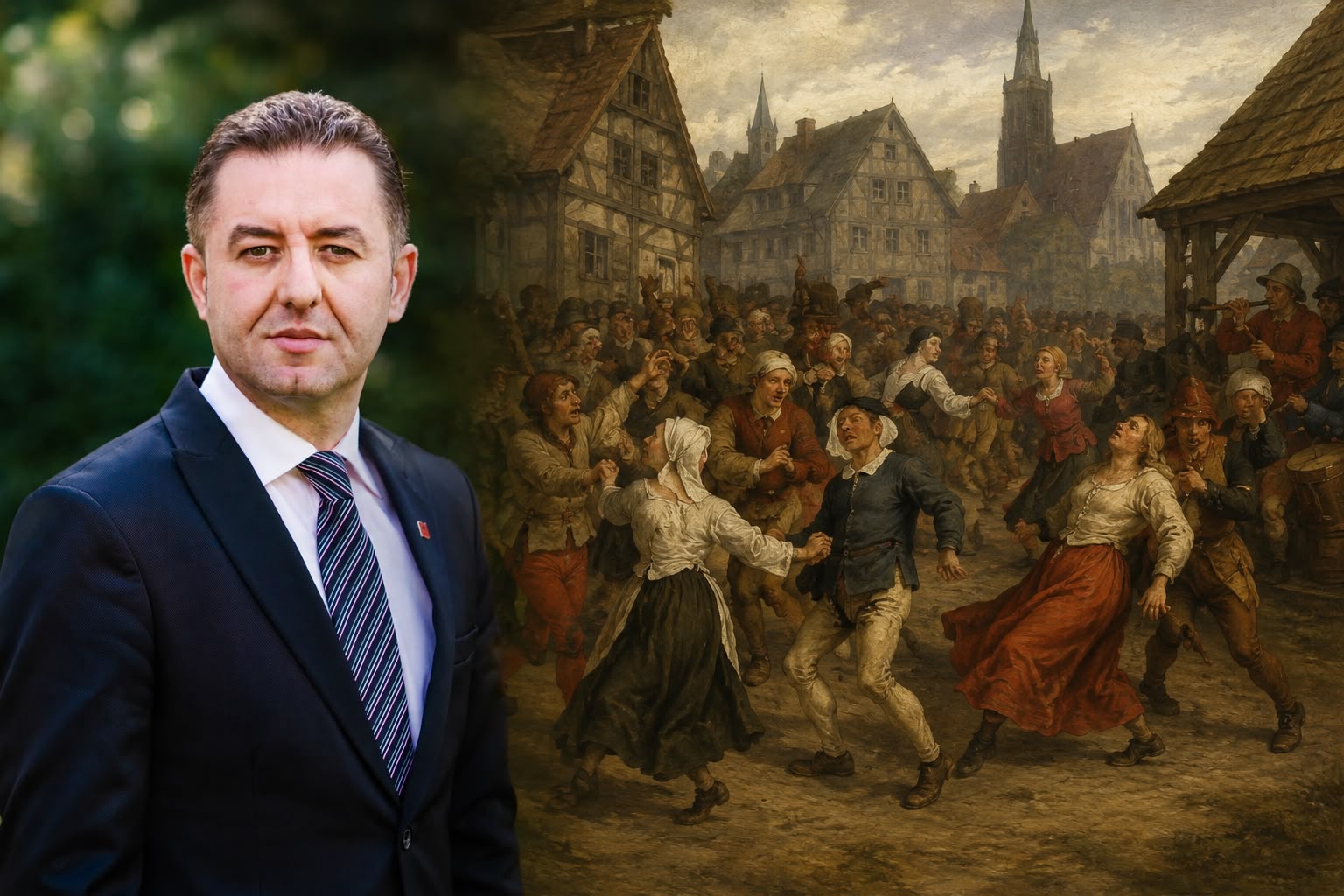
By Prof. Assoc. Dr. Bledar Kurti

In the summer of 1518, one of the strangest episodes in world history took place in Strasbourg. What I am about to tell you is a true story.

A woman named Frau Troffea walked into the street and began to dance. It was not a celebration. There was no music. There was no apparent reason. She simply danced, and she did not stop for days.

After her, others began to dance. Then more. Within a short time, the phenomenon had spread throughout the city. Hundreds of people became involved in what history would come to know as the “Dancing Plague” of 1518. People danced for days without being able to stop, until many of them died.

One person started. Others saw it. And others began doing the same thing. This is known as mass psychogenic illness.

Five centuries later, we no longer need the squares of Strasbourg. We have mobile phone screens. We have algorithms. We have social media. And we have what I would call the Digital Pandemic of Ridicule.

Today, whenever a political event, a public initiative, a project, an institutional decision, or a statement by a public figure takes place, we often no longer have a debate. We have a spectacle. Someone posts an ironic comment, another person copies it, someone else exaggerates it, another turns it into a meme, and someone else adds a derogatory remark. Within a few hours, a collective atmosphere is created in which not laughing, not mocking, and not ridiculing seems to mean that you are not part of the crowd.

This is where the problem lies.

I am not speaking against humor. Humor is healthy. Nor am I speaking against criticism. Criticism is the oxygen of democracy. The problem begins when ridicule replaces analysis, when irony takes the place of argument, when cynicism becomes a sign of intelligence, when a project is no longer analyzed for what it actually is but judged by how easily it can be turned into an object of ridicule, and when the question is no longer “Is this true?” but “Is this funny?”

The algorithm does not seek the truth. The algorithm is not a philosopher. It does not ask whether an argument is reasonable, whether a person has actually read the document, or whether an idea is beneficial to society. It measures engagement: clicks, comments, shares, reactions, anger, mockery, and the ability of a piece of content to make us stop our thumb while scrolling through our mobile phone screen. This creates one of the great paradoxes of our age: content that requires the least thought can receive the most attention.

A thousand-word analysis requires time, while a joke takes two seconds. A document requires reading, while a meme requires only a glance. An argument requires concentration, while ridicule requires only a smile. And so, gradually, we may move from a culture of argument to a culture of reaction.

It is no longer necessary to persuade; it is enough to ridicule. This is one of the most troubling changes in public communication. To defeat an argument, one once had to present another argument. Today, a meme may be enough. To challenge a project, one had to demonstrate its weaknesses. Today, a manipulated photograph and an ironic sentence may be enough. To criticize a politician, one had to analyze his or her decisions. Today, a derogatory nickname may be enough. This is the new economy of attention: argument requires work, while ridicule requires only an audience. And the audience is always there.

From Strasbourg to our phones, the parallel is frightening. In Strasbourg, people watched one another dancing, and instead of walking away, many joined in. Today, we see thousands of people reacting in the same way to an event, and instead of asking “Why are they reacting this way?”, we often ask “What is everyone else saying?” This is a fundamental difference.

Human beings are social creatures. We take cues from others to understand what we should think, what we should believe, and, above all, what we should feel. Social media has accelerated this mechanism to an unprecedented degree. Research on digital communication shows that content carrying moral and emotional weight tends to receive greater distribution, while negative behaviors can spread within online communities as behavioral models. Therefore, emotions are not merely a product of debate; they are also its fuel.

The pandemic of ridicule is spreading day by day. For this reason, “pandemic” is a useful metaphor, not because we are dealing with a medical disease and not because every person who makes a joke is part of a hysterical crowd, but because we are witnessing an emotional behavior that can spread from one individual to another, reinforced through repetition. Someone laughs, another laughs because they see the first person laughing, and a third laughs because they see hundreds of others laughing. After a while, no one knows anymore why they are laughing, but everyone continues. This is the point at which the individual disappears and the crowd emerges.

Cynicism is not intelligence; it is mass hysteria. We have created a dangerous misconception that mocking everything means you are more intelligent than everyone else. It does not. It is very easy to say, “What nonsense!”, but it is much harder to explain why. It is easy to say, “How ridiculous!”, but it is much harder to identify precisely where the problem lies. It is easy to attack the person, but it is much harder to defeat the argument. This is where the difference between criticism and cynicism lies. Criticism says, “This is the problem, and here is why.” Cynicism says, “Look how ridiculous they are.” Criticism requires thought, while cynicism requires only distance. Criticism can improve society, while cynicism can consume it.

The danger is not that people talk too much. The danger is that they react too much and think too little. This is an important distinction. We do not have a shortage of information; we have an excess of information. We do not have a shortage of opinions; we have an excess of opinions. We do not have a shortage of voices; we have millions of voices. But precisely for this reason, the most valuable ability of the modern citizen may not be the ability to speak. It may be the ability to stop: to not react immediately, to read, to verify, to compare, to question, to think, and only then to speak.

Democracy cannot be governed by a crowd that only reacts and ridicules. A healthy democracy needs citizens who know how to say “I disagree” or “I agree,” but who can also say, “Let me understand why.” It needs people who know how to challenge a project without humiliating its author, criticize a government or an opposition without hating everything it does, support an idea without becoming its fan, and change their minds without considering it a defeat.

But social media culture makes this balance increasingly difficult because the algorithm often does not reward calmness; it rewards reaction. It does not reward nuance; it rewards polarization. It does not reward complexity; it rewards simplification. And above all, it does not require you to be right. It is enough for you to be interesting enough to be watched.

Are we creating a society that no longer knows how to think? This is the question that should concern us. A society that loses its ability to engage in serious discussion does not become freer simply because it has millions of comments. A thousand comments are not a thousand arguments. A million clicks are not a million convinced minds. A trend is not necessarily the truth. And the majority is not always right. History has shown us this many times. Crowds can be powerful, but the power of a crowd is not the same thing as its wisdom.

We must learn to stop again. Perhaps the most important lesson of Strasbourg in 1518 is not why people danced, but the question: Why did they not stop? We, too, should ask ourselves why we are reacting, whether we have read something, whether we have understood it, whether we have an argument, whether we are criticizing an idea or following the crowd, whether we are saying something because we believe it or because we see everyone else saying it, and whether we are actually thinking or simply reacting.

These are small questions, but in the age of algorithms they may represent a great act of intellectual resistance. Because today, perhaps more than ever, thinking before reacting is an act of citizenship.

In Strasbourg, people had music. We have algorithms. They had the square. We have the mobile phone screen. They had the crowd in front of them. We have the crowd inside our phones. But the human mechanism may be similar: someone starts, others see it, the emotion spreads, the behavior becomes collective, and the individual forgets to ask whether they should dance.

Therefore, the challenge of democracy in the digital age is not to learn how to speak more. It is to learn not to dance to every rhythm the algorithm gives us. We must read, analyze, challenge with arguments, listen, change our minds when the facts compel us to, and have the courage not to laugh simply because everyone else is laughing.

Because in 1518 the crowd danced. Today the crowd comments. Back then, people were infected by one another’s dancing; today, we risk becoming infected by one another’s reactions. The difference is that back then the crowd was in the square. Today the crowd is on the screen. And perhaps this is the strangest pandemic of our time: the Digital Pandemic of Ridicule, when ridicule becomes faster than thought and reaction becomes more powerful than reason. And a society without reason moves toward self-destruction.

In 1518, the authorities believed that the way to stop the dancing was to play more music. It proved to be a serious mistake. Today, in the face of the Digital Pandemic of Ridicule, the answer cannot be more noise, more propaganda, or more emotional reactions. What we need is more reason, more calm, and above all, more leadership. True leadership does not follow the rhythm of the crowd, nor does it try to dance better than the crowd; it knows when to stop the music, silence the noise, and restore to society the ability to listen, think, and judge. Because when a society loses the rhythm of reason, the task of leadership is not to turn up the music, but to restore reason. This is historical leadership in the face of the fatal bewilderment of our times.

/Argumentum.al

© 2026 Argumentum

Related Posts

ENGLISH

Rama, Vučić, Zelensky: Where Is Albania’s National Interest?

20 August, 2026
ENGLISH

Belgrade, Zelensky and the Consulates! The European Pact takes water! Drone in Leipzig and hybrid war! Why a  ceasefire is needed in September

20 August, 2026
Current Events

The Delayed Awakening: Realpolitik and the Structural Causes of European Stagnation

20 August, 2026

Follow US

Subscribe

Receive Argumentum Magazine by Email

Last Posts

Rama, Vučić, Zelensky: Where Is Albania’s National Interest?

20 August, 2026

Belgrade, Zelensky and the Consulates! The European Pact takes water! Drone in Leipzig and hybrid war! Why a  ceasefire is needed in September

20 August, 2026

The Delayed Awakening: Realpolitik and the Structural Causes of European Stagnation

20 August, 2026

The Digital Pandemic of Ridicule

20 August, 2026

Democracy Cannot Be Governed by Noise

19 August, 2026
Argumentum

“Argumentum”, një proces intelektual …

Contact Us

[email protected]
[email protected]
[email protected]

Follow Us

Media Partner

Register

Receive Argumentum Magazine by Email
  • Home
  • Privacy Policy
  • About Us
  • Contact

© 2022 Argumentum. All Rights Reserved. | NUIS: L91415033Q

Welcome Back!

Login to your account below

Forgotten Password? Sign Up

Create New Account!

Fill the forms bellow to register

*By registering into our website, you agree to the Terms & Conditions and Privacy Policy.
All fields are required. Log In

Retrieve your password

Please enter your username or email address to reset your password.

Log In

Add New Playlist

No Result
View All Result
  • Home
  • OP/ED
  • Interview
  • Realpolitik
  • Current Events
  • Top News
  • YOUR VOICE
  • Shqip

© 2022 Argumentum. All Rights Reserved. | NUIS: L91415033Q

This website uses cookies. By continuing to use this website you are giving consent to cookies being used. Visit our Privacy and Cookie Policy.