































'/%3E%3C/svg%3E)

Assoc. Prof. Dr. Bledar Kurti
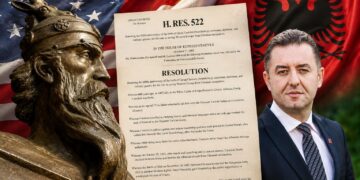
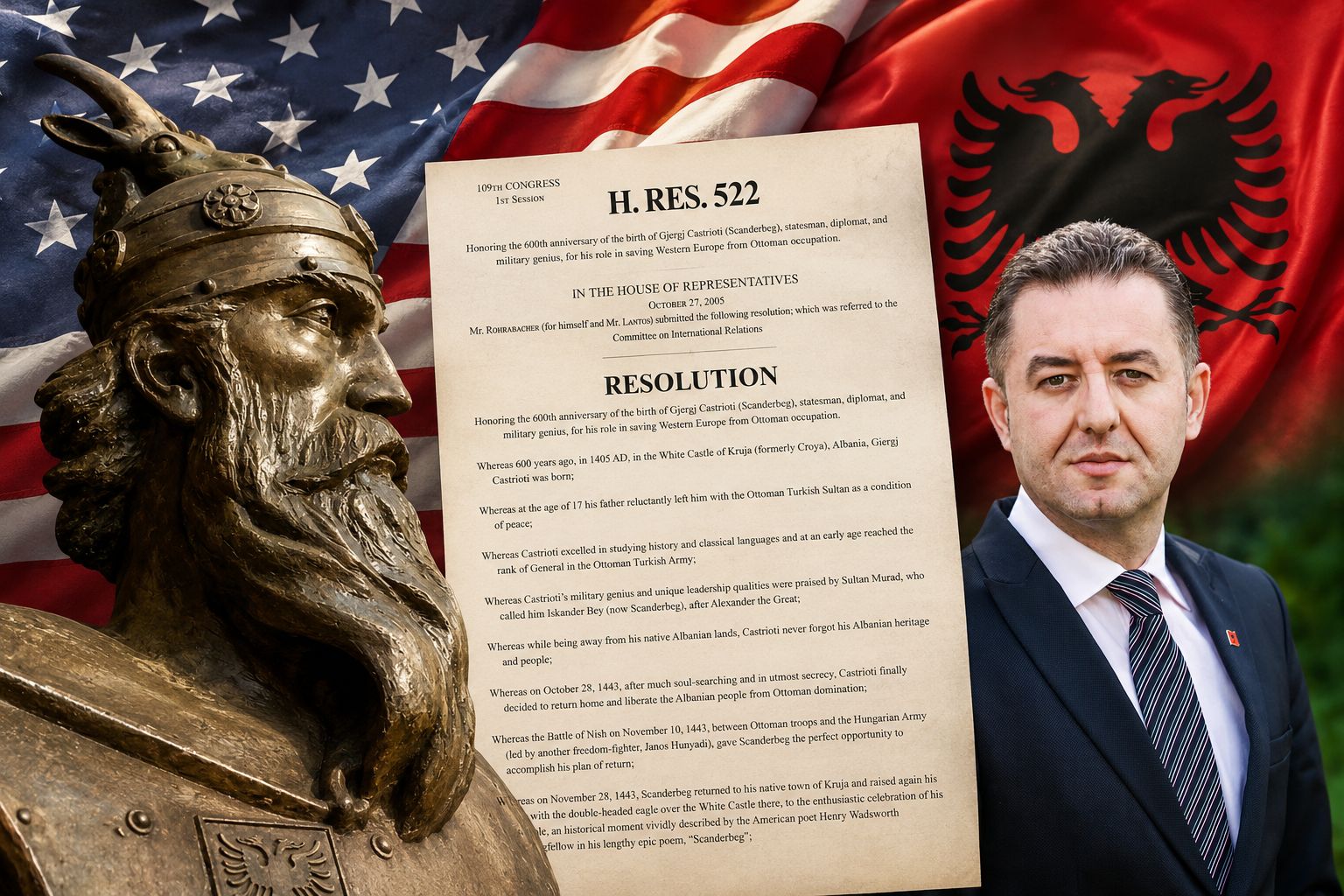
There are historical figures who belong to a single nation, but there are also figures who, through their deeds, transcend national borders and become part of the heritage of civilization. Gjergj Kastrioti Skanderbeg is one of them. For Albanians, he is the National Hero; for European history, he is one of the most significant figures of resistance in the fifteenth century. It was precisely this dimension of his legacy that was recognized by H. Res. 522, introduced in the United States House of Representatives in 2005 on the occasion of the 600th anniversary of Gjergj Kastrioti’s birth.
The title of the resolution is, in itself, significant. Skanderbeg is described as a statesman, diplomat, and military geniusfor his role in defending Western Europe from the expansion of the Ottoman Empire. The document was introduced in Congress by Dana Rohrabacher and Tom Lantos and referred to the Committee on International Relations. This is a point that should be emphasized with historical accuracy: H. Res. 522 was a resolution introduced in the House of Representatives, not an enacted law that entered into force. Yet the very fact that such a document was introduced in the most important representative institution of American democracy carries particular significance.
The resolution recalls the extraordinary journey of Gjergj Kastrioti: his birth in Krujë, the years he spent in the Ottoman Empire, his rise through the military hierarchy and, above all, his return to his homeland in 1443 to lead the Albanian resistance. It places his struggle within a context broader than Albanian national history: as part of a confrontation that influenced the fate of Europe. The document recognizes the resistance of the Albanians and their sacrifice in helping halt Ottoman expansion toward the West.
– Why is the American recognition so significant?
The United States is a relatively young nation compared with Europe’s ancient civilizations, yet its political identity has been built upon several universal ideas: freedom, self-government, independence, human dignity, and the right of peoples to determine their own destiny.
In this sense, Skanderbeg represents a figure who can easily be understood through the prism of American values. He is remembered not merely for the battles he won. He is remembered because he led a people far smaller in number and resources against one of the greatest powers of his age. His story is the story of a nation that refused to disappear politically and culturally.
America has a long tradition of admiring individuals and nations that fight for freedom. It is no coincidence that modern Albanian-American relations have been built upon a strong sense of connection to the ideal of liberty. The U.S. Department of State itself has described the partnership between the two countries as being supported by shared commitments to democracy, peace, and prosperity.
Thus, the recognition of Skanderbeg in the U.S. Congress should not be viewed simply as a ceremonial gesture toward the Albanian diaspora. It can also be seen as an acknowledgment of a history that resonates with one of the most powerful ideas in the American political tradition: freedom is not always the result of the strength of the powerful; it is often preserved by the courage of those who refuse to surrender.
– A bridge between yesterday’s history and today’s alliance
Relations between Albania and the United States are important not only because of history. Today, they also have a strong political and strategic dimension. The United States established diplomatic relations with Albania in 1922, while relations were reestablished in 1991 following the fall of communism. In 2015, the two countries formalized their Strategic Partnership, while Albania has been a NATO ally since 2009.
This partnership has also been strengthened through security cooperation. Albania and the United States have worked together within NATO and in international operations, while American diplomacy has described Albania as a close ally and an important partner on issues of regional and global security.
Within this special relationship, Skanderbeg represents a historical symbol of an idea that remains important today: Albania has been, and wishes to remain, part of the Euro-Atlantic and Western world.
Of course, history should not be used in an oversimplified manner. The fifteenth century is not the twenty-first century, and the conflicts of that era cannot be mechanically translated into today’s realities. Modern Albania maintains diplomatic relations and partnerships with many countries. But this does not alter the historical fact that Skanderbeg’s resistance represents a fundamental chapter in Europe’s political and military history.
– Why should Albania be proud?
Albanians have many reasons to be proud of Skanderbeg, but pride should not remain limited to monuments, anniversaries, and ceremonial speeches. True pride must mean a deep understanding of his legacy.
Skanderbeg was not merely a warrior with a sword in his hand. He was a political leader who understood the importance of alliances. He was a diplomat who communicated with the powers of his time. He was a strategist who for decades confronted a force far greater than his own. And, above all, he was a symbol of unity.
At a time when the Albanian territories were divided among different principalities and competing interests, his leadership created one of the most powerful moments in the development of Albanian political consciousness. This is perhaps Skanderbeg’s most relevant lesson today: a nation becomes stronger not when it divides its energies, but when it succeeds in uniting them around common interests.
Albania should be proud because Skanderbeg is one of those rare figures who requires no exaggeration to be great. His history, in itself, is extraordinary enough. But this pride must be accompanied by responsibility. It is not enough to place Skanderbeg’s portrait in public institutions if we fail to build institutions that respect freedom, the rule of law, and the national interest. It is not enough to invoke his sacrifice in ceremonies if we do not know how to build a modern, just, and strong state.
The greatest tribute to Skanderbeg is the construction of an Albania of which he would be proud.
– Why should Europe value him more?
Europe often remembers its history through great figures who represent decisive moments. Yet European history was not made only in its great capitals. It was also shaped along its frontiers, in small castles and in battles fought by peoples who were often far smaller than the powers they confronted.
Fifteenth-century Albania was precisely one of those places.
Resolution H. Res. 522 clearly places Skanderbeg within this broader dimension, linking his contribution to the defense of Western Europe. The document even argues that Albanian resistance helped hinder Ottoman advancement toward Italy and Western Europe. This is why the figure of Skanderbeg should not remain confined to Albanian school textbooks.
Modern Europe should recognize Skanderbeg not in order to create religious divisions or new hostilities, but to understand a historical truth: European civilization has been defended and built by many peoples, both large and small. Albanians were part of that history.
And this is why the commemoration of Skanderbeg should occupy a greater place in Europe’s collective memory. He was an Albanian who fought for his own land, but the consequences of his resistance extended far beyond Albania.
– A message that remains relevant
There is something particularly powerful about the fact that, six centuries after his birth, the name of Gjergj Kastrioti was brought before the United States House of Representatives for recognition and honor. It demonstrates that great figures do not belong only to the era in which they lived.
Skanderbeg lived in another age, in another world, and faced challenges entirely different from those of our own time. Yet the values associated with his name—freedom, courage, resilience, responsibility toward one’s nation, and the ability to refuse surrender in the face of overwhelming power—remain universal.
For Albanians, H. Res. 522 should be a source of pride. Not because America must tell us who our heroes are, but because one of the world’s most powerful democracies saw in Gjergj Kastrioti a figure whose significance extended beyond the borders of Albania. For America, Skanderbeg can be seen as a symbol of a people’s struggle for freedom. For Albania, he is the founder of one of the strongest traditions of national consciousness. And for Europe, he should serve as a reminder that freedom and civilization have not been inherited without cost. They have been defended in many places, by many peoples, and often by individuals who, in their own time, were compelled to confront what seemed impossible.
Gjergj Kastrioti Skanderbeg was one of them. And that is why Albania should be proud of him, why America has recognized his legacy within its democratic institutions, and why Europe should increasingly recognize and value him as a figure who belongs not only to Albanian history, but also to its shared historical memory.
(The full text of the resolution…)
Official text of H. Res. 522 on Congress.gov
© 2026 Argumentum