







































When an Instrument Becomes Memory, two Musical Worlds Between the Caucasus and the Balkans
By Albert Vataj
A musical instrument is not merely an object that produces sound. It is a fragment of a people’s history, a small architecture of wood, leather, metal, string and breath, in which ways of living, rituals, migration routes, crafts, beliefs, memories and forms of expression have been deposited. In the body of an instrument, one can read not only the material from which it is built, but also the relationship a community has forged with voice, rhythm, nature and itself.
This becomes particularly interesting when two musical spaces that are not direct neighbors are set side by side: Albania and Azerbaijan.
One lies at the western edge of the Balkans, between the Adriatic, the Ionian and the inland mountains of the peninsula; the other in the South Caucasus, in the space between the Caspian Sea, the Caucasus and the Iranian and Turkic-Oriental world. Two countries geographically distant, with different histories, languages and musical structures, yet whose traditional repertoires may offer us certain instruments that are close in form, function or terminology. But it is precisely here that we must be careful.
Similarity Does Not Necessarily Mean Common Origin
Two instruments may appear similar because they descend from a distant common ancestor. Because they travelled along the same cultural routes. Because one influenced the other, or because people in different cultures solved the same acoustic problem in similar ways.
A drum is natural to many human societies because a membrane stretched over a hollow body is one of the most direct ways of producing rhythm. A flute arises in many places because a hollow tube can easily be turned into a wind instrument. A long-necked chordophone is such an efficient solution for producing melody that it has appeared across an extraordinary expanse, from Central Asia to the Mediterranean.
Therefore, a serious comparison should not ask only: “Do they resemble each other?”
Rather, it should ask: “In what way do they resemble each other, why do they resemble each other, what history does this resemblance carry, and what happens when this instrument enters a particular musical system?”
This last question is decisive. For the instrument is not the music. The instrument is the body; the musical tradition is the way in which that body learns to speak.
Two Cultural Spaces, One Horizon of Comparison
Albania and Azerbaijan cannot be placed on a direct line of historical influence.
We have no reason to speak of an “Albanian-Azerbaijani school of music,” nor of a direct transmission of instruments from one culture to the other. Yet both spaces have been part of much broader historical networks.
For centuries, Albania was part of the Ottoman Empire. Azerbaijan, on the other hand, developed in a space where Persian, Caucasian and Turkic-Azerbaijani traditions intersect, along with, in various periods, Ottoman and Russian influences.
This does not mean that every shared instrument is “Ottoman.” It means that there existed a broad ecosystem of musical circulation, in which instruments, ensemble forms, names and ceremonial practices could travel beyond political borders.
Beyond this horizon lies an even older history: the networks of exchange that connected the Balkans, Anatolia, the Caucasus, Iran and Central Asia.
Therefore, when we see a long-necked instrument in Albania and another in Azerbaijan, we should think not of a single line connecting two points, but of a vast map of cultural circulation.
Azerbaijan: Music as a System of Modality, Improvisation and Memory
If we wish to understand the instruments of Azerbaijan, we must begin with mugham.
Mugham does not merely represent a repertoire of songs. According to UNESCO’s definition, it constitutes a traditional musical form characterized by a high degree of improvisation, with a classical and academic nature, which has absorbed influences and exchanged artistic features, thereby enriching itself.
This is important because it shows that an instrument in Azerbaijan cannot be separated from an entire world of modality, melody, ornamentation and mastery handed down from master to pupil.
At the heart of this universe stand primarily three instrumental figures: the tar, the kamancheh, and the daf.”
Together with the singer, they form one of the most characteristic configurations of Azerbaijani mugham. It is at this point that the difference from Albania begins to become very clear.
The Tar: The Architecture of Azerbaijani Sound
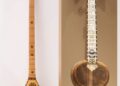
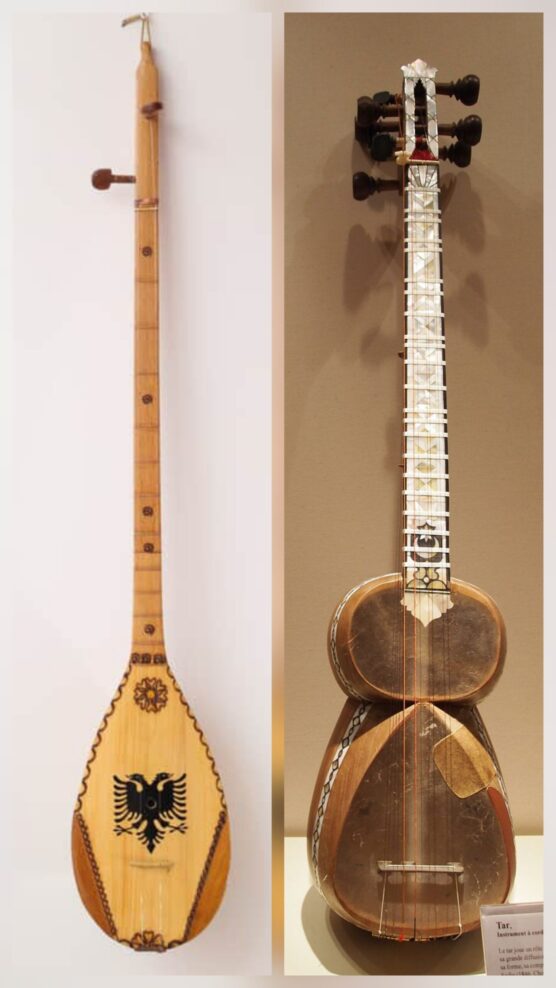
The tar is a long-necked chordophone played with a plectrum. UNESCO defines it as a long-necked, plucked lute with a characteristic figure-of-eight body covered by a thin membrane, and a fretted neck. The tradition of its craftsmanship and performance has been passed down from generation to generation, and the instrument plays an important role in Azerbaijan’s musical identity.
Yet the history of the tar is more complex than a national label. The collections of the Metropolitan Museum of Art show that the tar belongs to a broad family of long-necked lutes of the Near East and the Caucasus; one of the museum’s objects places the early emergence of this type around Shiraz and notes its spread towards Afghanistan and the Caucasus, where the instrument took on different forms.
This teaches us something important: an instrument can become deeply national without necessarily having been “born” in a single form within the borders of the modern nation.
Culture is not a factory that produces isolated objects. It is a process of selection, adaptation and identification. The tar became Azerbaijani not only because it was built in Azerbaijan, but because it became part of a specific way of playing, listening and thinking musically.
The Çifteli: Two Strings, One World
When we turn to Albania, one of the instruments that immediately invites comparison with the family of long-necked lutes is the çifteli. At first glance, it may remind us of certain instruments of the Caucasus and Anatolia. But here we must pause. Similarity of form does not mean historical identity.
The Albanian çifteli has a simple structure, usually with two strings and a small resonating body, and it has become particularly important in the folk music of Northern Albania and the surrounding Albanian-inhabited areas. One string may take on the melodic role, while the other functions as resonant support or drone. This creates an aesthetic entirely different from that of the tar. The tar is deeply embedded in the virtuosic and modal system of mugham.
The çifteli is more directly linked to folk song, rhapsody, traditional musical gatherings, the dance repertoire and forms of vocal accompaniment.
Thus, at the level of organology, there is affinity. At the level of cultural function, there is difference. And it is precisely this difference that is more interesting than the similarity.
The Saz, the Ashik and the Rhapsode: The True Bridge of Comparison
The comparison becomes even more interesting when we bring into play the saz and the ashik tradition. UNESCO has inscribed the “Art of Azerbaijani Ashik” as intangible heritage; this tradition links the instrument with poetry, storytelling and the figure of the singer-poet. Here we find a far more significant point of comparison with the Albanian rhapsodic tradition.
Not because the ashik is an exact counterpart of the Albanian rhapsode. But because in both cases we see an ancient Eurasian model in which instrument + singer + poetry + collective memory stand together as a single cultural unit. This matters far more than the question of whether an instrument has two strings or three.
In the ashik tradition, the instrument accompanies poetic narration and narrative songs. One object in the Metropolitan Museum is described as a coğur, an instrument used by Azerbaijani ashiks for narrative ballads and instrumental pieces, often accompanied by drums. In Northern Albania, the lahuta has performed an exceptionally powerful function in binding the instrument to the epic word. Thus, the instrument becomes memory when it gives voice to the narrative.
The Albanian Lahuta: The Instrument That Does Not Seek to Be an Orchestra
Herein lies one of the most beautiful differences. The Albanian lahuta is a single-stringed instrument, its string made of horsehair or wire, with a wooden body and a skin soundboard, played with a bow that is likewise strung with a taut string. Its tradition is linked to the rural communities of northern and north-western Albania and to narrative song, legends, historical events and personal memory. In 2025, UNESCO inscribed it on the List of Intangible Cultural Heritage in Need of Urgent Safeguarding. This makes the lahuta far more than an instrument. It is a technology of oral memory.
The rhapsode is not simply a musician. He is an archive. The lahuta is not simply a chordophone. It is the voice that keeps the archive alive.
In the tradition of the Epic of the Highland Warriors (Eposi i Kreshnikëve), the lahuta serves as accompaniment to the narration of heroic figures and events. Documentary sources on the culture of Malësia e Madhe describe precisely this role of the rhapsodes and the lahuta in the oral transmission of epic memory. And here the difference from the Azerbaijani kamancheh becomes remarkable.
The Kamancheh: The Bow That Speaks Vertically
The kamancheh is another story. It is a bowed chordophone, with four strings in its modern form, held upright on a spike and played vertically. UNESCO describes the kamancheh tradition as a practice more than a thousand years old in Iran and Azerbaijan, where the instrument is an important part of both classical and folk music.
This is one of the points at which the comparison with the Albanian lahuta becomes organologically interesting.
Both are chordophones; bowed; fretless; linked to ancient traditions; single-voiced melodic instruments. But the resemblance ends quickly. The kamancheh is part of a highly developed culture of instrumental performance, especially in mugham.
The lahuta is linked to a rhapsodic tradition in which the word, the rhythm and the restrained melodic contour of the voice form part of a single narrative act.
Thus, the kamancheh seeks melody; the lahuta seeks memory. This does not mean that the kamancheh carries no memory or that the lahuta has no melody. It means that the dominant cultural function of each has been shaped differently.
The Zurna and the Curle: Where the Comparison Becomes Most Convincing
If we are looking for a stronger similarity between the two spaces, we must turn to the wind instruments, and especially to the zurna/curle family. Here we no longer have merely an abstract resemblance of form.
We have a family of double-reed instruments with a powerful timbre, frequently used in ceremonies, celebrations, dances and public events across a very wide area stretching from the Balkans to Anatolia and the Caucasus. In this case, the historical networks of the Ottoman Empire and the cultural spaces connected with them are far more relevant as an explanation than in the case of other instruments.
In Albania, the curle and the drum have been a powerful part of outdoor, ceremonial and festive music. In Azerbaijan, the zurna and percussion instruments serve similar functions in festive and public contexts. This is one of the cases in which we can speak with greater confidence of a widespread interregional family of musical practices, without claiming that one tradition is a copy of the other.
The Balaban: A Distinction Worth Preserving
The Azerbaijani balaban also helps us understand what is absent from the Albanian tradition. It is a double-reed wind instrument, belonging to a broad Caucasian and Anatolian family that includes instruments such as the mey and the duduk. This family should not be confused with the Albanian fyell or kavall.
The fyell and the kavall are flutes in which sound is produced by the air stream itself, whereas the balaban works by means of a reed.
The acoustic difference is fundamental. In one case, the sound arises from the vibration of the air within the tube; in the other, the double reed creates the vibrating source that sets the column of air in motion.
Therefore, even when two instruments may serve in similar contexts, the sound mechanism and the timbral aesthetic are entirely different. This is a good example of why a serious comparison must include organology, and not merely the name or appearance.
Daf, Def, Gaval: A Word That Travels Farther Than Borders
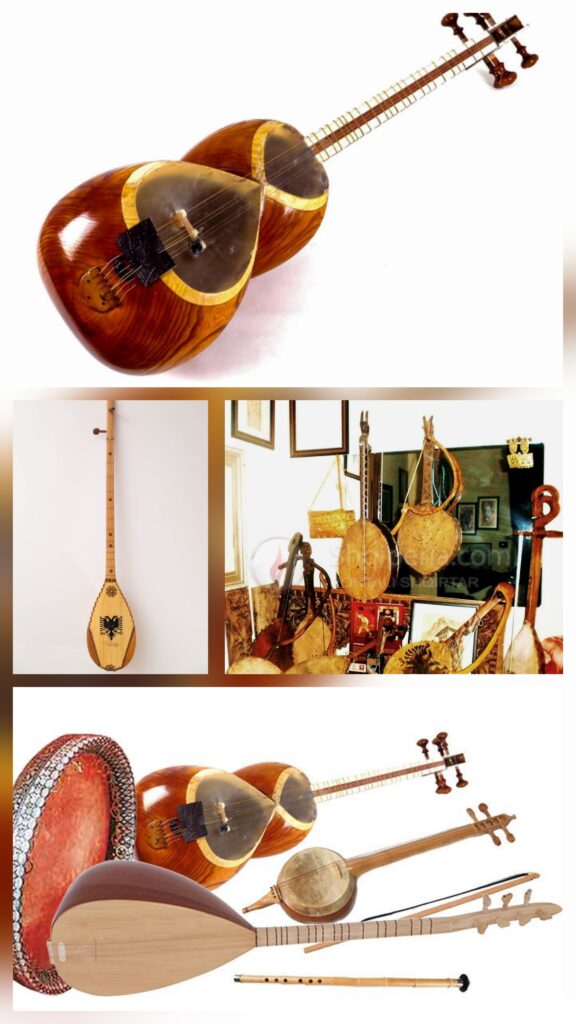
Among percussion instruments we find another broad field of comparison. The daf, the def, the gaval and the families of frame drums are present in many traditions of the Near East, the Caucasus, Anatolia and the Balkans.
Here the name itself may point us towards long cultural routes. But here too, caution is needed.
A shared word does not automatically prove that an instrument was transferred from one community to another. It may bear witness to a broader history of lexical and cultural circulation.
The Metropolitan Museum places the frame-drum family within a broad area of Western and Central Asia, where such instruments also accompany the tar, the kamancheh and the duduk.
This is highly significant. Instruments do not always travel alone. They travel as ensembles. And, most importantly, they travel together with their social functions.
The Drum: A Universality Not to Be Confused with Origin
The drum is perhaps the best example of the limits of comparison.
Albania has the drum. Azerbaijan has the naghara and other drum families. Anatolia has the davul. The Arab world has various forms of drums. Central Asia has others still. Yet one cannot say that an Albanian drum derives directly from an Azerbaijani one simply because both are used at weddings. What we have here is a combination of two factors: functional convergence + cultural circulation.
The drum is so fundamental an instrument that it has emerged independently in many societies.
But specific forms, names, playing techniques and ceremonial combinations may bear witness to historical contact.
This is the difference between “the instrument is the same” and “the tradition of the instrument’s use has a shared history.”
Mugham and Iso-Polyphony: Where the Paths Diverge
If instruments create the illusion of closeness, musical systems show us how different these two worlds are.
In Albania, one of the greatest markers of musical identity is folk iso-polyphony.
UNESCO describes it as a tradition with two main stylistic groups, the Gheg in the north and the Tosk in the south, with a structure in which individual melodies interweave over an iso-drone.
Here we have a remarkable difference: in mugham, the center is melodic development, modality and virtuosic improvisation.
In Albanian iso-polyphony, the center is the relationship between voices and collective polyphonic organization.
The one builds tension mainly through the development of the melodic line. The other, through the relationship among many voices. Therefore, the comparison of instruments should not mislead us into proclaiming an affinity between musical systems.
The Instrument as Identity: When the Object Becomes a Symbol
A traditional instrument is not a marker of identity merely because it is old. It becomes a marker of identity when a community recognizes itself in its sound. This is why the tar has become one of the musical symbols of Azerbaijan. UNESCO explicitly links the craftsmanship and performance of the tar to the identity and cultural continuity of the Azerbaijani community.
On the other hand, the lahuta is not simply an instrument of northern Albania. It is a repository of epic memory. The fact that UNESCO placed it on the List of Heritage in Need of Urgent Safeguarding in 2025 also reveals the fragility of this tradition amid social change. Here a great paradox of modernity emerges: the more technology we have to record sound, the less certain we are of preserving the way of life that gave that sound its meaning.
A recording can preserve the voice of the lahuta. But it cannot, by itself, recreate the oda where the rhapsode sang. It can record a mugham. But it cannot replace the master–pupil relationship that keeps the tradition alive. This is why intangible heritage is not preserved merely by preserving the object. It is preserved by preserving the practice.
An Instrument Cannot Be Understood Apart from the Musician’s Body
This is a point that is often forgotten. Traditional organology tends to describe the instrument: its material, shape, number of strings, tuning, dimensions.
But the instrument is not only the object. It is object + body + technique + repertoire + space + listener.
A tar in the hands of a master is not the same tar that sits in a museum display case.
A kamancheh on display in a museum is an artefact. A kamancheh beneath a performer’s bow becomes a voice.
A lahuta hanging on the wall is an object. A lahuta in the hands of a rhapsode becomes history.
A çifteli without song is wood, string and resonance. A çifteli at a traditional musical gathering becomes collective memory.
Therefore, true musicology must study not only the instrument, but the relationship between the human being and the instrument.
What Does the Comparison Teach Us About History?
The Albania-Azerbaijan comparison teaches us something far more important than a list of similarities.
It teaches us that cultures do not develop on islands. They are interconnected. But interconnection does not mean uniformity.
The Balkans, Anatolia, the Caucasus and the Iranian world have for centuries been part of a vast system of human, commercial, military, religious and artistic circulation.
Instruments have crossed borders. Melodies have crossed borders. Words have crossed borders. But each culture has appropriated them in its own way.
Thus, is born one of the most beautiful laws in the history of culture: whatever travels does not remain unchanged.
An instrument that arrives in a new place is no longer the same instrument after a few generations.
It changes its body, its tuning, its repertoire, its technique, its name, and ultimately it changes its meaning as well.
Beyond the Romanticism of “Origins”
Here a very great temptation must be avoided. When two peoples have similar instruments, it is tempting to say: “Here is the proof that we share a common origin.” But music does not work so simply. An instrument may have a distant common origin, dissemination through historical contact, parallel development, direct borrowing, functional convergence, or a combination of these factors.
Therefore, instead of searching for a “winner” in the contest of origins, we must reconstruct the history of circulation.
This is far more interesting. For the history of instruments is not a history of ownership. It is a history of travel.
And What Remains Albanian, What Azerbaijani?
After all these similarities, the answer is paradoxically simple: what remains is the particular way in which the instrument is used. The tar becomes Azerbaijani through mugham, through the craftsmanship of its making, through technique, and through the memory attached to it.
The kamancheh becomes part of Azerbaijani musical identity through a broad classical and folk tradition.
The çifteli becomes Albanian through the repertoire, the song, the rhythm, the social space and the memory of Albanian communities. The lahuta becomes Albanian not merely because it has a single string, but because that string has become the voice of an epic tradition.
Herein lies the difference between the instrument as object and the instrument as culture.
Two Peoples Who Need Not Be the Same to Sound Side by Side
The comparison between the traditional instruments of Azerbaijan and Albania does not prove a direct Albanian-Azerbaijani musical lineage. And perhaps it is precisely this that makes the comparison all the more graceful. For its value does not lie in finding a common origin at any cost. It lies in discovering the shared paths of humanity.
The tar and the çifteli may meet within the broad family of long-necked chordophones, yet each has built a different life.
The kamancheh and the lahuta may meet in the bow and the string, yet one has become one of the voices of mugham, while the other has become one of the voices of the Albanian epic.
The zurna and the curle may sound like distant cousins at people’s celebrations, because the histories of the Balkans, Anatolia and the Caucasus have been intertwined over many periods.
The daf, the tambourine and the drums remind us that rhythm is perhaps one of the oldest languages humanities has built. But in the end, an instrument is defined not by its form, but by what a people manages to say through it.
A piece of wood becomes a tar when the master’s hand turns it into a voice. Just as a piece of wood becomes a lahuta when a story comes to rest upon it.
Two strings become a çifteli when song finds its own rhythm upon them and the player’s fingers bear witness through virtuosity.
Four strings become a kamancheh when the bow gives voice to an entire melodic world. And so instruments become more than musical tools. They become a people’s way of remembering who it is.
Perhaps this is also the deepest point at which Albania and Azerbaijan can meet: not in the claim that they share the same music, but in the fact that both cultures have used sound as a way of preserving memory, expressing identity, and handing down to the next generation what time must not carry away with it.
This is why a traditional instrument should not be seen merely as a relic. It is an archive that sounds.
And as long as a hand takes it up, a finger touches the string, a bow glides across it, a breath passes through a tube, or a palm strikes the skin of a drum, history has not yet fallen silent.
It continues to speak, and perhaps this is where the deepest meaning of cultural dialogue between Albania and Azerbaijan can be found. Politics may, at times, create distance or divide interests, but culture has another language. Music, in particular, can cross borders without needing translation. It carries memory, emotion and identity from one generation to another, creating a space in which peoples can recognize something of themselves in the voice of another.
In this sense, music is not simply an element of cultural heritage. It can also become an instrument of friendship and mutual understanding, a quiet but powerful form of diplomacy between societies.
For Albania and Azerbaijan, the dialogue between the tar and the çifteli, the kamancheh and the lahuta, the zurna and the curle is therefore more than a comparison of instruments. It is an invitation to listen to one another.
Because at the end of the day, while geography and politics may sometimes divide, culture has the power to unite.
_________________________
Editorial Note: This article is part of Argumentum.al’s special edition exploring Azerbaijan, its culture and developments, and its role in relations with the wider world, the Balkans, and Albania.
© 2026 Argumentum