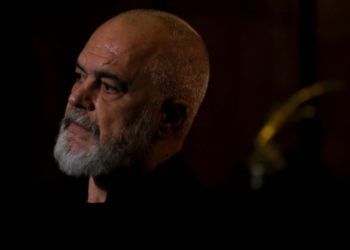































Robert Mobili
Chairman of the Albanian–Udi Christian Community of Azerbaijan,
Senior Research Fellow at the Department of Mineralogy, Crystallography and Geochemistry of the Baku State University
Since Azerbaijan restored its independence, favorable conditions have been created for the further strengthening of inter-church relations, promotion of national and spiritual values, and further development of the historically-formed environment of tolerance, inter-ethnic and inter-religious dialogue. Therefore, today Azerbaijan has become a center of the cross-cultural space, confessional discourse, and inter-religious dialogue.
Part of the united multi-national people of Azerbaijan that includes both the titular ethnic group and more than 20 indigenous national minorities, are Udi, i.e. Albanian-Udi Christian Community, the origin and history of which has been of great interest to scientists for more than two centuries [Мамедова, 2005; Джавадов, Гусейнов, 1999; Алексеев, Майсак, Ганенков, Ландер, 2008; Гусейнов, 2008; Данакари, 2013].
The Udi are an autochthonous people of Azerbaijan, one of the most ancient Caucasian indigenous ethnic groups and belong to ancestors of the modern Azerbaijani people. The history of the Udi ethnicity that has repeatedly suffered from political, religious and confessional intrigues as well as from rivalries between the major powers or stronger neighbors, is worthy of great respect and sympathy.
The Udi are a unique ethnic group and, unlike all other ethnic groups of the world, they are a phenomenon that has managed to survive, despite all the vicissitudes, cataclysms, and historical adversity, even being deprived of their own Church. They were mentioned in ancient sources as participants in the Battle of Gaugamela between Alexander the Great and the Persians (331 B.C.), in the writings of Herodotus, Strabo, Ptolemy, Pliny the Elder, Arab sources, and in diaries of European travelers. The most detailed information about the Udi is contained in the “History of the Albanians” written by the local author Moses from Kalankaytuk, a village located in the Albanian province of Utik [Мамедова, 2005; Мобили, 2008a, с.26-29; Mobili, 2008b; Мобили 2013, c.234-236].
Alexandre Dumas, who met G. Bezhanov, Udi by ethnicity, during his journey to the Caucasus in 1859, wrote in his travel notes: “The origin of the Udi is unknown; their language, that nobody understands, is not similar to any other language. They lose themselves in the darkness surrounding them” [Дюма, 1985, с.122-123].
Based on archives and recent studies, it is worthy of note that the Udi were mentioned in writings of French scientist Edward Duralier, in diaries of English travelers, in Arutinov’s anthropological studies, as well as in the description of the ancient Caucasian Albania by A. Yanovsky. Noteworthy is the discovery of a palimpsest in the Sinai in 1996.
Details on the Udi population going back to the last quarter of the 19th century suggest that there were 10-12 thousand of them in the Russian Empire [Раффи, 2009; Бежанов, 1892, с.213-262; РГИА: ф.796 (1836), ф.821 (1810, 1897–1910, 1914–1915), ф.735 (1859); Флоренский, 1992]. Until the beginning of the 12th century, close-knit Udi communities lived in several villages of Azerbaijan.
Today, the total Udi population is more than 10 thousand people, most of which (about 5 thousand people) live in Azerbaijan. They live compactly in the village of Nij and in a dispersed manner reside in Oguz and Baku. The Udi also live in southern regions of Russia, Kazakhstan, Georgia, Ukraine, and the Republic of Belarus. Several families have been found in the south of France, England, Italy, Latvia, and the USA. In Azerbaijan, tight Udi communities are only found in Nij, where their population is half of 7,500 inhabitants of the village. The Udi have outlived several great empires they had formed part of, such as the Sasanian Empire, the Islamic Caliphate, the Ottoman Empire, the Russian Empire, the USSR, and have managed to preserve their language, religion, and culture.
The Udi, being the direct descendants of Caucasian Albania, have survived as an ethnicity and have preserved, in addition to the language, culture, and traditions, their Christian faith, despite all the historical cataclysms, due to the multicultural environment in which they still live [Гусейнов, 2008, с.22-25; Джавадов, Гусейнов, 1999; Мобили, 2008а, с.26-29; Мобили, №2, 2009, с.214-219].
The Udi language (self-name: udi, udi muz) is part of the large group of Nakh-Daghestanian (Caucasian-Iberian) languages and has two dialects that are not as distinctive as to hinder the mutual understanding of their speakers. Currently, the Udi language is spoken by a little more than 10 thousand people, although in the past it was one of the most widespread languages of Caucasian Albania and formed the basis for the development of the literary language in the 4th century and the creation of the Albanian script. From a historical point of view, the commonly spoken Caucasian-Albanian language is closest to Udi, or rather to Proto-Udi language. The Albanian alphabet, created in the 4th century, emerged as a non-semiotic branch of the Aramaic graphic basis, consisting of 52 letters. In the time following, this alphabet became widely used. The most important biblical texts, liturgy, chants were translated into Albanian, and, most importantly, church services were held in that language. However, subsequently, the Albanian writing ceased to be used and gradually disappeared due to historical reasons. For a long time, scientists could not read the inscriptions on artifacts found during archaeological excavations. What helped them shed some light on this puzzle was a text (palimpsest) found in the Sinai in 1996 in the convent of St. Catherine. It was a liturgical collection that included liturgical basis and passages from the New Testament. This discovery put an end to the questioning the existence of the Albanian alphabet and the well-developed literary language. Up to now, these texts have been completely transcribed, read and published in two volumes [Gippert, Schulze, Aleksidze, Mahe, 2008] and translated into nine languages, including Udi. World-class Caucasian linguists Z.N. Aleksidze, J. Gippert, V. Schultz and Zh-P. Mache participated in this meticulous work. The key to deciphering these texts was the Udi language fluently spoken by the authors of the translation. The palimpsest, being the Christian heritage of Caucasian Albania, is a compilation containing fragments of the Gospel of John, a liturgy and a lectionary (a collection of liturgical reads). These texts and the related scientific research underlaid the assumption that the Albanian alphabet was created in the 4th century. [Алексеев, Майсак, Ганенков, Ландер, 2008; Ворошил Гукасян, 1974; Мобили, 2009, с.214-219; Мобили, 2010; Мобили, 2011].
Today, the Udi are bearers of Eastern Christianity and are specifically focused in the modern environment to the revival of the Albanian-Udi Christian ethno-cultural heritage and their Church, abolished by the tsarist autocracy in 1836 with the support of the Armenian Gregorian Church.
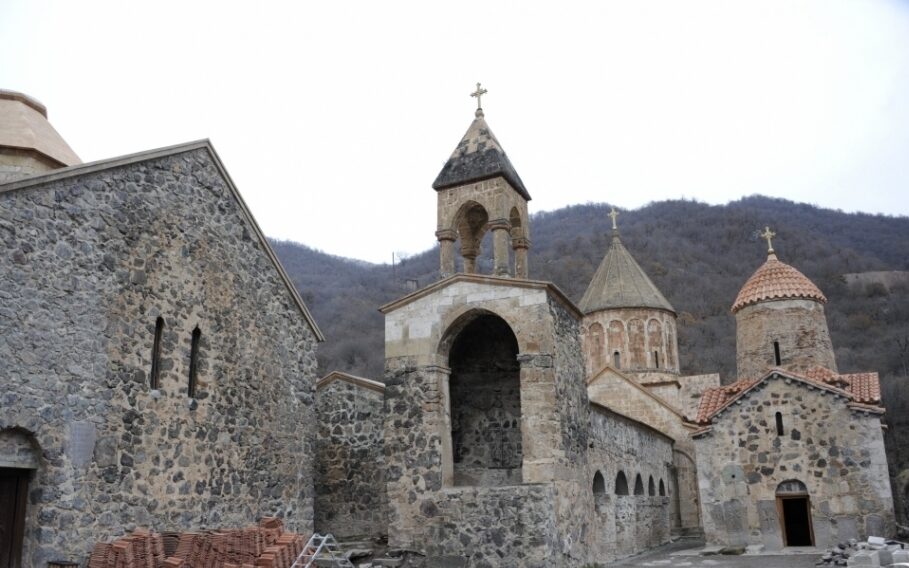
As a result, ancient chronicles and antique books had been destroyed, tremendous values had been lost, and the two-thousand-year-old cultural and religious ordination experience had been disrupted. In a word, a huge layer of the spiritual culture of Azerbaijan has been lost forever, including the Udi culture, ancient and medieval historical and literary monuments, the traditions of prayer and liturgy, the memory of centuries and the set of values. The Udi, deprived of their own Church, despite all the official protests, had to bear all the rigours and hardships, even to the extent of refusing to become parishioners of their Church. However, the Udi have managed to preserve their native language and religious roots to this day. Today, more than 100 monuments of the Albanian confessional heritage are located in the territories liberated from the occupation by the Armenian armed forces. Their fate has no parallel in the history of Christianity.
The Udi, being the direct descendants of the ancient Caucasian Albanians, are among the ancestors of the Azerbaijani people, as well as bearers of elements and symbols of the Albanian Christian heritage. They are proud of their ancient culture, their centuries-old traditions, spiritual wealth, language, ethnography and further enrich them in Azerbaijan, their historical homeland [Гусейнов, 2008, с.22-25; Джавадов, Гусейнов, 1999; Мобили, 2008а, с.26-29].
Inter-religious spiritual relationships that have existed for centuries in the history of Azerbaijan pave the way for the development of the ethnic diversity of this region. The multi-confessional people of Azerbaijan is an example and a symbol of religious harmony in the history of peoples of various faiths. Muslims, Jews, Orthodox Christians, Catholics and representatives of non-traditional confessions have lived here together in harmony and without any confrontation. Instead, they have been and are complementing each other. The very existence of their sacred sites, such as ancient temples of various confessions, synagogues, churches and mosques, next to each other symbolizes the common past of Our Country.
A bright example is the places compact residence of the Udi in Nij: ancient sacred places of worship, three churches and two mosques in such a small space. There are two Christian communities and one Udi cultural and educational center here. The phenomenon of religious tolerance has always been present in our historical environment, and a small oasis of tolerance within the Udi community, first of all, confirms the existence of diversity.
Against the background of the apparent dominance of the Muslim religion in Our Country, the ideals of respect for religious rituals, holidays and mutual visits are promoted today. Today, Udi Christians still celebrate the sacrifice as a ritual holiday. That is, the spread of Islam created favorable conditions for the Udi through strengthening the existence of religious tolerance, especially in the context of the Udi community. [Мобили, 2008; Мобили, 2012, с.165-172].
Hospitality is one of the traditions that have survived among the residents of the village of Nij. Since ancient times, the Udins gladly welcomed both bearers of their own religion and representatives of other confessions. Along with Christianity, the community has also managed to preserve folk customs, ceremonies, beliefs and holidays. Organization and holding of the celebration of Novruz Holiday is a very important factor promoting the religious tolerance in our community. This ancient spring festival that goes back centuries serves as a factor of cooperation and integration between Muslims and Christians.
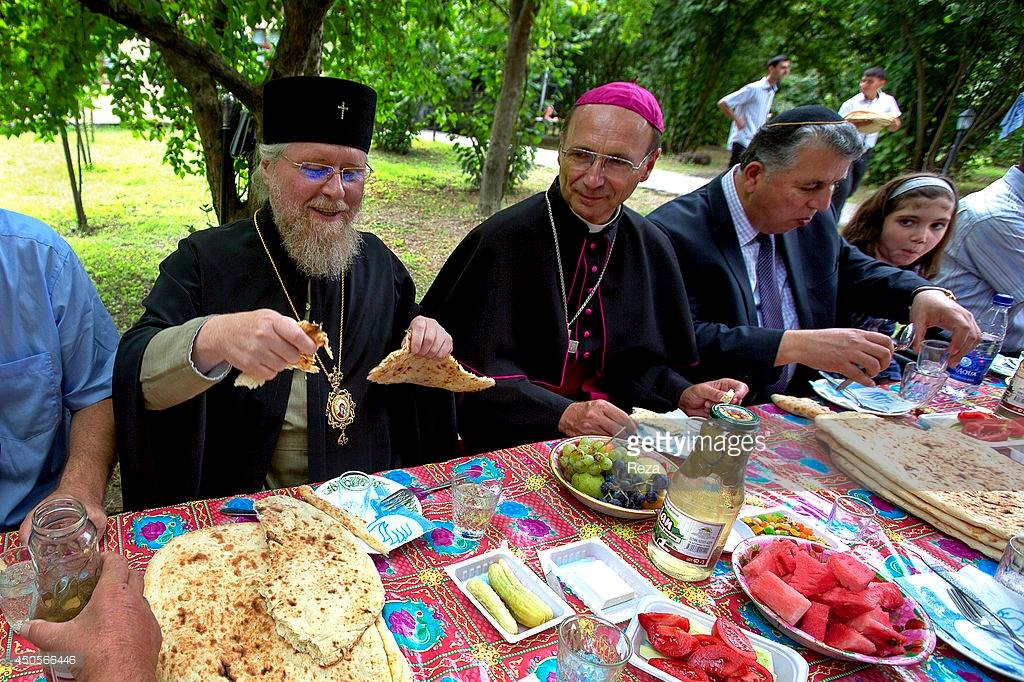
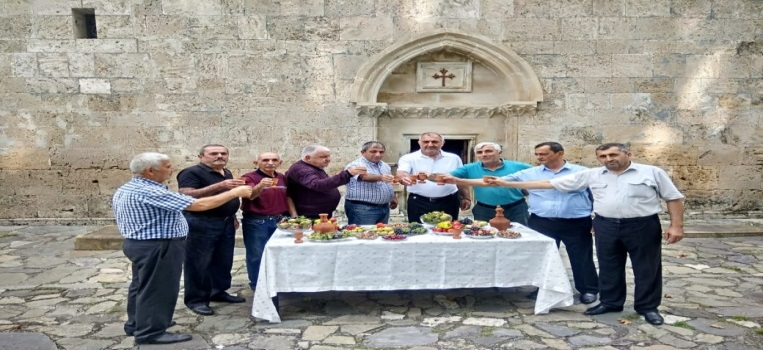
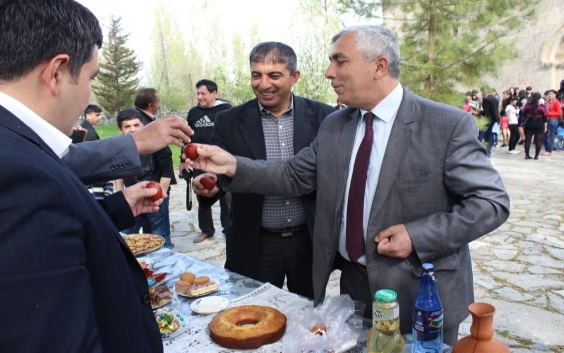
From this point of view, it can be noticed that there is no document that could confirm the fact of any inter-religious conflict. Historically, religious tolerance and respect between the communities have developed and existed from the outset.
The historical experience shows that the Azerbaijani have always been tolerant of other religions and, perhaps, Azerbaijan is the only country in the European environment where there were no religious wars. Such friendly co-existence can be observed in education, in daily life, in language and beliefs. An example of this is the joint worship of common sacred places places, indicative of the core connections incorporated in our genes. All these values make us to believe that in the model of tolerance, a thin line of good and evil runs between peoples, ethnic groups, religions, as well as through the dialogue and our hearts.
We feel strong governmental support, in particular, by Mr. President of Azerbaijan Ilham Aliyev (who visited Nij in 2005 and 2011), the State Committee for Religious Affairs, various ministries, NGOs, and ordinary citizens of Azerbaijan.
In the name of restoring historical justice and realities, the Albanian Udi Church of St. Elishe “Chotari” was renovated in 2006 [Мобили, 2013, c.234-236].
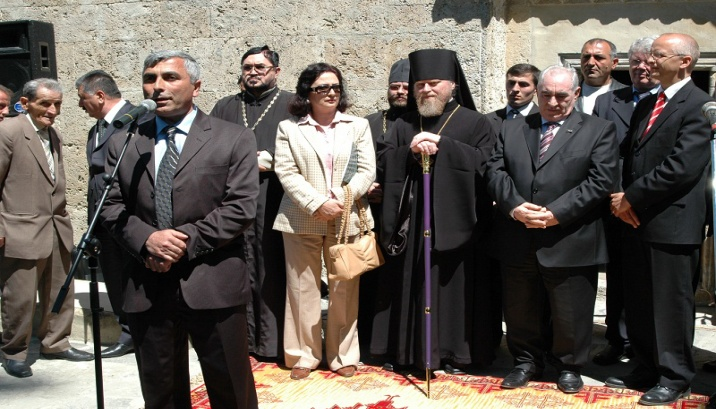
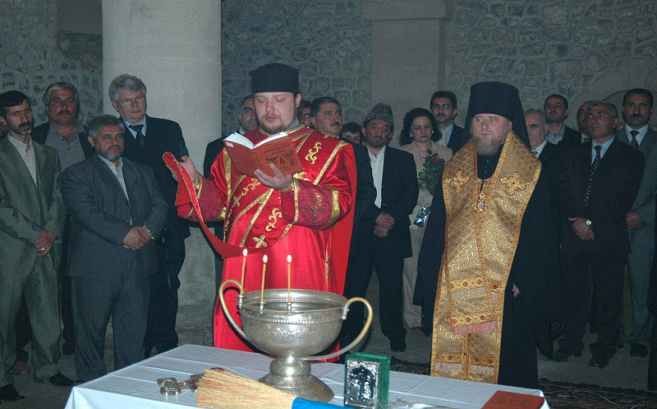
Solemn opening and consecration of the Church of St. Elishe (“Chotari”), 2006
In mid-August 2018, “Udi ocağı” (Udi Hearth) Historical Ethnographic Park and Museum was founded in Nij. Local and Polish specialists assisted in establishment of this facility, and Azerbaijani architect-artist Shahveled Mammadov was among them. Azerbaijani word “ocaq” means “bonfire”, “hearth”, and also “sacred place”, originally associated with fire. Such places are revered by both Udi and Azerbaijani, who decorate the location with ribbons and bring sacrificial lambs there. Despite the fact that this pagan tradition diverges from church canons and Muslim customs, there are a lot of such sanctuaries, and this rich historical experience is enshrined in genes of each Udi. The park’s display includes the house of the Gangalov family built at the end of the 17th century and a household plot with a pond, garden, household outbuildings, and a fire. In this region, houses were often built with a mansard floor. In the summer, locals grew silkworm cocoons and dried tobacco leaves in the dark ventilated roof space, and held holidays in the fall. A specific feature of Udi houses, also common for houses of Azerbaijani and Lezgins, is the prayer room. The main horticultural crop in their gardens is hazel. Today, the village’s economy is mainly based on cultivation of hazelnut. In Nij, everyone has its own plantation. On the display, there are many pottery objects because Christian Udi, unlike their Muslim neighbours, were engaged in wine-making and aged wine in clay vessels. In the estate’s courtyard, there is an apparatus used by the Udi to make dogwood or cherry-plum vodka. Today, nobody dries tobacco under the roof, and only tourists are shown the process of alcohol home-brewing. Guests can stay in houses located right in the park-museum’s territory. Forums, conferences, and round tables are also held there.
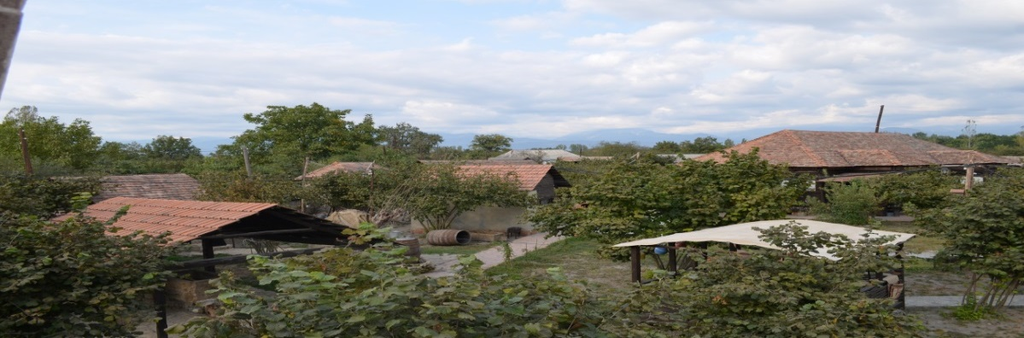
View of the ethnographic open-air museum. Nij, 2021
Nij is called an example of multiculturalism that aligns with the policy implemented in Azerbaijan at the state level. Its objective is to create conditions for the co-existence and co-development of different cultures within the Country. When the Udi celebrate Easter or Christmas, Protestants, Jews, Orthodox Christians and Muslims sit all together at the same table. In the village, two mosques are functioning, and two of three churches have been restored. Of the five schools, three are Russian and two are Azerbaijani.
In 2012, due to the efforts of the Heydar Aliyev Foundation, upper secondary school No. 2 has been renovated in Nij, where Udi pupils are taught in Russian but learn their native language till the fifth grade.
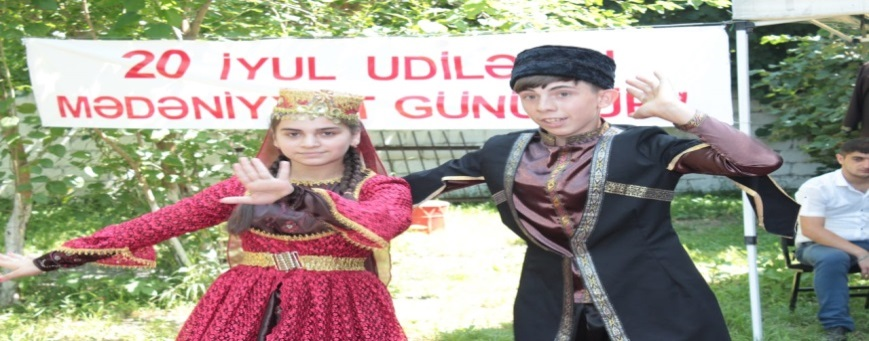
The primary mission of the Albanian-Udi Christian Community is to study and raise awareness of its history. In the age of globalization and integration, the problem of preservation of the original culture is faced not only by small groups of population, and the Udi an example of its solution. The Udi have never lived in isolation and yet have managed not to blend into other larger ethnic groups. Up to date, the Udi have preserved their traditions, faith and language, that allowed them to pass on the knowledge and spiritual values of their ethnicity from generation to generation.
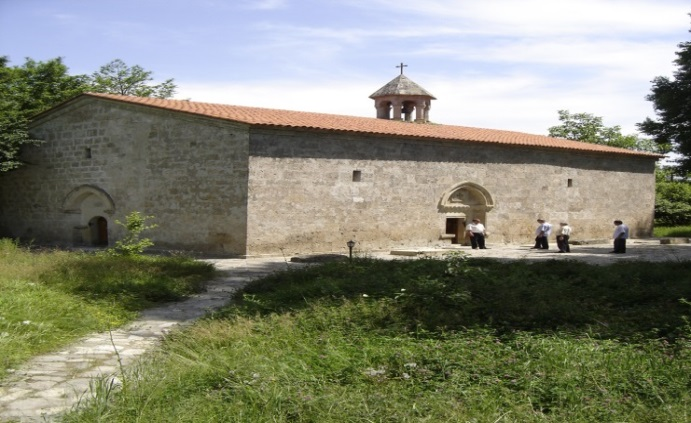
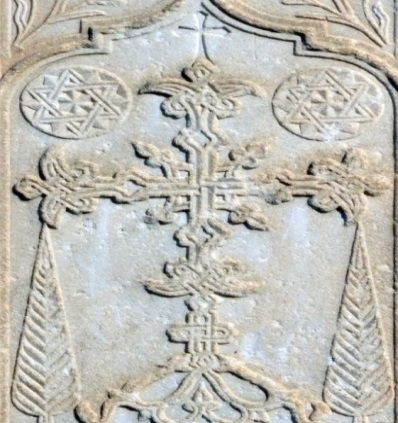
As part of the “Azerbaijan – the Address of Tolerance” program, the Heydar Aliyev Foundation launched a project for the restoration and renovation of the Church of the Most Holy Mother Mary and the courtyard around it in Nij, which has been completed by November, despite the COVID-19 pandemic. In Soviet times, the church was used as a warehouse and was slowly breaking down. Its dome collapsed, grass and trees grew on the roof, and the walls began to crumble. Now, the new conical dome is surmounted by the Albanian cross, which differs from the crosses of other churches. There are three sharp petals at each of its four ends: the central one symbolizes the flame tip, and those at the extreme edges denote the moon sickles (crescents). These patterns are relics of the pagan cults of the peoples of Caucasian Albania, who worshiped the Moon and fire. Workers found vase-like hollow clay indentations in the walls and vaults, which served as resonators to improve the hall acoustics. In 2006, they were removed during the restoration of the first of the three churches in Nij, but in this church they were left in their original places. Also, font basins were restored in the churchyard, where three springs shoot up from the ground. In the old days, the sacraments of baptism were held in the point where the springs merged together. The restored church was passed over to the Albanian-Udi Christian Community of Azerbaijan. It is planned to be solemnly consecrated after the end of the pandemic.
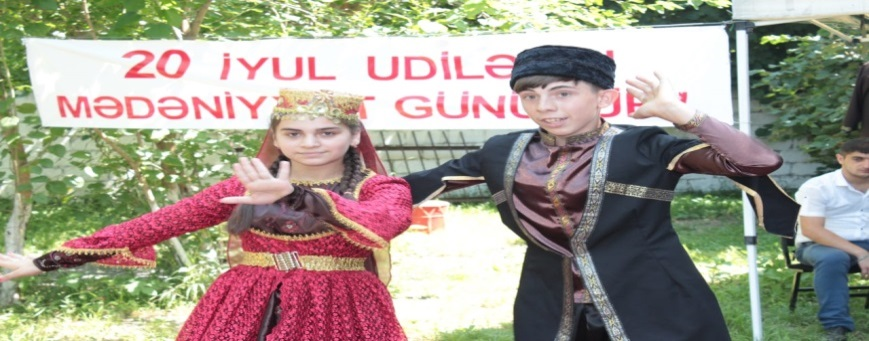
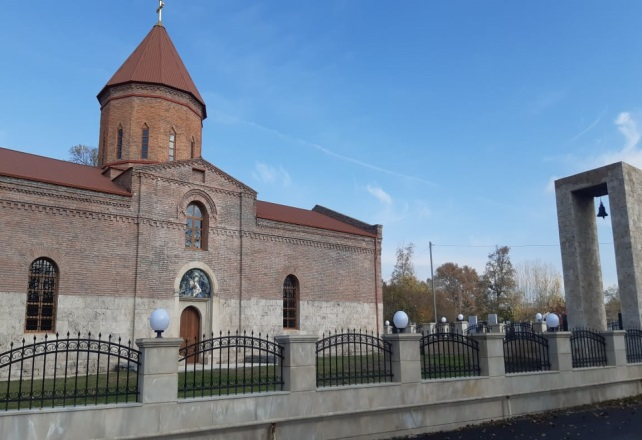
View of the Church of the Most Holy Mother Mary after the restoration, July 11, 2020
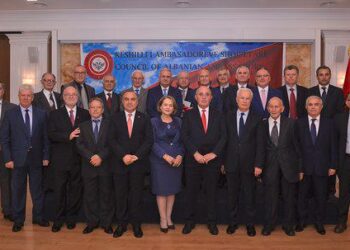
Today Azerbaijan is an example of tolerance and cooperation among representatives of different confessions and cultures. The Udi are represented by the Community Leader at the Supreme Religious Advisory Council, at the UNESCO session, as well as at various international conferences, forums, and meetings.
In conclusion, it should be noted that, despite the difference between religions and confessions, the role of the Udi in the formation of the state of Caucasian Albania and in the preservation of the rich Eastern Christian heritage, ethnic language, culture, customs and traditions is indisputable.
Today, the Udi Church is an integral part of the Albanian Apostolic Autocephalous Church. The Udi have played an important role in the consolidation of the Azerbaijani’s ethnogenesis, so the Udi and the Azerbaijani have centuries-old genetic connection. During the last decade, the Udi ethnic group has been experiencing another peak of renaissance characterized by a surge in their national identity and ethnic consolidation. A bright example and an oasis of this phenomenon is the conglomerate of associations of harmonious relations among different nationalities and confessions, and places of compact residence of the Udi as a model of tolerance in the multicultural environment of Azerbaijan. This is, undoubtedly, a result of the historical impulses of the great Albanian heritage taken through the ages and preserved in the genes of this ancient people, and calling of modern time, granting the Udi a chance to identify and preserve their niche in the model of the ethnic and cultural environment of their historical homeland – Azerbaijan.
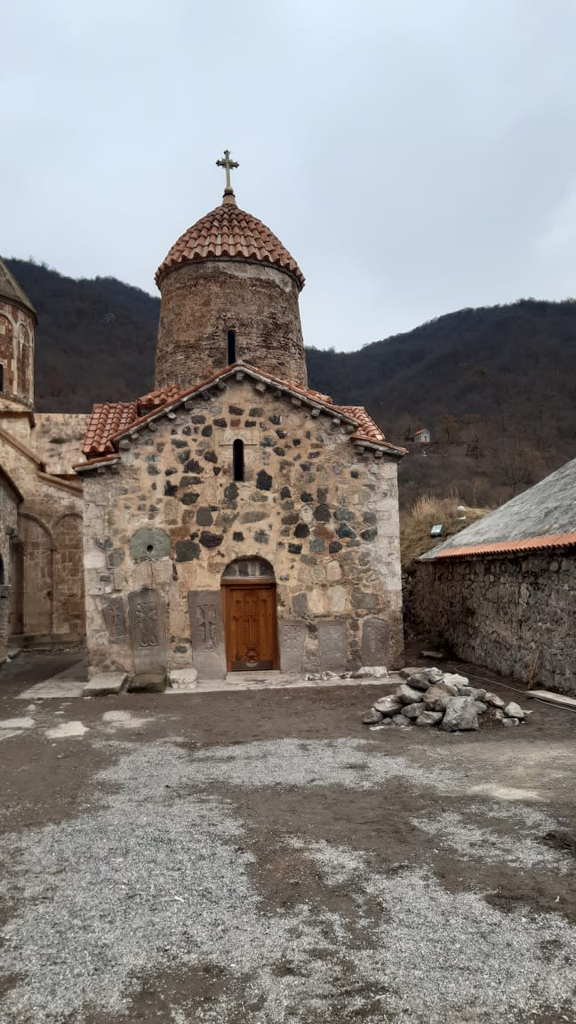
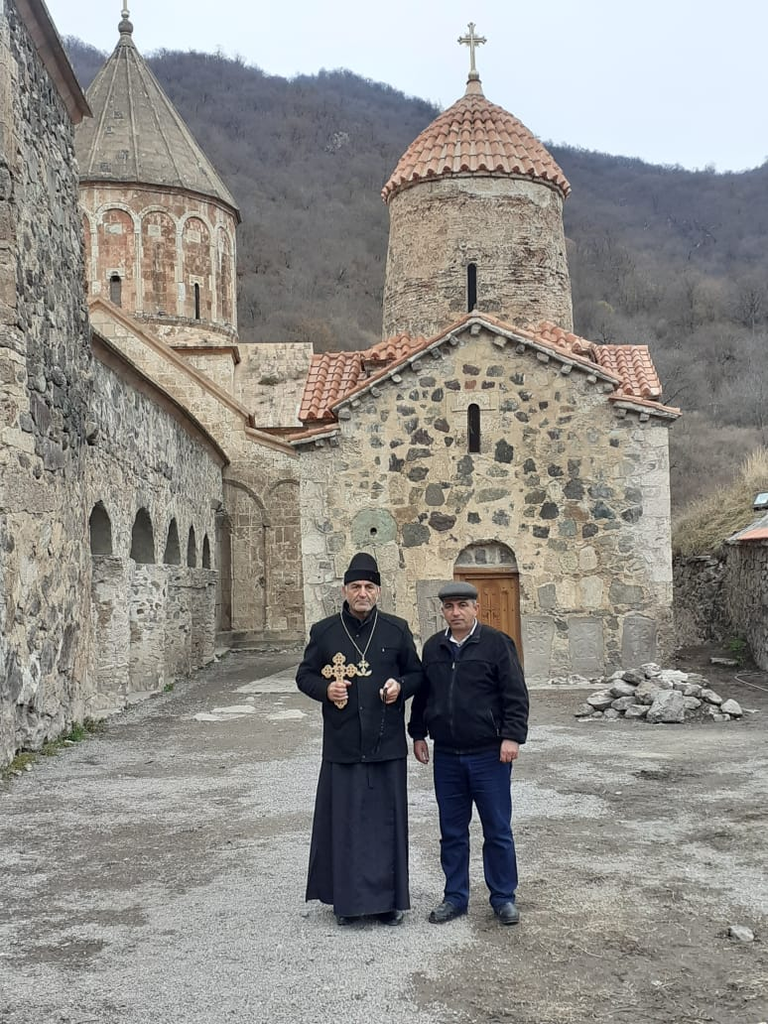
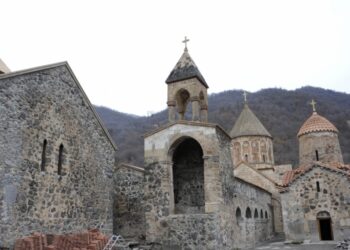
Albanian Dadivang/Khudavang monastery complex (Kalbajar)
Visit by the Udi after the liberation from the occupation, December 4, 2020
REFERENCES:
- Алексеев М.Е., Майсак Т.А., Ганенков Д.С., Ландер Ю.А. Удинский сборник /грамматика, лексика, история языка/ (Udin Сollection / grammar, vocabulary, language history). М.: Изд-во «Академия» РАН (Институт языкознания и Институт востоковедения России), 2008, 446 с.
- Бежанов М. Краткие сведения о Варташене и его жителях (Brief information about Vartashen and its inhabitants) / СМОМПК, вып.XIV, 1892, с.213-262.
- Ворошил Гукасян. Удинско-азербайджанско-русский словарь (Udi-Azerbaijani-Russian Dictionary) Баку: Элм, 1974, 260 с.
- Гусейнов Р.А. Удины (The Udi) // ИРС («Наследие»). Международный журнал, №3 (33). М., 2008, pp.22-25 www.udi.az
- Данакари Р.А. Этническое бытие удин: опыт политико-философского и феноменологического исследования (Ethnic genesis of the Udi: political, philosophical and phenomenological research experience) // Научный журнал. «Исторические, философские, политические науки, культурология и искусствоведения». Volgograd, 2013, pp.60-66 www.udi.az
- Джавадов Г.Дж., Гусейнов Р.А. Удины. Историко-этнографическое исследование. (The Udi. Historical and ethnographic research) Баку: Элм, 1999, 256 с. (на азерб. языке).
- Дюма А. Путешествие на Кавказ (Le voyage au Caucase) /Перевод с фр. Г.Пашаева и Г.Аббасова на азерб. язык / Глава «Удины…». Баку: Элм, 1985, с.122-123.
- Кечаари Г.А. Танец вокруг костра /Образцы удинского фольклора/ (Dancing around a fire / Samples of Udi folklore). Гянджа: Изд-во «Агах», 2001, 78 с. (на азерб. языке).
- Мамедова Ф. Кавказская Албания и албаны Баку (Caucasian Albania and the Albanians of Baku), 2005, 800 с.
- Мобили Р.Б. Научная и общественная деятельность (Scientific and social activities). Баку: Изд-во «Адильогды», 2008, 216 с.
- Мобили Р.Б. (Ethnography of the Udi) // ИРС («Наследие»). Международный Азербайджанский журнал, №3 (33), М., 2008а, с.26-29 www.udi.az
- Мобили Р.Б. Удины: язык, религия, фольклор и традиции (The Udi: language, religion, folklore, and traditions)// Культурологический журнал «Азербайджан и азербайджанцы в мире», №2, 2009, с.214-219.
- Мобили Р.Б. Место и роль удин в Албанской (Кавказской) Церкви» (Place and role of Udins in the Albanian (Caucasian) Church) / «European Applied Sciences: modern approaches in scientific researches» (Европейские прикладные науки: современные подходы в научных исследованиях). 18-19 февраля 2013 г., Штутгарт (Германия), c.234-236 www.udi.az
- Раффи. «Меликство Хамсы. 1600–1827 гг. (Melikdom of Hamsa. 1600–1827) М.: Изд-во «ЮниПресс СК», 2009, 223с.
- Мобили Р. Албано-удинская христианская община – основа возрождения Албанской (Кавказской) церкви в Азербайджане» (The Albanian-Udi Christian community is foundation for revival of the Albanian (Caucasian) Church in Azerbaijan) / Труды Международной конференции «Место и роль Кавказской Албании в истории Азербайджана и Кавказа». Baku, 2012, pp.165-172 www.udi.az
- Мобили Р. Удинско–азербайджанско–русский словарь (Udi-Azerbaijani-Russian Dictionary). Баку: Изд-во «Леман», 2010, 368 с.
- Мобили Р. Удины: язык, религия и этнография (The Udi: language, religion and ethnography)». Баку: Изд-во «Леман», 2011, 80 с.
- Флоренский П. Воспоминания прошлых лет. Генеалогические исследования. Из соловецких писем. Завещание (Memories of the past. Research into genealogy. Fragments of letters from Solovki. The will). М.: 1992, 376 с.
- РГИА (Росс. Государ. Истор. Архив): ф.796, оп.17, ед.хр.1821, лл.1-18 (1836 г.).
- РГИА: ф.821, оп.150, ед. хр. 284, лл.33-42 (1914–1915 гг.).
- РГИА: ф.821, оп.7, ед. хр. 232, лл.43 (1897–1910 гг.)
- РГИА: ф.821, оп.138, ед. хр. 87, лл.1-19 и 106-110 (1810 г.)
- РГИА: ф.735, оп.5, ед. хр. 269, лл.1-9 (1859 г.)
- Mobili R. Geological interpretation of building materials of the historical Gabala–Sheki region in the ancient Caucasus Albania». DVD. 6–14 August 2008b. Oslo www.33igc.org
- Gippert J., Schulze W., Aleksidze Z., Mahe J.P. The Caucasus Albanian Palimpsests of Mt.Sinai. Brepols, 2008, 2 vols., XXIV+530 p.
© 2026 Argumentum