







• SHQIPËRI
  • KOSOVË
  • MAQEDONIA E VERIUT
  • MALI I ZI
  • Revista në PDF
9 June, 2026
  • Home
  • OP/ED

    Pierre Nora and the institution of memory we lack in Eastern Europe

    The Blueprint of a Diplomatic Debacle: Analyzing Germany’s Historic UNSC Loss

    Cyber Attribution, Corruption, and the False-Flag Question in Albania’s 2022 Alleged Iranian Cyberattack

    Between Russia, Iran and Europe: Azerbaijan as a balancing power in the South Caucasus

    The Zero-Tariff Gate: Sovereignty as a Service in the Sino-African Corridor

    Albania vs. the Sea/ Marginal Notes on A. Leka’s Novel The Hidden Side of the Albanian Socialist Garden

    May 9 and the long shadow of a Letter: Is Europe still Schuman’s Project?

    The Arbnesh of Zadar: A living memory of Albanian identity on the Adriatic coast

    Science Diplomacy and Academic Freedom: A strategic nexus for contemporary diplomacy

  • Interview

    Exclusive Interview with Oleksandr Tyshchenko: A 40-Year Legacy of Chernobyl, Nuclear Risks, and Global Responsibility

    INTERVIEW: ZLATKO KRAMARIĆ – THOUGHTS ON THE OLD CONTINENT

    EXCLUSIVE / Ukrainian Ambassador to Albania, Volodymyr Shkurov: “Ukraine wants peace, but not at the expense of its freedom and independence”

    EXCLUSIVE| Ambassador Tayyar Kagan Atay: Türkiye and Albania, a Strategic Partnership Rooted in Shared Heritage and a Common Vision for the Future

    “Diplomacy, Not War”: Palestinian Ambassador to Albania Calls for Justice, Peace, and Global Action for Gaza

    Exclusive: “Even After Tito – Tito”/ Ambassador Zlatko Kramarić on Authoritarian Legacies and Democracy’s Future in the Balkans

    The Conclusion of the Diplomatic Mission / Ambassador Dancho Markovski: Strengthening Albania-North Macedonia Relations for a Shared European Future

    A Century of Diplomatic Relations Between Albania and Russia: Exclusive Interview with the Russian Ambassador to Albania, H.E. Alexey Zaytsev

    Exclusive/ The chairman of the Freedom Party, Ilir Meta: “The will of the citizens will triumph in Albania, as it did in North Macedonia”

  • Realpolitik

    IBAR? ”Sufficiently! Much ado about nothing! Shart contrasts in Beijing! Where is the exit?!

    Neither peace nor war! Peace with bombs?! IBAR in autumn?! Not another Hormuz in Taivan! 

    IBAR – a springing board or an obstacle? Can we catch the EU Negotiation train 2027? When the dress makes the news!  EU electoral April  ends in a draw 1:1!  

    The European Parliament building in Strasbourg, France with flags waving calmly celebrating peace of the Europe. July 12, 2020.

    EU 2027 or 2037! Even half membership failed! No exit strategy!     

    What next?

    “With diplomatic velvet“! Major question marks! In Washington yes, but  in the White House NO! A strange dinner in Brussels!

    From a great ‘apple of disaccord’ to a  point of  cooperation! A bad start! The strange absence in Davos!

    5 lessons from the American 3 January! Don’t count the chicken before they are hatched! Will NATO freeze in Greenland? Wrong diplomatic messages!

    German Chancellor Friedrich Merz, European Commission President Ursula von der Leyen, Ukraine's President Volodymyr Zelenskiy, U.S. Special Envoy Steve Witkoff and Jared Kushner, son-in-law of U.S. President Donald Trump line up for a family photo opportunity at the Chancellery in Berlin, Germany, December 15, 2025.    REUTERS/Lisi Niesner/Pool

    A Strategy that could change the world! Europe in Berlin! Why an historic compromise? Only charm diplomacy in Athens!

  • Current Events

    Rama alleges ‘hybrid war’ behind protests against Kushner-linked coastal development

    BELGRADE, SERBIA - JUNE 18. 2020: Russian and Serbian flags on display during Russian Foreign Minister Sergei Lavrov's visit to the Liberators of Belgrade Memorial. Valery Sharifulin/TASS,Image: 533095429, License: Rights-managed, Restrictions: UWAGA! Zdjęcia zawierają oryginalny opis dostawcy (ITAR-TASS). Szczególnie w związku z agresją Rosji na Ukrainę mogą zawierać przekaz niezgodny z faktami. Zweryfikuj go przed publikacją, Model Release: no, Credit line: Valery Sharifulin / TASS / Forum

    Balkan Maskirovka: Why Moscow’s “Distancing” Is Only an Operation for the Survival of Vučić’s Regime

    Serbia – China 2026: Technological partnership, geopolitical positioning and a new phase of the Chinese presence in the Western Balkans

    The Digital Protectorate: How the EU AI Act Codified Silicon Valley’s Monopoly

    The 28th MFC Annual Conference in Durrës / Sulaj: Microfinance remains a key instrument for financial inclusion

    Serbia at the Crossroads of EU Integration and Geopolitical Balancing: IFIMES Analysis

    Tirana – €20 Million EU–Banking Agreement Boosts Albanian SMEs

    The Myth of Independence: How Chinese Efficiency is Rewriting the Constitution of Modern Geopolitics!

    Europe Yesterday and Today: Why 9 May Still Matters

  • Top News

    Rama alleges ‘hybrid war’ behind protests against Kushner-linked coastal development

    No End in Sight: Trump, Netanyahu and the Expanding Middle East War

    Tirana – €20 Million EU–Banking Agreement Boosts Albanian SMEs

    “EU4Municipalities II” Project, a Strategic Investment for Strengthening Municipalities and Accelerating Albania’s Path towards the EU

    Albania, Italy deepen defence ties with naval shipbuilding deal

    U.S. Embassy: Iran-Linked Groups May Target Americans and Iranian Opposition in Albania

    The Council of Albanian Ambassadors disappointed with the voting of the draft law on the foreign service in the parliamentary committees.

    Prime Minister Edi Rama Addresses Israel’s Knesset in Historic Special Session

    Kazakhstan’s Strategic Reform Agenda: Stability, Modern Governance, and Responsible Diplomacy

  • YOUR VOICE
  • Shqip
No Result
View All Result
Argumentum
  • Home
  • OP/ED

    Pierre Nora and the institution of memory we lack in Eastern Europe

    The Blueprint of a Diplomatic Debacle: Analyzing Germany’s Historic UNSC Loss

    Cyber Attribution, Corruption, and the False-Flag Question in Albania’s 2022 Alleged Iranian Cyberattack

    Between Russia, Iran and Europe: Azerbaijan as a balancing power in the South Caucasus

    The Zero-Tariff Gate: Sovereignty as a Service in the Sino-African Corridor

    Albania vs. the Sea/ Marginal Notes on A. Leka’s Novel The Hidden Side of the Albanian Socialist Garden

    May 9 and the long shadow of a Letter: Is Europe still Schuman’s Project?

    The Arbnesh of Zadar: A living memory of Albanian identity on the Adriatic coast

    Science Diplomacy and Academic Freedom: A strategic nexus for contemporary diplomacy

  • Interview

    Exclusive Interview with Oleksandr Tyshchenko: A 40-Year Legacy of Chernobyl, Nuclear Risks, and Global Responsibility

    INTERVIEW: ZLATKO KRAMARIĆ – THOUGHTS ON THE OLD CONTINENT

    EXCLUSIVE / Ukrainian Ambassador to Albania, Volodymyr Shkurov: “Ukraine wants peace, but not at the expense of its freedom and independence”

    EXCLUSIVE| Ambassador Tayyar Kagan Atay: Türkiye and Albania, a Strategic Partnership Rooted in Shared Heritage and a Common Vision for the Future

    “Diplomacy, Not War”: Palestinian Ambassador to Albania Calls for Justice, Peace, and Global Action for Gaza

    Exclusive: “Even After Tito – Tito”/ Ambassador Zlatko Kramarić on Authoritarian Legacies and Democracy’s Future in the Balkans

    The Conclusion of the Diplomatic Mission / Ambassador Dancho Markovski: Strengthening Albania-North Macedonia Relations for a Shared European Future

    A Century of Diplomatic Relations Between Albania and Russia: Exclusive Interview with the Russian Ambassador to Albania, H.E. Alexey Zaytsev

    Exclusive/ The chairman of the Freedom Party, Ilir Meta: “The will of the citizens will triumph in Albania, as it did in North Macedonia”

  • Realpolitik

    IBAR? ”Sufficiently! Much ado about nothing! Shart contrasts in Beijing! Where is the exit?!

    Neither peace nor war! Peace with bombs?! IBAR in autumn?! Not another Hormuz in Taivan! 

    IBAR – a springing board or an obstacle? Can we catch the EU Negotiation train 2027? When the dress makes the news!  EU electoral April  ends in a draw 1:1!  

    The European Parliament building in Strasbourg, France with flags waving calmly celebrating peace of the Europe. July 12, 2020.

    EU 2027 or 2037! Even half membership failed! No exit strategy!     

    What next?

    “With diplomatic velvet“! Major question marks! In Washington yes, but  in the White House NO! A strange dinner in Brussels!

    From a great ‘apple of disaccord’ to a  point of  cooperation! A bad start! The strange absence in Davos!

    5 lessons from the American 3 January! Don’t count the chicken before they are hatched! Will NATO freeze in Greenland? Wrong diplomatic messages!

    German Chancellor Friedrich Merz, European Commission President Ursula von der Leyen, Ukraine's President Volodymyr Zelenskiy, U.S. Special Envoy Steve Witkoff and Jared Kushner, son-in-law of U.S. President Donald Trump line up for a family photo opportunity at the Chancellery in Berlin, Germany, December 15, 2025.    REUTERS/Lisi Niesner/Pool

    A Strategy that could change the world! Europe in Berlin! Why an historic compromise? Only charm diplomacy in Athens!

  • Current Events

    Rama alleges ‘hybrid war’ behind protests against Kushner-linked coastal development

    BELGRADE, SERBIA - JUNE 18. 2020: Russian and Serbian flags on display during Russian Foreign Minister Sergei Lavrov's visit to the Liberators of Belgrade Memorial. Valery Sharifulin/TASS,Image: 533095429, License: Rights-managed, Restrictions: UWAGA! Zdjęcia zawierają oryginalny opis dostawcy (ITAR-TASS). Szczególnie w związku z agresją Rosji na Ukrainę mogą zawierać przekaz niezgodny z faktami. Zweryfikuj go przed publikacją, Model Release: no, Credit line: Valery Sharifulin / TASS / Forum

    Balkan Maskirovka: Why Moscow’s “Distancing” Is Only an Operation for the Survival of Vučić’s Regime

    Serbia – China 2026: Technological partnership, geopolitical positioning and a new phase of the Chinese presence in the Western Balkans

    The Digital Protectorate: How the EU AI Act Codified Silicon Valley’s Monopoly

    The 28th MFC Annual Conference in Durrës / Sulaj: Microfinance remains a key instrument for financial inclusion

    Serbia at the Crossroads of EU Integration and Geopolitical Balancing: IFIMES Analysis

    Tirana – €20 Million EU–Banking Agreement Boosts Albanian SMEs

    The Myth of Independence: How Chinese Efficiency is Rewriting the Constitution of Modern Geopolitics!

    Europe Yesterday and Today: Why 9 May Still Matters

  • Top News

    Rama alleges ‘hybrid war’ behind protests against Kushner-linked coastal development

    No End in Sight: Trump, Netanyahu and the Expanding Middle East War

    Tirana – €20 Million EU–Banking Agreement Boosts Albanian SMEs

    “EU4Municipalities II” Project, a Strategic Investment for Strengthening Municipalities and Accelerating Albania’s Path towards the EU

    Albania, Italy deepen defence ties with naval shipbuilding deal

    U.S. Embassy: Iran-Linked Groups May Target Americans and Iranian Opposition in Albania

    The Council of Albanian Ambassadors disappointed with the voting of the draft law on the foreign service in the parliamentary committees.

    Prime Minister Edi Rama Addresses Israel’s Knesset in Historic Special Session

    Kazakhstan’s Strategic Reform Agenda: Stability, Modern Governance, and Responsible Diplomacy

  • YOUR VOICE
  • Shqip
No Result
View All Result
Argumentum
No Result
View All Result
Home ENGLISH

2020 US-Serbia-Kosovo agreement: New era of Serbia-US political and economic relations

25 September, 2020
in ENGLISH, English OP/ED
A A
Marreveshja USA
Share on FacebookShare on Twitter

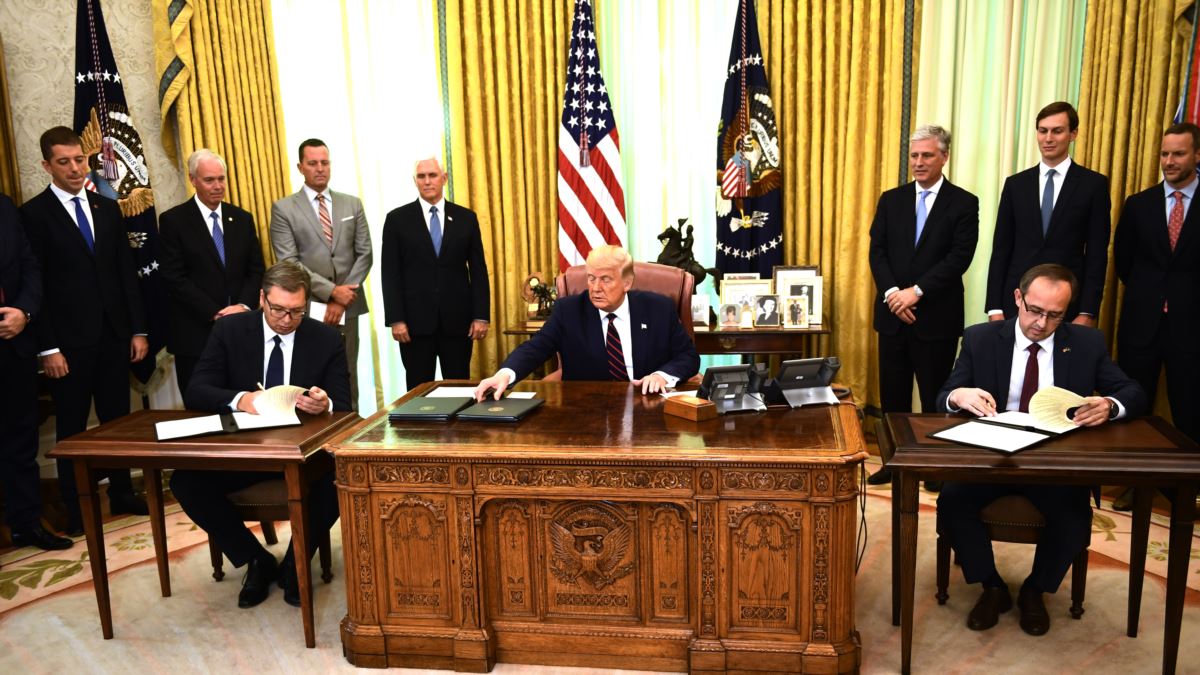
In Washington, on 4 September 2020, Serbia and Kosovo signed separate agreements with the United States on “economic normalization”. The agreements have no bearing on the existing dialogue that is underway between official Belgrade and Priština and mediated by the European Union.

The Washington agreement is a new political reality not just for Kosovo and Serbia but also for the entire West Balkans region, and even the EU itself. It is a product of long and hard work, which included strong engagement of the US special envoy for the dialogue between official Belgrade and Priština, Ambassador Richard Grenell.

The agreement envisages, inter alia, establishment of direct air and rail connections between Belgrade and Priština, construction of the Niš–Priština highway and a number of other economic and energy projects. The signatories to the agreement undertook to suspend for a year the campaign for recognition, that is withdrawal of recognition of Kosovo.

Correlations between the Balkans and the Middle East

The framework of the signed agreements also includes mutual recognition of Israel and Kosovo, and relocation of the Serbian Embassy in Israel from Tel Aviv to Jerusalem within a period of one year. President Donald Trump’s administration also prepared the so-called Abraham Agreement, which led to mutual recognition and establishment of diplomatic relations between Israel and two Arab nations – United Arab Emirates (UAE) and Bahrein. They underlined the necessity to instigate efforts on promotion of interreligious and intercultural dialogue aimed at promoting culture of peace among three Abraham religions and the entire human kind. The signatories emphasized that they believe that the best way to address challenges are cooperation and dialogue, as well as that development of friendly relations among states advances the interests of long-lasting peace in the Middle East and around the world.

As Judaism, Christianity and Islam trace their origins to a common ancestor in Abraham (Ibrahim), the intent of Trump’s administration was to broker a package of agreements not just to relax the relations between the three major monotheistic religions (Judaism, Christianity and Islam), but also to find lasting solutions for these multi-decade, and even century-long open issues and disputes. However, one should not forget the fact that all until World War I the Middle East and the Balkans were covered by the same division in the State Department, which indicates that the relations and entities in the two regions are similar in many respects and mutually connected. Even in a part of international circles comparisons are being made between the Israel-Palestine and Serbia-Albania disputes.

“Mini Schengen” – prosperity of the West Balkans thanks to the US

The Washington agreement has reaffirmed once again the commitment and strong intent of the US administration to implement the “Mini Schengen” project, which after a history of 30 years of disputes, tensions, conflicts and halts could lead to prosperity of all countries in the region.

Serbian President Aleksandar Vučić (SNS), Prime Minister of North Macedonia Zoran Zaev (SDSM) and Prime Minister of Albania Edi Rama (PS) signed on 9 October 2019 in Novi Sad a Joint Declaration of intent to establish a “Mini Schengen” among the three states. The joint declaration envisages elimination of border controls and other barriers, which should facilitate movement in the region by 2021. It would also enable citizens of the three countries to travel in the region using only an identification card and find employment anywhere in the region on the basis of their professional qualifications. The declaration also envisages recognition of diplomas, as well as better cooperation in the fight against organized crime, corruption and assistance in case of natural disasters, which has proven as very important during the Covid-19 pandemic.

The signed declaration should help the Western Balkans region to start functioning on the four key freedoms on which the European Union is founded – freedom of movement of people, capital, goods and services. The initiative is open also for other Western Balkans countries: Bosnia and Herzegovina, Montenegro and Kosovo. It was stressed that the respective initiative is not a compensation or alternative to membership of the countries in the region in the EU.

Analysts have assessed that the bold and visionary idea of a “Mini Schengen” project is the most important project ever since the fall of the Socialist Federal Republic of Yugoslavia (SFRY). The project evokes optimism and instills hope that a better and more prosperous future can be secured in this part of the world. Implementation of the “Mini Schengen” project would contribute to homogenization of the European area and provide for practical realization of European freedoms of movement of people, goods, capital and services. This would render senseless the Balkan nationalisms and at the same time strengthen the EU, which is powerless under the pressures coming from Russia, China and Turkey and does not resolutely confront the populists that collaborate with the forces whose only goal is to destroy European unity and eventually the EU itself. A part of the factors in the region, Europe and the world oppose such an initiative, because it suits their interests to have the Balkans permanently remain an unstable area in which reconciliation and cooperation among neighbors, true Europeanization, lasting economic prosperity, stability and peace, good prospects for young and educated people with the ultimate goal of integration of all Western Balkans countries into the EU would never happen.

By signing the Washington agreement Kosovo undertook to join the “Mini Schengen” project, which is an important moment for its further implementation. After the fall of the 31-years-long regime of Milo Đukanović (DPS), it is expected that Montenegro will also join the “Mini Schengen” initiative. Đukanović’s opposition to establishment of “Mini Schengen” is a testimony that territories or states that are weak for different reasons or are criminal/corrupted do not favor any economic prosperity, because economic connections mean a beginning of the rule of law. The fallen economy and corruption at Kosovo, as well as Đukanović’s criminal-mafia state of Montenegro provide the same or similar examples. Milo Đukanović has a “double mortgage” because of his engagement not just in crimes and corruption but also war crimes, which is why any activity aimed at development of connectedness comes under the attack of his regime. It is expected that Bosnia and Herzegovina will also join the “Mini Schengen” project, as otherwise individual political leaders from Bosnia and Herzegovina could face US sanctions, just like those that the US has already imposed against a member of the BiH Presidency, Milorad Dodik (SNSD). Serbia and Kosovo are expected to immediately suspend all the associated war crime arrest warrants. Serbia is also expected to suspend all the arrest warrants it had issued using its universal jurisdiction over war crimes committed in Bosnia and Herzegovina.

The Washington agreement and the “Mini Schengen” project are also strongly supported by the newly opened regional office of the US International Development Finance Corporation (DFC) in Belgrade, after the meeting of Serbian President Aleksandar Vučić and Serbian Prime Minister Ana Brnabić (SNS) with the Special Envoy of US President for the Serbia-Kosovo dialogue Richard Grenell and Adam Boehler, DFC Chief Executive Officer.

Model for resolution of property issues on Kosovo

The signed agreement on “economic normalization” in Washington in no way brings into question the dialogue between official Belgrade and Priština under the EU mediation. Although the Brussels agreement was signed on 19 April 2013, it has not been implemented primarily due to the obstructions by Kosovo authorities in the implementation of the agreement, and particularly the part that is related to missing persons (OVK/UÇK archive) and establishment of the Community of Serb Municipalities.

The issue of property is one of the key areas of disputes between official Belgrade and Priština. The Washington agreement envisages resolution of the issue of use and management of the Gazivode Lake/Liqeni i Ujmanit, for which a feasibility study will be made.

There is also a dispute related to other property on Kosovo. The most frequently mentioned property in this context is the Mining, Metallurgy and Chemical Combine Trepča and the property in the energy sector, which is appraised to more than three billion EUR.

Experts believe that the model of the Krško nuclear power plant, which was constructed with joint funds of the then Socialist Republic of Slovenia and Socialist Republic of Croatia, can be used to resolve the disputed property issue, which is related to ownership shares. The fall of the SFRY led to emergence of a new reality, that is new states- Republic of Slovenia and Republic of Croatia and the Krško power plant remained on the territory of the Republic of Slovenia. The issue of ownership and management is resolved in the way that each party (state) received a 50% ownership share and therefore now jointly manage the power plant. The model of the Krško power plant could be applied on Kosovo as well. Namely, as the power supply facilities will remain on the territory of Kosovo, the ownership shares of Kosovo and Serbia and the method of joint management of respective power supply facilities would need to be defined. By using analogy, this model could be used also for resolution of property/ownership shares issues in other sectors on Kosovo.

“Lax” role of the EU

During the Covid-19 pandemic, the EU was slow and inapt, due to what some other states tried to fill the vacuum in the period of corona diplomacy.

The EU demonstrated all its anomalies and powerlessness during its mediation in the dialogue between the official Belgrade and Priština. Although the Brussels agreement was signed back in 2013, its key aspects have not been implemented yet. The EU was powerless also when the Kosovo government and its leader Ramush Haradinaj (AAK) bluntly violated the CEFTA free trade agreement by introducing additional taxes on import of goods and services from Bosnia and Herzegovina and Serbia.

Instead of defining more closely its policy of enlargement on the West Balkans and the respective timelines, the EU still uses the general platitudes about the European perspective of the West Balkans and how the West Balkans belongs to Europe, which mean very little to Western Balkans countries and their citizens and do not reduce the already existing uncertainties that they face.

Analysts believe that the EU can rectify its mistake, that is its “lax” role, and speedily integrate as full-fledged members the remaining Western Balkans countries (Serbia, Kosovo, Albania, Bosnia and Herzegovina, North Macedonia and Montenegro), as otherwise it will create space for strong influences of Russia, China and Turkey, which can lead to a change in geopolitical orientation of specific countries. Analysts remind that in its recent history the EU coopted Bulgaria and Rumania as its full-fledged members, although in some sectors the Western Balkans countries are functioning better than Bulgaria and Romania, and that in 2004 the EU even integrated only a half of the state of Cyprus as its full-fledged member. Hence, the EU has no excuse when it comes to accelerated integration of the Western Balkans countries into EU membership.

That is why it is important that through the “Mini Schengen” project the Western Balkans countries maintain political and economic stability so that, with the strong support and presence of the US in the region, the positive trend of their mutual cooperation would not be stopped.

New era of Serbia-US political and economic relations

The address by Serbian President Aleksandar Vučić at the opening of the International Development Financial Corporation (DFC) office in Belgrade offers a good illustration of the relevance of the agreement signed in Washington and the beginning of a new era of political and economic relations between Serbia and the US. “This is an important day for us. We resolved our trade relations with the United States back in 1881, and we haven’t had such an important agreement since then” said Vučić and added “Serbia will meet the obligations stemming from the agreement that was signed in Washington on 4 September 2020. Wherever the Americans want to invest, the US development agency is present, and that is where things happen. We are proud that the DFC is opening its office here and it will have all the support of the Republic of Serbia.”

President Trump’s special envoy for dialogue between Belgrade and Priština, Ambassador Richard Grenell said that the goal was to turn these promises into real jobs. “We ask the people of Serbia to hold us accountable”, said Grunell and added that the promises given will be kept. “We need a year to demonstrate to the people on Kosovo and in Serbia betterment in economy,” Grenell underlined.

Analysts believe that Serbia is the key country in the region for preservation of stability and peace and that therefore the opening of the regional office of the International Development Finance Corporation (DFC) is a new beginning for Serbia and the West Balkans, which needs to show the strength as a region, which will no longer be “trapped in the past” but will be “oriented to the future”.

Ljubljana/Washinton/Belgrade/Priština, 25 September 2020

Footnotes:
[1] IFIMES – International Institute for Middle East and Balkan Studies (IFIMES) from Ljubljana, Slovenia,has a special consultative status with the Economic and Social Council (ECOSOC)/UN since 2018.
Tags: agreeementifimeskosovoSerbia

Related Posts

ENGLISH

The View from Tirana: Navigating the Intra-European Split for Digital Sovereignty

8 June, 2026
Current Events

Rama alleges ‘hybrid war’ behind protests against Kushner-linked coastal development

5 June, 2026
ENGLISH

Pierre Nora and the institution of memory we lack in Eastern Europe

5 June, 2026

Follow US

Subscribe

Receive Argumentum Magazine by Email

Last Posts

The View from Tirana: Navigating the Intra-European Split for Digital Sovereignty

8 June, 2026

Rama alleges ‘hybrid war’ behind protests against Kushner-linked coastal development

5 June, 2026

Pierre Nora and the institution of memory we lack in Eastern Europe

5 June, 2026
BELGRADE, SERBIA - JUNE 18. 2020: Russian and Serbian flags on display during Russian Foreign Minister Sergei Lavrov's visit to the Liberators of Belgrade Memorial. Valery Sharifulin/TASS,Image: 533095429, License: Rights-managed, Restrictions: UWAGA! Zdjęcia zawierają oryginalny opis dostawcy (ITAR-TASS). Szczególnie w związku z agresją Rosji na Ukrainę mogą zawierać przekaz niezgodny z faktami. Zweryfikuj go przed publikacją, Model Release: no, Credit line: Valery Sharifulin / TASS / Forum

Balkan Maskirovka: Why Moscow’s “Distancing” Is Only an Operation for the Survival of Vučić’s Regime

5 June, 2026

The Blueprint of a Diplomatic Debacle: Analyzing Germany’s Historic UNSC Loss

4 June, 2026
Argumentum

“Argumentum”, një proces intelektual …

Contact Us

[email protected]
[email protected]
[email protected]

Follow Us

Media Partner

Register

Receive Argumentum Magazine by Email
  • Home
  • Privacy Policy
  • About Us
  • Contact

© 2022 Argumentum. All Rights Reserved. | NUIS: L91415033Q

Welcome Back!

Login to your account below

Forgotten Password? Sign Up

Create New Account!

Fill the forms bellow to register

*By registering into our website, you agree to the Terms & Conditions and Privacy Policy.
All fields are required. Log In

Retrieve your password

Please enter your username or email address to reset your password.

Log In

Add New Playlist

No Result
View All Result
  • Home
  • OP/ED
  • Interview
  • Realpolitik
  • Current Events
  • Top News
  • YOUR VOICE
  • Shqip

© 2022 Argumentum. All Rights Reserved. | NUIS: L91415033Q

This website uses cookies. By continuing to use this website you are giving consent to cookies being used. Visit our Privacy and Cookie Policy.