



















• SHQIPËRI
  • KOSOVË
  • MAQEDONIA E VERIUT
  • MALI I ZI
  • Revista në PDF
9 June, 2026
  • Home
  • OP/ED

    Pierre Nora and the institution of memory we lack in Eastern Europe

    The Blueprint of a Diplomatic Debacle: Analyzing Germany’s Historic UNSC Loss

    Cyber Attribution, Corruption, and the False-Flag Question in Albania’s 2022 Alleged Iranian Cyberattack

    Between Russia, Iran and Europe: Azerbaijan as a balancing power in the South Caucasus

    The Zero-Tariff Gate: Sovereignty as a Service in the Sino-African Corridor

    Albania vs. the Sea/ Marginal Notes on A. Leka’s Novel The Hidden Side of the Albanian Socialist Garden

    May 9 and the long shadow of a Letter: Is Europe still Schuman’s Project?

    The Arbnesh of Zadar: A living memory of Albanian identity on the Adriatic coast

    Science Diplomacy and Academic Freedom: A strategic nexus for contemporary diplomacy

  • Interview

    Exclusive Interview with Oleksandr Tyshchenko: A 40-Year Legacy of Chernobyl, Nuclear Risks, and Global Responsibility

    INTERVIEW: ZLATKO KRAMARIĆ – THOUGHTS ON THE OLD CONTINENT

    EXCLUSIVE / Ukrainian Ambassador to Albania, Volodymyr Shkurov: “Ukraine wants peace, but not at the expense of its freedom and independence”

    EXCLUSIVE| Ambassador Tayyar Kagan Atay: Türkiye and Albania, a Strategic Partnership Rooted in Shared Heritage and a Common Vision for the Future

    “Diplomacy, Not War”: Palestinian Ambassador to Albania Calls for Justice, Peace, and Global Action for Gaza

    Exclusive: “Even After Tito – Tito”/ Ambassador Zlatko Kramarić on Authoritarian Legacies and Democracy’s Future in the Balkans

    The Conclusion of the Diplomatic Mission / Ambassador Dancho Markovski: Strengthening Albania-North Macedonia Relations for a Shared European Future

    A Century of Diplomatic Relations Between Albania and Russia: Exclusive Interview with the Russian Ambassador to Albania, H.E. Alexey Zaytsev

    Exclusive/ The chairman of the Freedom Party, Ilir Meta: “The will of the citizens will triumph in Albania, as it did in North Macedonia”

  • Realpolitik

    IBAR? ”Sufficiently! Much ado about nothing! Shart contrasts in Beijing! Where is the exit?!

    Neither peace nor war! Peace with bombs?! IBAR in autumn?! Not another Hormuz in Taivan! 

    IBAR – a springing board or an obstacle? Can we catch the EU Negotiation train 2027? When the dress makes the news!  EU electoral April  ends in a draw 1:1!  

    The European Parliament building in Strasbourg, France with flags waving calmly celebrating peace of the Europe. July 12, 2020.

    EU 2027 or 2037! Even half membership failed! No exit strategy!     

    What next?

    “With diplomatic velvet“! Major question marks! In Washington yes, but  in the White House NO! A strange dinner in Brussels!

    From a great ‘apple of disaccord’ to a  point of  cooperation! A bad start! The strange absence in Davos!

    5 lessons from the American 3 January! Don’t count the chicken before they are hatched! Will NATO freeze in Greenland? Wrong diplomatic messages!

    German Chancellor Friedrich Merz, European Commission President Ursula von der Leyen, Ukraine's President Volodymyr Zelenskiy, U.S. Special Envoy Steve Witkoff and Jared Kushner, son-in-law of U.S. President Donald Trump line up for a family photo opportunity at the Chancellery in Berlin, Germany, December 15, 2025.    REUTERS/Lisi Niesner/Pool

    A Strategy that could change the world! Europe in Berlin! Why an historic compromise? Only charm diplomacy in Athens!

  • Current Events

    Rama alleges ‘hybrid war’ behind protests against Kushner-linked coastal development

    BELGRADE, SERBIA - JUNE 18. 2020: Russian and Serbian flags on display during Russian Foreign Minister Sergei Lavrov's visit to the Liberators of Belgrade Memorial. Valery Sharifulin/TASS,Image: 533095429, License: Rights-managed, Restrictions: UWAGA! Zdjęcia zawierają oryginalny opis dostawcy (ITAR-TASS). Szczególnie w związku z agresją Rosji na Ukrainę mogą zawierać przekaz niezgodny z faktami. Zweryfikuj go przed publikacją, Model Release: no, Credit line: Valery Sharifulin / TASS / Forum

    Balkan Maskirovka: Why Moscow’s “Distancing” Is Only an Operation for the Survival of Vučić’s Regime

    Serbia – China 2026: Technological partnership, geopolitical positioning and a new phase of the Chinese presence in the Western Balkans

    The Digital Protectorate: How the EU AI Act Codified Silicon Valley’s Monopoly

    The 28th MFC Annual Conference in Durrës / Sulaj: Microfinance remains a key instrument for financial inclusion

    Serbia at the Crossroads of EU Integration and Geopolitical Balancing: IFIMES Analysis

    Tirana – €20 Million EU–Banking Agreement Boosts Albanian SMEs

    The Myth of Independence: How Chinese Efficiency is Rewriting the Constitution of Modern Geopolitics!

    Europe Yesterday and Today: Why 9 May Still Matters

  • Top News

    Rama alleges ‘hybrid war’ behind protests against Kushner-linked coastal development

    No End in Sight: Trump, Netanyahu and the Expanding Middle East War

    Tirana – €20 Million EU–Banking Agreement Boosts Albanian SMEs

    “EU4Municipalities II” Project, a Strategic Investment for Strengthening Municipalities and Accelerating Albania’s Path towards the EU

    Albania, Italy deepen defence ties with naval shipbuilding deal

    U.S. Embassy: Iran-Linked Groups May Target Americans and Iranian Opposition in Albania

    The Council of Albanian Ambassadors disappointed with the voting of the draft law on the foreign service in the parliamentary committees.

    Prime Minister Edi Rama Addresses Israel’s Knesset in Historic Special Session

    Kazakhstan’s Strategic Reform Agenda: Stability, Modern Governance, and Responsible Diplomacy

  • YOUR VOICE
  • Shqip
No Result
View All Result
Argumentum
  • Home
  • OP/ED

    Pierre Nora and the institution of memory we lack in Eastern Europe

    The Blueprint of a Diplomatic Debacle: Analyzing Germany’s Historic UNSC Loss

    Cyber Attribution, Corruption, and the False-Flag Question in Albania’s 2022 Alleged Iranian Cyberattack

    Between Russia, Iran and Europe: Azerbaijan as a balancing power in the South Caucasus

    The Zero-Tariff Gate: Sovereignty as a Service in the Sino-African Corridor

    Albania vs. the Sea/ Marginal Notes on A. Leka’s Novel The Hidden Side of the Albanian Socialist Garden

    May 9 and the long shadow of a Letter: Is Europe still Schuman’s Project?

    The Arbnesh of Zadar: A living memory of Albanian identity on the Adriatic coast

    Science Diplomacy and Academic Freedom: A strategic nexus for contemporary diplomacy

  • Interview

    Exclusive Interview with Oleksandr Tyshchenko: A 40-Year Legacy of Chernobyl, Nuclear Risks, and Global Responsibility

    INTERVIEW: ZLATKO KRAMARIĆ – THOUGHTS ON THE OLD CONTINENT

    EXCLUSIVE / Ukrainian Ambassador to Albania, Volodymyr Shkurov: “Ukraine wants peace, but not at the expense of its freedom and independence”

    EXCLUSIVE| Ambassador Tayyar Kagan Atay: Türkiye and Albania, a Strategic Partnership Rooted in Shared Heritage and a Common Vision for the Future

    “Diplomacy, Not War”: Palestinian Ambassador to Albania Calls for Justice, Peace, and Global Action for Gaza

    Exclusive: “Even After Tito – Tito”/ Ambassador Zlatko Kramarić on Authoritarian Legacies and Democracy’s Future in the Balkans

    The Conclusion of the Diplomatic Mission / Ambassador Dancho Markovski: Strengthening Albania-North Macedonia Relations for a Shared European Future

    A Century of Diplomatic Relations Between Albania and Russia: Exclusive Interview with the Russian Ambassador to Albania, H.E. Alexey Zaytsev

    Exclusive/ The chairman of the Freedom Party, Ilir Meta: “The will of the citizens will triumph in Albania, as it did in North Macedonia”

  • Realpolitik

    IBAR? ”Sufficiently! Much ado about nothing! Shart contrasts in Beijing! Where is the exit?!

    Neither peace nor war! Peace with bombs?! IBAR in autumn?! Not another Hormuz in Taivan! 

    IBAR – a springing board or an obstacle? Can we catch the EU Negotiation train 2027? When the dress makes the news!  EU electoral April  ends in a draw 1:1!  

    The European Parliament building in Strasbourg, France with flags waving calmly celebrating peace of the Europe. July 12, 2020.

    EU 2027 or 2037! Even half membership failed! No exit strategy!     

    What next?

    “With diplomatic velvet“! Major question marks! In Washington yes, but  in the White House NO! A strange dinner in Brussels!

    From a great ‘apple of disaccord’ to a  point of  cooperation! A bad start! The strange absence in Davos!

    5 lessons from the American 3 January! Don’t count the chicken before they are hatched! Will NATO freeze in Greenland? Wrong diplomatic messages!

    German Chancellor Friedrich Merz, European Commission President Ursula von der Leyen, Ukraine's President Volodymyr Zelenskiy, U.S. Special Envoy Steve Witkoff and Jared Kushner, son-in-law of U.S. President Donald Trump line up for a family photo opportunity at the Chancellery in Berlin, Germany, December 15, 2025.    REUTERS/Lisi Niesner/Pool

    A Strategy that could change the world! Europe in Berlin! Why an historic compromise? Only charm diplomacy in Athens!

  • Current Events

    Rama alleges ‘hybrid war’ behind protests against Kushner-linked coastal development

    BELGRADE, SERBIA - JUNE 18. 2020: Russian and Serbian flags on display during Russian Foreign Minister Sergei Lavrov's visit to the Liberators of Belgrade Memorial. Valery Sharifulin/TASS,Image: 533095429, License: Rights-managed, Restrictions: UWAGA! Zdjęcia zawierają oryginalny opis dostawcy (ITAR-TASS). Szczególnie w związku z agresją Rosji na Ukrainę mogą zawierać przekaz niezgodny z faktami. Zweryfikuj go przed publikacją, Model Release: no, Credit line: Valery Sharifulin / TASS / Forum

    Balkan Maskirovka: Why Moscow’s “Distancing” Is Only an Operation for the Survival of Vučić’s Regime

    Serbia – China 2026: Technological partnership, geopolitical positioning and a new phase of the Chinese presence in the Western Balkans

    The Digital Protectorate: How the EU AI Act Codified Silicon Valley’s Monopoly

    The 28th MFC Annual Conference in Durrës / Sulaj: Microfinance remains a key instrument for financial inclusion

    Serbia at the Crossroads of EU Integration and Geopolitical Balancing: IFIMES Analysis

    Tirana – €20 Million EU–Banking Agreement Boosts Albanian SMEs

    The Myth of Independence: How Chinese Efficiency is Rewriting the Constitution of Modern Geopolitics!

    Europe Yesterday and Today: Why 9 May Still Matters

  • Top News

    Rama alleges ‘hybrid war’ behind protests against Kushner-linked coastal development

    No End in Sight: Trump, Netanyahu and the Expanding Middle East War

    Tirana – €20 Million EU–Banking Agreement Boosts Albanian SMEs

    “EU4Municipalities II” Project, a Strategic Investment for Strengthening Municipalities and Accelerating Albania’s Path towards the EU

    Albania, Italy deepen defence ties with naval shipbuilding deal

    U.S. Embassy: Iran-Linked Groups May Target Americans and Iranian Opposition in Albania

    The Council of Albanian Ambassadors disappointed with the voting of the draft law on the foreign service in the parliamentary committees.

    Prime Minister Edi Rama Addresses Israel’s Knesset in Historic Special Session

    Kazakhstan’s Strategic Reform Agenda: Stability, Modern Governance, and Responsible Diplomacy

  • YOUR VOICE
  • Shqip
No Result
View All Result
Argumentum
No Result
View All Result
Home ENGLISH

31 March – Day of Genocide of Azerbaijanis

31 March, 2021
in ENGLISH, English OP/ED
A A
Share on FacebookShare on Twitter

By Anar Huseynov *

 Ambassador of the Republic of Azerbaijan to the Hellenic Republic and to the Republic of Albania.

March 31, commemorated in the Republic of Azerbaijan as the Day of Genocide of Azerbaijanis, reflects the memory of the bloody massacre committed against Azerbaijanis in March 1918. The rapid development of the oil industry in Baku in the late 19th and early 20th centuries attracted a wave of Armenian migration to the city. As one of the main industrial centres in tsarist Russia, Baku saw the emergence of an industrial proletariat and revolutionary fervour. Armenian workers, whose number increased considerably in the early 20th century, took active part in Baku’s revolutionary and socialist movements. On the eve of the first Russian revolution (1905-1907), the Armenian nationalist Dashnaksutyun Party started to spread nationalistic ideas among Armenian workers in Baku. They used revolutionary ideas to promote their own nationalistic agenda. Inspired by ideas of creating a “Greater Armenia,” Armenians carried out a series of bloody massacres against Azerbaijanis in the period of 1905-07. Hundreds of Azerbaijani settlements were destroyed and razed to the ground, and thousands of civilians were brutally killed. The massacre of 1918 was a more skillfully prepared and ruthlessly implemented act than the 1905-1907 attacks. The victory of Bolsheviks during the Russian revolution of 1917 and thereby collaboration with them gave the Dashnaksutyun Party way for smooth realisation of its nationalistic objectives. Capitalizing on the situation that followed October 1917 Revolution in Russia, Armenian nationalists began to pursue the implementation of their plans under the banner of Bolshevism. In 1918, leader of the Russian Bolsheviks Vladimir Lenin appointed ethnic Armenian Stephan Shaumyan Extraordinary Commissar of the Caucasus. By that time, the Bolsheviks seized power in Baku and viewed the Armenian Party of Dashnaktsutyun as a source of support for eliminating the influence of Azerbaijani national party-Musavat in Baku and the regions. In this regard, the interests of Bolsheviks and Dashnaks by March 1918 coincided. On March 2, 1918, speaking at a meeting of the Baku Soviet, Shaumyan strongly criticised the Musavat Party, blaming it for secession of Azerbaijan from Russia. Right at the beginning of tragic events, the Baku Soviet, under the pretext of combating counter-revolutionary elements, set about the plan to liquidate Azerbaijanis throughout the Baku Province. By the acknowledgements of Stephan Shaumyan, 6000 armed soldiers of the Baku Soviet and 4000 armed men from Dashnaksutyun Party took part in the massacre of Azerbaijani civilians.

On 30 March Armenian-Bolshevik units subjected Baku to volley fire from ships. Then, armed Dashnaks attacked the homes of Azerbaijanis and carried out a merciless slaughter. On 31 March and in the first days of April, the carnage became even more ruthless. Thousands of Azerbaijani civilians were killed only because of their ethnicity. In this period, Armenian-Bolshevik units wiped out more than 20,000 Azerbaijani civilians in Baku: people were burned in their homes, killed and tortured with unparalleled cruelty. As a result, more than 16,000 people were killed with utmost barbarity in the Guba province in the first five months of 1918; a total of 167 villages were destroyed, 35 of which do not exist to this day. The Armenians had installed machine guns in various places of the city in order to shoot those who were trying to escape. Avanes Apresyan, an Armenian officer, one of the active participants in the massacre of the Azerbaijanis, wrote in his memoirs titled “Men were like this,” that in Baku alone, they murdered 25,000 Azerbaijanis in the March massacre. However, genocide of the Azerbaijanis by the Dashnaks was not limited to Baku. Within a short period of time, Armenians committed massacres in Shamakhy, Guba, Irevan, Zengezur, Karabakh and Nakhchivan.

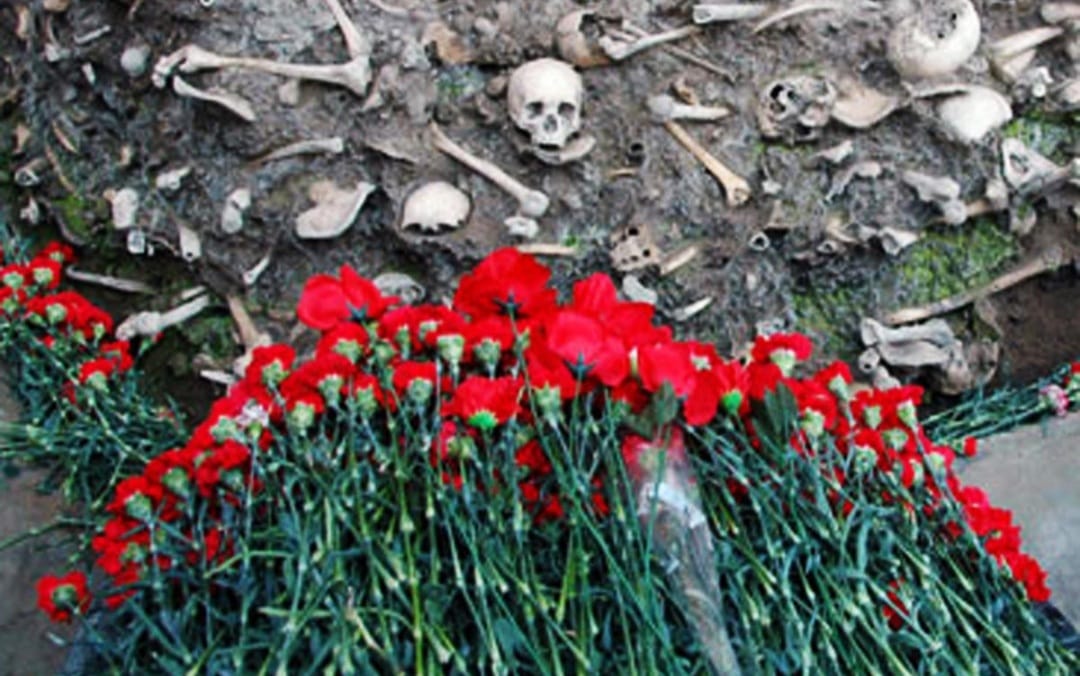
The discovery of mass graves in Guba region of Azerbaijan in 2007 confirms Armenian inhumanity. Study of the burial site has revealed that during an Armenian armed attack on Guba in 1918, people were subjected to unprecedented violence and killed with cruelty. The grave contains remains of mass burials of local residents.

The Austrian researcher Erich Feigle in his research “Truth terror. Armenian terrorism – roots and reasons” speaking of Shaumyan’s activity in 1918 stresses that his aim was to armenianize Baku “by any hooks or crooks”. According to various estimates, 12,000 to 30,000 people were killed in Baku in three days alone. In this regard, S.Shaumyan, the Chairman of Baku Soviet, did not hide his satisfaction: “We were frightened by the national structure of our city. We were afraid that the fight might assume an unwanted colouration. We even had to resort to the Armenian Dashnak Regiment. We could not even allow ourselves the luxury of refusing their services. The Armenian National Council carried out arrests, searches, requisitions, etc. on its own. However, the victory is so great that it does little to overshadow the reality”. Baku Soviet’s reliance on the Dashnak forces caused outrage among the Bolsheviks of other nationalities. One of the witnesses of the genocide of Azerbaijanis, Bolshevik Blyumin, later noted in his memoirs, “With the advent of the events of 1918, we resorted to Dashnak troops, as we had no armed forces of our own. Still, Dashnak troops did their dirty work. They turned a civil war into a national cleansing, having slaughtered up to 20,000 poor Azerbaijanis”.

The March events of 1918 became the focus of attention following the proclamation of Azerbaijan Democratic Republic (ADR). The Extraordinary Investigation Commission (EIC) was established by ADR on July 15, 1918 in order to investigate the violence against Azerbaijani population. An important trait of this commission was that it was comprised of the best lawyers of that time representing different nationalities – Russians, Jewish, Polish, Georgians and even Armenians. These factors testify competence and impartiality of the EIC. Materials collected by the EIC by August 1919 filed in 36 volumes and 3,500 pages. Based on this evidence, the EIC prepared 128 reports and drafts to file lawsuits against 194 persons accused of different crimes against a peaceful population. Thus, by mid-August, 24 people in Baku and about 100 people in Shamakhy were arrested. This was the first attempt to conduct a political and legal assessment of the policy of genocide perpetrated against the Azerbaijanis. However, the demise of the Azerbaijan Democratic Republic made it impossible to complete this work. After restoring its independence in 1991, the Republic of Azerbaijan resumed political assessment of genocide of March 1918 and is committed to complete ADR’s unfinished attempts to bring about justice. On the eve of the 80th anniversary of the tragedy, the then President Heydar Aliyev issued a Decree to announce 31 March as a national day of mourning. The Decree has become a key document for conducting a political and legal assessment of the genocidal acts committed against Azerbaijanis in the beginning of 20th century. The Decree also signifies the Azerbaijani people’s devotion towards its national values, historical roots and homeland. At the same time, the commemoration of the Day of Genocide of Azerbaijanis raises the awareness of the world community to the facts of the massacre and ethnic cleansing of Azerbaijanis in the past and present.

/argumentum.al

© Argumentum

Tags: Anar Huseynovarmeniaazerbajxhangencoid 31 march

Related Posts

ENGLISH

The View from Tirana: Navigating the Intra-European Split for Digital Sovereignty

8 June, 2026
Current Events

Rama alleges ‘hybrid war’ behind protests against Kushner-linked coastal development

5 June, 2026
ENGLISH

Pierre Nora and the institution of memory we lack in Eastern Europe

5 June, 2026

Follow US

Subscribe

Receive Argumentum Magazine by Email

Last Posts

The View from Tirana: Navigating the Intra-European Split for Digital Sovereignty

8 June, 2026

Rama alleges ‘hybrid war’ behind protests against Kushner-linked coastal development

5 June, 2026

Pierre Nora and the institution of memory we lack in Eastern Europe

5 June, 2026
BELGRADE, SERBIA - JUNE 18. 2020: Russian and Serbian flags on display during Russian Foreign Minister Sergei Lavrov's visit to the Liberators of Belgrade Memorial. Valery Sharifulin/TASS,Image: 533095429, License: Rights-managed, Restrictions: UWAGA! Zdjęcia zawierają oryginalny opis dostawcy (ITAR-TASS). Szczególnie w związku z agresją Rosji na Ukrainę mogą zawierać przekaz niezgodny z faktami. Zweryfikuj go przed publikacją, Model Release: no, Credit line: Valery Sharifulin / TASS / Forum

Balkan Maskirovka: Why Moscow’s “Distancing” Is Only an Operation for the Survival of Vučić’s Regime

5 June, 2026

The Blueprint of a Diplomatic Debacle: Analyzing Germany’s Historic UNSC Loss

4 June, 2026
Argumentum

“Argumentum”, një proces intelektual …

Contact Us

[email protected]
[email protected]
[email protected]

Follow Us

Media Partner

Register

Receive Argumentum Magazine by Email
  • Home
  • Privacy Policy
  • About Us
  • Contact

© 2022 Argumentum. All Rights Reserved. | NUIS: L91415033Q

Welcome Back!

Login to your account below

Forgotten Password? Sign Up

Create New Account!

Fill the forms bellow to register

*By registering into our website, you agree to the Terms & Conditions and Privacy Policy.
All fields are required. Log In

Retrieve your password

Please enter your username or email address to reset your password.

Log In

Add New Playlist

No Result
View All Result
  • Home
  • OP/ED
  • Interview
  • Realpolitik
  • Current Events
  • Top News
  • YOUR VOICE
  • Shqip

© 2022 Argumentum. All Rights Reserved. | NUIS: L91415033Q

This website uses cookies. By continuing to use this website you are giving consent to cookies being used. Visit our Privacy and Cookie Policy.