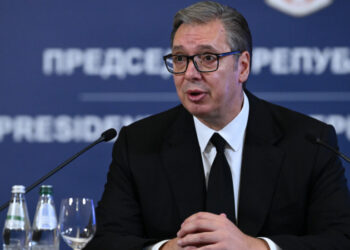






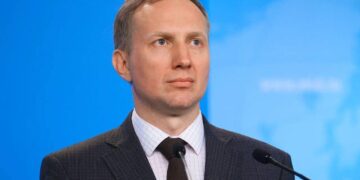



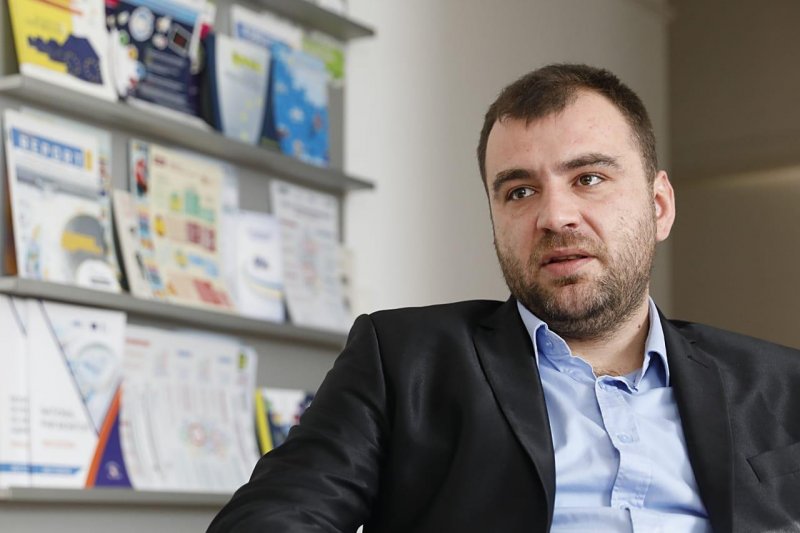
There is a lot of potential in the relations between North Macedonia and Albania, particularly when it comes to trade, tourism, and infrastructure. Many things have improved in the past, particularly in the tourism sector and the equality of the transport infrastructure especially in Albania, but I hope that the elites will follow up on the needs of the societies, who are united in the desire to do business, cooperate and live in normal, corruption-free and functional liberal democracies, said political analyst Ljupco Petkovski
By Genc Mlloja
Senior Diplomatic Editor
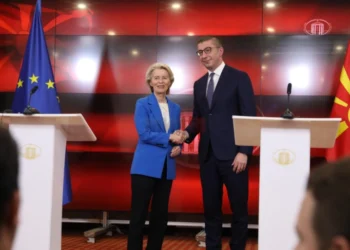
The Parliament of North Macedonia voted 62-51 in favor of the new government led by Social Democrat leader Zoran Zaev on Sunday, ending a months-long leadership void amid the COVID19 pandemic in this Balkan country. Zaev and his coalition partners , who won 62 of the 120-member Parliament in the July election this year, formed a 19-member Cabinet in which seven posts went to the Democratic Union for Integration (DUI) from the Albanian bloc. In addition, according to the coalition government agreement, DUI will lead the country’s government 100 days before the end of the government’s four-year term, in 2024, an event to be recorded as the first ethnic Albanian to become government head of North Macedonia.
Albanians are the largest ethnic minority in North Macedonia. Of the around two million citizens of this country, more than 500,000, or a quarter, are Albanian according to the 2002 national census, data by unpo.org
say.
Unveiling his government platform, PM Zaev has declared in Parliament that his new Cabinet will focus on reviving the economy, dealing with the coronavirus pandemic and fighting corruption. He announced 1 billion euros ($1.19 billion) in new foreign investments, a 40% increase in the minimum wage and pensions and a planned judiciary reform.
“A period of order, justice and discipline is coming, it is time for vetting of the judiciary and unselective rule of law,” Zaev told the Parliament.
To speak on the latest developments in the neighboring country of Albania I had a conversation with the North Macedonian political analyst, Ljupco Petkovski, who was Executive Director of Eurothink, Centre for European Strategies, in Skopje.
“The SDSM-DUI coalition was not a surprise, although there was a significant deterioration of the political rhetoric that they used against each other during the campaign. SDSM’s leader Zoran Zaev rallied with a promise that if he gets enough votes he would “send DUI to opposition’. DUI’s leader Ali Ahmeti replied with accusations of corruption among SDSM insisting that his party would participate in a Government only if an ethnic Albanian is elected PM. I think that both strategies did justice to the truth. DUI has been in power for almost two decades now, developing a broad clientelist network as part of the ‘peace cartel’ they have formed with ethnic Macedonian parties following the Ohrid Framework Agreement,” said the North Macedonian analyst.
According to him, the low turnout particularly among ethnic Macedonians produced a result which made the new SDSM-DUI coalition the least impossible one among all other available options, but Zaev got what he wanted – the position of PM, while DUI got more influential ministerial positions coupled with more access to state funds.
DUI, a ‘Kingmaker’…
Social Democrats won 46 seats in the July elections, narrowly beating their opposition rivals headed by VMRO DPMNE party, which won 44 seats. In the meantime, the Democratic Union for Integration managed to win 15 MPs.
Albanian parties which ran in the July elections won 32 seats in the 120-member Parliament, the highest ever representation of ethnic Albanians in the North Macedonia legislative.
Asked about his opinion on the ‘kingmaker’ role of the Democratic Union for Integration on the political scene of North Macedonia, the political analyst, Petkovski said that DUI had created a significant amount of political and symbolic capital thanks to the fact that they are seen by many ethnic Albanians as an actor that brought more rights and equality for their community. “But it was not all about ethnic rights – DUI managed to institutionalize the access of their clients to the spoils of state capture -state jobs, public procurement, lucrative businesses with the state, corruption and impunity,” he said.
Greece-North Macedonia agreement, a ‘win-win’ situation
Answering a question if the Greece-North Macedonia agreement has delivered reflecting on findings and conclusions of the paper “Lessons learned from the Greece-North Macedonia agreement” compiled by Greek political researcher Ioannis Armakolas and him as part of the Initiative “Program for Rapprochement between North Macedonia and Greece” implemented by EUROTHINK – Skopje, ELIAMEP – Athens and the Skopje and Athens offices of Friedrich-Ebert-Stiftung published in June 2019, researcher Ljupco Petkovski had the following answer: “The agreement has already delivered on the key demands and expectations of the parties. North Macedonia got what it wanted – NATO membership and prospect of EU integration epitomized in the start of accession talks with the EU. Greek nationalism can now be pacified – it is clear that the legacy of antiquity will not be used for nation building by its neighbours. So, we have a win-win situation, in which nobody seems to be entirely happy, but everybody got something. That is a definition of good compromise. The extra for North Macedonia and ethnic Macedonians is the fact that we finally got rid of the silly story about the ancient glory of the Slavic speaking Macedonians, which has never been part of our official national historiography until the former PM and the current fugitive Nikola Gruevski used it for his political interests.”
Political will can produce agreements
It has been claimed that some crucial elements of the Prespa Agreement make it a potential example for resolving other bilateral disputes in the region, but, as Petkovski argued, straightforward parallels can hardly be drawn, although some of the components of the agreements can be used as an inspiration for negotiators in other countries insofar as for the international mediators.
“The most important one is the existence of political will. If there is political will, there will be an agreement. The second one is the domestic agency – there will be no deal if it is imposed, because domestic agency is crucial. The third one is the fact that the populations, despite expectations, were very much constructive in the process in terms of not sustaining long-lasting anti-agreement mobilizations. I think that something similar can be expected in other countries as well, because people are focused on mundane, every-day problems and it is very difficult for subversive politicians to mobilize people on the national card. The 1990s are over,” he noted.
Asked about the course of Kosovo-Serbia negotiations and an eventual final solution when besides Brussels’ mediation there is US involvement in the process, the North Macedonian analyst believed that there would be an agreement but when parts of their elites come to an agreement. “To my opinion, there will be agreement between Serbia and Kosovo when (parts of) their elites come to an agreement they can ‘sell’ to their respective public opinions without devastating damage to their approval ratings. I think that Vucic in Serbia can do so because he has a complete control over the political sphere. If there is agreement between the more plural Kosovar elites about the basic parameters of the future agreement, or if Kosovo’s politics becomes dominated by an elite that is pro-agreement, the agreement between Prishtina and Belgrade is inevitable. As observers and supporters of rapprochement in the Western Balkans, we should take into consideration two important things. First, that Serbia, despite being totally villainised because of its war past and autocratic present, has a legitimate right to defend what it sees as its national interest, of course, as long as it does so using peaceful means. Second, Kosovo as a state is a reality which nobody can deny.”
Part of the conversation was the schemes on new borders or land swaps between Kosovo and Serbia, which have become a controversial issue not only in the relevant countries but also at international level. In this frame Germany’s known opposition to territorial exchanges as part of a final settlement has been reconfirmed sharply a few weeks ago.
Ms. Susanne Schutz, the Western Balkans Director at the German Federal Foreign Office, told BIRN on August 10 this year that thanks to the facilitation efforts by EU Special Representative Miroslav Lajcak, and the support of Germany and France, the EU-led dialogue between Belgrade and Pristina finally resumed on July 12, after its interruption 20 months ago.
“We see an urgent need for progress in the dialogue as the unresolved situation is holding both countries back and hampering much needed regional cooperation in the entire Western Balkans,” Ms. Schutz, who was Ambassador to Albania, said.
“A comprehensive agreement that allows for the realization of the EU perspective is in the interest of both Kosovo and Serbia, as well as the region as a whole. This agreement should also bring greater stability to the region. As is well known, we do not believe that new borders or land swaps would contribute to such a sustainable solution,” Ambassador Schutz explained, referencing Germany’s known opposition to territorial exchanges as part of a final settlement.
Dwelling on the complexity of the above issue the North Macedonian analyst did not worry so much about the content of the future agreement. “If it is based on the agency of the local actors it will be a one that actors will live with. Maybe the option involving some sort of land swap is not based on principles, but the same can be said about the lack of political vision of the German position because it offers no viable alternative. Having a not perfect agreement is better than having a frozen conflict,” he said.
I asked Petkovski on the opportunities of North Macedonia and Albania to start the accession talks with EU during Germany’s Presidency of the Union.
In his view there is no obstacle to the launch of the first intergovernmental talks within 2020. “I don’t see handicaps. The whole process should be focused on content, not on timing. Several months will not change anything but the PR prospects of the political class in both countries.”
Regarding a proposal on a “mini-Schengen” initiative in the Western Balkans launched after meetings of President of Serbia Aleksandar Vucic, Prime Minister of Albania Edi Rama and then-PM of North Macedonia Zoran Zaev in Novi Sad in October and Ohrid in November last year, the next meeting of the initiative was expected to take place in Belgrade in late January or early February 2020, but did not materialize. Anyway PM Rama brought the issue again to the attention as an alternative which, as a matter of fact, has not been supported by all the regional countries with some analysts saying it is not a good time to further force the story of ‘mini-Schengen’”.
But, according to researcher Petkovski, any initiative that would bring benefits for the peoples and businesses in the region should be welcome. He had the following opinion on the issue: “There is a lot of narcissism of small differences dominating the relations between our leaders. It is a total disgrace that in the 21st century we need internationally facilitated processes to start cooperating as neighbours. I really wonder why our elites don’t feel they are being infantilised. Our peoples and businesses cooperate a lot, there is a lot of cross-border movement, politics has fundamentally failed yet again and it is not just lagging behind the human relations we are building but sometimes it is preventing larger cooperation from happening, particularly in terms of business. The road that connects Skopje with the adjacent border with Kosovo is a disgrace for North Macedonia.”
A lot of potential in North Macedonia-Albanian ties
The analyst, Petkovski was ‘very skeptical’ about the Berlin Process, which was launched at the initiative of Germany in 2014, and the 2020 BP Summit under the joint presidency of Bulgaria and North Macedonia is expected to be held in November as it has been learned by Albanian Daily News from a diplomatic source in Sofia.
In his view such a process has not delivered as much as expected when it was launched. “It has produced very little results for a lot of resources while giving alibi, legitimacy and false agency to elites that are not capable of delivering. The place of broader civil societies in this process is virtually non-existent, except for organized CSOs being invited to listen to politicians during (some of) the Summits,” he said. “Much ado about nothing! Let us be pragmatic and focus of experimenting of what could work, instead of spending energy on something that has proven not to work.”
In conclusion my question was on what new unexplored potentials could be used by Albania and North Macedonia to diversify their relationship in the new critical circumstances created in the region, Europe and the entire world because of the C19 pandemic. His answer is as follows: “There is a lot of potential, particularly when it comes to trade, tourism, infrastructure. Many things have improved in the past, particularly in the tourism sector and the equality of the transport infrastructure especially in Albania, but I hope that the elites will follow up on the needs of our societies, who are united in the desire to do business, cooperate and live in normal, corruption-free and functional liberal democracies.” /ADN