






• SHQIPËRI
  • KOSOVË
  • MAQEDONIA E VERIUT
  • MALI I ZI
  • Revista në PDF
4 June, 2026
  • Home
  • OP/ED

    Cyber Attribution, Corruption, and the False-Flag Question in Albania’s 2022 Alleged Iranian Cyberattack

    Between Russia, Iran and Europe: Azerbaijan as a balancing power in the South Caucasus

    The Zero-Tariff Gate: Sovereignty as a Service in the Sino-African Corridor

    Albania vs. the Sea/ Marginal Notes on A. Leka’s Novel The Hidden Side of the Albanian Socialist Garden

    May 9 and the long shadow of a Letter: Is Europe still Schuman’s Project?

    The Arbnesh of Zadar: A living memory of Albanian identity on the Adriatic coast

    Science Diplomacy and Academic Freedom: A strategic nexus for contemporary diplomacy

    Serbia and Kosovo between new regional alliances and old geopolitical patterns

    Hungarian Writers and the European Spirit: Between Central Europe, Auschwitz, and Inner Exile

  • Interview

    Exclusive Interview with Oleksandr Tyshchenko: A 40-Year Legacy of Chernobyl, Nuclear Risks, and Global Responsibility

    INTERVIEW: ZLATKO KRAMARIĆ – THOUGHTS ON THE OLD CONTINENT

    EXCLUSIVE / Ukrainian Ambassador to Albania, Volodymyr Shkurov: “Ukraine wants peace, but not at the expense of its freedom and independence”

    EXCLUSIVE| Ambassador Tayyar Kagan Atay: Türkiye and Albania, a Strategic Partnership Rooted in Shared Heritage and a Common Vision for the Future

    “Diplomacy, Not War”: Palestinian Ambassador to Albania Calls for Justice, Peace, and Global Action for Gaza

    Exclusive: “Even After Tito – Tito”/ Ambassador Zlatko Kramarić on Authoritarian Legacies and Democracy’s Future in the Balkans

    The Conclusion of the Diplomatic Mission / Ambassador Dancho Markovski: Strengthening Albania-North Macedonia Relations for a Shared European Future

    A Century of Diplomatic Relations Between Albania and Russia: Exclusive Interview with the Russian Ambassador to Albania, H.E. Alexey Zaytsev

    Exclusive/ The chairman of the Freedom Party, Ilir Meta: “The will of the citizens will triumph in Albania, as it did in North Macedonia”

  • Realpolitik

    IBAR? ”Sufficiently! Much ado about nothing! Shart contrasts in Beijing! Where is the exit?!

    Neither peace nor war! Peace with bombs?! IBAR in autumn?! Not another Hormuz in Taivan! 

    IBAR – a springing board or an obstacle? Can we catch the EU Negotiation train 2027? When the dress makes the news!  EU electoral April  ends in a draw 1:1!  

    The European Parliament building in Strasbourg, France with flags waving calmly celebrating peace of the Europe. July 12, 2020.

    EU 2027 or 2037! Even half membership failed! No exit strategy!     

    What next?

    “With diplomatic velvet“! Major question marks! In Washington yes, but  in the White House NO! A strange dinner in Brussels!

    From a great ‘apple of disaccord’ to a  point of  cooperation! A bad start! The strange absence in Davos!

    5 lessons from the American 3 January! Don’t count the chicken before they are hatched! Will NATO freeze in Greenland? Wrong diplomatic messages!

    German Chancellor Friedrich Merz, European Commission President Ursula von der Leyen, Ukraine's President Volodymyr Zelenskiy, U.S. Special Envoy Steve Witkoff and Jared Kushner, son-in-law of U.S. President Donald Trump line up for a family photo opportunity at the Chancellery in Berlin, Germany, December 15, 2025.    REUTERS/Lisi Niesner/Pool

    A Strategy that could change the world! Europe in Berlin! Why an historic compromise? Only charm diplomacy in Athens!

  • Current Events

    Serbia – China 2026: Technological partnership, geopolitical positioning and a new phase of the Chinese presence in the Western Balkans

    The Digital Protectorate: How the EU AI Act Codified Silicon Valley’s Monopoly

    The 28th MFC Annual Conference in Durrës / Sulaj: Microfinance remains a key instrument for financial inclusion

    Serbia at the Crossroads of EU Integration and Geopolitical Balancing: IFIMES Analysis

    Tirana – €20 Million EU–Banking Agreement Boosts Albanian SMEs

    The Myth of Independence: How Chinese Efficiency is Rewriting the Constitution of Modern Geopolitics!

    Europe Yesterday and Today: Why 9 May Still Matters

    “EU4Municipalities II” Project, a Strategic Investment for Strengthening Municipalities and Accelerating Albania’s Path towards the EU

    Eight Years in the Service of Identity: The Journey of the Montenegrin Community in Albania

  • Top News

    No End in Sight: Trump, Netanyahu and the Expanding Middle East War

    Tirana – €20 Million EU–Banking Agreement Boosts Albanian SMEs

    “EU4Municipalities II” Project, a Strategic Investment for Strengthening Municipalities and Accelerating Albania’s Path towards the EU

    Albania, Italy deepen defence ties with naval shipbuilding deal

    U.S. Embassy: Iran-Linked Groups May Target Americans and Iranian Opposition in Albania

    The Council of Albanian Ambassadors disappointed with the voting of the draft law on the foreign service in the parliamentary committees.

    Prime Minister Edi Rama Addresses Israel’s Knesset in Historic Special Session

    Kazakhstan’s Strategic Reform Agenda: Stability, Modern Governance, and Responsible Diplomacy

    Trump Invites Rama to Peace Board, Prime Minister: Proud of Albania

  • YOUR VOICE
  • Shqip
No Result
View All Result
Argumentum
  • Home
  • OP/ED

    Cyber Attribution, Corruption, and the False-Flag Question in Albania’s 2022 Alleged Iranian Cyberattack

    Between Russia, Iran and Europe: Azerbaijan as a balancing power in the South Caucasus

    The Zero-Tariff Gate: Sovereignty as a Service in the Sino-African Corridor

    Albania vs. the Sea/ Marginal Notes on A. Leka’s Novel The Hidden Side of the Albanian Socialist Garden

    May 9 and the long shadow of a Letter: Is Europe still Schuman’s Project?

    The Arbnesh of Zadar: A living memory of Albanian identity on the Adriatic coast

    Science Diplomacy and Academic Freedom: A strategic nexus for contemporary diplomacy

    Serbia and Kosovo between new regional alliances and old geopolitical patterns

    Hungarian Writers and the European Spirit: Between Central Europe, Auschwitz, and Inner Exile

  • Interview

    Exclusive Interview with Oleksandr Tyshchenko: A 40-Year Legacy of Chernobyl, Nuclear Risks, and Global Responsibility

    INTERVIEW: ZLATKO KRAMARIĆ – THOUGHTS ON THE OLD CONTINENT

    EXCLUSIVE / Ukrainian Ambassador to Albania, Volodymyr Shkurov: “Ukraine wants peace, but not at the expense of its freedom and independence”

    EXCLUSIVE| Ambassador Tayyar Kagan Atay: Türkiye and Albania, a Strategic Partnership Rooted in Shared Heritage and a Common Vision for the Future

    “Diplomacy, Not War”: Palestinian Ambassador to Albania Calls for Justice, Peace, and Global Action for Gaza

    Exclusive: “Even After Tito – Tito”/ Ambassador Zlatko Kramarić on Authoritarian Legacies and Democracy’s Future in the Balkans

    The Conclusion of the Diplomatic Mission / Ambassador Dancho Markovski: Strengthening Albania-North Macedonia Relations for a Shared European Future

    A Century of Diplomatic Relations Between Albania and Russia: Exclusive Interview with the Russian Ambassador to Albania, H.E. Alexey Zaytsev

    Exclusive/ The chairman of the Freedom Party, Ilir Meta: “The will of the citizens will triumph in Albania, as it did in North Macedonia”

  • Realpolitik

    IBAR? ”Sufficiently! Much ado about nothing! Shart contrasts in Beijing! Where is the exit?!

    Neither peace nor war! Peace with bombs?! IBAR in autumn?! Not another Hormuz in Taivan! 

    IBAR – a springing board or an obstacle? Can we catch the EU Negotiation train 2027? When the dress makes the news!  EU electoral April  ends in a draw 1:1!  

    The European Parliament building in Strasbourg, France with flags waving calmly celebrating peace of the Europe. July 12, 2020.

    EU 2027 or 2037! Even half membership failed! No exit strategy!     

    What next?

    “With diplomatic velvet“! Major question marks! In Washington yes, but  in the White House NO! A strange dinner in Brussels!

    From a great ‘apple of disaccord’ to a  point of  cooperation! A bad start! The strange absence in Davos!

    5 lessons from the American 3 January! Don’t count the chicken before they are hatched! Will NATO freeze in Greenland? Wrong diplomatic messages!

    German Chancellor Friedrich Merz, European Commission President Ursula von der Leyen, Ukraine's President Volodymyr Zelenskiy, U.S. Special Envoy Steve Witkoff and Jared Kushner, son-in-law of U.S. President Donald Trump line up for a family photo opportunity at the Chancellery in Berlin, Germany, December 15, 2025.    REUTERS/Lisi Niesner/Pool

    A Strategy that could change the world! Europe in Berlin! Why an historic compromise? Only charm diplomacy in Athens!

  • Current Events

    Serbia – China 2026: Technological partnership, geopolitical positioning and a new phase of the Chinese presence in the Western Balkans

    The Digital Protectorate: How the EU AI Act Codified Silicon Valley’s Monopoly

    The 28th MFC Annual Conference in Durrës / Sulaj: Microfinance remains a key instrument for financial inclusion

    Serbia at the Crossroads of EU Integration and Geopolitical Balancing: IFIMES Analysis

    Tirana – €20 Million EU–Banking Agreement Boosts Albanian SMEs

    The Myth of Independence: How Chinese Efficiency is Rewriting the Constitution of Modern Geopolitics!

    Europe Yesterday and Today: Why 9 May Still Matters

    “EU4Municipalities II” Project, a Strategic Investment for Strengthening Municipalities and Accelerating Albania’s Path towards the EU

    Eight Years in the Service of Identity: The Journey of the Montenegrin Community in Albania

  • Top News

    No End in Sight: Trump, Netanyahu and the Expanding Middle East War

    Tirana – €20 Million EU–Banking Agreement Boosts Albanian SMEs

    “EU4Municipalities II” Project, a Strategic Investment for Strengthening Municipalities and Accelerating Albania’s Path towards the EU

    Albania, Italy deepen defence ties with naval shipbuilding deal

    U.S. Embassy: Iran-Linked Groups May Target Americans and Iranian Opposition in Albania

    The Council of Albanian Ambassadors disappointed with the voting of the draft law on the foreign service in the parliamentary committees.

    Prime Minister Edi Rama Addresses Israel’s Knesset in Historic Special Session

    Kazakhstan’s Strategic Reform Agenda: Stability, Modern Governance, and Responsible Diplomacy

    Trump Invites Rama to Peace Board, Prime Minister: Proud of Albania

  • YOUR VOICE
  • Shqip
No Result
View All Result
Argumentum
No Result
View All Result
Home ENGLISH

What are the biggest challenges for Macron’s second term?

28 April, 2022
in ENGLISH, Global
A A
Share on FacebookShare on Twitter

Tom WHEELDON

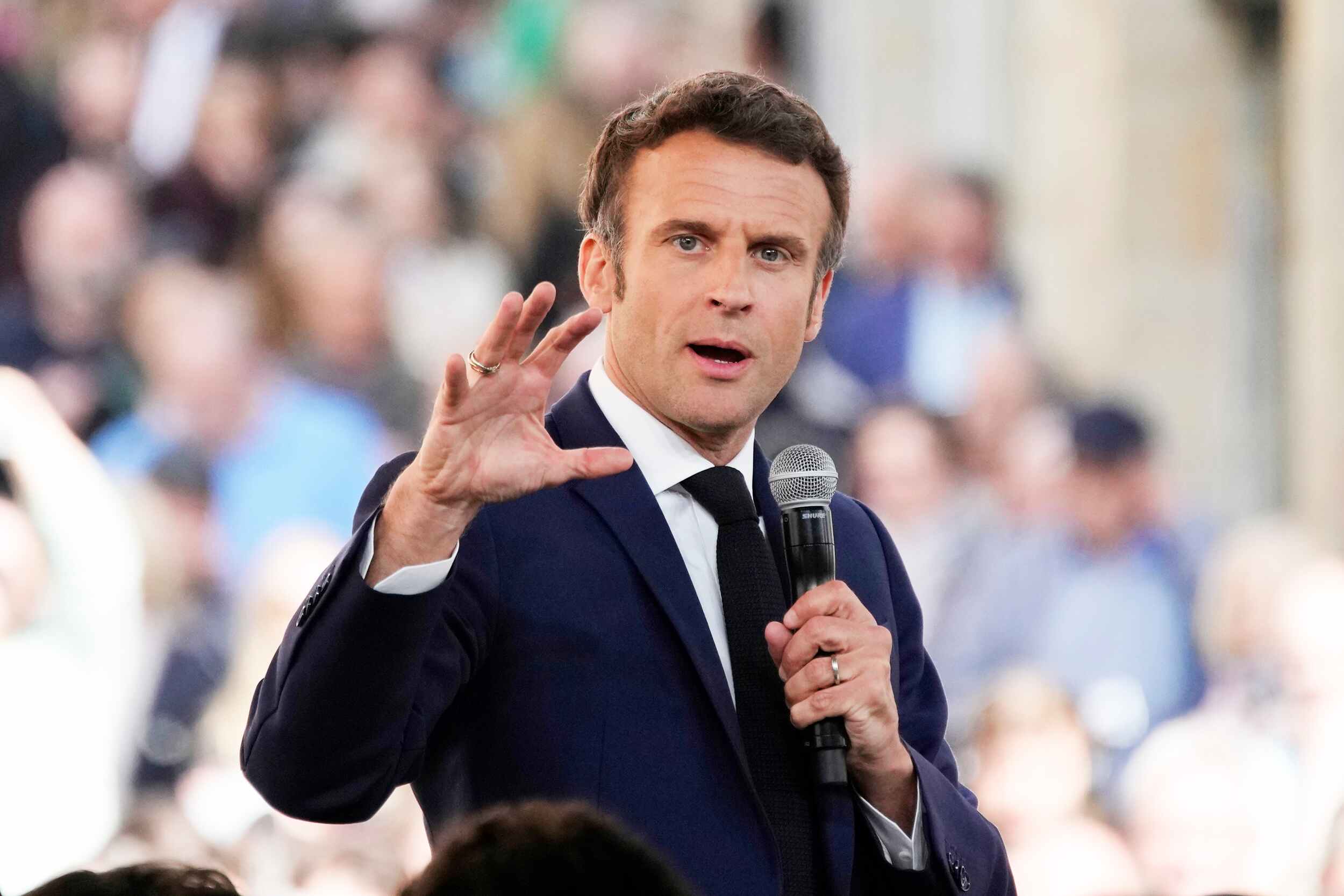
Emmanuel Macron pulled off an impressive feat as he became the first French president in 20 years to win a second term in office – in face of fierce antipathy amongst large numbers of voters on the left and, in even bigger numbers, to his right. Macron will have to navigate this enmity as he tries a “different way” of governing while facing a series of challenges, from the cost of living crisis to pension reform.

Macron’s victory suits the French penchant for paradox – a penchant de

monstrated by his very own catchphrase “en même temps” (“at the same time”).

The president beat nationalist Marine Le Pen comfortably in the second round after topping the polls by a decent margin in the first, where the French have a menu of voting options. The presidential election showed that – of the three main voting blocs – the biggest is the centre-right cluster revolving around Macron.

At the same time, the election underlined how plenty of French people on both sides of the political spectrum detest Macron – regarding him as the embodiment of the arrogant, insensitive technocratic stereotype.

So after losing some 2 million votes between his two face-offs against Le Pen in 2017 in 2022 – and after seeing a record-breaking second-round abstention rate at 28 percent – Macron promised to rule France in a “different way” and to be “everybody’s president”.

Macron has plenty of issues to deal with as he enters the second half of the presidency, following a first term marked by crises – from Covid-19 to the Yellow Vests to the war in Ukraine – which many voters think he handled well.

As that list shows, expect the unexpected. But for now FRANCE 24 looks at the top issues already on Macron’s in-tray.

  • Parliamentary election in June

The first challenge Macron faces is the parliamentary election held in two rounds on June 12 and 19. Le Pen and extreme-left firebrand Jean-Luc Mélenchon (who came third in the presidential first-round) both want to win a National Assembly majority to give Macron a difficult second term.

Indeed, Mélenchon is explicitly pitching himself as a potential Macron prime minister. This would mark a return to “cohabitation”, the system which kicks in when the president lacks majority support in the National Assembly and so picks a prime minister from the winning party, creating a programme based on compromise between the two.

However, analysts see a Macron majority as the likely outcome, given voters’ tendency to back the recently elected president’s party and a history of poor performances for the parties’ of second- and third-placed candidates.

  • Cost of living crisis

Macron’s “whatever it takes” approach to Covid-19 buoyed the French economy as it emerged from the pandemic – with 7 percent growth in 2021, higher than Germany, Italy and Spain. Unemployment fell to 7.8 percent in the fourth quarter of 2021, the lowest rate since 2008.

However, the rampant price rises bedevilling many economies have caused a cost of living crisis in France, as year-on-year inflation surpassed 4 percent in March.

Le Pen made diminishing purchasing power the crux of her campaign, a focus that powered her up the polls, helping her capture even more of the squeezed working class that historically voted for the left – and making her by far the most popular candidate amongst the middle-aged.

Responding to the threat she posed, Macron promised a “special bill” for the cost of living – indexing all pensions to inflation and reducing costs for the self-employed.

“We’ve got to respond to the anger and concern of millions of French people who’re saying they can’t get by,” Macron’s Finance Minister Bruno Le Maire told France Info on Monday – promising to keep the gas price cap until the end of 2022 at least, and to roll out “by the summer” a package to help people who need to drive a lot cope with rising petrol prices.

“Cost of living is Macron’s single biggest problem; it’s very clearly the issue on which voters ranked him second or third in the first round,” said Paul Smith, a professor of French politics at Nottingham University. If Macron is not careful, he continued, “a Gilets Jaunes [Yellow Vests] Part II is on the cards”.

But France’s public debt remains high; it was 112.9 percent of GDP in 2021 – and rising interest rates are expected to make government debt more expensive in the coming years. This puts Macron in a difficult position, warned Jim Shields, a professor of French politics at Warwick University: “Macron has an irresolvable dilemma – how to balance France’s finances while bringing an adequate government response to the cost of living crisis,” he put it. “With the newly re-elected, new improved Macron on probation in public opinion, we are unlikely to see fiscal rectitude become the priority in the short term at least.”

  • Pension reform

Macron promised back in 2017 to streamline France’s byzantine pension system – prompting in the winter of 2019-20 the country’s biggest wave of strikes since the famous upheaval of 1968. Once Covid-19 hit, pension reform was postponed indefinitely, then shelved.

Between the two presidential election rounds Macron said he is open to raising the retirement age from 62 to 64 – instead of 65, as he originally planned – after postponing the decision until 2027 when his mandate is over.

“I am ready to change the timeline and say we don’t necessarily have to implement the reform by 2030 if people are too anxious [about it],” he added on the campaign trail, while insisting his proposed changes are necessary.

Fresh from Macron’s victory, his Finance Minister Bruno Le Maire struck a harsher tone – refusing to rule out using special presidential powers to pass the pension reforms on Monday.

Like the cost of living, pension reform is “really fundamental”, Smith warned. “Macron really needs to address these issues ahead of the parliamentary elections – with real clarity.”

  • National health system under pressure

French hospitals are in a difficult position with staff shortages and emergency measures still in place more than two years after Covid first hit.

As the pandemic shook France’s renowned healthcare system, Macron’s government reacted with unprecedented pay increases for medical staff.

But the long-awaited salary hikes have failed to relieve French hospitals’ acute staff shortages. “It’s an emergency right now,” said Didier Birig, head of health workers’ union FO-Santé – urging Macron’s government to increase salaries even further to relieve strain on staff and make healthcare jobs more attractive.

  • Climate change

Climate change was a major lacuna in the presidential campaign until Macron placed it at the centre of his second-round pitch at a rally in Marseille.

Macron made a bold promise ahead of his re-election, pledging to go “twice as fast” to reduce greenhouse gas emissions – getting them down by 40 percent by 2030.

His plans rely on nuclear power to decarbonise electricity production, continuing a French trend dating back to the 1970s – when then prime minister Pierre Messmer poured resources into nuclear energy in a long-term strategy to drastically reduce France’s oil dependency after the 1973 OPEC crisis. Macron says France will build six to 14 EPR reactors – a new generation design pioneered by France – as well as building 50 offshore windfarms by 2050 and increasing solar power output tenfold.
Related Posts

Current Events

Serbia – China 2026: Technological partnership, geopolitical positioning and a new phase of the Chinese presence in the Western Balkans

1 June, 2026
ENGLISH

IBAR? ”Sufficiently! Much ado about nothing! Shart contrasts in Beijing! Where is the exit?!

1 June, 2026
ENGLISH

How Alkida Lushaj is redefining democratic inclusion globally

31 May, 2026

Follow US

Subscribe

Receive Argumentum Magazine by Email

Last Posts

Serbia – China 2026: Technological partnership, geopolitical positioning and a new phase of the Chinese presence in the Western Balkans

1 June, 2026

IBAR? ”Sufficiently! Much ado about nothing! Shart contrasts in Beijing! Where is the exit?!

1 June, 2026

How Alkida Lushaj is redefining democratic inclusion globally

31 May, 2026

Cyber Attribution, Corruption, and the False-Flag Question in Albania’s 2022 Alleged Iranian Cyberattack

30 May, 2026

The Digital Protectorate: How the EU AI Act Codified Silicon Valley’s Monopoly

30 May, 2026
Argumentum

“Argumentum”, një proces intelektual …

Contact Us

[email protected]
[email protected]
[email protected]

Follow Us

Media Partner

Register

Receive Argumentum Magazine by Email
  • Home
  • Privacy Policy
  • About Us
  • Contact

© 2022 Argumentum. All Rights Reserved. | NUIS: L91415033Q

Welcome Back!

Login to your account below

Forgotten Password? Sign Up

Create New Account!

Fill the forms bellow to register

*By registering into our website, you agree to the Terms & Conditions and Privacy Policy.
All fields are required. Log In

Retrieve your password

Please enter your username or email address to reset your password.

Log In

Add New Playlist

No Result
View All Result
  • Home
  • OP/ED
  • Interview
  • Realpolitik
  • Current Events
  • Top News
  • YOUR VOICE
  • Shqip

© 2022 Argumentum. All Rights Reserved. | NUIS: L91415033Q

This website uses cookies. By continuing to use this website you are giving consent to cookies being used. Visit our Privacy and Cookie Policy.