








• SHQIPËRI
  • KOSOVË
  • MAQEDONIA E VERIUT
  • MALI I ZI
  • Revista në PDF
24 July, 2026
  • Home
  • OP/ED

    The Self-Inflicted Decoupling: How U.S. Immigration Policy Is Ceding the Tech Edge to China

    The Blueprint Does Not Stop at the Drina

    The Underlying Logic behind China’s Economic Success

    Do Not Misuse the U.S. Declaration of Independence to Justify the Narrative of Insurrection in Albania

    The visit that changed Albania’s strategic future

    Pierre Nora and the institution of memory we lack in Eastern Europe

    The Blueprint of a Diplomatic Debacle: Analyzing Germany’s Historic UNSC Loss

    Between Russia, Iran and Europe: Azerbaijan as a balancing power in the South Caucasus

    The Zero-Tariff Gate: Sovereignty as a Service in the Sino-African Corridor

  • Interview

    Exclusive Interview with Oleksandr Tyshchenko: A 40-Year Legacy of Chernobyl, Nuclear Risks, and Global Responsibility

    INTERVIEW: ZLATKO KRAMARIĆ – THOUGHTS ON THE OLD CONTINENT

    EXCLUSIVE / Ukrainian Ambassador to Albania, Volodymyr Shkurov: “Ukraine wants peace, but not at the expense of its freedom and independence”

    EXCLUSIVE| Ambassador Tayyar Kagan Atay: Türkiye and Albania, a Strategic Partnership Rooted in Shared Heritage and a Common Vision for the Future

    “Diplomacy, Not War”: Palestinian Ambassador to Albania Calls for Justice, Peace, and Global Action for Gaza

    Exclusive: “Even After Tito – Tito”/ Ambassador Zlatko Kramarić on Authoritarian Legacies and Democracy’s Future in the Balkans

    The Conclusion of the Diplomatic Mission / Ambassador Dancho Markovski: Strengthening Albania-North Macedonia Relations for a Shared European Future

    A Century of Diplomatic Relations Between Albania and Russia: Exclusive Interview with the Russian Ambassador to Albania, H.E. Alexey Zaytsev

    Exclusive/ The chairman of the Freedom Party, Ilir Meta: “The will of the citizens will triumph in Albania, as it did in North Macedonia”

  • Realpolitik

    The Summit of Unity! Think of peace and prepare for war! It’s only the start to the end! Just a pause between two wars!

    Peace with war diplomacy! The protest,  image and tourism! Why this silence from the EU Commission and Council? A deal or a pause?

    Just kind words  in Tivat! Where is the peace!? A deal yes, peace No!What is happening with USA and  EU?  5 elections but no solution!

    IBAR? ”Sufficiently! Much ado about nothing! Shart contrasts in Beijing! Where is the exit?!

    Neither peace nor war! Peace with bombs?! IBAR in autumn?! Not another Hormuz in Taivan! 

    IBAR – a springing board or an obstacle? Can we catch the EU Negotiation train 2027? When the dress makes the news!  EU electoral April  ends in a draw 1:1!  

    The European Parliament building in Strasbourg, France with flags waving calmly celebrating peace of the Europe. July 12, 2020.

    EU 2027 or 2037! Even half membership failed! No exit strategy!     

    What next?

    “With diplomatic velvet“! Major question marks! In Washington yes, but  in the White House NO! A strange dinner in Brussels!

  • Current Events

    Who Is Interested in War in the Balkans?

    From Calculating Executions to Justifying Ethnic Cleansing

    When Algorithm Becomes the Most Powerful Manipulator: The Case of the Protests in Tirana

    NATO Summit in Ankara: Allies Adopt Declaration Reaffirming Collective Defence and Long-Term Security Commitments

    The Diplomacy of Gas and Algorithms: The Nuances of Official Tirana—Is It Breaking the European Taboo with Azerbaijan?

    Protection for Serbs, or Protection for Radoicic?

    The Architecture of Selective Sovereignty:Corporate Immunity, Technological Protectionism, and the Erosion of Credibility

    Montenegro’s Unfinished Transition

    The Paradox of Selective Capitalism: How Western Rule-Breaking Accelerates Its Own Systemic Demise

  • Top News

    The Council of Albanian Ambassadors condemns chauvinistic rhetoric by Serbian officials and calls for diplomatic action

    NATO at Ankara 2026: Strategic Rebalancing Between Russia Deterrence, Turkey’s Rise, and National Interests

    Daniel Serwer: A Bad War Ending Badly May Still Be Good News

    Friedrich Merz, Keir Starmer, António Costa, Donald Trump, Emmanuel Macron, Mark Carney, Ursula von der Leyen, Giorgia Meloni and Sanae Takaichi

    G7 Leaders Gather in Évian Amid Global Uncertainty, Focus on Security, Economy and International Cooperation

    Russian Ambassador in Tirana: “Without a Strong and Sovereign Russia, the Creation of a Just World Order Is Impossible”

    “The Flamingo Revolution”: Day 10 of Protests in Albania Draws International Attention

    Rama alleges ‘hybrid war’ behind protests against Kushner-linked coastal development

    No End in Sight: Trump, Netanyahu and the Expanding Middle East War

    Tirana – €20 Million EU–Banking Agreement Boosts Albanian SMEs

  • YOUR VOICE
  • Shqip
No Result
View All Result
Argumentum
  • Home
  • OP/ED

    The Self-Inflicted Decoupling: How U.S. Immigration Policy Is Ceding the Tech Edge to China

    The Blueprint Does Not Stop at the Drina

    The Underlying Logic behind China’s Economic Success

    Do Not Misuse the U.S. Declaration of Independence to Justify the Narrative of Insurrection in Albania

    The visit that changed Albania’s strategic future

    Pierre Nora and the institution of memory we lack in Eastern Europe

    The Blueprint of a Diplomatic Debacle: Analyzing Germany’s Historic UNSC Loss

    Between Russia, Iran and Europe: Azerbaijan as a balancing power in the South Caucasus

    The Zero-Tariff Gate: Sovereignty as a Service in the Sino-African Corridor

  • Interview

    Exclusive Interview with Oleksandr Tyshchenko: A 40-Year Legacy of Chernobyl, Nuclear Risks, and Global Responsibility

    INTERVIEW: ZLATKO KRAMARIĆ – THOUGHTS ON THE OLD CONTINENT

    EXCLUSIVE / Ukrainian Ambassador to Albania, Volodymyr Shkurov: “Ukraine wants peace, but not at the expense of its freedom and independence”

    EXCLUSIVE| Ambassador Tayyar Kagan Atay: Türkiye and Albania, a Strategic Partnership Rooted in Shared Heritage and a Common Vision for the Future

    “Diplomacy, Not War”: Palestinian Ambassador to Albania Calls for Justice, Peace, and Global Action for Gaza

    Exclusive: “Even After Tito – Tito”/ Ambassador Zlatko Kramarić on Authoritarian Legacies and Democracy’s Future in the Balkans

    The Conclusion of the Diplomatic Mission / Ambassador Dancho Markovski: Strengthening Albania-North Macedonia Relations for a Shared European Future

    A Century of Diplomatic Relations Between Albania and Russia: Exclusive Interview with the Russian Ambassador to Albania, H.E. Alexey Zaytsev

    Exclusive/ The chairman of the Freedom Party, Ilir Meta: “The will of the citizens will triumph in Albania, as it did in North Macedonia”

  • Realpolitik

    The Summit of Unity! Think of peace and prepare for war! It’s only the start to the end! Just a pause between two wars!

    Peace with war diplomacy! The protest,  image and tourism! Why this silence from the EU Commission and Council? A deal or a pause?

    Just kind words  in Tivat! Where is the peace!? A deal yes, peace No!What is happening with USA and  EU?  5 elections but no solution!

    IBAR? ”Sufficiently! Much ado about nothing! Shart contrasts in Beijing! Where is the exit?!

    Neither peace nor war! Peace with bombs?! IBAR in autumn?! Not another Hormuz in Taivan! 

    IBAR – a springing board or an obstacle? Can we catch the EU Negotiation train 2027? When the dress makes the news!  EU electoral April  ends in a draw 1:1!  

    The European Parliament building in Strasbourg, France with flags waving calmly celebrating peace of the Europe. July 12, 2020.

    EU 2027 or 2037! Even half membership failed! No exit strategy!     

    What next?

    “With diplomatic velvet“! Major question marks! In Washington yes, but  in the White House NO! A strange dinner in Brussels!

  • Current Events

    Who Is Interested in War in the Balkans?

    From Calculating Executions to Justifying Ethnic Cleansing

    When Algorithm Becomes the Most Powerful Manipulator: The Case of the Protests in Tirana

    NATO Summit in Ankara: Allies Adopt Declaration Reaffirming Collective Defence and Long-Term Security Commitments

    The Diplomacy of Gas and Algorithms: The Nuances of Official Tirana—Is It Breaking the European Taboo with Azerbaijan?

    Protection for Serbs, or Protection for Radoicic?

    The Architecture of Selective Sovereignty:Corporate Immunity, Technological Protectionism, and the Erosion of Credibility

    Montenegro’s Unfinished Transition

    The Paradox of Selective Capitalism: How Western Rule-Breaking Accelerates Its Own Systemic Demise

  • Top News

    The Council of Albanian Ambassadors condemns chauvinistic rhetoric by Serbian officials and calls for diplomatic action

    NATO at Ankara 2026: Strategic Rebalancing Between Russia Deterrence, Turkey’s Rise, and National Interests

    Daniel Serwer: A Bad War Ending Badly May Still Be Good News

    Friedrich Merz, Keir Starmer, António Costa, Donald Trump, Emmanuel Macron, Mark Carney, Ursula von der Leyen, Giorgia Meloni and Sanae Takaichi

    G7 Leaders Gather in Évian Amid Global Uncertainty, Focus on Security, Economy and International Cooperation

    Russian Ambassador in Tirana: “Without a Strong and Sovereign Russia, the Creation of a Just World Order Is Impossible”

    “The Flamingo Revolution”: Day 10 of Protests in Albania Draws International Attention

    Rama alleges ‘hybrid war’ behind protests against Kushner-linked coastal development

    No End in Sight: Trump, Netanyahu and the Expanding Middle East War

    Tirana – €20 Million EU–Banking Agreement Boosts Albanian SMEs

  • YOUR VOICE
  • Shqip
No Result
View All Result
Argumentum
No Result
View All Result
Home ENGLISH

With Reformers Sidelined, Iranian Elections Looking Like Hard-Liners Vs. Conservatives

26 January, 2020
in ENGLISH, In Focus
A A
Share on FacebookShare on Twitter

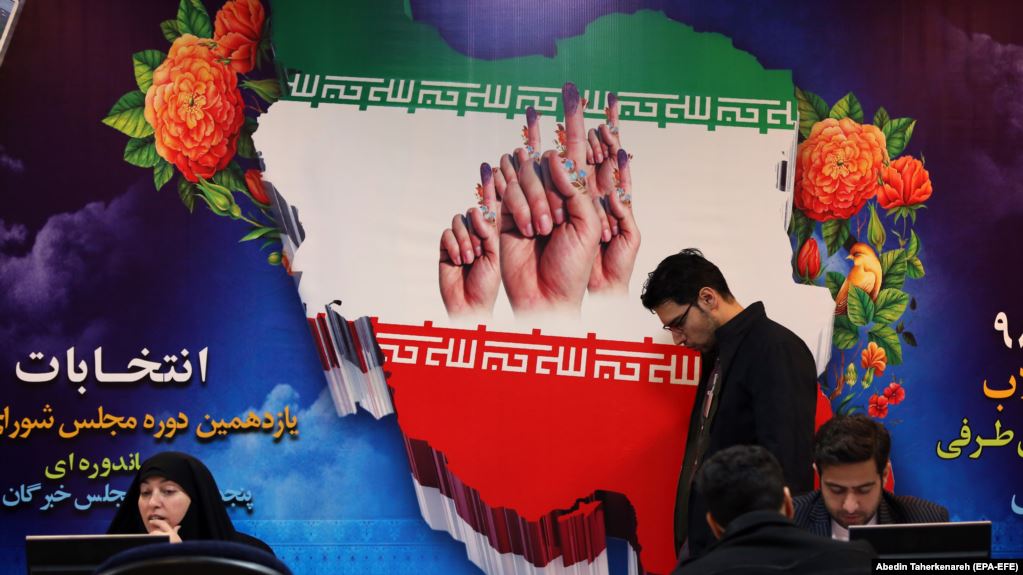
With Iranian parliamentary elections just a month away, there are increasing signs that the vote will be a case of the conservatives battling hard-liners, in what analysts describe as an attempt by the clerical establishment to consolidate power.

The hard-line Guardians Council, which vets all election candidates, has disqualified some 9,000 of the 14,000 who registered to run in the elections, including 90 current lawmakers.

A reformist political activist said this week that 90 percent of the reformist candidates throughout the country have been barred from running in the February 21 elections.

Hamid Saberian, a political deputy to the head of the reformist Consultative Party, said on January 20 that the upcoming elections will be an “intra-factional vote” due to a mass disqualification of pro-reform candidates.

“Principalists will be competing against each other,” Saberian said.

Saedi Golkar, a political science professor and senior fellow for Iran policy at the Chicago Council on Global Affairs, says the mass disqualification is part of “a big plan” to consolidate power for conservatives before the likely succession of Iranian Supreme Leader Ali Khamenei, an octogenarian who has undergone surgery in recent years amid long-standing rumors he has prostate cancer.

“Day by day, we get closer to the time which the regime should choose another leader. [And to] be prepared for that, Khamenei and his wing want to make sure the parliament and the next president are on the same page with the office of the [supreme] leader, and the [Islamic Revolutionary Guards Corps],” Golkar told RFE/RL.

Exiled political activist Taghi Rahmani told RFE/RL’s Radio Farda that the 12-member Guardians Council, six of whom are directly appointed by Khamenei, is acting based on “Khamenei’s views and the kind of parliament [the Iranian leader] envisions.”

Golkar says the hard-liners are planning to roll out a new generation of supporters and put them in power throughout the government.

“The most critical crisis the regime faces is competency, which the system tries to solve by homogenization of the state branches: judiciary, legislative, and executive,” he added. “One has been done, and two should be achieved to not only strengthen the regime’s internal cohesion but to make it more efficient and ready for the succession.”

Abbas Ali Khadkhodayi, the spokesman for the Guardians Council, which has a record of disqualifying candidates deemed not sufficiently loyal to the clerical establishment, claimed last week that “financial abuse” and “financial crimes” are the main reasons for the disqualification of sitting parliamentarians, many of whom are reportedly reformists.

But some of the affected lawmakers have said a “lack of commitment to Islam” or “lack of commitment to the establishment” have been cited as reasons for their disqualification.

Rejected candidates can appeal decisions by the Guardians Council. In the past, only a few of those rejected have been allowed to run.

Speaking on January 15, Iranian President Hassan Rohani criticized the massive disqualifications and said it is not possible to run the country with only one political faction.

“It’s like you put 2,000 pieces of the same item in a shop…it’s the same item,” he said, adding that “people want diversity.”

“Allow all parties and groups to run for office,” Rohani, a self-proclaimed moderate, said.
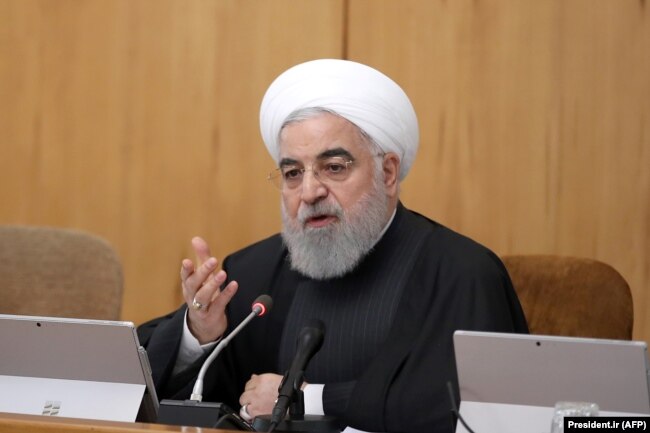
Iranian President Hassan Rohani: "Allow all parties and groups to run for office."
Iranian President Hassan Rohani: “Allow all parties and groups to run for office.”

But Khadkhodayi has dismissed the criticism and claimed the elections will be competitive, with more than 5,000 vetted candidates running, and noted that there will be some 17 people on average competing for each of parliament’s 290 seats.

Among those who have been banned from running is reformist lawmaker Mahmud Sadeghi, who said earlier this week that “one faction” has not been able to agree on lists due to an abundance of candidates, while another faction has had so many candidates disqualified that it is struggling to come up with lists for the ballot.

Austrian Foreign Minister Alexander Schallenberg has stated in an interview with Wiener Zeitung that good ties with Russia are a key part of European stability and that the bloc should not be engaged in conflict with Moscow.

“What glorious elections these will be!” the outspoken Sadeghi said sarcastically on Twitter on January 19.

Shahindokht Molaverdi, who served as Rohani’s vice president for family affairs, said “efforts are being made to uniformize the parliament.”

Molaverdi warned that the Guardians Council’s decision will alienate Iranians at a time when the country faces external and internal pressures.

“Given the recent events and the worrying consequences of [U.S.] sanctions, it was expected that members of the Guardians Council would demonstrate a [different] approach,” she said.

Iran has faced several rounds of anti-establishment protests in past months, including in November in more than 100 cities during which several hundred protesters were killed.

The January 8 downing of a Ukrainian passenger jet by the Islamic Revolutionary Guards Corps (IRGC) that killed 176 people has also led to angry protests and calls for Khamenei to resign.

Reports suggest many Iranians have been disillusioned with the reformists due to their failure to bring meaningful changes to society. Some have said on social media that voting doesn’t make sense.

The popular news site Asriran.com said earlier this week that the election atmosphere in the country is “even colder” than the snowy winter days that Tehran and other cities have been experiencing.

Asriran said a “widespread hopelessness” and the “single-faction election” are the reasons for a lack of enthusiasm for the upcoming vote.

The current situation, the news site said, is not what Iranians who took part in the 1979 Islamic Revolution wanted.

“The people’s vote was supposed to count, not the vote of a group of people,” it added. /Rel

Related Posts

ENGLISH

Public Administration and Civic Engagement in the Western Balkans: From Macro-Politics to Procedural Accountability

24 July, 2026
ENGLISH

A constant in an era of radical change

22 July, 2026
ENGLISH

Azerbaijan’s Policy in the Middle East: ties, overlaps, and divergences

22 July, 2026

Follow US

Subscribe

Receive Argumentum Magazine by Email

Last Posts

Public Administration and Civic Engagement in the Western Balkans: From Macro-Politics to Procedural Accountability

24 July, 2026

A constant in an era of radical change

22 July, 2026

Who Is Interested in War in the Balkans?

22 July, 2026

Azerbaijan’s Policy in the Middle East: ties, overlaps, and divergences

22 July, 2026

The Summit of Unity! Think of peace and prepare for war! It’s only the start to the end! Just a pause between two wars!

20 July, 2026
Argumentum

“Argumentum”, një proces intelektual …

Contact Us

[email protected]
[email protected]
[email protected]

Follow Us

Media Partner

Register

Receive Argumentum Magazine by Email
  • Home
  • Privacy Policy
  • About Us
  • Contact

© 2022 Argumentum. All Rights Reserved. | NUIS: L91415033Q

Welcome Back!

Login to your account below

Forgotten Password? Sign Up

Create New Account!

Fill the forms bellow to register

*By registering into our website, you agree to the Terms & Conditions and Privacy Policy.
All fields are required. Log In

Retrieve your password

Please enter your username or email address to reset your password.

Log In

Add New Playlist

No Result
View All Result
  • Home
  • OP/ED
  • Interview
  • Realpolitik
  • Current Events
  • Top News
  • YOUR VOICE
  • Shqip

© 2022 Argumentum. All Rights Reserved. | NUIS: L91415033Q

This website uses cookies. By continuing to use this website you are giving consent to cookies being used. Visit our Privacy and Cookie Policy.