










By Sergey LAVROV*
The month of May and the fireworks are now behind us. The country and the world celebrated Victory Day, which is a holiday of war veterans, home front workers, and all the people of Russia and other victorious nations. There was a grand parade on Red Square and a wreath laying ceremony at the tomb of the Unknown Soldier. The march of the Immortal Regiment – a civil initiative that has acquired a truly global dimension – took place again not only in Russia, but in many other countries as well, with the participation of hundreds of thousands of Russians, our compatriots abroad and citizens of other countries – all people who cherish the memory of Victory and the memory of those who worked to bring it closer.
There’s another date ahead – June 22, the day of memory and grief for those who died during the Great Patriotic War. We will be remembering those who fell in battles, were tortured to death in captivity and concentration camps, or died of hunger and the toils of war. Preparations are beginning for celebrating the 75th anniversary of Victory in 2020, which, of course, will be held at a level appropriate to the scale of the feat and the greatness of the spirit of the heroes of that war. One can’t help thinking about it: what does May 9 mean for the peoples who were on the verge of annihilation, and why do some people loathe this holiday today?
As someone who is part of the first post-war generation, who grew up on the stories told by war veterans and family tales about the war, I believe the answers to these questions are obvious. The peoples of the Soviet Union and other countries became the object of the inhuman ideology of Nazism, and then the victim of aggression on behalf of the most powerful, organised and motivated war machine of that time. At the cost of terrible sacrifices, the Soviet Union made a decisive contribution to defeating Nazi Germany and, jointly with the Allies, liberated Europe from the fascist plague. The victory laid the foundation for the post-war world order based on collective security and state-to-state cooperation, and paved the way to creating the UN. These are the facts.
Unfortunately, however, the memory of Victory is not sacred to all around the world. It is regrettable that there are individuals in Russia who picked up the myths spread by those who want to bury this memory, and who believe that time has come to stop solemn celebrations of Victory Day. The greater the anniversary numbers become, the more we come face to face with the desire to forget.
Bitter as it is to witness, we see the attempts to discredit the heroes, to artificially generate doubts about the correctness of the path our ancestors followed. Both abroad and in our country we hear that public consciousness in Russia is being militarised, and Victory Day parades and processions are nothing other than imposing bellicose and militaristic sentiment at the state level. By doing so, Russia is allegedly rejecting humanism and the values of the “civilised” world. Whereas European nations, they claim, have chosen to forget about the “past grievances,” came to terms with each other and are “tolerantly” building “forward-looking relations.”
Our detractors seek to diminish the role of the Soviet Union in World War II and portray it if not as the main culprit of the war, then at least as an aggressor, along with Nazi Germany, and spread the theses about “equal responsibility.” They cynically equate Nazi occupation, which claimed tens of millions of lives, and the crimes committed by collaborationists with the Red Army’s liberating mission. Monuments are erected in honour of Nazi henchmen. At the same time, monuments to liberator soldiers and the graves of fallen soldiers are desecrated and destroyed in some countries. As you may recall, the Nuremberg Tribunal, whose rulings became an integral part of international law, clearly identified who was on the side of good and who was on the side of evil. In the first case, it was the Soviet Union, which sacrificed millions of lives of its sons and daughters to the altar of Victory, as well as other Allied nations. In the second case, it was the Third Reich, the Axis countries and their minions, including in the occupied territories.
However, false interpretations of history are being introduced into the Western education system with mystifications and pseudo-historical theories designed to belittle the feat of our ancestors. Young people are being told that the main credit in victory over Nazism and liberation of Europe goes not to the Soviet troops, but to the West due to the landing in Normandy, which took place less than a year before Nazism was defeated.
We hold sacred the contribution of all the Allies to the common Victory in that war, and we believe any attempts to drive a wedge between us are disgraceful. But no matter how hard the falsifiers of history try, the fire of truth cannot be put out. It was the peoples of the Soviet Union who broke the backbone of the Third Reich. That is a fact.
The attacks on Victory Day and the celebration of the great feat of those who won the terrible war are appalling.
Notorious for its political correctness, Europe is trying to smooth out “sharp historical edges” and to substitute military honours for winners with “neutral”
reconciliation events. No doubt, we must look forward, but we must not forget the lessons of history either.
Few people were concerned that in Ukraine, which gravitates towards “European values,” the former Poroshenko regime declared a state holiday the day of founding the Ukrainian Insurgent Army – a criminal organisation responsible for the deaths of tens of thousands of civilian Ukrainians, Belarusians, Russians, Poles and Jews (although in Israel, whose people survived the Holocaust, May 9 is an official holiday, Victory Day). Other glaring examples from neighbouring countries include Nazi Germany-like torchlight processions of neo-Banderites along the main streets of the Hero City of Kiev, and the marches of veterans and supporters of Waffen-SS in Riga and Tallinn. I would like to ask those who do not like the tears of our veterans during parades and who criticise the “militarised” events in honour of Victory: how do you like this kind of “demilitarisation” of consciousness in a European way?
No one will admit this, of course, but here are the facts: the United States, NATO and the EU let their junior partners, who are using blatant Russophobia to build their careers, get away with quite a lot. These guys get away with everything, including glorification of Nazi henchmen and hardcore chauvinism towards ethnic Russians and other minorities for the sole purpose of using them to keep Western alliances on anti-Russian positions and to reject a pragmatic dialogue with Moscow on an equal footing.
Occasionally it appears that the purpose of such connivance on behalf of the West is to relieve of responsibility those who, by colluding with Hitler in Munich in 1938, tried to channel Nazi aggression to the east. The desire of many in Europe to rewrite that shameful chapter of history can probably be understood. After all, as a result, the economies of a number of countries in continental Europe started working for the Third Reich, and the state machines in many of them were involved in the Nazi-initiated genocide of Russians, Jews and other nations. Apparently, it is no accident that the EU and NATO members regularly refuse to support the UN General Assembly resolution on the inadmissibility of glorifying Nazism, which was advanced by Russia. The “alternative vision” of World War II among Western diplomats clearly does not stem from the lack of historical knowledge (although there are problems in this department as well). As you may recall, even during the Cold War such blasphemy did not exist, although it would seem that an ideological face-off was a perfect setting for it. Few dared to challenge the decisive role of the Soviet Union in our common Victory back then and the standing our country enjoyed during the post-war period, which our Western allies recognised without reservations. Incidentally, it was they who
initiated the division of Europe into “areas of responsibility” back in 1944, when Churchill raised this issue with Stalin during the Soviet-British talks.
Today, distorting the past, Western politicians and propagandists want to make the public doubt the fair nature of the world order that was approved in the UN Charter following World War II. They adopted a policy seeking to undermine the existing international legal system and to replace it with a certain “rule-based order.” They want to create this order based on the principle of “he who is stronger is right” and according to the “law of the jungle.”
This primarily concerns the United States and its peculiar perception of 20th century history. The idea of “two good wars” is still widespread there, as a result of which the United States secured military dominance in Western Europe and a number of other regions of the world, raised confidence in its strength, experienced an economic boom and became the world leader.
Just as enthusiastically as the Europeans, the Americans are creating an image of “militaristic Russia.” However, most of their own history is a sequence of endless wars of conquest. Over 243 years of “American exceptionalism,” interventionism has become an integral part of Washington’s foreign policy. Moreover, the US political elite think of the use of force as a natural element of “coercive diplomacy” designed to resolve a wide range of issues, including domestically.
Not a single election campaign in the United States is complete without the candidates trying on a toga of a commander-in-chief in action. The ability to resort to the use of force for any reason is proof of an American politician’s prowess. There are many examples of such stereotypes being implemented under various “plausible” pretexts: Grenada in 1983, Panama in 1989, Yugoslavia in 1999 and Iraq in 2003. At the same time, America honours its fallen soldiers regardless of what cause they fought for. Memorial Day is celebrated in May, and no one has any suspicions of “militarism” when naval parades and air shows with the participation of military equipment take place in various US cities.
We are essentially accused of preserving the memory of our fathers and grandfathers, who laid down their lives in a sacred liberation war, giving them military honours, and celebrating Victory Day widely and with pride. Was it Russia or the Soviet Union that unleashed two world wars? Is it us who today operate an extensive network of military bases that were created to control the entire world?
For diplomats and politicians, May 9 is also a good occasion to recall that the Allies referred to themselves as the United Nations in 1945. They stood shoulder to shoulder during the war, conducted Arctic convoys and fraternised on
the Elbe. French pilots in the Normandie-Neman fighter regiment fought the enemy on the Soviet-German front. Awareness of the common threat in the face of the inhuman ideology of National Socialism had helped the states with different political and socioeconomic models to overcome differences. The belief that the defeat of Nazi Germany will mark the triumph of justice and the victory of light over darkness was the unifying factor.
After the war, the Allies built a new architecture of international relations based on the ideal of equal cooperation between sovereign states. The creation of the UN was supposed to warrant that the sad fate of its predecessor, the League of Nations, will not be repeated. The founding fathers learned the lessons of history well and knew that without the “concert of the great powers” – that is, the unanimous consent of the leading countries of the world which hold permanent seats at the Security Council – the world cannot enjoy stability. We must be guided by this commandment today as well.
This year, as we took part in Victory Day celebrations, we once again told everyone willing to listen: “Yes, just like our ancestors we are ready to decisively repel any aggressor. But Russians do not want war, and do not want to go through horror and suffering again.” The historical mission of our nation is to guard peace. The peace we are trying to preserve. Therefore, we are offering a hand to anyone who wants to be good partners to us. Our Western colleagues have long had our proposals which open realistic ways to overcoming confrontation and putting up a reliable barrier to all those who allow for the possibility of a nuclear war. These proposals were further reinforced by an appeal made by the CSTO member states to the North Atlantic Alliance in May to begin a professional depoliticised dialogue on strategic stability issues.
I am confident that the citizens of Russia and other countries will be watching parades in honour of the 75th anniversary of the Great Victory on May 9, 2020 and joining the ranks of the Immortal Regiment with St George ribbons attached to their lapels with thoughts of peace in their minds. The memory of those who fell in battle fighting the enemies of the homeland, the enemies of civilisation, will remain alive as long as we mark the great holiday of victorious nations, the holiday of salvation and the holiday of liberation. And there is no need to be embarrassed about the grandiose scale of this celebration.
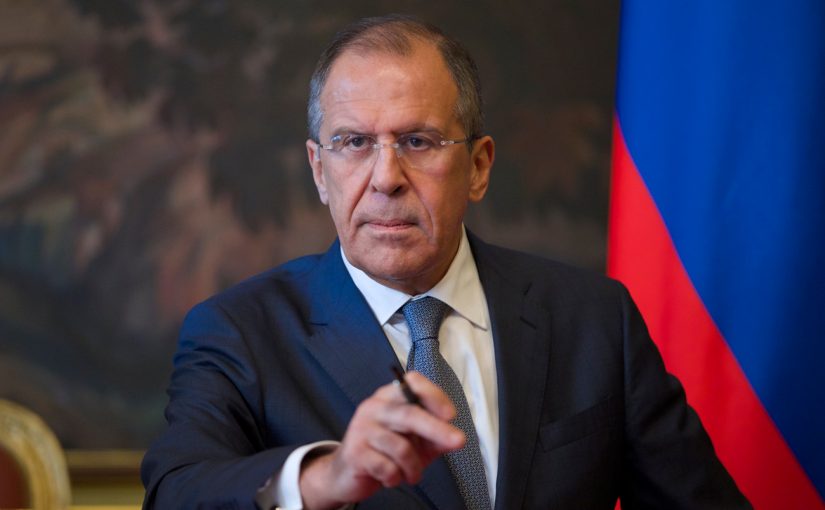
*Article “On Victory Day” by Foreign Minister Sergey Lavrov for International Affairs magazine, June 4, 2019
© Argumentum