





























By Zlatko Kramarić*|ARGUMENTUM
The position of Jacques Derrida in the philosophical landscape of the 20th century is singular: he belongs to the European intellectual tradition while radically unsettling its metaphysical foundations. His project of deconstruction reveals the hidden assumptions underlying Western thought and politics—not with the aim of abandoning them, but in order to open them toward a future where suppressed voices and unresolved questions still demand speech.
In Specters of Marx (1993), Derrida challenges the triumphalist narrative declaring the death of Marxism after 1989. Employing the figure of the specter, he argues that what is declared dead can return more powerfully than ever. The specters of colonialism, global inequality, and unfulfilled emancipation continue to haunt the neoliberal imagination. Thus, Derrida famously remarks: “We have never ceased being Marxist”—not out of dogma, but because Marx’s questions remain unanswered. (1)
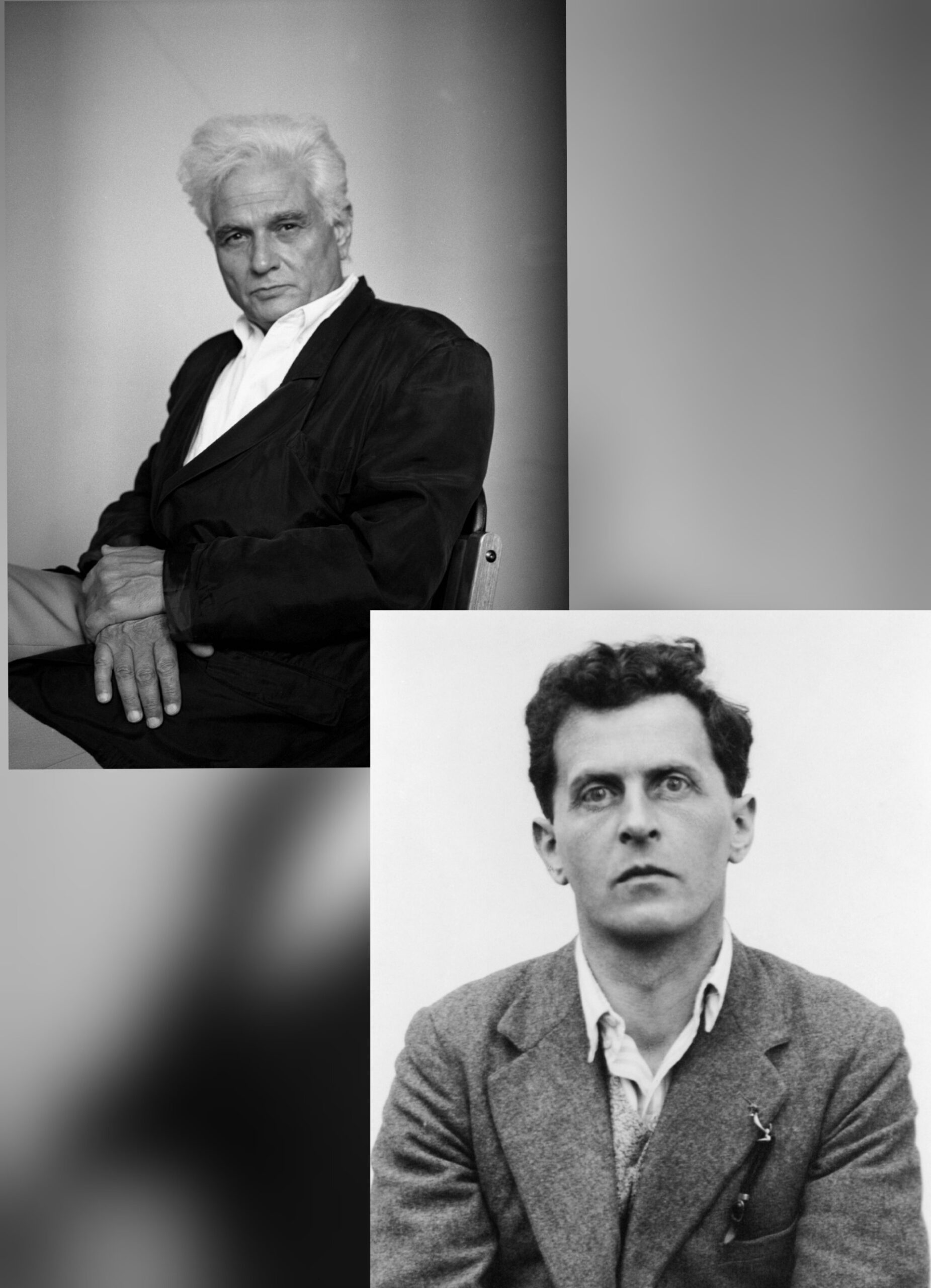
The bridge between Derrida and the “European spirit” lies in the pivotal role of language—understood as a world-shaping and world-questioning force. Here, an unexpected convergence emerges between Derrida and Wittgenstein. Both share the fundamental premise that language is not merely a tool for representation but a practice that constitutes the world itself.
Wittgenstein, in his later philosophy, introduces the notion of language-games to show that meaning arises not from reference but from use within forms of life. (2) There is no reality beyond language, only forms of articulation and practice. Derrida radicalizes this insight through the concept of différance, revealing the perpetual deferral and displacement of meaning. (3) Language does not mirror the world; it generates the conditions under which meaning and truth become thinkable.
Derrida’s discussion of the politics of friendship—in which community is reimagined as responsibility toward the Other, rather than as a unity of identity or fraternity—flows directly from this linguistic and ethical insight. Language becomes the arena of politics: a site where justice may be claimed, postponed, or denied.
Derrida thus remains committed to Europe—not as a completed project, but as one haunted by its own spectral futures. Like Husserl, he sees Europe as a task; but unlike Husserl, he insists that Europe must confront its metaphysical and colonial legacy. (4) If Europe has a spirit, it must be that of an unfinished promise—coming to terms with its specters in the hope of creating space for a more inclusive and just community.
Footnotes
(1) Jacques Derrida, Specters of Marx: The State of the Debt, the Work of Mourning, and the New International. Routledge, 1994.
(2) Ludwig Wittgenstein, Philosophical Investigations. Blackwell, 1953.
(3) Jacques Derrida, Of Grammatology. Johns Hopkins University Press, 1976.
(4) Edmund Husserl, The Crisis of European Sciences and Transcendental Phenomenology. Northwestern UP, 1970.
Bibliography
Primary Sources:
- Derrida, Jacques. Specters of Marx. Galilée, 1993 / Routledge, 1994.
- Derrida, Jacques. Of Grammatology. Johns Hopkins UP, 1976.
- Derrida, Jacques. Politics of Friendship. Verso, 1997.
- Wittgenstein, Ludwig. Philosophical Investigations. Blackwell, 1953.
- Husserl, Edmund. The Crisis of European Sciences and Transcendental Phenomenology. Northwestern UP, 1970.
Secondary Sources:
- Norris, Christopher. Derrida. Harvard UP, 1987.
- Rorty, Richard. Contingency, Irony, and Solidarity. Cambridge UP, 1989.
- Critchley, Simon. Very Short Introduction to Continental Philosophy. Oxford UP, 2001.
- Gasché, Rodolphe. The Tain of the Mirror. Harvard UP, 1986.
*Zlatko Kramarić is a Croatian publicist, author, and diplomat, currently serving as Ambassador to Albania. Formerly a university professor and politician, he is known for his work in literature, cultural studies, and regional history.
© 2025 Argumentum