






















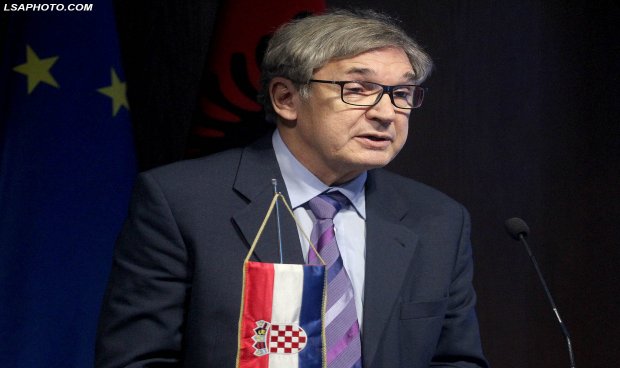
By Zlatko Kramarić*|ARGUMENTUM
Introduction
Miguel de Unamuno (1864–1936), one of the most recognizable figures of the Generation of ’98, developed a concept of the European spirit that is simultaneously rooted in Hispanic spirituality and open to the universal intellectual impulses of modernity. His work is marked by an ongoing dialogue between the particular and the universal: between Spain’s self-understanding and Europe’s cultural self-awareness. This tension—often productive—forms the foundation of Unamuno’s philosophy of life, faith, doubt, and identity.
Cultural Context: The Crisis of Spain and the Question of Europeanization
Unamuno’s intellectual maturation unfolded during a period marked by a profound national upheaval following the defeat of 1898. The “Desastre del 98” was, for him, not merely a political event but an existential trauma that opened the question of Spain’s identity in relation to Europe. In the debate that followed, Unamuno positioned himself between traditionalism and regenerationism, often criticizing both. While he accused traditionalists of a “closed soul,” he reproached the regenerationists for “superficial Europeanization”—the mechanical adoption of European institutions without an inner ethical and spiritual transformation.
Hispanic–European Heritage and Sources of Inspiration
Unamuno’s concept of the European spirit is infused with various intellectual layers:
1.Castilian introspective spirituality
The Hispanic mystical tradition—especially Teresa of Ávila and John of the Cross—shaped Unamuno’s obsession with the inner struggle between faith and doubt, between reason and the yearning for immortality.
“Anxiety is the very essence of man,” Unamuno writes in Del sentimiento trágico de la vida.[^1]
2. Cervantine humanism
In Cervantes he recognizes a model of open, self-ironic, morally free humanism that he considers authentically European. Europeanization, for Unamuno, is impossible without the Cervantine spirit of freedom and dialogue.
3. Krausism and liberal reform
The Krausist influence, present in Spanish intellectual circles in the second half of the 19th century, transmitted to Unamuno a belief in moral rationalism and in the cultural-educational mission of the intellectual.[^2]
4. Russian novels and German idealism
From Dostoevsky he adopts the psychological exploration of conscience and inner drama; from Kierkegaard the existential sense of the paradox of faith.[^3]
Unamuno’s Understanding of the European Spirit
For Unamuno, the European spirit is not a political project nor an institutional framework, but above all a spiritual energy, a “culture of searching” and a “continent of restlessness.” Alongside Montaigne, Pascal, Kierkegaard, and Dostoevsky, Unamuno views Europe as a space of inner tension where man is confronted with himself.
The fundamental components of this spirit are:
• critical conscience – Europe develops only “through doubt, not dogma”;
• existential drama – the relationship between reason and the heart as the central field of spiritual experience;
• freedom and personal responsibility, as prerequisites for historical and cultural development;
• humanistic measure – man remains the fundamental criterion of society, not technique or institutions.
Legacy and Ambivalent European Position
Unamuno is a paradoxical figure because he simultaneously:
• anticipates existentialism (Sartre, Camus),
• embodies tragic humanism,
• criticizes superficial modernization and “technocratic Europe,”
• and yet remains one of the deepest advocates of spiritual and cultural Europe.
Through his sensitivity to the drama of identity and spiritual anxiety, Unamuno shaped intellectual currents not only in Spain but also in European philosophy of the 20th century.
Unamuno and Ortega y Gasset: Two Europes
The relationship between Unamuno and José Ortega y Gasset is key to understanding Spanish thought of the 20th century and its connection with Europe.
1. Europe as drama (Unamuno)
For Unamuno, Europe is a space of inner struggle, tragedy, and spiritual self-examination. His philosophy is deeply personalist, driven by questions of immortality, suffering, and meaning.
2. Europe as project (Ortega)
Ortega, especially in La rebelión de las masas and Meditaciones del Quijote, advocates Europe as a cultural project, a space of modernization, institutions, and the “mission of elites.”[^4]
3. Methodological difference
Unamuno is anti-systemic, paradoxical, emotional;
Ortega is rational, systematic, historically analytical.
4. Complementary visions
Their conceptions are not contradictions but two dimensions of the same idea of Europe:
• one existential and individualistic,
• the other cultural-civilizational.
From this tension emerges the richness of the Spanish intellectual tradition, which, between Unamuno’s inner drama and Ortega’s modernist project, seeks its place in the European spiritual space.
[^1]: M. de Unamuno, Del sentimiento trágico de la vida, Madrid, 1913.
[^2]: P. L. Martínez, El Krausismo y su influencia en España, Madrid, 1987.
[^3]: Unamuno read Kierkegaard’s works in French translations; see D. Harris, Unamuno and Kierkegaard, Oxford, 1969.
[^4]: J. Ortega y Gasset, La rebelión de las masas, Madrid, 1930.
*Zlatko Kramarić is a Croatian publicist, author, and diplomat, currently serving as Ambassador to Albania. Formerly a university professor and politician, he is known for his work in literature, cultural studies, and regional history.
© 2025 Argumentum